The Philosophers—Reckless Musings on the Evolution & Devolution of Human Consciousness in the West
“The precision of naming takes away from the uniqueness of seeing.”
~ Pierre Bonnard
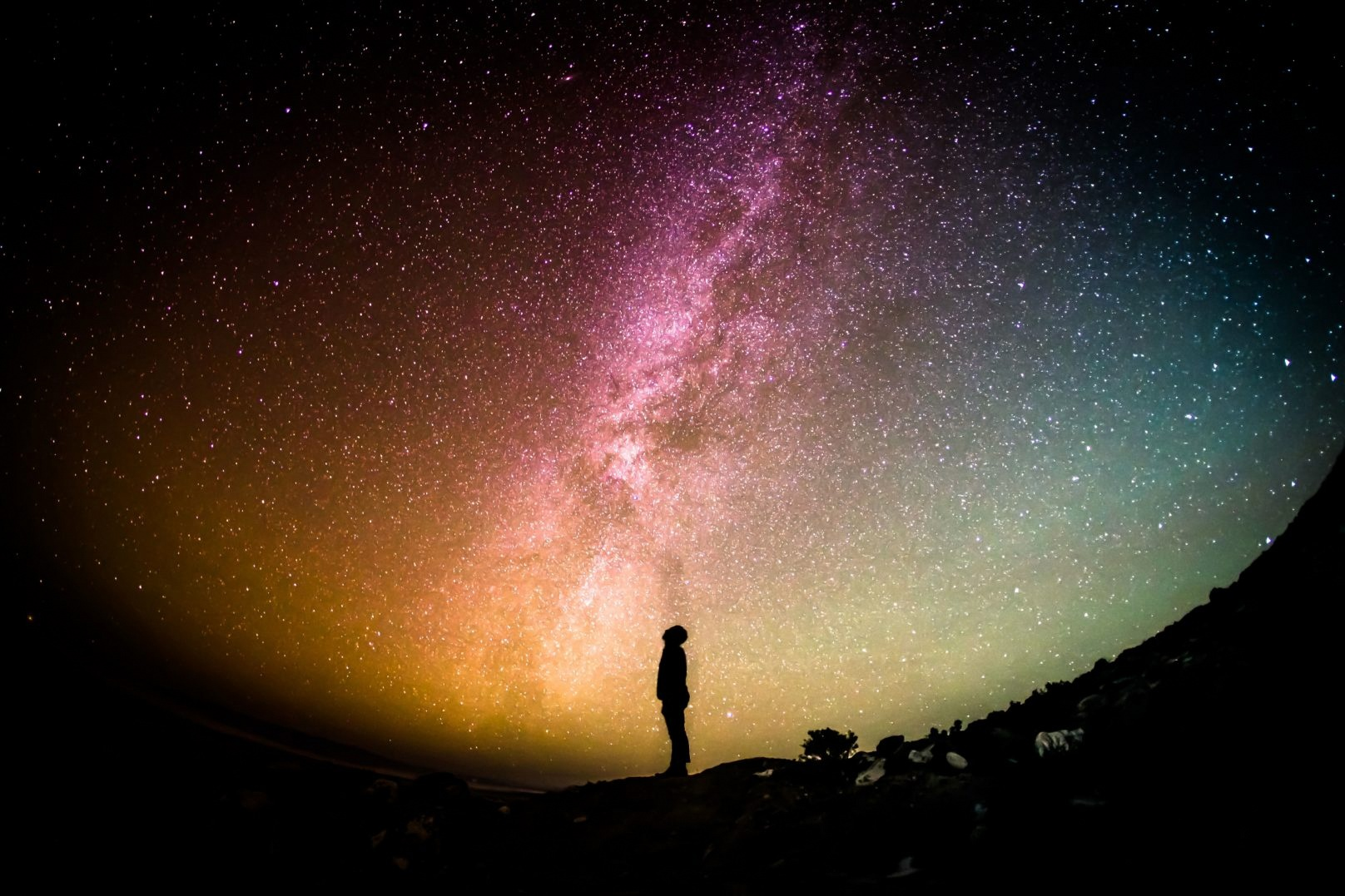
I am not a philosopher, nor do I pretend to understand exactly how ‘this led to that’ in this history of ideas, much less the evolution of human consciousness. However, having listened to voices from across the globe and throughout human history, one thing that has become clear to me is that the voices of people who stood on the same globe and looked up to the same sky testify to an altogether different world than the one I see when I stand, alone, and look up. Some of those voices, in fact, testify to a world much closer to the one I desperately want to see, the one I squint my eyes and try to see, the world I believe, and often struggle to believe, must be really there. Because I remember it. I remember the world I saw when I was still small, tromping around in an infinitely wide and wonderful mystery, when still there were “tongues in trees, books in the running brooks, sermons in stones, and good in everything” (Shakespeare). I remember seeing the world God saw and said was good.
But I am a product of my age, which is to say, a product of the ideas of I’ve inherited, ideas I’ve been swimming in from my youth, ideas embedded in the words I was given to describe the world, the metaphors given to scale the world (in its otherwise unscalable dimensions), all manner of symbols given to shape and shade my vision of this world’s soul. That’s the part I struggle to see. Slowly and systematically my consciousness has been conditioned to see a world that surely is not there, or not to see a world that surely is. At least it was before I learned it wasn’t. Over time the trees have grown silent, the stones neatly classified, and the glory beaming through pinholes in the black veil above have been reduced mostly to hydrogen and helium. My vision of the entire universe has been mechanized, leaving me finally staring blankly at a disenchanted mirage. My eyes have grown old, my vision blurred by a taxonomy of spellbinding words that are bound together in an elaborate network of willful ideas that together form a single picture, a single project, a single consciousness, the likes of which has not been so successfully constructed since that tower in the land of Shinar (Gen. 11).
The following exploration is no attempt to explain anything to anyone else but to try to begin to understand for myself how we got here. I simply want to try to stand in the shoes of those whose voices seemed to speak on behalf of their own age and see the world from their eyes, however foreign their language sounds and strange their world looks, beginning with ‘the philosophers’, who are the ones, however tedious and difficult, that confront the ideas of their age head-on, and sometimes break open a dam for a new stream of consciousness to burst forth—where ‘the poets’ are always swimming but are seldom heard. Along the way, I’ll be praying for the living God to tear open the veil and send a mighty rushing wind to topple over our towers and confuse our speech with tongues ablaze with vision.
“Now I am ready to tell how bodies are changed
Into different bodies.”~ Opening line in Tales from Ovid, approximately 1 A.D.
It has been said that ancient philosophy began in wonder (thaumazein-so Plato in Theaetetus and Aristotle in Metaphysics), while modern philosophy began in doubt (so Descartes’ Meditations on First Philosophy). Imagine waking up tomorrow morning, alone, in a remote wilderness with no memory or knowledge of the world, no google search engine or google earth, none of the basic truths you now take for granted about the motion of heavenly bodies, the winds and the waves, the source of life all around in plants and in animals and in you, and in the waves and the winds and the heavenly bodies—surely it’s all alive. You then have to build a theory of how everything works and fits together from the ground up. How would you make sense of this seemingly infinite and living mystery in which you are enveloped? That kind of wonder.
The wonder of the world began to be explicitly expressed (as opposed to the implicit expressions that abound in the mythopoetic literature of the ancient world) in written form as an ongoing debate over the bewildering antinomies of the one and the many (as we perceive space), of being and becoming (as we perceive time), knowledge of which we now take for granted, but we shouldn’t forget just how mysterious it must have been, how mysterious it really is.
What is the unifying principle holding together a world of difference? What is it that abides in a world that never ceases to change? Surely amidst the ceaseless change and motion of the surface world there must be an underlying substrate of reality, something permanent, the being of beings, something that is. Change implies a single process of transition from whence to whither, from something into something else, so what is it that undergoes this process of change? The question still presents mysteries even to current models of the universe, which has only shown to be in more a state of flux than the ancients could have ever imagined in light of quantum physics and astrophysics, from subatomic strings to the ever-expanding universe. Or consider the fact that none of the cells that constituted your infant body (if you’re old enough and bored enough to be reading this) constitute your presently aging body. Are you the same you now as were then? If so, in what sense? In what does the “you” abide if not your physical body?
If human consciousness is too special a case, take any ordinary object, animate or not—a flower, rockfish, rock, mountain, planet, star, universe, multiverse—stretch it out for a long enough period of time, and eventually it will crack open and reveal its mystery. If the paperweight on your desk seems immune to the mystery of change, just remember that it, rather the elements that constitute it, is the afterbirth (leftover material), along with the rest of planet earth, of a newly formed star, our sun, which for millions of years was just a swirling cloud of gas until it collapsed in on itself, a cloud of residue that had been shot across the Milky Way from an exploding star, or supernova, that in turn became a black hole. If there’s still no mystery in how that thing became the paperweight on your disk, just keep working backward 13.8 billion years until you get to nothing. Nothing became a paperweight. That almost sounds like magic.
What, then, abides amidst the change from nothing to paperweights? This philosophical question led to the earliest theories about the elemental stuff of the universe in the sixth century B.C. (e.g., water, fire, air), which developed by the fifth century B.C. into the familiar theory of imperceptible, indivisible units of matter called “atoms” (the term in Greek literally means “indivisible”). Indeed, it was this ancient philosophical question that would eventually lead to modern science’s periodic table. The theory still represents in principle the model developed by modern science 2,500 years later. In the famous words of Richard Feynman:
If we were to name the most powerful assumption of all, which leads one on and on in an attempt to understand life, it is that all things are made of atoms, and that everything that living things do can be understood in terms of the jigglings and wigglings of atoms.
Richard Feynman, The Feynman Lectures on Physics
In fact, our advancements in atomizing and classifying and quantifying the stuff of the universe have not gotten us any closer to answering the original question at all. It all reduces to particles and waves, matter in motion. We still ended up with a uni-verse (uni=one, verse=turn/rotation), and modern scientific and philosophical descriptions tend to fall, however unwittingly, into one of two opposing streams that began thousands of years ago in Ancient Greece from polar opposite vantage points: Heraclitus and Parmenides.
Heraclitus asks the question of being / the one (that which abides) and becoming / the many (that which changes) and negates the unity of being by absolutizing change. According to Plato, “Heraclitus says somewhere that all things pass and nought abides” and thus, “the One only exists in the tension of opposites: this tension is essential to the unity of the One.” The One is the many; change as such is all that abides. But if change alone abides, so that being can only be said to be ever-coming-to-be, which is also to say ever-ceasing-to-be, there is no one thing, no-thing, that abides.
Being, for Heraclitus, is a clock with only the long hand, no numbers, no abiding presence reconciling past with future. Heraclitus imaged being, or the essence of all things, as fire—and not the kind that does not consume! Fire exists only by consuming the existence of what-it-is-not; what-it-is-not ceases to be as it becomes fire; fire ceases to be when nothing is left of what-it-is-not. “All things,” Heraclitus asserts, “are an exchange for Fire, and Fire for all things,” which is a way of imaging the underlying rationale of the undeniable and plain observation that “all things are in motion, nothing steadfastly is.” And again, “all things come into being and pass away through strife.” For Heraclitus, then, it might be said that Being only subsists in the never-ending annihilation of beings.
Parmenides asks the question of being and becoming, the one and the many, and negates change / difference by absolutizing the One. Frederick Copleston summarizes the argument (better, or at least more concisely, than Parminedes) thus: “Being, the One, is, and…Becoming, change, is illusion. For if anything comes to be, then it comes either out of being or out of not-being. If the former, then it already is—in which case it does not come to be; if the latter, then it is nothing, since out of nothing comes nothing. Becoming is, then, illusion. Being simply is and Being is One, since plurality (the many) is also illusion.” Thus, for Parmenides, the world that is perceived through the senses, the world of change, the world of human experience, the world as we know it, must not be the world as it truly is, because we only experience the world as coming-to-be. If it comes to be out of being, then it (being) already is and there is no real becoming of being-as-such. And it cannot come to be out of not-being without construing not-being as being something that was before becoming what is, which is to say without not-being being something. Being, therefore, does not come to be, does not be-come, but simply is. Change is illusion.
Accordingly, being is one. If change is illusion, so the many as well. Being is simply what is. Being cannot be added to, since only not-being could be added to being, but to be added to being not-being would have to already be, an obvious contradiction and category error. Even the existence of apparent opposites, say fire and water, have existence (being) in common. The coincidence of the many, therefore, still bespeaks a single unifying incidence of being. Being can never be added to or divided, therefore, because being is all there is, besides which there is nothing, and out of nothing comes nothing. Thus, difference, the many, is illusion.
This did not lead Parmenides to develop a metaphysical ontology, such that the material/sensory world is the illusion disguising a non-material/non-sensory world of an altogether different order. He asserted that being, the One, is eternal but (spatially) finite, “equally poised from the center in every direction…not greater or smaller in one place than in another.” To have a center is to have a periphery, to be bounded, and to be so bound is a property of the finite, of being-here and not-being-there. But if being is encompassed by not-being, it is surrounded by nothing, but nothing does not exist and therefore Parmenides’ theory collapses in his failure to conceive the necessity of transcendence, the truly infinite nature of being.
The one, then, for Parmenides, is not a truly transcendent unifying principle but merely a material principle of unity humans are blind to. Being is still immanent, still conceived in material terms, but the material substrate of being is imperceptible to the senses. Democritus later develops Parmenides’ basic argument, following his logic where it naturally leads, accounting for change and difference by postulating the clustering and dividing of otherwise undifferentiated particles of matter. The many / becoming thus reduces merely to quantitative differences within the qualitative sameness of the One, something like physicalism, or Buddhism. For Parmenides, then, beings are not annihilated in Being’s coming-to-be (a la Heraclitus) but in having never truly been.
As esoteric as the arguments may sound to modern mind, it is probably the result of either the hubris or laziness of the modern mind, not the weakness of the arguments. All one has to do is apply either argument to a materialist model of the universe to see it leads to one or the other same absurd conclusion. There really is no other way to conceive of the material world. It’s one or the other, nihilism by fire or by anātman—unless one conceives of two worlds. Enter Plato.
Plato concedes a necessary agnosticism about the mystery the world and absolutizes the chasm between the one and the many, being and becoming, so as to reconcile them, however ironically, with a two world solution. The two worlds of Platonic dualism (so often begrudged and dismissed by Christian thinkers today) was actually Plato’s way of reconciling the world-as-it-appears to itself. He was indeed ‘saving the appearances’ (Barfield), the only alternative to nihilism in the end.
The two streams of thought Plato was confronted with could not be reconciled, but neither could be adopted. Neither theory accounted for the coincidence of the one and the many, being and becoming, without the dissolution of the other and thus a denial of not only the world-as-it-appears but human knowledge of it. Plato gleaned from Parmenides the recognition of an important discrepancy between the world-as-it-appears / -is-experienced through sense perception and the world-as-it-is-understood through rational reflection, but instead of chalking up the former to one grand illusion on the basis of the logical necessities demanded by rational reflection, he recognized, following Heraclitus, that the world-as-it-appears / -is-experienced cannot alone be the basis of the true knowledge of being, precisely because nothing abides. What can truly be inferred by observing objects that either have no true existence or no existence beyond their passing from nothing to nothing? Unless the inferences themselves, the ideas of rational thought, were included in the equation of being, not regarded merely as the analytic faculty kept at a remove from the consideration.
Thus, for Plato, ideas themselves paved the way to the realm of Ideas or Forms (which he used interchangeably). The mind itself was the intersection of two distinct worlds, the world perceived by the senses and the world understood through rational reflection, and for Plato the former could only be understood in the light of the latter.
Plato conceived of a necessary duality to reconcile the world-as-it-appears / -is-experienced through sense perception and the world-as-it-is-understood through rational reflection. The world of becoming (change) is a participation in but a privation of the world of being, which abides as the realm of unchanging ideas or forms, eternal truths. The forms of this higher realm constitute the perfect essences of the lower realm’s fleeting and imperfect instances of existence. Plato eventually develops a hierarchy of being. Aristotle succinctly summarizes Plato’s ontology saying, for Plato, “the Forms are the cause of the essence of all other things, and the One is the cause of the essence of the Forms.” He imagined something like the One as the mind of God and the many as the many ideas of God, none of which abide in their teleological (perfect) form in a world in which nothing abides.
This isn’t some arbitrary fairy world that is foreign to human experience. It is the world Plato saw as necessary to make sense of the universals of human experience perceived in objects subject to change (as all objects are). What makes every apple (the many apples) the one thing called an apple? The idea (form) of the apple. What abides (being) of the apple once it has been transformed (becoming) into compost? The idea of the apple. The idea / form is the unchanging essence of a given object, without which it would not be the kind of thing it is. The object is an appearance (phenomenon) of the form as it exists under the conditions of the world of change. Hence the distinction between the perfect yet invisible forms of an eternal realm and imperfect visible phenomena in our temporal realm.
No one can deny at least some measure of descriptive accuracy to this model as regards our experience of the world, even the most ardent materialist. Perfect things all seem to be the truest things and like the truest things all seem to be invisible. My math teacher in high school believed in the idea of an equilateral triangle, even though not a single such triangle actually exists in nature. (He also didn’t believe in God because only things that can be seen truly exist.) Geometry is itself, in a very real sense, the study of platonic forms, none of which exist in nature, but it turns out to be better to base building codes on ideals that don’t actually exist in the world than on an approximately plumb-and-level realism. An architect knows that perfect right angles cannot really be constructed, but he still fills his blueprints full of them. If the idea of perfect forms didn’t exist in the mind, neither could a skyscraper exist at all for very long. Plato opened up a highway and skyway for considering the realness of otherwise mental abstractions that could henceforth enable the coherent apprehension of transcendent truths.
Despite the various developments from Plato onward, the Western world would conceive of itself in the light of a higher realm of being. Transcendence thus grounds all classical ontologies, without which it is not possible to describe a unified theory of the world as it is perceived in human experience, the evidence of which is demonstrated in modern ontologies that describe a world that is utterly imperceptible to human experience, not because the world they describe is only perceptible through telescopes and microscopes (although that certainly says something about something) but because modern ontologies deny the place of human perception in that world. They refuse to do what Plato insisted on doing—including their ideas of being into their models of being, which have thus in principle collapsed back into ancient models within an immanent frame.
To summarize the broad contours of the discussion thus far, suffice it to say the philosophy of wonder succeeded in exposing the nature of a fundamental mystery inherent to all human experience of the world: the world of surfaces haunted by the permanence of a veil. There must be more than what we know to be, or what we know to be must be more than what appears to be. Behind the veil there exists either a quantitative or qualitative unknown, the multiverse or the heavens, bricks to the bottom or the face of God. This impassable gap between being and knowing grounds every ontology within an inescapable metaphysical epistemology, however implicit or un-self-aware, since there is an infinite distance between all that is ontic and all that is logical.
A sudden shift in the ontological grammar of Western thought took place that day in 1637 when the heavens collapsed into Descartes’ head, resulting in a new philosophical heuristic that inverted transcendence and immanence by exchanging absolute presence with the present awareness of presence—the glory of the eternal now was exchanged for the fragmentary image of the immediate now. The question of being, a question that seeks a knowledge encompassing the whole of reality, turned inward, perhaps out of the sheer exhaustion of debating for thousands of years the inexhaustible Original question, to ask a much more modest question, a question that was possible to answer with at least some measure of certainty. The shift from: What is? to What can I know for certain?
The argument in his Meditations on First Philosophy begins, like Plato, with a concession to a certain kind of agnosticism. In fact, it made a method out of this agnosticism, spelled out in the first line of Meditation I: “Of the things which may be brought within the sphere of the doubtful.” The discussion, which reads like a series of journal entries—a man alone with his thoughts, searching for first principles in the first-person—begins by recognizing how often throughout his life he had been convinced of “truths” that turned out to be demonstrably false. As a thought experiment, he began asking what else could be false. What could I be wrong about? Eventually he realized he could be wrong about literally everything. Everything could be an illusion, a dream, a deception by some evil demon, the Matrix—that sort of thing. Finally, he concludes: “So that after having reflected well and carefully examined all things, we must come to the definite conclusion that this proposition: “I am, I exist, is necessarily true each time that I pronounce it, or that I mentally conceive it…I find here that thought is an attribute that belongs to me; it alone cannot be separated from me. I am, I exist, that is certain.” Thus, famously, he declares as the first principle of knowledge: I think, therefore I am.
Ironically, Descartes’ question about knowledge as such finally concluded with an answer about being as such. The two were thus wed in a unholy matrimony, much like the kind in Genesis 6 between the sons of God and the daughters of men, with consequences much like the kind that follow from Genesis 6.
What can I know? was answered by a claim of What is. I am. Ontology collapsed into epistemology, being collapsed into knowing—no, into not-knowing. Being collapsed into thinking, doubting, and doubting anything beyond the self doing the thinking, forming not only a new and soon to become dogmatic epistemological method, but also erecting a new altar to the ground of being. Ontology would henceforth be confined to the infinitesimal immanent frame of the human ego, which would soon result, quite logically, into a god-complex of gargantuan proportions.
No higher realms or unobservable essences would henceforth need to be consulted in a triangulated apprehension of truth—perceiving subject, perceived object, and the transcendent frame that held it all together in a unity of qualitative difference—no necessary phenomenological interplay between the interiority of perception and the exteriority perceived; the being of the external world(s) was held in suspicion and would have to stand before the threshing floor of the human ego, where the high throne of heaven had been replaced to pronounce judgment on all lesser truths than the only absolute truth: “I am.” Everything now is, in principle, relative to that absolute, even what I am. Thus, despite his honest and even admirable intentions, all Descartes’ ontological offspring would be liberated to define a new reality for themselves, full of new names and descriptions and and identities and metaphorical pretensions about the subjective and objective world. Not to discredit the contribution this new philosophical a priori would offer posterity (particularly, in all likelihood, in the area of human rights), but almost half a millennium after that great liberation, the results of taking up the throne of Being are in: the objective world (universe) has become a machine, and we have become proficient in manipulating it accordingly, and “we” no longer convincingly exist. The subjective, first-person, world has atomized into fragmented kingdoms of the autonomous self, each the captain of his / her / theys / zir / hir / eir / vis / ters ship.
It is from this ground that a new duality emerges. It is not between the one and the many or being and becoming—the transcendent absolute and the contingency of the immanent—but between the absolute inside (“I”) and the contingent outside (“objects”). If the ego is going to inquire as to the truth of being, then there must be new rules of engagement for its encounter with the concrete world outside and the agreed-upon limits of what’s allowed to be analyzed in abstraction from that world within. The foundations of empiricism and rationalism were thus established. Eyewitness evidence and a jury of peers, respectively, now populated the courtroom: the truth of being would thus be reduced to theories always and only inchoately verified by the scientific method and judgments rendered through banal formulae of unspeculative reason-without-wonder. On these grounds alone, more or less, would the Western world come together to pursue knowledge, typically, and systematically, in service to technology.
The philosophy of doubt came of age. Transcendence collapsed. Unity vanished. Time absolutized. Heraclitus triumphed, uncontested.
This of course served to liberate Western thought from its metaphysical roots and transcendent skies. But the original mystery has not simply disappeared. This is simply because, even if being has been imprisoned within the mind of the finite confines of the thinking subject, that mind was born by way of baptism in the metaphysical stream of consciousness, where all human consciousness is born. This can be quite simply and readily proven by putting aside for a moment the question that typically preoccupies the lone mind (Who am I?—and all its attendant questions concerns about love and belonging and the rest), and instead asking Where am I? Is it my body? If so, where in my body? Is it my brain? If so, which part? Surely not the brain stem, the “lizard brain,” the part that runs the body’s autopilot controls (heartbeat, breathing, fight or flight, most of Twitter). Maybe some combination of the limbic system and the neo-cortext, but where in there am I, the unified-experience-of-consciousness I.
The human mind is always already participation in some obviously non-physical reality, however bound it may also be to its physical vantage. To speak of human consciousness this way is not to suggest that the human mind can exist apart from or is independent of a human brain. It is simply to recognize that the one is not the other and to assert that the former cannot be produced naturally by the latter, even if it is somehow supernaturally so. The brain, like the rest of the mechanized version of the universe, reduces finally to atomic elements in motion. No matter how patterned and predictably they may spontaneously cooperate in the sustained biochemical process involved in thinking, there simply can be no magicless causal narrative that explains how this atom and that atom rise up and say univocally to themselves “I” (much less imagine, intend, dream, have déjà vu) in a unity of consciousness, not to mention a unity that typically stretches out over a period of time that will outlast each of those atoms participation in the brain.
All modern creeds of being have thus snuck forward from Descartes’ foundation by way of a leap of faith over a non sequitur in the infinite outer darkness to create closed systems of knowledge adrift like planets with no light to circle at the center. They have not grappled with the fact that Descartes never solved the riddle of being and time, of unity and difference. He simply inverted Plato’s priority so that the subject replaced the Object(s) and became the new ground of being. The inevitable result is, unsurprisingly, that subjectivity itself has begun to dissolve into objectivity. You can’t make a machine of being (the “universe”) without all beings eventually being mechanized (and so valued, discarded, aborted, etc., accordingly).
The mind, whose self-perception borrows its interior reflection from exterior conception, whose immanence can only be conceived by a circumlocution, indeed a circumnavigation, through self-transcendence, enjoins the eye of Horus with the eye of Ra, that is, the eye of Being with the I of being, and thus has become blind to both.
If transcendence collapses into the immanent frame of the human subject, then soon even human thought must conceive of itself in purely material terms or all material must be conceived in purely mental (whatever that is) terms. The old battle between Heraclitus and Parmenides reemerges.
The movement forward should in fact be a movement backward. If an absolute is the necessary basis of all that is contingent—as it obviously must be—then we are taken back to the original question: does the world truly abide and only seem to change or the does world truly change and only seem to abide? It is no surprise, therefore, that in rejecting Plato virtually every account of the modern world can be found swimming with either Parmenides or Heraclitus, and why all accounts of being in the modern world must necessarily begin with a negation of the human being, and certainly not the creation of the human being, since the human is either the ground of being or the illusion of being.
Closed systems of knowledge can certainly be affirmed within schema of the empirical world and the rational mind. The scientific method can verify that this or that knob or lever effects that or this result within a machine that, as a whole, remains unchanged, conserved. The laws of logic can aid us in hoisting around abstract figures and numbers orders of magnitude greater than even the observable universe (as we observe it). The orderliness of the world is a given of scientific inquiry. The exacting nature of logic and computational power of reason is a given of rational inquiry. But they still represent two worlds that aren’t allowed to touch.
There is no rationally coherent givenness granting access to a bridge that crosses Lessing’s Ditch (which he was right to dig his in the first place but wrong to ever stop digging, since the problem is not between universal truths and historical truths but between the universe and truth itself—Lessing was simply less ambitious than Plato. Had he followed his own logic more faithfully, would have succeeded in polarizing body and mind, objective and subjective, love and beloved, alongside history and eternity, but alas, that’s a long day’s work!). There is only the miracle of the bridge and the fact that we freely and regularly traverse it without even noticing the infinite abyss beneath. We always participate the duality. It is constitutive human being.
To continue further along Descartes’ train of thought: I think, therefore I am. But why “I”? Or in what sense “am” I? What becomes clear upon reflection about this conclusion is not just that I=am but also I≠am, or rather I<am (that is, i=being, i≠Being, i<Being).
I am thinking, therefore being is necessary, but I (my being) am certainly not. In fact, in my thinking my being is revealed to be only the momentarily necessary instance of or participation in some necessary other Being. That is, precisely my being is revealed to be unecessary being-as-such. The fact that an artificial bridge must be built (constructed purely of the same mental materials that constitute my thinking, mind you) in order for “I” to arrive at “am” demonstrates the qualitative difference (if not alienation) between subject and predicate. Thus, in the jarring yet self-evidently true words of the the poet, Juan Ramón Jiménez, i am not I.
I can only perceive of being between the chasm before I was and after I am, cradled in the void of my nonbeing as a resident alien in human being. Yet, perceiving my non-being is at once perception of being-as-such. Indeed, self-perception and self-transcendence are one identical moment. The human experience is always at once awareness and oblivion, unity and alienation, revelation and mystery, the inescapable inside placed within the inescapable outside: “I am” and “I am not”—”I am me” and “I am not you” or “that rock” or “that corpse in that casket at this funeral;” most decisively, “I am me” and I am not I AM.
It’s easy to see the source of the confusion. The apparent immediacy of “I am” dissolves oneself into a unity of being. However, the selfsame immediacy of “I am not” reveals the apparent immediacy as an apparition, precisely as non-immediacy. It is in that interval, after all, that Descartes’ inquiry began, the realm from which all thought emerges and questions are asked, where wonder leads to wandering and doubt leads to determining. It is in this realm where the self is fragmented into an ineffable qualitative distance that alienates the human subject not only from the world of objects / others but, more puzzlingly, from the outer (inner?) courts of a Subject from which (Whom) my own being-as-such appears merely to be on loan. I think that I am and I know I am not I AM that I AM.
Resolutions to this problem simply cannot unify the duality by closing off one side or the other. And thus, human inquiry must move forward in a concession to this impasse. Plato was right. The mind is simply not capable of reconciling the duality. Descartes must be so long as he’s thinking, but Descartes must not need be. Being can be a predicate of thinking no more than infinity can be a predicate of counting, anymore than God can be a predicate of “God created.” I AM that I AM or nothing is. The only sure conclusion a thinking self can arrive at is that absolute being must be and it must not be me. The inevitable question arises (as Balthasar perceived): Whence comes the division? Why am I not I AM? Why am I not God?
It is true that being is necessary if thinking is happening, but it is the necessary condition of thought, not the necessary conclusion of thinking, just as the mind must conceive of the brain in the realm of ideas only while conceding that ideas only exist in the realm of the mind. Objectivity is always already the a posteriori discovery of a subjective a priori discoverer, that is, of a subject delineated and delimited not only within a world of apparent objects, but within a realm of an objective Subject. “I think” only leads to the awareness of “I am” with the concurrent awareness of standing in Someone Else’s shoes. Maybe that’s why Moses took off his shoes the day I AM said “Moses!” in the second person.
And if the subjective mind that models the universe through reason and representation is bold enough to believe its model actually represents something real, otherwise objectively inaccessible in that ‘outer darkness,’ the logical deduction of reason seems to inescapably suggest that models of objective reality are always already predicated on an absolute subjective container—something far more analogous to mind, will, imagination, and intention than birds of a feather or stars in the sky. I contain both the heavens and the earth that so self-evidently, and far more convincingly, contain me. I am a god complex.
Hence, a more accurate universal grammar follows. “I am” does not follow from “I think.” “I think” leads to “I am too,” whose corollary is “I am not.” The division must draw its line between the inside and the outside as a common sense affirmation of both, or it must draw its line inside itself to absolutize the self as such, and therefore to absolutize fluctuation as such, distance as imminence, absence as presence, not-being as being, the double negation of ultimacy and immediacy, of essence and existence—nihilism. Descartes has jumped into Heraclitian waters, opening a dam to unleash the formless void of existence as such. He has merely asbolutized thinking, which nothing more than a proudly decorated absolutization of change, decay, the ever-becoming of something-from-nothing-into-nothing-and-therefore-nothingness. But it is precisely for that reason that the subject of contingent being and subject of absolute being cannot share the same syntactical throne. The logic of the thinking self discovers itself as a fragment within the being that cannot be logically fragmented. There is thinking and there is being. There is Moses and there is God. “I AM that I AM,” and yet, “Here am I!” (Exod. 3:4-14). I AM, therefore I think I am.
Nevertheless, Western thought has barreled forward, fingers in its ears, leaving a trail of philosophical systems of bigoted internal logic all of which ultimately announce a final illusion or final negation, as though announcing something new, the enclosed totality of being which is its precise dissolution. Whether illusion or negation, the affirmation of the former is precisely as such the triumph of the latter, the apparent objects of being consumed by the eternally circular subject of being, infinite freedom bastardized and bent into itself so as to tame eternity’s perplexing dimensions, giving it a palatable geometry, the self-gratifying ouroboros of a wonderless system of answers.
Despite the innumerable advancements in the history of ideas, there has been only one unique development in the Idea of history. Hegel’s historical dialectic, the universal will of World Spirit, is perhaps the most unique way of addressing the limits of philosophy by creating a system wherein two negatives equal a positive, the interpolation of negations as somehow an answer to the abiding world in flux: the becoming of history as the will of being, Parmenides feasting on the mind of Heraclitus. Or something like that—but who actually understands Hegel? (Did Hegel even understand Hegel?)
Thus we are left with two or three (depending on how you count) modern creeds of being in principle, all of which depend upon the ultimate negation of Being qua human being, that is nihilism proper, respectively, (1) two circles and (2) one ray ever-detaching from its source: (1a) there is being as the one, all difference is illusion, the conservation of matter-from-nothing and so the conservation of nothing; (1b) there is only change, the many, nothing truly abides, Quantum-Fluctuation writ large; or (2) the ever becoming negation of the negation, Hegel’s eternal Ouroboros conceived outlandishly as a straight line. Any other movement to cross the Infinite Ditch can only do so honestly with Kierkegaard’s leap. And thus philosophical discourse capitulates—as it must—to religious discourse. Only a miracle can reconcile the world to itself. Only Christmas.
“With all wisdom and insight God has made known to us the mystery of his will, according to his purpose, which he set forth in Christ as a plan for the fullness of time, to unite all things in him, things in heaven and things on earth.”
~ Ephesians 1:8-10
For a sermon expounding on the implications of this ‘worldview’ (free of all the technical jargon and argumentation), click here.
 Dim Reflections For Now