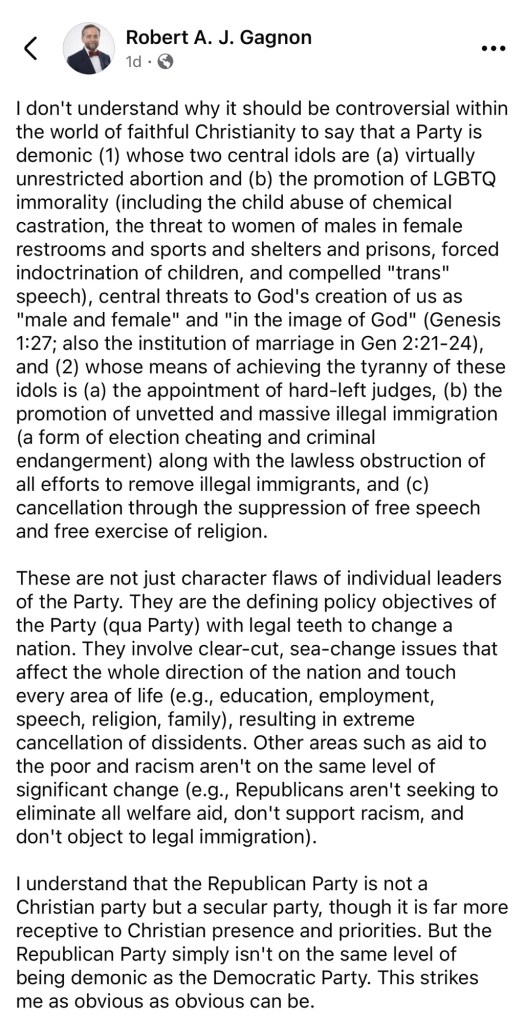
Writing in response to Dr. Robert Gagnon’s recent post declaring categorically that the entire Democratic Party is “demonic” (see below)—as an evangelical pastor, I’d like to offer another perspective. I’m doing by best here to follow Scripture in all this confusion—and I’m pretty sure the diagnosis is way worse than most of us think. God, help us all.
James calls “bitter jealousy and selfish ambition…demonic” (Ja. 3:14-15). Will you, Dr. Gagnon, apply that biblical standard across the board to both “parties”? No. You won’t. You would suddenly have to employ “nuance” for sins of the heart that are not nearly as measurable as murdered babies and flagrant sexual profligacy. Yet it’s no less demonic—is it?!—and it is far more insidious, precisely because of its immeasurability. Beware of the leaven of the Pharisees, Bob.
Does it ever give anyone who thinks this way pause to consider that the “party” (the Pharisees) most adamant about reestablishing God’s holy Law in the land—unlike the shadowy principles from God’s Law we rightly work to see established in our land—were the primary object of Jesus’s rebukes and condemnations. That concerns me for readers of this kind of leavening rhetoric.
Let’s keep in mind: you can’t dispense with the entire first table of the Law, as well as the commandments against adultery and against covetousness, the latter of which Paul calls idolatry (Col. 3:5), and pretend you have anything like righteous laws in the land. Can you have any righteous laws if they are not predicated on the laws to have no other gods, no idols, no blasphemy, no Sabbath, no honoring of parents? What about not charging interest? What about laws concerning sojourners? What about the year of jubilee? They were all made to work together. Are we smarter than God? Have we progressed beyond all God’s commands? Can’t we just admit the whole system is ungodly in the most proper sense, even while we fight for justice as best we can?
This is why the Church is necessary. It’s an institution that alone follows God’s Law—because it alone worships the God who gave it in the “obedience of faith” (Rom. 1; 16)—but the Church can’t enforce them. To the degree the church takes up a sword to enforce “God’s law” it ceases to be the church. It ceases to understand its distinct identity and calling. The Church in our context takes up the sword today by taking the hand of those who, under God, are appointed to carry it. Instead of maintaining our proper prophetic distance, we lose ourselves in nuptial affairs thru rhetorical alliances. The upshot? Namely this: the more Christians fight for a church-sponsored state, the more they end up with a state-sponsored church. Then the two start looking strangely similar. I believe the church needs to start looking in the mirror.
Only the Church can obey the Law of God and the commands of its Lord, according to his standards of righteousness—keeping in mind that God is an extremist: “For whoever keeps the whole law but fails in one point has become guilty of all of it” (Ja. 2:10). We’re all guilty of all of it, because “he who said, ‘Do not commit adultery,’ also said, ‘Do not murder.’ If you do not commit adultery but do murder, you have become a transgressor of the law” (Ja. 2:11).
Unrighteousness ain’t about disobeying a command but disobeying the commander. Only the Church can obey the commands of God because they are confessionally obeying the Commander! Promoting laws without the Law-giver is a damning religious humanism. When morals and “godly principles” get abstracted from the God who gives neither, but who rather gives concrete commands, it creates scales of human judgment that form the basis for all manner of unholy alliances, none of which can be properly or practically understood as the Church.
God’s plan for the Church is to confess its own unrighteousness, and thereby the unrighteousness of the world, and proclaim the good news of God’s grace in Christ—and indeed to bear witness to his righteousness through the “obedience of faith” (Rom. 1; 16). That’s how the Church becomes a light to the nations. But the message in this post is effectively telling half the nation they are already light, because only the other side is dark, even demonic. Skubala!
I could be wrong, but I would hazard an educated guess that posts like these are not leading anyone to repentance and faith in the Gospel but are much more likely only perpetuating the cancerously growing problem of people gathering for themselves teachers to scratch their itching ears in a campaign of disgust against “others” whose overt unrighteousness distracts them from their covert self-righteousness. It’s all filthy rags.
The selfish ambition of absentee republican fathers is as filthy and demonic as the dead babies of would-be democrat mothers. Because it’s all entangled. You don’t get aborting mothers without the selfish ambition of abortion doctors and lustful men who refuse to be fathers. Is pornography less demonic than abortion? Are they in no causal relationship at a social level? What about no-fault divorce, first signed into law by the darling of the right, Ronald Reagan? Isn’t that the most explicitly anti-Christ political doctrine in America: “Husbands, divorce your wives as Christ divorced the Church for irreconcilable differences?!” Anathema! It was not so from the beginning. Where is the evangelical outrage about that? Where are the spines when it comes to calling out the sins of the right that reinforce the sins of the left.
But who’s going to say that? Who’s going to tell the truth and lose fans and sychophants on both sides? God’s Word offends our moral “Judeo-Christian” sensibilities. But that is because Judeo-Christian sensibilities are neither Jewish nor Christian.
This is just the problem. I will readily decry the injustice codified in democratic policy, but I will also readily point out that free market capitalism in our secular republic is nothing like the economic policy of God’s Law, much less the commands of our Lord by which we will be judged—and any evangelical who affirms the doctrine of original sin and not the inevitability of corporate corruption and social destructiveness (such as the recent announcement of the forthcoming release of interactive AI porn) is willfully ignorant, at best. I will also readily point out that saying God has given every man the unalienable right to pursue happiness is blasphemous and only promotes demonic selfish ambition above what James calls true religion that inconveniences itself with orphans and widows. I’ll also point out that “all toil and all skill in work come from a man’s envy (or bitter jealousy) of his neighbor” (Eccles. 4:4). It’s all demonic.
But who’s willing to say that? Who’s willing to stop scratching itching ears and offend everyone’s moral sensibilities with the News that leads to true repentance that shuts every mouth and humbles every heart—so that Christ alone is our righteousness and the Church alone is his light in the world:
“We know that we are from God, and the whole world lies in the power of the evil one” (1 Jn. 5:19).
—
But that’s not how I would typically speak in (digital) public discourse, because I don’t think it’s helpful. I think it buries the lead. I think people are utterly confused and emotively charged because of the onslaught of accusations that echo the voice of the enemy, the accuser, and people need to hear there is hope in Jesus. They need to hear Jesus’ headline to a world headed for hell and desperate for hope: “Blessed are the poor in spirit, for theirs is the kingdom of heaven” (Jesus’ first words in the Sermon on the Mount).
Anything that makes people more prideful, smug, and self-assured in their disgust of the poor in spirit, however, is surely demonic.
“Glory to God in the highest, and on earth peace among those with whom he is pleased” (Lk. 2:14).
Other than a few proper names, there is no word in my vocabulary more important to me than the word peace. I suppose it is because for a long time I lived without it. Anyone whose world has been stripped of peace knows just how much it’s worth.
But defining peace is nearly impossible. This is evident the moment you try to think of its opposite. There’s happy and there’s sad. There’s hope and despair. There’s joy and sorrow, good and evil, heaven and hell, dogs and devils I mean cats. But what is the opposite of peace? Is it war or is it worry? Is it Hostility? Restlessness? Angst? Anxiety? Fear? Bitterness? Hatred? Rage? Violence? Revenge? Discord? Division? Divorce? Chaos? Where is peace essentially located, or not? Is it in the heart or in relationships or in nations or between nations? Is it within or without? Is peace the natural state of affairs or do we, and does our world, default to its opposite, whatever that opposite may be at bottom?
Peace is such an all-encompassing word that there is no single word that can describe what it is like not to have it. Nor is it clear how to get it. There are no guaranteed paths that lead to peace, even though everyone is searching for it in one way or another, or perhaps running from its opposite, but there simply is no predictable profile of a person who has it or does not. We may have all been able to guess that Kurt Cobain struggled to find peace, but Robin Williams? Those at the top of the ladder are just as potentially bankrupt as those at the bottom.
Perhaps, then, there is no definitive opposite of peace to speak of, only its definitive absence. It is surely the case that no matter how many things a person might have, to have no peace is in a certain sense to havenothing. I do not mean tonot have anything but to have precisely nothing: an inescapable void right at the center of everything else, like the billions of stars in our galaxy that all have a supermassive black hole churning at the center. It is indeed the absence of peace that sets much of our world in motion, into commotion. Everyone is searching for its presence (or running from its absence) but more often than not search (or run) in vain. The absence of peace cannot be filled with any substitute presence any more than a black hole can be filled with starlight. It’s like the absence of a person. The only thing that can fill the absence of a person is that same person’s presence. There is no replacement for peace.
In the Bible the absence of peace is, in fact, a personal matter. There is a hole churning in the heart of the world. God made the world to be especially present to it, in it. After breathing the universe into being and hanging the stars and planets up like nursery mobiles on natural laws, he picked one planet to fill personally with his presence. Apart from his presence “the earth was without form and void and darkness was over the face of the deep” (Gen. 1:2). The formless void is creation with no particular reference points, no special order, no governing Lord, like the raging storms of Jupiter or the searing surface of Venus–character without face. The laws of nature may be able to loosely hold things together but they cannot put life together in the least. Special attention is needed. A Person is needed to make persons. The world apart from God is utterly indifferent to life. Indeed, the popular atheist writer Richard Dawkins is at least partially write:
“The universe that we observe has precisely the properties we should expect if there is, at bottom, no design, no purpose, no evil, no good, nothing but pitiless indifference” (Dawkins, River Out of Eden: A Darwinian View of Life).
Except that down here, at bottom, on the ground from which we observe the apparently lifeless, though unspeakably beautiful, universe, life is teaming and sprawling in a messy abundance. The world is given its daily bread—indiscriminately, not indifferently—because God has intervened, bringing order and giving form, separating seas from trees and shaping up mountains from the mantle, filling the void with his presence calling forth sea urchins and seagulls, petunias and pomegranates, and finally breathing his Spirit into a creature filled with a unique blessing of life in the form of love, completing his work by entering into on the seventh day, his first day off and our first day alive. The table was set and we were born into a feast, born at rest (Gen. 1:1-2:4). The world with God is utterly at peace.
God had given dominion to human beings to govern the world in his image with his presence under his guidance. But they abused their power, seeking to become gods in their own image, and thus turned away from the presence of God (Gen. 3). It was not long before all creation all but returned to a formless void: “In the six hundredth year of Noah’s life…on that day all the springs of the great deep burst forth, and the floodgates of the heavens were opened” (Gen. 7:10-11). It wasn’t that God caused something unnatural to happen so much as it was that he allowed nature to take its course. He had separated the waters in ordering creation to make an oasis of life (Gen. 1:7). Judgment was simply a matter of withdrawing his sustaining hand.
And in the book of Revelation, the rider on the “fiery red horse” did not bring judgment by wielding his own sword. He was simply sent “to remove peace from the earth, so that men would slay one another” (Rev. 6:4). Men apart from God are utterly indifferent to life. The natural world and all that is in it defaults to chaos in God’s absence. There is no more terrible a prospect of God’s wrath than God’s absence.
Perhaps, then, peace does have a definitive opposite in that it does have a definitive absence. The opposite of peace is godlessness, in a literal sense. In the words of Karl Barth, “The enterprise of the No-God is avenged by its success.” So if you want to find peace, you have to go straight to the source. There is no replacement for God.
About five years back, Keldy and I were meeting regularly with a young gal helping her through some of life’s regulars, a few irregulars as well. One evening we had one of those rare “come to Jesus” moments, because it was pretty clear Jesus had come to her. There were tears, confessions, a white flag slowly being raised from her heart. But I could tell there was still some white in her knuckles as it related to one very destructive relationship she knew she needed to let go. I tried to convince her that staying in this relationship was like holding on to a ticking time bomb. I’ll never forget her response: “I’d rather die with someone who hurts me than be left alone. I just don’t want to be alone.” For this girl, it wasn’t a presence she feared, no matter how destructive, but an absence.
I can’t say that I blame her. I know what all sorts of pain feels like, and there is no pain that hurts more than loneliness, especially the loneliness born of grieve, the loneliness of a presence missing. Indeed, “it is not good for man to be alone” (Gen. 2:18), so we would rather die with the ones who hurt us than be left to live alone. “Your desire will be for your husband, and he shall rule over you” (Gen. 3:16).
But that’s not our only option.
A few years later I got a text from the same girl. It’d likely been a year since I had talked to her. She was off to college and I had, quite frankly, given up on her. But Jesus hadn’t.
I saved our conversation:
G: [Her opening line:] “I am ready to give my life to Jesus. I’m not sure what to do, so I need your help.”
Me: “Did something happen? What changed?”
G: “I was lying in bed in my dorm room, by myself, and suddenly I just felt at peace. It felt like my room filled up with peace.”
Me: “What do you mean?”
G: “I mean I didn’t feel alone anymore, and the only thing I could think about was Jesus.”
Me: “Go and tell three people what just happened. I’ll call you tomorrow morning.”
His name shall be called Emmanuel, which means “God with us.” The Gospel of God-with-us is the restoration of the personal presence of God: peace, Shalom. The God-sized hole at the center of our hearts, which turned out to be anything but God-shaped (more like god-shaping—I believe Calvin called it an idol factory), was met with a Man with holes in his hands, who revealed how utterly void we are of peace without him—and he made peace by giving his life to those who tried to take it from them, loving them while they actively hated him with hammers, stripping them of the satisfaction of victory over an enemy, the satisfaction of triumph conflict born of mutual hatred (cf. Col. 2:15). The presence of God has come to us in the Person of Jesus Christ and comes to dwell within us in the Person of the Holy Spirit. Jesus himself said,
“The Spirit of truth…is with you, and he will be in you. I will not leave you as orphans; I will come to you…Peace I leave with you; my peace I give to you. Not as the world gives do I give to you. Let not your hearts be troubled, neither let them be afraid. You heard me say to you, ‘I am going away, and I will come to you…I have told you before it takes place, so that when it does take place you may believe’” (Jn. 14:18-29).
Jesus gives us his peace not as the world gives. I could think of no better time for us all to consider what it is we’re running after in our variously aimed pursuits of peace, but even more to consider what we might be running from. Perhaps we need to face the Absence square in the eye, like a man on Mars Hill, and fill the void with the Name of Jesus, calling on him to do what only he can do: to fill the absence of Life with the very Presence we’re running from. There simply is no replacement for Peace.
“Adam, where are you?” —Genesis 3:9
“It is not the war that disturbs our peace. The war is not even the cause of our unrest. It has merely brought to light the fact that our lives are all based on unrest. And where there is unrest there can be no peace. But God is peace.” (Karl Barth: His Life from Letters and Autobiographical Texts, Eberhard Busch).
As an evangelical pastor—in order to say what I need to say and to whom, I have to begin with a statement that may seem a bit abrupt but will hopefully preempt (and also demonstrate) the problem I intend to address:
I believe abortion is murder (except as a means of preventing the death of a mother) and I would support a federal ban on all abortions. Moreover, I have never and will never vote for a pro-choice candidate to assume the highest offices either of our federal or state governments.
This is my position on abortion. It is a red line for me. I am that stereotype. I make no apologies for it. Now that I have made a public confession of it and lost all credibility to half the country, I’d like to speak to the other half: to those who need to hear me confess my pro-life commitment publicly before you are willing to hear me say anything else politically. I want you to hear me say Yes, I am on yourside politically (so far as it goes), so I can explain why No, God is not on our side politically. God has his own red line: Jesus Christ is Lord.
“Now when Joshua was near Jericho, he looked up and saw a man standing in front of him with a drawn sword in his hand. Joshua went up to him and asked, “Are you for us or for our enemies?”
“Neither,” he replied, “but as commander of the army of the Lord I have now come.”
—Joshua 5:13-14
Thanks for reading Jeremy’s Substack! Subscribe for free to receive new posts and support my work.
I am not writing as a polemicist but as a pastor. It’s not that I think I’m “right” and have something to say—I hope I’m not to some extent—but I’m genuinely puzzled, and equally troubled, by the willful and politically confused [mis]handling of the Word of God and Name of Jesus Christ throughout this campaign season. In my living memory, I do not recall an election ever being so explicitly framed as a holy war by both sides—both sides claiming to be on the side of the Good, both sides defining the evils of the other, both sides presuming definitions of good and evil that can be divided cleanly along partisan lines—but one side, the Right side, has been increasingly entangling their definitions of good and evil to names and terms and confessions of the Church, thereby effectively redefining “christ” and “christian” and “jesus is lord,” claiming that Jesus is on our side.
It has become commonplace now for celebrity pastors and Christian leaders, such as Eric Metaxas (known by some for his biography of Diedrich Bonhoeffer, by others for his ongoing misrepresentation of Bonhoeffer’s theology), to claim unequivocally that this election is a spiritual battle not against flesh and blood but against Democrats who are apparently more “principality and power” than “flesh and blood.” In this particular instance (representative of many like it) he, with the approval and echoes of a likeminded and likelipped panel of celebrity pastors, then proceeded to publicly urge all Christians whose pastors are not publicly endorsing Trump in this spiritual battle against the demoniacrats to leave their churches—to break fellowship with real communities made up of real relationships built up over years and decades in the name of Jesus Christ and held together by the Holy Spirit—dividing the body of Christ in the name of Jesus+Trump2024. He was at a church when he said this.
“Is Christ divided?” (1 Cor. 1:13)!
As a card-carrying Protestant, I can appreciate on this rainy Reformation Day that dividing is sometimes necessary to preserve the integrity of the Church—except where uniting is necessary to preserve the identity of the Church. It’s like the difference between calling off an engagement on grounds of faith and calling off a marriage on grounds of faith, on account that a spouse has just become too liberal politically. When Paul wrote to the liberal Corinthians, he did not call for division but for an alignment with the reality of the Church’s union in Christ as his body, the indivisible temple of the Holy Spirit (1 Cor. 3; 6; 12), reminding them that “all of us must appear before the judgment seat of Christ” (2 Cor. 5:10). The only occasion for division in the New Testament seems to be the excommunications of individuals doing harm to the local Church community (cf. Mt. 18; 1 Cor. 5) or explicitly to the Name of Jesus Christ (1 Tim. 1:20).
Consider the difference between these criteria and the likes of what Eric Metaxas and company have called for. Consider the effect this public messaging has to a lost world, who hears the Church saying allegiance to Jesus is concretely proven (or not) by allegiance to Donald Trump (or conservative / pro-life policy, etc.) on November 5, Election Day, the day we will all choose whether or not we are the elect of the Lord Jesus Christ in our vote for the next president-elect. (If you don’t think this is the impression many believers and unbelievers alike have about this election, I will be happy to provide a truckload of examples.) Christ alone divides the sheep from the goats, the wheat from the chaff, and too many Christians have assumed their position on the threshing floor and begun pronouncing “judgment[s] before the appointed time, before the Lord comes, who will bring to light things now hidden in darkness and will disclose the purposes of the heart” (1 Cor. 4:3-4).
My concern is that the Church of Jesus Christ is being sucked into an echo chamber of collective self-deception among self-identifying evangelical Christians, who are daily listening to themselves call Jesus “lord” and themselves “christians” and “evangelicals” using definitions that “distort the Gospel of Christ” and thus lead people away from Jesus or to a false gospel (Gal. 1:6-7). I believe the most important problem facing the Church in America is not how our faith in Jesus should inform our politics but how our politics is informing our faith in Jesus. It is possible to be wrong about the former and end up with the wrong politics, to be sure, but it’s also possible to be wrong about the latter and end up with the wrong Jesus. Jesus is Lord—and this is far more than a political claim but not less (see part 2 in followup post)—but “not everyone who says to me, ‘Lord, Lord’ will enter my kingdom” (Mt. 7:21).
The Stolen Words of True Community
It’s hard to know where to begin attempting to adequately summarize the word-circus of profanities entangling the Name (and therefore conception) of Jesus Christ in current political discourse. Instead, I’ll start with a principle description of the problem and then (in the final section) a particularly poignant and representative example.
The problem—The Propaganda of the Echo Chamber: In his Ethics, Diedrich Bonhoeffer described how Hitler (no, I don’t think Trump is analogous to Hitler but, as a social phenomenon, propaganda works the same in every age) “made use of the meanness of the human heart by nourishing it and giving it other names. Anxiety is called responsibility; greed is called industriousness; lack of independence becomes solidarity; brutality becomes masterfulness. By this ingratiating treatment of human weaknesses, what is base and mean is generated and increased ever anew.” He then describes how attempts to oppose this vision of reality would be vilified and demonized as a threat to humanity, so that the ulterior motives of all involved remain hidden (to all involved) behind “the stolen words of true community.”
Slowly, over time, as the language seeps into the vernacular of everyday descriptions of people and problems (or is forcefully shouted through the screens into the minds of a fearful nation), fundamental terms like “good” and “evil” and “God” and “loyalty” begin to change in their imagined meanings and proper syntax. I believe the terms and confessions that belong to the communion of the saints are being stolen and coopted in American political discourse, willfully by false Christians (whose motives are transparent unto themselves) and unwittingly by genuine Christians (whose motives may be pure but whose regurgitation popular Christian-political tropes echo Gospel distortions that people hear as a false gospel—it’s not just what gets said but what gets heard!), to break up the body of Christ to form a new communion.
With the emergence of even the most primitive forms of mass communication, long before the digital age, Bonhoeffer recognized the ever-present threat of the spin-cycle of deceptions possible when the language of God’s Word is taken out of context and thrown to the brothels in the public exchange of political discourse, where words and definitions exchange fluids and names, so that the language of God begins to evolve into “the language of Ashdod” (Neh. 13:24)—and thus “the name of God is profaned among the nations” (cf., Ezek. 36:23; Rom. 2:24). To profane is ‘to make common’ by improper use (taking his Name ‘in vain’), leading to confused conceptions of God based on human projection, not divine revelation.
The Evangelicals Who Beat Their Wives: Evidence of this type of ‘profanity’ doesn’t have to be inferred from the hypocrisy or cognitive dissonance of evangelicals. According to a recent survey by Ligonier Ministries and LifeWay Research, it’s out in the open. “43 percent of evangelicals said Jesus was ‘not God’ and 65 percent seemed to disagree with the doctrine of original sin. [However], On hot-button social issues like abortion and sex outside of heterosexual marriage, however, evangelicals were nearly unanimous that they are sins.”[2] Who exactly do we evangelicals believe defines sin?! If this study is even approximately representative, the implication is clear: the term “evangelical” has been adulterated to such an extent that about half of the self-identifying evangelicals in this country are not evangelical Christians—they are evangelical Republicans.
The trickle-down effects of this evangelonomics is ugly, particularly among men. It leads to absurd statistical contradictions that have long plagued the Church’s reputation, and therefore our witness of Jesus Christ, because of so many self-designating “evangelical Christians” who don’t belong to, and are thus not representative of, the body of Christ. In her illuminating book, The Toxic War on Masculinity (advocating for the return to godly masculinity), conservative author Nancy Pearcy exposes the way studies that fail to differentiate between what she calls “devout” evangelicals (qualified by their attending church at least three times per month) and “nominal” (“in name only”) evangelicals (who do not attend church regularly) misrepresent the character of practicing Christians, leading to a number of misleading statistics that have been used as fodder for charges of Christian hypocrisy. It’s worth quoting at length:
Whereas “evangelical Protestant men who attend church regularly are the least likely of any group in America to commit domestic violence…Nominal Christian family men do fit the negative stereotypes—shockingly so. They spend less time with their children, either in discipline or in shared activities. Their wives report significantly lower levels of happiness. And their marriages are far less stable. Whereas active evangelical men are 35 percent less likely to divorce than secular men, nominals are 20 percent more likely to divorce than secular men. Finally, for the real stunner: Whereas committed churchgoing couples report the lowest rate of violence of any group (2.8 percent), nominals report the highest rate of any group (7.2 percent)…Sociologist Brad Wilcox, one of the nation’s top experts on marriage, summarized his research in Christianity Today, writing, ‘The most violent husbands in America are nominal evangelical Protestants who attend church infrequently or not at all” (Pearcy, 36-37).
When you account for the difference of these designations, the results describe two entirely different groups, indeed two “churches”—the gathered evangelical church and the ungathered evangelicals. Except that they are gathering—at Trump rallies.
Rallying Around “Jesus is Lord”
The example: Jesus is Lord is Not a Conservative Confession: At a campaign rally last week, as Kamala Harris was criticizing Donald Trump for his part in selecting supreme court justices that led to the overturning of Roe v. Wade, a few hecklers began shouting, “Christ is King!” “Jesus is Lord!”, to which the Vice President responded, “You guys are at the wrong rally!” This response elicited a predictable reaction of evangelical outrage, on the one hand, but also reinforced all the implicit and explicit claims (of many evangelicals) that the Jesus-is-Lord people do not belong with the Harris-for-President people and therefore obviously do belong with the Trump-for-Present people.
Naturally, Trump picked up on this line of reasoning and capitalized on it, beginning with his first response at a rally in NC, where he reassured Christians they belonged in his movement (“in our movement we love Christians”) and, after the crowd stopped chanting “Jesus! Jesus! Jesus!” (to which he reciprocated thank-yous), he then gave them their marching orders: “At Trump rallies we don’t tell Christians to get lost; we tell Christians to get out and vote! You don’t have the choice of sitting out this election because if Kamala Harris gets four more years the radical left is not going to leave Christians alone. It’s going to get worse and worse. You will suffer greatly.” This this past weekend, at the MSG rally, the rhetoric reached new heights in this ever-escalating holy war of words, where Kamala Harris achieved the rank of “the devil” and “anti-Christ” by one speaker (as he held up a wooden wall crucifix), with enthusiastic approval from the crowd—not to mention Hillary Clinton is “some sick bastard…a sick son of a bitch,” and “the whole fucking [Democratic] party a bunch of degenerates, low-lives, Jew haters.” This is the side Jesus is on. No—Jesus is Lord.[3]
These are the words forming a new communion. It’s not about Trump himself; it’s about the words being used to rally people around him and the fact that the name of Jesus Christ is being brought night after day into alliances with many strange bedfellows.
The notion that Jesus is more at home at Trump rally, where he is “welcomed” with open arms, than at a Harris rally, where he is “rejected,” seems almost willfully naïve. We teach our kids to know better. We teach our kids to be aware that sometimes invitations come with ulterior motives. Hansel and Gretel were welcomed in with open arms. Jesus was welcomed into Jerusalem with outstretched arms of evangelistic praise by the same crowd who cheered him into execution a week later. Jesus does not always respond compliantly to our invitations, even if we don’t support abortion or claim to believe in him or shout his name in protest of his enemies: “Many believed in his name…But Jesus on his part did not entrust himself to them, because he knew all people and needed no one to bear witness about man, for he himself knew what was in man” (Jn. 2:24-25).
Just because “their side” supports abortion, it doesn’t follow that Jesus is therefore on “our side.” This is like saying the Caiaphas was on Jesus’ side but Pilate wasn’t, like Jesus was more at home in the Sanhedrin than he was in the Praetorium. You don’t think the chief priests and the Pharisees would have been pro-life? This is like pretending the Gospel leaves us with the impression that to join the side of Jesus one only needs to affirm the laws and policies closest to God’s Law, like the Pharisees did. Does Jesus take sides based on a legal basis? What implications follow from that thinking? Iraq, for example, has a federal ban on abortion, so if America goes to war against Iraq, whose side will Jesus take? Does Jesus take sides based on a legal basis—or does he give us his own commands and call all our laws and policies and presidents into his courtroom for examination and judgment?
The Minimal Ethic of a “Christian” Nation
Of course, I genuinely believe most Christians have good intentions in the desire to see justice in their nation. The problem is when the Church tries to ‘christen’ the nation, rather than call it to repentance and faith in Christ. You don’t get a more Christian nation by getting policies that are “closer” to Christ’s commands to not be angry or lust or turn the other cheek or refuse seats of honor, etc., but by getting more Christians in the nation who obey Christ, who truly “know [him” (Mt. 7:21-23!). This requires accurate definitions of sin and righteousness, sin according to God’s Law and righteousness according to faith in Jesus Christ. Moreover, the Church’s job includes naming first its own sins (integral to our confession), but then, yes, the sins of the world and of the state—like abortion and no-fault divorce (the latter policy was first signed by Ronald Reagan as Governor of CA in 1969 in the Family Law Act)—the naming of which helps the Church and the state know the difference both the Church and the world.[4] That difference is the Church’s visibility.
For the church to get the world to adopt Christian convictions, it has to abstract “moral principles” from Christ’s specific commands, detaching them from Christ himself (as though Christ wants obedience to his commands apart from “know[ing him]” (Mt. 7:21-23!)! This depersonalizing reduction leads to a “minimal ethic.” We dilute Christ’s commands to what can be reasonably agreed upon and adopted by the world. How is this effort any different in principle to the efforts of secular humanists? How is political evangelicalism not merely religious humanism? Regardless, when the world does adopt this minimal ethic it, in turn, becomes the new standard for “Christian ethics.” Then you end up with people who call themselves “evangelical” and “Christian” because they hold to the high standard of not murdering babies or supporting the state sanctioned murder of babies.
The Church’s Confession
Furthermore—don’t get me wrong in the statements above that began with a couple of Christian hecklers: I’m all for evangelistic heckling, and I’d be happy join in heckling people with the Name of Jesus and the call to repentance at a Harris rally, but not because I think there is more need for repentance and conversion among Democrats than Republicans. Herein lies the rub, and it has everything to do with the particular confession in question. “Jesus is Lord” is singular confession that defines Christ’s identity in relation not only to Christian identity but to human identity. Jesus is not “my Lord” or “the Church’s Lord”—he is Lord in the absolute sense—King of kings and Lord of lords—the one to whom “all authority in heaven and on earth has been given” (Mt. 28:18).
“Jesus is Lord” is not a Christian confession—it is the Christian confession. It is the divine claim from God’s Word that divides the world and unites the Church. “Jesus is Lord” is the Church’s confession. It is constitutive of it. It belongs to no other group as a group than the group that believes it, and that group is the Church. It’s function as our confession is to give reason for our way of life (we say what we say and do what we do because Jesus is Lord). The Church cannot be identified with boundary markers typically associated with religious identity (e.g., ethnic, linguistic, national, etc.), only by its confession. When Nero set out to arrest Christians in Rome, the only way to find them was to get them talking—confessing—and talk they did: Jesus is Lord! Many were promptly killed for it. This confession is treasured above life by those who truly believe, because there is “no other name under heaven by which we must be saved” (Acts 4).
“Jesus is Lord” is the confession of the Church’s faith in the world (this is why we’re weird, different) that is at once our proclamation to the world, “because if you confess with your mouth that Jesus is Lord and believe in your heart that God raised him from the dead, you will be saved” (Rom. 10:9). It is no an exaggeration to say, therefore, that this confession is the single most important statement that the Church has to say to the world, and that no statement could be more important for the Church to communicate to the world clearly, which is also to say not to miscommunicate to the world, and at the very least not use the Church’s confession in service any other syncretistic allegiances (which form false alliances). Sadly, Jesus anticipated precisely this kind of miscommunication: “And then I will declare to them, ‘I never knew you” (Mt. 7:23).
What to Do on Election Day
I’m going to have to end with a conclusion as abrupt as the beginning of this article, but I will put out a followup article tomorrow (Lord willing!) that includes an exposition of the above reference from Matthew 7 and its troubling implications. For now, I just want to offer an orientation to Election Day different than what many popular Christian leaders are suggesting, placing an ultimatum on the children of God to the effect that their vote for Trump is an exercise of their faith in Christ, and that the refusal to vote, or a vote for the opposition, calls their faith into question. To this I say: Leave the children alone. The children of God are free! The conditions for life and faith as a child of God and co-heir with Jesus Christ will not be amended by some evangelical pastor or leader caught up in the faithless anxiety of a political moment, recklessly drawing new dividing and uniting lines around anything other than the name of Jesus Christ. If your convictions lead you to vote for Trump, for Harris, or the vote of a non-vote because you are being so radically misrepresented by both candidates, Beloved, you are free.
Here’s the rule: if it’s not necessary for salvation, it’s not the right boundary line.[5] “Whosoever calls on the name of the Lord will be saved” (Rom. 10). There’s salvation. Where two or three are gathered in my name, there I am in their midst” (Mt. 18:20). There’s the Church. The name of Jesus is the boundary for both. May the name of Jesus Christ be hallowed by his Church.
[1]Disclaimer: I May Be Wrong—I Hope I Am. I may be wrong in the analysis that follows, and the interpretations and intuitions and judgments it presumes—I truly hope I am to some extent. If I am wrong, fundamentally speaking, it is because (a) I have underestimated the general American’s ability to readily discern and understand the Gospel through the maelstrom of popular and political Christian messaging and / or (b) I have overestimated the importance of hallowing the name of Jesus Christ and the integrity of our—the Church’s—principal confession: Jesus is Lord. If my ‘estimations’ are even approximately accurate, then my sense of urgency is justified.
[2]The Week, “Has U.S. evangelical Christianity become more a political culture than a religion?”
[3] Don’t get me wrong, I’m not saying that Jesus is not on “our side” because our side has become so vulgar or whatever. This has been true of every side since Ceasar on through Biden by way of Washington. Nor am I an anarchist who thinks the governing authorities have no responsibility before God and/or the Church should just stay out of politics. It’s an issue of definitions and roles—the most fundamental issue—and the Church has different responsibility before God than the governing authorities. I will offer an approach to navigating the complexities of the Church’s relation to state in a democratic republic in a followup article.
[4] The Church that has preserved its identity will understand how and on what basis to condemn not only abortion but also no-fault divorce, and explain why this policy has, according to Jesus’ definition of marriage (which is utterly different than our state-authorized contract with its godless terms and conditions), millions of people are living in adulterous second- third- fourth-, etc., marriages, who were married by pastors who never thought twice about the implications of Jesus’ teaching on marriage and amendment to the divorce clause in the Old Testament (cf., Mt. 19:7-12). We would also be able to encourage people to see the obvious connection between this destructive marriage policy and the increase in abortions in our country.
[5] And if an individual has is not harming the body of Christ or the confession of the Church’s faith, they must not be treated as excommunicates.
Adapted from a journal entry, sometime in the blur that was 2020—
The Son of Man, A Self Portrait by René Magritte
The other day I was working with Ryser (my then six-year-old son) on some simple math problems because #COVIDCLASSROOM2020. On a worksheet was a group of apples. The first question was How many apples are there? Ryser responded, “lots of ones.” I asked him what he meant. He said, “that’s one apple, that’s one apple, that’s one…” and so on. I almost corrected him with conventional notions of addition, but I stopped myself and ended up explaining to him why he was right and conventional mathematics was wrong. It occurred to me that Ryser still saw the world as it truly is, in all its particularities, and I did not want to aid in his loss of innocence.
Ryser was seeing the personal creative form of the divine λόγος (logos, word/identity) in the particularity of each apple, each a unique “fingerprint” of its Maker. The question of identities has been observed and described in various aspects from various standpoints, some attempting to generalize, others to particularize, but all observing parts and wholes and relations the sum of which, in the end, should lead us all back to the ability to see everything in ones, in my mathematical aesthetic judgment.
It’s what Plato first called “ποιότης” (poiotes, literally “whatness,” the quality that distinguishes this from that, orange from apple, orange from red, etc.), or what Aristotle called with a back-and-forward tilt “τὸ τί ἦν εἶναι” (to ti en einai, “the what it was to be”), or what medieval scholastics called “quiddity” (“essence” / “whatness”), or what Duns Scotus called its “haecceity” (literally “thisness”), or what Gerard Manley Hopkins’ called “inscape” (or “the thingness of a thing” according to Thomas Merton’s reading of Hopkins). Ryser was putting his finger on the distinct and peculiar identity of every created thing and being—precisely because it is a created thing or being.
The Philosophers—Reckless Musings on the Evolution & Devolution of Human Consciousness in the West
“The precision of naming takes away from the uniqueness of seeing.”
~ Pierre Bonnard
I am not a philosopher, nor do I pretend to understand exactly how ‘this led to that’ in this history of ideas, much less the evolution of human consciousness. However, having listened to voices from across the globe and throughout human history, one thing that has become clear to me is that the voices of people who stood on the same globe and looked up to the same sky testify to an altogether different world than the one I see when I stand, alone, and look up. Some of those voices, in fact, testify to a world much closer to the one I desperately want to see, the one I squint my eyes and try to see, the world I believe, and often struggle to believe, must be really there. Because I remember it. I remember the world I saw when I was still small, tromping around in an infinitely wide and wonderful mystery, when still there were “tongues in trees, books in the running brooks, sermons in stones, and good in everything” (Shakespeare). I remember seeing the world God saw and said was good.
But I am a product of my age, which is to say, a product of the ideas of I’ve inherited, ideas I’ve been swimming in from my youth, ideas embedded in the words I was given to describe the world, the metaphors given to scale the world (in its otherwise unscalable dimensions), all manner of symbols given to shape and shade my vision of this world’s soul. That’s the part I struggle to see. Slowly and systematically my consciousness has been conditioned to see a world that surely is not there, or not to see a world that surely is. At least it was before I learned it wasn’t. Over time the trees have grown silent, the stones neatly classified, and the glory beaming through pinholes in the black veil above have been reduced mostly to hydrogen and helium. My vision of the entire universe has been mechanized, leaving me finally staring blankly at a disenchanted mirage. My eyes have grown old, my vision blurred by a taxonomy of spellbinding words that are bound together in an elaborate network of willful ideas that together form a single picture, a single project, a single consciousness, the likes of which has not been so successfully constructed since that tower in the land of Shinar (Gen. 11).
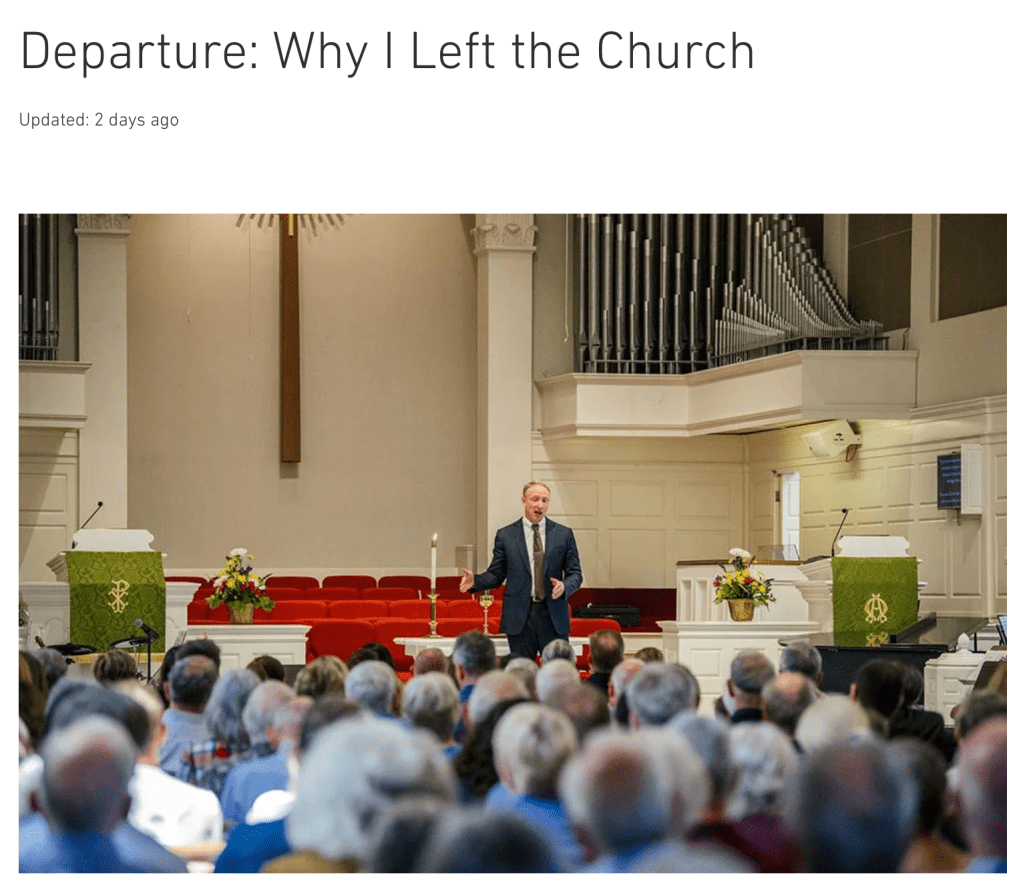
I have seen this article (and many like it) being shared by many pastors and ex-pastors alike (click the image above to link to it). For what it’s worth, I’d like to offer a counter-narrative as a pastor who actually has grown to love being a pastor, after reluctantly becoming one, and found the church community to be quite opposite to what this ex-pastor describes—an all too familiar description regularly echoed throughout the airwaves that needs to be exposed for what it is. Pardon my french.
In the article recently published by First Things titled “Open Communion Invites the Devil to the Table,” Hans Boersma argues against a growing trend in eucharistic practices among Protestants churches of what he calls a “pure hospitality mindset.” He identifies an early sign of this trend beginning with the decision made by delegates at the Anglican Communion’s 1968 Lambeth Conference to vote in favor of “’eucharistic hospitality’—the practice of inviting all baptized Christians to partake of the Eucharist, no matter their denominational allegiance.” This, according to Boersma, was the first step onto the slippery slope that would quickly send churches careening helplessly toward that unforgivable habit of eating and drinking with sinners and tax collectors and demons and the like.
Boersma’s concern, to be fair, is a justified one. It’s an issue of boundaries and therefore of identity. In short, if “we change our eucharistic boundaries, we change the church’s identity; and when, in postmodern fashion, we take away eucharistic boundaries, we take away the church.” It is certainly true, as he pointed out, that “attacks on stable identity and boundaries are now commonplace in our culture,” and the church should indeed be most vigilant about such attacks from within. No one can tear down a wall faster than those in the position to defend it.
Megan walked into my office “[something something] Radley…seizure.”
Everything scrambled, static. Next breath I remember I was pulling onto my street. The ambulance and firetruck were parked in front of my house, exactly where they do not belong. I yanked open the ambulance door. Heads turned around and words flew around and I couldn’t hear anything and neither could she. I was small and helpless and out of control and so was she. Keldy knelt beside her with all her heart and soul and mind and strength poured outside of herself. She had become a cross and turned the space all around into a womb.
Radley was there, somewhere, lost behind some thick black curtain. She was thankfully now breathing but still far from responding, far from herself and from us. For all her life she has been naked and not ashamed, proudly wearing her whole soul and sin on her sleeve. But my daughter was nowhere to be found on that surface. She had sunken beneath the surface of her body and was trapped somewhere inside herself and outside everyone else, kept from entering into that middle space where love lives and people say “you and me” and “daddy” and “we,” that space where children come home. They’re supposed to.
Her body was ironed out and flexed like a toddler’s body is not. It was like the body of someone who wants to escape in a place for people who are not allowed to escape. Her hands were balled in fists and arms stretched stiff at her side. It looked like she was trying to split herself in two longways to let herself out. Her mouth was pursed and lips jerking at angles and taking turns being bitten, like if a face could have its wires crossed. The sound of her teeth grinding was louder than the voices I couldn’t hear. It sounded like a torture chamber. Her eyes were lost. Everything was.
It wasn’t that her eyes were out of focus but overly focused. Her face looked dead serious, like a search party at sunset. Keldy’s eyes were locked into hers, knowing her, trying to remind her. Radley was looking back intently, pupils jolting in small angled orbits, scanning like a satellite in outer space looking for signals through the outer darkness. But–wrong frequency or something. There was sinking, grasping distance. It was like Keldy was yelling down from the top of a well that Radley had fallen—was falling—down, and Radley was trying her best to keep looking up to the light to make out the silhouette, to recognize the voice, to hear her name, to remember, to be known. You could tell she was fighting with all her powerful little self against the gravity of the of the night beneath. But we remained out of reach—she remained out of reach.
Jesus, where the hell are we!
We arrived at the hospital and I carried her into a sterile buzzing room and laid her little body down on a big white bed custom-made for non-working adult bodies, equipped with rubber blood vessels and wires to do the math and chrome bars for the weight of the world and flashing lights and beeping beeps and sick adults and serious sounding words. It was a scary place for a two-year-old little girl and a thirty-seven-year-old little boy trying to be a giant, trying to hold up all that weight on that bed.
She looked at my eyes the same way she looked at Keldy’s, like she was looking for a memory, looking for a mirror—lost. She just couldn’t penetrate beneath the surface where names are kept, where we see “daddy” and “daughter” and not strangers and eyeballs. The distance of that prolonged moment is incomparable to any I’ve ever known, from this vantage at least. It feels precisely godless, which I’ve only ever known from the other side, the lost side, where my two-year old daughter should not be allowed to go.
I knelt down and cupped my hand around her ear to block out the universe and began to tell her all the secrets about her that nobody knows but us, because only I can see them and I’ve never told anybody but her. I always tell her secrets at bedtime, when the universe is gone and it’s dark and we’re the only two voices left, because bedtime is not the only time it gets dark like that and I want her to know there are always at least two voices left. So I told her some secrets about her two middle names (because one isn’t enough for my only daughter), Jael Dawn, and a story about a rider on a white horse, the soldier of Light who makes war against the darkness.
After a while she began to loosen up. She was still not responding but no longer looked panicked like she was trying to escape her body. Eventually, her eyes began to relax and her body settled into the bed. Keldy stroked a finger down the bridge of her nose and like a light switch she was out. Keldy finally was able to recount to me the events as they took place at the epicenter of the eclipse—when she first lost her eyes along with her breath as her body seized and face filled blue—and she began to weep and I tried to hold it together so I just suffocated all over and my soul turned blue.
When Radley woke up she had risen closer to the surface. She still wasn’t identifying people by name or pointing but seemed to see more of us or more of herself in us, a step toward meeting in the middle. Keldy actually got a few giggles out of her with her customary (Canadian) Eskimo kisses. Her laugh sounded like trumpets blasting from the four corners of the earth and the roar of many waters. Then she peed a baby-pool worth of baby-pee on Keldy’s mommy-lap, or Keldy peed her pants and blamed Radley for it, and shortly after looked straight at Keldy and said “mommy.” “And the tombs burst open, and many bodies of the saints who had died were raised and they left the cemetery… and went into the holy city…and appeared to many people.” (Mt. 27:52-53). It was like that.
After that Keldy asked, “Can you say daddy?” She looked at me and her face promptly filled with bright red sadness and she began to cry as she reached out to me with both arms. I reached across the bed and pulled her to my chest and she laid her head on my shoulder and we both cried like babies and I had my servants kill all the fattened calves in the kingdom.
I held her while Keldy RN adulted with doctors and signatures and words words words and I did not put her down until long after we got home. On the way home, while holding her illegally in the backseat of my truck, I asked her if she wanted me to draw a picture of her on my phone. She nodded. She still had not called me “daddy” but I had a hunch that it was now only because she knew I wanted her to and she takes after her mother. So I was tricking her. Every time I finish drawing a picture of her she makes a request (demand), the same request (demand) every time. I finished the picture and, without hesitation, she demanded, “Draw you.”
“Then I saw a new heaven and a new earth, for the first heaven and the first earth had passed away…and I saw the holy city and the streets of gold and unshuttable gates and all the rest…” (Rev. 21-22).
The sun was shining in full strength. I was “you” and “we” were together again (see above fine art).
Radley came home.
Within two hours she was talking to “mommy” and “daddy.” By the end of the night she was doing the shake-your-booty dance. I don’t think I’ll ever be so relieved to see my daughter doing the shake-your-booty dance, but tonight it was life abundant.
P.S. Doc says the seizure was caused by a fever and is confident it was not epileptic. Thank you, Jesus. I’m sorry, Jesus. I did a lot more sinning and doubting today than praying and believing. But you did you anyway. Thank you.
If we have died with him, we will also live with him; if we endure, we will also reign with him; if we deny him, he also will deny us; if we are faithless, he remains faithful—
~ 2 Timothy 2:11-13
A BLESSING TO A SOLDIER OF THE DAWN
Most blessed of women is Jael… Of tent-dwelling women most blessed. …
May all your enemies perish, O LORD! But may those who love you
Be as the rising of the sun in full strength.
Imagine how much bigger and more mysterious the world must have been before it got entangled in the World Wide Web, a world without Buzzfeeds that reduce our ordinary world to a series of tragic or trivial headlines and Newsfeeds that reduce our social world to a series of one-way conversations 140 characters-deep, 10,000 friends-wide. Imagine a world without Google Maps and Google Earth and Google Sky and Google Multiverse (forthcoming). Imagine what it must have felt like to not feel like you are at the center of the earth or the center of every event and every relationship on earth. Imagine a world with board games and the great big woods outback.
I wonder what it felt like to be as small as Jesus was.
Just as a thought experiment, go type “headlines” into your search engine of choice. Read the headlines. Then ask yourself the following question: “What can I do about this?” I’m thinking of specific actions that can actually address specific problems or make specific differences in my life or anyone else’s.
Here are the top headlines from a few various news media outlets (at the time an earlier version of this was written):
There it is, folks, the “news.” These are the new things happening all over our world. Behold the newness of it all.
“What has been will be again, what has been done will be done again; there is nothing new under the sun.”
Ecclesiastes 1:9
Just because it’s a headline doesn’t mean it’s important, that it rightly demands your attention, that it can add to or take away from your hope, that it actually deserves to be regarded as “news.” The vast majority of information incessantly being pumped through the media outlets is not designed to “inform” the public but to form cultural (and tribal) attitudes (cf. G.K. Chesterton’s sobering work, What’s Wrong with the World; also Jaques Ellul’s Propaganda), and of course to entertain. It’s spectacle, a coliseum at our fingertips. But it is certainly not news in any real sense of the word. It’s just an ever-expanding buffet of rearranged words that are used to say the same old thing over and over and over ad infinitum. It’s like Mexican food. There is nothing new under the sun. We’re just moving around the rice and the beans.
The unquenchable fires of the nightly news feed only on the world of decay, a world that requires the new to ever become old, a world that skims atop the surface of time desperately groping at what men identify as meaningful today but what moth will identify as food tomorrow. But Christians have been given a cross staked into history’s yesterday and Life raised up into history’s Tomorrow. That news has pierced the soul of the world, and it is the one thing that remains new because it is the only news that never grows old. It is the news that the angel heralded over history as “the eternal Good News…to every tribe, tongue and nation” (Rev. 14:6). It’s the eternal good news because it’s the news that makes all things new.
It is helpful to remember that when Jesus saved the world the worldwide web didn’t even exist. News feeds were word of mouth, and the words were from mouths that were not even miked. Without even the help of K-Love, somehow the love of God managed to spread throughout the airwaves. It was even more primitive than a landline phone call, as old fashion as family dinner. In fact, not a single member of his little lakeside church had a voice loud enough even to cast a Roman vote. How they managed to function without a cultural pat on the back and a governmental stamp of approval baffles the religious right and the camel staring eye-to-eye with the needle. But as Jesus once said, it’s easier for the Gospel to get into North Korea than for Donald Trump to enter the kingdom of heaven.
So we cannot be deceived to think that the effect of the Gospel increases with an increase in volume. Besides, I don’t know about you, but I tend to avoid sitting next to the guy with the bullhorn, especially if he is carrying a Bible. The Church’s News about the Prince of Peace sounds personal, like an invitation or a confrontation, not a pep rally. It belongs at the table, not in the bleachers. If we keep blasting it out into the nation-wide airwaves, our best words, like “evangelical,” are going to keep getting distorted, bastardized under the jurisdiction of “the prince of the power of the air” (Eph. 2:2). And that just deepens the mess we’re in now of needing to “unspeak” about Jesus as much as we need to speak about him. God speaks in a still small voice because that kind of speech requires nearness, and God wants us to speak like him when we speak about him. When we speak about him we speak about the God who is near in Jesus Christ, and the God who is near in Jesus Christ brings near the kind of people who would otherwise remain far apart in the name of so many other names of so many other tribes and gods and herculean lords-elect.
I’m not saying it is bad to be concerned with or aware of the national scene or global scene, especially if you are in a position to do something about it–-if you’re reading this, you are not-–but I do think it is bad to be unconcerned with and oblivious to the local scene. In the words of Gustavo Gutierrez: “So you say you love the poor. Name them.” Indeed, I’m as suspicious of the religion of the liberal left as I am that of the religious right, of the man who decries world hunger but has never offered to buy a local man’s lunch, who endorses love for the world but doesn’t sit down to eat dinner with his family, who rails against abortion but doesn’t teach his son how to respect a woman, his daughter how to respect herself. The greater are our delusions of grandeur, the severer we suffer the sickness of Doestoevsky’s doctor, who
loved mankind…but…the more I love mankind in general, the less I love people in particular. I often went so far as to think passionately of serving mankind, and, it may be, would really have gone to the cross for people if it were somehow suddenly necessary, and yet I am incapable of living in the same room with anyone even for two days; this I know from experience. As soon as someone is there, close to me, his personality oppresses my self-esteem and restricts my freedom. In twenty-four hours I can begin to hate even the best of men: one because he takes too long eating his dinner, another because he has a cold and keeps blowing his nose. On the other hand, it has always happened that the more I hate people individually, the more ardent becomes my love for humanity as a whole.
Fyodor Dostoevsky, The Brothers Karamazov
The problem with actual human beings, the kind that bleed real blood (Jn. 19) and eat real fish (Jn. 21), is that they get in the way of human ideals, especially our ideal of humankind. That’s why human beings are most hatable precisely in the name of humankind. We hate Hitler so much because we love humankind so much. But if it is an ideal of humankind we are after, we are better off leaving this world to find it. If God himself cannot fix the world without first getting caught up in the thickets of its realism, then neither should we imagine an ideal world void of invasive thorns and corrupted crowns, or of some strange combination of the two. Till kingdom come in all its fiery cleansing, humans will continue to erect crosses and blow their noses. And unless we are going to join the effort of the ones holding the hammers, joining the effort of the One holding the nails will always feel small and personal, and likely at least a pain in the neck.
The truth is, you can’t make your world different until your world becomes close enough to touch, low enough to look in the eye. That is your world. Everything bigger is a mirage. Anything more important is unimportant. And strangely enough, it is in that little insignificant world of yours, too small to see through a screen, that you will find meaning, purpose and permanence, because it is in that world that you will find God. The shepherds found God in a makeshift cradle, after all, and God Almighty himself said he’d continue to be found in little unlikely places like prayer gatherings (Mt. 18) and prison ministries (Mt. 25).
This point is this: it’s easier to care about everything and everyone on earth than to care about one single human being. At least as far as the Church is concerned, we don’t need more initiatives than the one we’ve inherited. We just need to take the one we’ve inherited seriously. But that requires believing in a very large gap between the size of your efforts and the size of the difference it makes, but it also requires disbelieving in the size of Washington and Wall Street and Hollywood’s depictions of how heroes make a difference, so that you don’t waste all your efforts trying to change the one to look like the others or give up altogether because you don’t look like an X-Man. Neither did the God-Man.
The kingdom of God is not revolutionary like a typical change in thrones or regimes. It is indeed more evolutionary, like a garden. Jesus may not have been as radical as Karl Marx, but he was just as practical as potatoes. Now I don’t mean evolutionary in the way Professor Whitehead meant it, nor am I talking about the kind of ‘practical’ found in the mouths of politicians or the most popular preachers. I just mean there is a certain size and speed men have tended to associate with God that God has tended to dissociate with himself. Jesus, truly God and truly Man, was somehow less divine than all the gods of the pantheon and even more human than the Greeks. He is the kind of God, in all his effortless omnipotence, who portrays himself taking a whole week to create the universe and then without apology takes a break. In fact, creation wasn’t complete until he rested from creating it–and it took all day (Gen. 2:2). To be sure, of all the things that made the post-Easter highlight reel of the risen Christ, John tells us about Thomas touching his glorified wounds followed by fish and chips on the beach. Even new creation itself isn’t complete without rest.
The Gospel thus frames the divine revolution of God’s kingdom in mustard seed packets. And these mustard seeds are not like Jack’s beans. They don’t magically produce watermelons on vines of Zigguratic proportions. The difference is both bigger and smaller than that–it just depends on how you measure, and I can’t help but think that the Church’s measuring sticks need about as much conversion as the Church’s nonmembers, and exactly as much as its members.
Unfortunately or not, the magical mustard seeds of the kingdom turn out merely to produce more mustard seeds (Mt. 13:31), which is precisely the way love works. Loving people in Jesus’ name rarely ever produces mass conversions or a moral majority. Most of the time loving people in Jesus’ name just produces more people who love people in Jesus’ name. And that’s how the kingdom of God has been forcefully advancing for over 2,000 years, longer than any nation has been in existence, and will continue to do so longer than any nation will remain in existence.
And this is actually actionable for everyone, because people really only need moderate amounts of love. What I mean is: people do not need love from the whole human race or even the whole federal government; they just need it from their neighbor, their nearest, and only one at a time. In fact, God-sized love can only fit through a funnel that is one-person wide, not because that’s how big God is but because that’s how personal God is, and how radically condescending (in the best possible sense) God’s Incarnate love is, and if it weren’t it wouldn’t be love. A cup of cold water in Jesus’ name will always be more satisfying than a free drink from the fire hydrant. A pro-life rally will always be less effective than taking a troubled young teen out for ice cream. A father who works 23 hours a day to provide for his family in the name of “love” does not have children who have 23 hours worth of daily love filling up their big house and empty hearts. Love can only be measured by its capacity to be received. So if you want to love the poor or the refugees or the least of these, find one one of them. If you can’t find one without a country, find one without home, or one without a father, or one with a father who is too busy working for his kids to bother loving them. They are everywhere, especially right next door.
If you want to join the heroic mission of God and help save the world, just make sure whatever world you intend to save is one inhabited by human beings as real and as small as you are, or at least as small as Jesus was. Even if God sends you across the globe, it will only be in order to send you across the street. But he doesn’t have to send you across the globe to send you across the street, so please don’t wait until you are called overseas to reach the nations to reach out to the neighbor next door.
If you are committed to becoming part of something as small as God’s global mission, going around town proclaiming “good tidings of great joy” to little kids and annoying neighbors, you may not encounter anything as supernatural as a Marvel battle scene, but you will encounter something as supernatural as the Holy Spirit. Sometimes that will look like kingdom-come and be as sweet as Christmas morning, other times it will look quite otherwise and be as sour as a sponge dipped in vinegar. But that’s because kingdom-come often looks quite like the opposite of what we imagine, quite the opposite direction of where we tend to pay our attention, because God cares about the people who are paid no attention, people like you, people like me, people like your neighbor, people like your enemy. But therein lies the opportunity for you to go with the Good News and see the kingdom of God forcefully advance to the ends of the earth next door.
May I offer a simple way to stay grounded in the kind of Gospel that actually touches the ground? Think about a time you received the grandest expression of love you’ve known: now go, descend from on high, and do likewise in the name of Jesus.







 Dim Reflections For Now