*Christmas Eve* Advent Sermon (2/2): Here–In No Man’s Land

Here–In No Man’s Land

“Unto us a child is born, to us a son is given; and the government shall be upon his shoulder, and his name shall be called Wonderful Counselor, Mighty God, Everlasting Father, Prince of Peace. Of the increase of his government and of his people there will be no end” (Isa. 9:6).

This is the sermon that completes the Advent series. Advent is over. He is here.

[This was originally preached at the Christmas Eve service at First Alliance Church. I will be publishing this in an extended reflection within the month, so you can checkin in in a few weeks on that if you’re interested. Also, below is one of the many videos that attempt to reconstruct the miracle that happened that Christmas Eve and Christmas Day. Enjoy it. Then go attempt to reconstruct that miracle in your own lives.]

*Christmas Eve* Advent Reflection 24: Salvation (1/2)

Salvation

“Blessed be the Lord God of Israel, for he has visited and redeemed his people and raised up a horn of salvation for us in the house of his servant David.”

It all started with a song. The single most powerful act of war in the history modern warfare started with a song that broke out from the trenches of the Western front. It was Christmas Eve, 1914.

The 20th century was supposed to be the century of possibility. With advances in modern science, industry and medicine, we were entering a new era of human flourishing. Diseases would be cured, life would be extended, and nations would open up in peaceful dialogue. And perhaps most importantly, there was a widespread declaration of independence in the Western world from the shackles of religion. Finally, humankind had the tools it needed to live in harmony together.

But by December 1914, harmony seemed anything but possible. It was the dawn of the First World war. European nations were trying to draw new, dark red lines on the world’s map, expanding and defending their borders. A generation of youth were enlisted to fight “for God and country.” Naive boys kissed their mother goodbye one last time to go off on an adventure that everyone believed would be over by Christmas. But by Christmas Eve, 1914, barely four months into the war, over one million of those young men had been killed.

The First World War was unlike any the world had seen. With the advances in science and industry came a host of new tactics and technologies designed to make destruction more efficient. The capacity to preserve life was met with a disproportionate capacity to destroy life. The unprecedented volume and pace of modern munitions could easily turn seconds of battlefield exposure into hundreds, even thousands, of casualties on both sides. Approaching the battlefield proved to be as dangerous as moving behind enemy lines. There was virtually no way in and no way out.

Prior to this era, shelter was simply a matter of distance. Battlefields generally formed along the borders of two opposing sides. These strips of land were recognized by both sides as “enemy lines,” the place you go to fight, certainly not to go to bed. Rest and refuge were found as far away as possible. But the horizontal war rhythms of fight and flight, advance and evacuate, would simply no longer work in the 20th century. Waves of soldiers were overwhelmed by the constant flood of firepower. The only way to get close enough to kill without inevitably being killed was to stay close—and to lay low. So early on in the war, field commanders learned that digging down was the only way to take survive the advent of modern machine guns. The shovel became the greatest weapon for national defense.  And so began the era of trench warfare.

Trench warfare made for an unusual battlefield situation. Battlefields began to take on a new role, even a new look. War had theretofore been fought in anonymous clashes on the occasion of battles, but now they would be fought with familiar voices. Battlefields had become would be populated, even between the battles. Enemy lines would begin being accentuated by rows of trenches that ran along parallel tracks like neatly-spaced neighborhood sidewalks. Trenches needed to be close enough to the range of a bullet but far enough from the reach of a grenade. On the front lines that was just over a stone’s throw away. Trench warfare thus brought enemies into proximity. Battlefields became neighborhoods. Enemies lived across the street. In the space between was “no man’s land.” But that little strip of land represented infinite distances. No one was safe with the neighbors around. THe aboveground world was unfit for human life. So rest would only be found, life would only be found, around six feet under.

By the end of the war over 12,000 miles of trenches scarred the European landscape with the hollowing memory of incalculable loss. Any talk of gain from the war seemed hardly appropriate as the death toll crept past 17 million. The battlefield neighborhoods became ghost towns. The rows that were once the only silver linings life on the edges of a black nightmare of power were filled in with shared dirt from the space between. It was the sign for the surviving soldiers to return to their aboveground homes, that the world was again fit for life. Or was it the sign that the world itself is homeless, a place unfit for human life, a place we spend our entire lives doing little more than shifting around the dirt of no man’s lands, trying to blend the lines and cover the scars until the day those sidewalks are lined with headstones?

The lines are just too blurred now to tell.

No matter how much we try to forget, we cannot. Too much was exposed, and it has revealed more about human nature than any of us care to know. It revealed not only what we are capable of doing to our enemies, but what we are capable of doing to our neighbors, to people with familiar voices, to people who live just across the street. It revealed, in the end, that there is no human power greater than our power to destroy.

War reveals the greatest strength humans possess. And thus the Western Front has etched deep beneath the surface of its now lush green meadows a self-portrait of the human heart filled with a dark red dye that has stained the memory of Western Civilization as we know it. Indeed, the West is itself merely a front. The whole world lay buried in the trenches East of Eden: No Man’s Land.

So we try to forget, because how can we remember without losing hope?

But we are hopeless. We need a Savior.

But there is a memory of something else. It is a memory that arises from the trenches in the middle of the war. It is the memory of a power so immense that it can only be described as a miracle, because it put a halt to the highest form of all human power. It was found in a song on Christmas Eve, 1914. It was the song that stopped the war.

To hear about that song, listen to the Christmas Sermon from this year’s Christmas Eve service here.

The Formless Void of Absolute Freedom

Theological Footnote “Advent Reflection 23: Peace

“In the beginning, God created the heavens and the earth. The earth was without form and void, and darkness was over the face of the deep. And the Spirit of God was hovering over the face of the waters” (Gen. 1:1-2).

God is the Infinite fullness of Being. There is nowhere and no-when God is not (Ps. 139:7-12). He is Presence itself and Subjectivity itself: He is I AM. 

But God chose to create beings, subjects, otherness, things. How can there be true “otherness” in a place where there is nowhere God is not? How can there be other “presences” when God is Presence? How can there be other lives and movements and beings when God is infinite Life and absolute Being itself. Indeed, how can it be that “in him, we are living and moving and being” (Acts 17:28)?* Doesn’t our living and moving and being simply exist as such as parts of the whole that is God rather than wholes (or holes?) within a wholly (or holy?) other Whole? 

In this vein, and most perplexing of all, how can there be other “subjects” when God is the infinite Subject, subjectivity itself? How can two I-AMs exist in the ‘same space’? How can the creation of subjects be anything more than the predicates of a single Subject, the multi-charactered soliloquy of a single voice, Geppetto’s puppet when it was still wood? Does creation require us all to just be (honest) Calvinists (re determinists)? How could God create a world where things could be said like, “Your will be done” or “Crucify him!”? How can I AM create all those dependent clauses (and put up with such confused subjects): “I think, therefore I am.”

It could happen if God created a space for subjective freedom, which is the fundamental precondition for love. That is the space of Genesis 1:2. God must create godlessness in order to create subjects who can give love and objects who can receive love–human beings, aka “Our Image and Likeness” (the Trinity). [For an extended discussion on the definition of freedom, click here.]

So creation of all things, naturally, must begin with the creation of a no-thing. God must create a space that is not God. Our existence must begin with the creation of a non-existence, the creation of beings with not-being, of light with darkness, of form with formlessness, the creation of daisy fields with a deep, dark void. “In the beginning” God created a non-beginning, a time of timelessness where everywhere there was nothing going nowhere. Absolute zero would have to come before Let there be summer.

So God creates ex nihilo, out of nothing, by first creating nihilum, nothingness. God is not removed from that space; rather, it is a space where he suspends his presence–he “hovers over” it. This is nature in its purest form, and it is utter emptiness, because it is godlessness. But godlessness is then filled with God’s speech, the communication of his presence in absolute freedom. Godlessness is then filled with the proposal to be filled with the fulness of God. God filled the void with form, the darkness with light, the wallless canyon with his living breath. God exhaled, creation inhaled. God spoke, the earth bloomed. God had created the space of the no-god, true distance and difference, and then invited it into harmony with God. It was a space where God could be heard. God said, “Let there by light.” Creation said, “Don’t mind if I do.” But that same space is one where God can be ignored. God said, “Let me be God.” Adam said, “No.”

But godlessness was the inevitable possibility of human freedom. The freedom to love is precisely the freedom not to. Living subjects could choose to deny the Absolute Subject, and thereby deny themselves, to say no to God, and thereby to themselves. We can always choose to die. But we can also choose life. Because the living God loves us, and his eternal Word of Grace is stronger than all our past words of defiance, all our future ones too.

So be still, and listen to God.

“The Word is near you. It is in your mouth and in your heart, so that you can do it. ‘See, I have set before you today life and good, death and evil. If you obey the commandments of the LORD your God that I command you today, by loving the LORD your God…then you shall live and multiply…Therefore choose life, that you and your offspring may live, loving the LORD your God” (Dt. 30:14-20).

*ἐν αὐτῷ γὰρ ζῶμεν καὶ κινούμεθα καὶ ἐσμέν.

Advent Reflection 23: Peace

Peace

“Of the increase of his government and of peace there will be no end, on the throne of David and over his kingdom, to establish it and to uphold it with justice and with righteousness from this time forth and forevermore. The zeal of the Lord of hosts will do this” (Isa. 9:7).

“All humanity’s problems stem from man’s inability to sit quietly in a room alone” (Blaise Pascal, Pensées).

Other than a few proper names, there is no word in the world more important to me than peace. I suppose it is because for a long time I lived without it. Anyone whose world has been stripped of peace knows just how much its worth.

But defining peace is nearly impossible. This is evident the moment you try to think of its opposite. There’s belief and there’s unbelief. There’s happy and sad. There’s hope and despair. There’s good and evil, heaven and hell, holy and unholy, books and Instagram. But what is the opposite of peace? Is it War or is it angst? Is it Chaos? Hostility? Worry? Restlessness? Anxiety? Bitterness? Hatred? Rage? Violence? Revenge? Discord? The Middle East? The nightly news? Divorce court? The human heart? Where is peace located—within or without?

Yes.

Peace is such an all-encompassing word that to not have it is to be both engulfed by and filled with the “formless void.” The formless void is existence with no reference points, not coordinates, no order. To be in a formless void is to be restlessly lost. It is to live in world of darkness that both covers the face of the deep (Gen. 1:2) and hides its face in the dark (Gen. 3:7-8). It is the void within and the darkness without. In fact, in the book of revelation, the second of the so-called four horsemen of the apocalypse was not instructed to impose violence in an otherwise peaceful world, as is sometimes suggested. He was simply “permitted to remove peace from the earth, so that people will slay one another” (Rev. 6:4). There is no more terrible a prospect of God’s wrath than God’s absence. If perfect peace has an exact opposite, it is pure absence. (See this footnote for explanation). In the words of Karl Barth, “The enterprise of the No-God is avenged by its success.” Indeed.

But this is counterintuitive. In our culture, we actually tend to think of peace as a kind of absence. If I could just get some peace and quiet! By that we mean we need a halt, a ceasefire, a break—we need to be absent from all the activity and noise we are surrounded by to find peace. But the real question isn’t why we need some peace and quiet every now and again. The real question is why we need activity and noise all the time. Why are we more compelled to return to the chaos than retreat from it? Why are 63% of Americans stressed, a quarter of which addicted to stress, while people on the other side of the cultural pole are addicted to distraction? Why is it so hard to not fill the void with the noise?

Is it that our abundance of activity contributes to our lack of peace or that our lack of peace contributes to our abundance of activity? 

How long can you sit in a room alone?

I can’t help but think that a “culture of more” is the inevitable product of culture that has poured its foundation in the void. I can’t help but think that in such a culture more can never be enough–because the void wasn’t for us to fill; it was created for God to fill. It is there so that we will come to know our need of God.

About five years back, Keldy and I were meeting regularly with a young gal helping her through some of life’s regulars, a few irregulars as well. One evening we had one of those rare “come to Jesus” moments, because it was pretty clear Jesus had come to her. There were tears, confessions, a white flag slowly being raised from her heart. But I could tell there was still some white in her knuckles as it related to one very destructive relationship she knew she needed to let go of. I tried to convince her that staying in this relationship was like holding on to a ticking time bomb. Her response: “I’d rather die with someone who hurts me than be alone. I just don’t want to be alone.” For this girl, it wasn’t a presence she feared, no matter how destructive, but an absence.

I can’t say that I blame her. I know what all sorts of pain feels like, and there is no pain that hurts more than loneliness. Indeed, “it is not good for man to be alone” (Gen. 2:18), so we would rather die with the ones who hurt us than be left to live alone.

But that’s not our only option.

On October 1, 2014 (an easy day to remember: my mother’s birthday, the day I got my second DUI–I was 18), I got a text from the same girl. It’d likely been a year since I had talked her. She was off to college and I had, quite frankly, given up on her. But Jesus hadn’t.

I saved our conversation:

G: [Her opening line:] “I am ready to give my life to Christ. I’m not sure what to do, so I need your help.”

Me: “Did something happen? What changed?”

G: “I was lying in bed in my dorm room, by myself, and suddenly I just felt at peace. It felt like my room filled up with peace.”

Me: “What do you mean?”

G: “I mean I didn’t feel alone anymore, and the only thing I could think about was Jesus.”

Me: “Go and tell three people what just happened. I’ll call you tomorrow morning.”

Jesus has a special holiday name, Emmanuel, which means “God with us.” The Gift of Christmas is the nothing less than the presence of God. It is God’s gift of God’s self. The King of Kings comes to us as Prince of Peace. 

At the second Advent of Christ, Isaiah says there will be no end to peace, no empty dorm rooms, no empty high school girl hearts, no empty void selling endless fixes for to a culture of more. Jesus will establish a government based on the peace of his presence. But Jesus’ presence is available today. Emmanuel really means Emmanuel.

The question we all must confront is whether our lives are based on a presence or whether our lives are based on an absence. Have you dared to pray for God’s peace?


Be, and Be Thankful

One of the implications of God being Infinite–the Absolute fullness of Being–is that everything that exists that is not God, from supernovas to black holes to subatomic tinker-bells, are always at every moment ‘borrowing’, rather ‘receiving’, their being from God, who is always at every moment donating to them their being out of his own bottomless resourcefulness and generosity. We are just a bunch of dependent clauses leaning on the same needless Subject-and-Verb, who nevertheless continues to extend the sentence: “I AM,” “therefore i am.” In other words, God is always at every moment creating you–in freedom and for freedom–in the unsolicited gratuity of his own freedom.

“Be still, and know that I am God.”

~ God

Advent Reflection 22: Favor

Church_and_Mosque

[For the abridged version of this reflection, click here.]

“The Spirit of the Lord GOD is upon me, because the LORD has anointed me to bring good news to the poor; he has sent me to bind up the brokenhearted, to proclaim liberty to the captives, and the opening of the prison to those who are bound; to proclaim the year of the LORD’s favor” (Isa. 61:1-2).

The verse actually doesn’t end there. It continues: “to proclaim the year of the Lord’s favor, and the day of vengeance of our God: to comfort all who mourn” (Isa. 61:2). “The year of the Lord’s favor” would begin on “the day of vengeance of our God.”

But this shouldn’t come as a surprise to us. This is the way the world works. For one to be favored, another has to be slighted; for one to be triumphant, another has to be defeated; for one to be “us,” another has to be “them.” In Isaiah’s world, the Lord’s favor would be seen when he unleashed his vengeance on Israel’s enemies. It was the same in Jesus’s world, until the day Jesus rewrote Isaiah, or at least rearranged it.

That day began like any other. Turns out it was a lazy Sabbath day, the day the Lord should have been resting. But Jesus was in Nazareth, one of the places he had created when he created the universe, which also happened to be the place he was born on Christmas #1. On this particular morning, Jesus woke up, brushed his teeth, and went to the local synagogue. Shortly after arriving, a man in robes called on volunteers to read. You know how it goes. Some tried not to make eye-contact. Others pretended to pray. John Paul Jr. raised his hand for the twelfth time in a row. The rabbi pretended not to see him. Lots of pretense at church.

But then a man with a half-familiar face stood up. It was the son of the carpenter, the one who had apparently abandoned his father’s business (cf. Lk. 2:49). But it was a break from JP Jr. So he handed him the scroll. The only visible letters were written in bold just under a tattered edge: “ISAIAH.” Jesus began unrolling the scroll, volunchoosing people to hold it up as he stretched it dang near across the entire sanctuary. Finally, just near the end, he put his finger on the passage above and began reading. But then he stopped. Making his way back up toward the top of the scroll, about five pews worth, he dragged his finger to another spot, read a few lines, then stopped again. Taking his sweet time, he then moved back down to toward the bottom to yet another passage, which he took the liberty of paraphrasing (cf. Isa. 61:1-2; 48:8-9; 58:6). He then rolled the scroll back up, gave it to the man in the robes, and shouted: “Today this Scripture has been fulfilled in your hearing!” (Lk. 4:21, cf. vv. 16-20).

It wasn’t only that his choose-your-own-adventure approach to reading God’s Word rather unorthodox, or that he announced he was carrying the fulfillment of Isaiah’s prophecy on his Person; it was that he hadn’t even chosen a favorable ending. He said nothing about “the day of vengeance of our God,” nothing about Rome or Caesar or Herod or any of Israel’s enemies or ISIS or illegals or even those dang Liberals! He simply said that “the year of the Lord’s favor” was commencing “today…in your hearing” (Lk. 4:21). And it was so, it seemed, simply in virtue of his presence.

But where was the vengeance?

That must have been the question the people were asking themselves. And when they didn’t get the answer they wanted, it must have been the reason they “were filled with wrath,” the reason they chased him out of the synagogue and tried to throw him off a cliff (Lk. 4:28-29). It must have been the reason the “year of the Lord’s favor” seemed to set in motion a “day of vengeance.” If so, perhaps the “day of the vengeance of our God” was never about a day God would begin taking his vengeance out on people but The Day people would begin taking their vengeance out on God.

In that case, it’s no wonder just after his announcement about “the year of the Lord’s favor” (in Greek: dektos) Jesus announced that “a prophet has no favor (dektos) in his hometown” (Lk. 4:19, 24). The Lord’s favor was too favorable toward Israel’s enemies, and so Israel made a new enemy out of their unfavorable Lord.

Perhaps those who have the biggest problem with Jesus are not His overt enemies, but rather those who insist He destroy His overt enemies, because by “His” they really mean “theirs” (cf., a person in the Bible called Jonah). The “Lord’s favor” on us is not all that favorable if it doesn’t involve the “Lord’s vengeance” on them–our enemies. When that happens, it’s all too easy to confuse the Lord as an enemy and to unwittingly make him the object of our vengeance, caught up in the crossfire. You’d think that would be a hard mistake to make, except that it turns out to be the hardest mistake not to make, because it’s as easy as making an enemy out of anyone.

No matter how confounded we are by the news of a God who was crucified as an object of human vengeance in order to make his enemies the objects of his love, we humanoids never fail to find ways of taking the objects of God’s love and making them the “rightful” objects of our vengeance and our violence and our grudges and our gossips. The people in Nazareth did it to his face, but we’ve all done it behind his back. That’s why Jesus would later explain in one of his last teachings that the way we treat our enemies and inconveniences, ISIS and illegals, the ones he commanded us to love in one of his first teachings (Mt. 5:44), would in the end be the measure for how we treated him. “As you did it to one of the least of these my brothers, you did it to me…As you did not do it to one of the least of these, you did not do it to me” (Mt. 25:40, 45). He would then say something about sheep and goats.

It’s in this light that the following article, published yesterday by the BBC, should be read as something of a reminder, if not a warning, to the Church:

This is news worth reading: “Kenyan Muslims shield Christians in Mandera bus attack”

“A group of Kenyan Muslims traveling on a bus ambushed by Islamist gunmen protected Christian passengers by refusing to be split into two groups, according to eyewitnesses.”

I can’t help but be reminded upon reading this of the God who wrapped his righteousness in “sinful flesh”(Rom. 8:3; 1 Cor. 5:21) that day he was found wrapped in “swaddling clothes” (Lk. 2:12), because he refused to let Himself and His creation be split into two groups.

If this doesn’t call Christians to their own faith, I don’t know what will. In a few days, we will celebrate the Incarnation of God, the day two infinitely different ‘groups’ became One in the person of Jesus Christ, the day which began The Hour when the “enemies of God were reconciled to God through the death of his Son” (Rom. 5:10). And every week, when we put that piece of bread in our mouths, we remember the One who was made flesh who was broken in order that we who are broken can be made One in Spirit by his flesh.

If Muslims, who do not know Christ, stand with those who do on pain of public execution, then I hope that Christians, who do know Christ, will be willing to stand with those who don’t on pain of public opinion. *And not because everyone just worships the same God anyway(!), but because Christians worship the God who became the same as us, indeed, the God who became a shield for us.* I don’t know the reasons these particular Muslims acted the way they did, but I do know the reason every Christian is called to act this way:

“If anyone is in Christ, he is a new creation. The old has passed away; behold, the new has come. All this is from God, who through Christ reconciled us to himself and gave us the ministry of reconciliation; that is, in Christ God was reconciling the world to himself, not counting their trespasses against them, and entrusting to us the message of reconciliation. Therefore, we are ambassadors for Christ, God making his appeal through us. We implore you on behalf of Christ, be reconciled to God. For our sake he made him to be sin who knew no sin, so that in him we might become the righteousness of God” (2 Cor. 5:17-21; cf. esp. Eph. 2!).

If we are going to be entrusted with the ministry of reconciliation, then we are going to have to take seriously that our witness to Christ has at its very center a way of transforming our categories, so that “enemies” are given a new name. Our witness extends beyond the walls of the Church, even if it compromises the walls of our nation, just as Christ extended beyond the walls of heaven, even when it compromised the walls of Jerusalem. If our Muslim “enemies” are ever going to come to know their Savior, we are going to have to learn that our Muslim “enemies” from some other nation are nothing other than our fellow “neighbors” in some Other Kingdom (Lk. 10:25-37).

How else can we celebrate Christmas with a clear conscience? Is Christmas not the day Jesus crossed enemy lines to set up a neighborhood called the kingdom of God that is no respecter of borders, the day God made his dwelling with sinners?

Christians don’t identify with non-Christians on some higher ground than God–whether it be “humanity” or “peace” or “justice” or “love,” whatever, as is the popular way of our ‘peace-talking’ these days. Rather, Christians identify with non-Christians on the lower ground of guilt, where crosses are raised, because it is there we find our fellow man who has been found by our Fellow God.

“Precisely when we perceive that we are sinners do we perceive that we are brothers.”

~ Karl Barth

“For I determined to know nothing among you except Jesus Christ and him crucified.”

~ The Apostle Paul

“The earth is the Lord’s and the fulness thereof, the world and all who dwell therein.”

~ God

A Letter to My Skeptic Friends

Brooklyn_Museum_-_What_Our_Lord_Saw_from_the_Cross_(Ce_que_voyait_Notre-Seigneur_sur_la_Croix)_-_James_Tissot.jpg

The Crucifixion, seen from the Cross, by James Tissot, 1890

To My Skeptic Friends,

I am writing this letter to try to help you see where I am coming from when we debate and why I will likely never be able to satisfy your questions with my arguments.

The elephant in the room of every Christian-atheist debate will forever remain there, firmly seated, because confessing Christians ultimately have no real, or at least ordinary, evidence to show for our confession. We may be able to argue persuasively from first principles about the inherent inconsistencies and ironies in, say, a purely physicalist model of reality, perhaps even pointing out the metaphysical nature of, say, models of reality. We may even be able to prove, as a logical necessity, any universal model of reality that denies universals thereby also denies itself (as Jesus once said, “If you deny perfect right angles on earth, your skyscrapers will fall from heaven” (a paraphrase)). 

All that notwithstanding, when it comes to proofs for our distinctly, and merely, Christian confession—not simply that a god created the universe but all that stuff about a peasant Jewish God-Man being raised from the dead and promising to return to judge the world in an apocalyptic battle against the devil and all who do his bidding, ending in a lake of fire preparing the way for a bejeweled city of light for all the resurrected ex-dead bodies of the saints who, like worms unrecognizable fresh out of the cocoon, were raised to a new kind of life with no more heartaches or headaches, and no more lies, to rule with him in an eternal kingdom—about all that, we have nothing to argue, something to say but nothing to prove. 

Christians have not only been asked to affirm an apparent contradiction, but we have been commanded to base the universe on a contradiction. It should go without saying, but unfortunately it needs to be said again, that Christ crucified is not a rational basis for universal truthsThere is nothing rational, nothing necessary, about a creature crucifying his Creator. Such is not a given, a probable cause, or even plausible explanation. It is an impossibility. And it is the foundation of Christian speech. From hence are all specifically Christian conclusions drawn, beneath which is a void of non sequiturs (often called apologetics).  

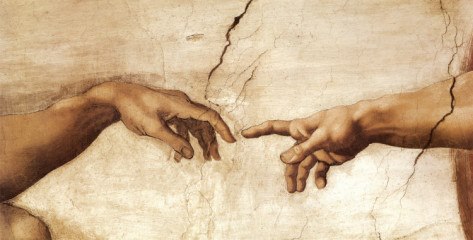
God was not oblivious to this design. He set it up so that the contradiction would have to run its course before it can do the work of drawing people back in. We must first look away only to realize we cannot look away. We must be repulsed by the death of Christ only to be seduced by it. We must see who God is in Christ, so that we can see decisively who God is not in us. We must first see the infinitive qualitative distinction of Christ crucified in order to see the infinite qualitative beauty of Christ crucified. We must behold the One lifted up as we behold the ceiling of the Sistine Chapel, as an unattainable spectacle of impossible grandeur, as something that is kept from our reach but given to our eyes, as something so absolutely alien but somehow so absolutely at home. We must learn not only to handle the truth of God, to follow the goodness of God, but, perhaps at the very center of it all, to behold the beauty of God. But we cannot run to the academy for proofs of God’s beauty, because, in Von Balthasar’s words, “Beauty is the last thing which the thinking intellect dares to approach, since only it dances as uncontained splendor around the double constellation of the true and the good and their inseparable relation to one another.”


I find that what I’m really trying to do when I share the Gospel is not something that is possible for me to do, because the Gospel itself suggests that those who believe it do so because God himself compels them to, because he will speak to your heart in a way you will not be able to deny, no more than you can deny the delight at seeing a shooting star tear a wound of glory in the veil of night. So what can I do but point away from myself into the infinite space between us and God and declare a deep mystery. What context is there for me to describe this cosmic enigma but in the great gap of the otherwise unknowable? It’s not like I can ever assume a direct correlation between what I say and how you respond, so if you are going to really hear what I’m trying to say, you will simply have to listen for Someone Else’s voice. And if He doesn’t speak, I have nothing to say.

The truth many Christians deny either in their ignorance or their embarrassment, refusing to despise the shame, is that there simply is no irrefutable Christian claim attainable through an unbroken chain of reason. The distance between the Gospel of Jesus Christ and the highest link on the chain of reason is like the distance between the highest title wave and the moon. And yet, for all lack of appearances, and in an act of self-humiliation, I am still commanded to proclaim that there was a day that the moon plunged itself into the heart of the sea, only to return three days hence to rule the night sky. I do not expect that I can prove this actually happened, nor do I pretend it is not a foolish story, as though we should have expected it to happen, as though Via Negativa follows a merely logical path to Via Delarosa, no matter the God, no matter the universe. More foolish still, I need to concede that I was not even there when it did happen, and yet I have been commanded to proclaim it as though I witnessed it myself, because I did witness it myself.

It is such an absurd story indeed that if you ever do find yourself believing it, it will be nothing short of a miracle, and your faith will not rest in the wisdom of men but this miracle of God (cf. 1 Cor. 1-2), so please don’t try to persuade yourself into believing it, and neither will I try to persuade you. When you do believe it, it will only be because you cannot help but believe it, only because it is in your head not like people are in an airport but like busyness is in an airport. It will be in your head unlike any other idea or fact or truth is in your head because it will be in more than just your head, as though its roots have grown down and wrapped around your heart and your gut and begun sprouting its life in a way that distorts your vision, like the suddenly permanent image of the sun after you foolishly behold its beauty too directly. Even in your doubt, you’ll have to stop and have a little chuckle at yourself after suddenly realizing you are in an impassioned argument with the God whose very existence you are questioning. You won’t be able to doubt him like you can doubt every other god. You will always find yourself doubting him to his face. He will be for you like the presence of a fresh memory, always just an immeasurable moment away from being as tangible as the bread and wine in your mouth–invisible but indelible.

And you would rather it be so, because you will know that anything nearer than that would be confined to time; that the permanence of his presence as such is precisely why his presence is not fleeting, why the Bread of Life must hide itself from our tongues to remain hidden in our hearts. You will know that to keep from being objectified and made into an idol, God mustn’t objectify himself to those who desire nothing more than to make him an idol, to make him a possession so as to avoid becoming His possession. Indeed, you will know that his single pendulum swing through time in Jesus Christ was his perfect, unrepeatable form, so that his cruciform temporality is as necessary to behold as his reigning eternality–for it is The Infinite whose form is perfectly revealed by his becoming The Mortal–the reality of which will become for you so irresistible, so radiant, so beautiful, that you will long for others to see as you see, not because it makes you feel so large and in control, but precisely because it makes you feel so small and out of control; precisely because it will have restored for you a vision of the wonder and mystery that you had only as a child tromping around in an infinitely large and wonderful world; precisely because you have again become a child. And indeed, unless you become a child, you will never see it (cf. Mt. 18:3).

So my only hope of your understanding why I must speak of him to you, is that you see him for yourself. And you will know when you have really found him with your eyes because you won’t be able to keep him out of your mouth. But you won’t speak of him as a man with a unified theory of the universe, rather as a child pointing aimlessly into the night sky, not with great confidence but with great delight. You will not do it because you think you’re right about Jesus and others are wrong about him. That’s just not the point. You will do it because you think Jesus is beautiful and will eagerly want others to see in him what you see. But, I must warn you, there will be moments of heartache, the kind of heartache that is felt the day the most splendrous sunset begins to fall into your vision, but you’ve no time to find someone to share it with; the kind of heartache the anxious museum curator feels as he begins fumbling over desperate words trying to capture the attention of a distracted group of teenagers, who at some point will have to realize that nothing can persuade a person to see Beauty but Beauty itself. But never stop pointing and naming what you see, even as you concede the great gap between the end of your finger and the beginning of the moon. And never stop praying that naïve prayer, as naïve as a child’s birthday wish, that the moon would once again descend from the heavens and land in the abyss of another’s heart, that is, of course, if you ever do find yourself believing. And that is my prayer for you even as you read this: simply that you would be able to see his glory and unable not to.

The Most Difficult Sermon of All

Kezek came out of his room early this morning while I was preparing a sermon before he was really ready to wake up. I held him until he went back to sleep. As I was looking down at him, already lamenting the fact that I would not always be able to look down at him in this way, I was suddenly overcome with a surprising sense of my own hypocrisy, because I was confronted with the reality about what I was planning to say…

Preaching about suffering is not difficult, because the Gospel speaks of a suffering God who ends all suffering.

Preaching about judgment is not difficult, because the Gospel speaks of a crucified God who absorbs all judgment.

Preaching about repentance is not difficult, because the Gospel speaks on behalf of the God whose summons to repentance is a summons to grace.

In light of the Gospel, there is really only one thing in this world that is difficult to preach about. It is the goodness of God, because the goodness of God always comes as a summons for us to trust him entirely with our lives and with the lives of our loved ones more than we trust ourselves.

And there is nothing more difficult, or more necessary, than that.

“I believe but help my unbelief” (Mk. 9:24).

Mere Christianity


adam

I didn’t realize when I became a youth pastor that my students would assume I was an expert in science. And yet, apart from questions of the heart, the most prominent questions I get asked have to do with the relationship between faith and science. How do we reconcile the creation account in the Bible with generally accepted theories in cosmology? How old is the earth? What about evolution–do I have to reject the theory of evolution to embrace faith in Jesus? 

My problem in answering these questions is that I don’t know enough about science to know what I am disagreeing or agreeing with and I do know enough about the Bible to know that many of the questions asked are not addressed in the Bible, a book which not only gives us the right answers for life but stubbornly insists on asking the questions as well. And the Bible simply wasn’t designed to answer many of the questions of modern science demands that it answers. How then do we articulate a robust orthodox faith and prepare our kids to choose their battles wisely? 
 
Timothy Tennent, president of Asbury Theological Seminary, spoke to this issue and suggested that we begin to again cultivate what C.S. Lewis called Mere Christianity.We must maintain that God spoke, God came, and God breathed. What we know about creation is that it is precisely that, God’s very good creation. God spoke this world into being and it is upheld by the Word of his power (Ps. 33:9; Heb. 11:3). But God’s very good creation did not stay very good, because of human sinfulness. So God came-the very Word by which creation was made was made in the likeness of sinful flesh and dwelt among us (Jn. 1:14; Rom. 8:1-4), so that we could be made again like him (2 Cor. 5:21; Rom. 8:29). Upon his death and resurrection God breathed–the very breath that first gave life to Adam (Gen. 2:7) was breathed on his disciples (Jn. 20:22) and then spilled out recklessly and lavishly on all flesh (Acts 2). 
 
God the Father spoke, God the Son came, and God the Spirit breathed and is breathing throughout the earth according to his mission of global redemption. I don’t know all the arguments for or against competing theories of science, but I do know that it is more necessary that our young folks are able to articulate the essentials of the faith, mere Christianity, than it is for them to argue for nonessentials of the faith, ornamental Christianity. 


Besides that, maybe we need to show our kids that for all the questions science can ask and answer, we are still left with a very bleak world if that is all we know. It’s not that the Sistine Chapel cannot be reduced to mathematical quantities and essential qualities, not that it doesn’t ultimately break down to elemental ordinariness, indistinct in essence from the 7-Eleven down the road. It’s just that, while all physical objects can be described with the language of science, there are some things-–like the Sistine Chapel and the Universe–-that are best understood with the language of art–and I tend to imagine God with a canvas and a brush, not a lab coat and a beaker. How sad it would be if we failed to see Adam for the atoms. How sad would it be if we failed to see ourselves for our answers?

“What is Adam (humankind) that You are mindful of him, And the son of man that You care for him? Yet You have made him a little lower than God, And You crown him with glory and majesty” (Psalm 8:4-5).

Duplicitous Allegiance

I’m glad I live in 21st century America and not 1st century Rome. But as such, I can’t help but be suspicious of my own casual ideas about what the phrase “kingdom of God” actually means, or what the word “Lord” actually means for that matter. How does a mind like mine, nurtured as it has been in the entitlements of a democracy for which I am deeply thankful, become convinced that there is a truer Government established not by “We the people…” but by “I AM the way…”, not organized according to the unalienable God-given rights of equality and the pursuit of happiness but by “Not my will” and “Take up your cross”?

I guess if I am going to start thinking about this immensely important biblical theme, I should just go ahead and assume that the kingdom of God is as far from a human democracy as the word kingdom is from democracy and the word human is from God. I should probably assume that the kingdom of God is actually a kingdom and that it is actually God’s. But to begin there is a fearful prospect, because kingdoms only have one king and “God’s kingdom” has already settled on the apostrophe of its first word and the singularity of its second.

But, on the other hand, I suppose it is a hopeful prospect in the end, because I know that a kingdom organized according to “Not my will” and “Take up your cross” is the only kingdom where the blossoms of love can be protected from the towers of greed. Sadly, wars are required to achieve freedom in a fallen world, and I am thankful for those who have died to defend the freedom of this nation. But more sadly still, crosses are required to achieve love in a fallen world, and I am struggling to defend the love of this Kingdom by taking up my own.

But daily I will try, because I know that “Take up your cross” is the only thing that will protect my wife and my children from their husband’s and father’s bitter distaste for crosses and stubborn infatuation with thrones, from his immense capacity to take them to the altar of his freedom, praying “Not thy will!”, and walk away as though no blood has been spilled in those places he has failed to love–in those times when I am too proud to say I’m sorry, too busy to stop and listen, too lazy to go to the park, too bored to read it again, too idolatrous to sacrifice myself. Selfishness in the kingdom of God is high treason. Even its more subtle and pervasive forms–neglect, coldness, humorlessness, smugness, busyness–are a declaration to the universe that the apostrophe belongs to another name and the kingdom is divided.

Lord, help me to daily drag all my freedom with all its fleshy and unalienable rights up this tireless hill to that intersection, so that I might crucify it, in order that love can spill forth from my heart and into my home, my church, my community–to save my home, my church, and my community from my own tyrannical reign. Help me to believe that Jesus is really Lord in the way that God is really God and that I am really not.

‪#‎WeBelieveInOneLordJesusChrist‬
‪#‎ButHelpOurUnbelief‬