The Other Ants & The Grasshopper: A Fable for Becoming Human

~ A tribute to Josef Pieper

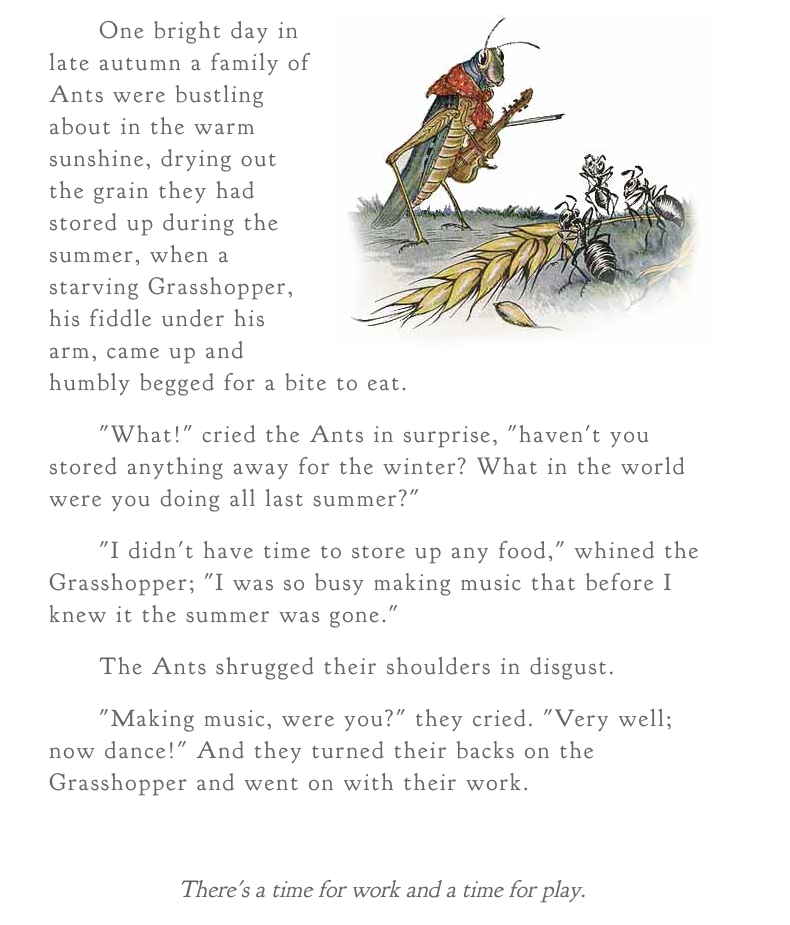
Screen Shot 2019-08-02 at 12.55.47 PM

Screen Shot 2019-08-02 at 12.55.32 PM.png


The moral of the story from The Ants & The Grasshopper (above, as found at The Library of Congress), one of Aesop’s Fables, is among the most damning morals of any story ever told, at least since the morals of the Old Testament story (although in an altogether different way). In my failure to adequately censor the story selection suitable for my own children–Lord, have mercy–I made the tragic mistake of reading this utterly perverse fable to them at bedtime last night. Since it is impossible to un-tell a story once told, below I have written not so much an alternative reading but what I will tell as “the rest of the story” in a sequel under a similar title.

May the God of the Seventh Day redeem our work with his rest, his joy, his beauty, so that, in Plato’s words, “after being refreshed in the company of the gods,” we might again find the moral courage to “return to an upright posture.”  


The Other Ants & The Grasshopper

One dark winter evening a family of Ants was dancing about the bonfire, celebrating during their festive season of play, when an ant from another colony, bored out of his ever-loving mind, wandered up, a sack of rations hanging heavy on his back, and knocked on the door. The music stopped with a screech, and one of the Ants (slightly annoyed by the interruption) opened the door, at which point the weary visitor humbly begged to join the party. 

“What!” cried the Grasshopper in surprise from the mic on stage at the front.


Prior to this knock at the door, the Grasshopper had been leading the Ants in song and dance. The Ants and the Grasshopper had developed a symbiotic relationship, which began one late autumn day when the Ants approached a forlorn and half-starved Grasshopper, after being brought to tears while overhearing him play Mozart’s Requiem on his violin under a willow tree. They had never felt such a bright, longing sadness, or really much of anything, other than feeling a little hungry just before lunch breaks. So they approached the Grasshopper and asked him to join their colony. They offered to provide him with food and shelter in exchange for the Grasshopper providing them with music and laughter, as well as officiating weddings and funerals for them.

The Ants taught the Grasshopper how to work with his hands, but his only real summer responsibility was to provide music at the work site, which they discovered actually made their time at work quite enjoyable, especially after he taught them how to whistle while they worked. They did let him work alongside them (on the rare occasion he actually wanted to), although he mostly just got in the way. But even his clumsy contributions were amusing to the Ants.

The Grasshopper, on the other hand, taught the Ants how to play and rest, which included all sorts of strange and properly useless activities. He taught them how to play instruments, even forming a summer internship program for a select group that would only work half-days in order to spend the second-half of each day practicing for the winter solstice celebrations. He taught them how to dance, or tried to anyway, and was always quite amused at their stiff and clumsy movements, often commenting at their uncanny ability to turn every dance move into “the robot.” He held cooking classes, teaching them how to think outside the box and to experiment with new recipes, an altogether unexpected contribution that changed their whole approach to and methods of food-gathering, which had formerly been one-dimensional, with the only goal of maximizing their “energy reserves.”

[This actually led to a reorganization of the entire colony into three primary work crews in a new division of labor (breakfast crew, lunch crew, and dinner crew), which were then subdivided into smaller work crews with various assignments, all with the goal of maximally diversifying the possibilities of each meal, right down to the smallest group assigned only with the task of gathering garnishes.]

He also taught them about the visual arts, holding art appreciation classes on Tuesday evenings and painting seminars on Sunday afternoons, during which they never ceased to be astonished at discovering just how different each of them “looked” on the inside—through the array of unique expressions on the canvases.

[It was actually this discovery that led to them taking individual names as well as beginning to name their children.]

He even taught them a number of interior design techniques to help brighten up windowless living spaces, which they had found especially helpful for battling against their formerly unrecognized Seasonal Affect Disorder, apparently common to all ants, not only because of the darkness but because they never really knew what to do with the time, or with themselves, when they couldn’t spend it working.


“Haven’t you found anything worth celebrating in the winter? What in the world were you working for all last summer?”, asked Jim (one of the Ants). 

“I didn’t have time to learn how to play,” whined the ant; “I was so busy storing up food for the winter that before I knew it, summer was gone.” 

The Grasshopper and the rest of the Ants shrugged their shoulders in disgust. 

“Storing up food, were you?,” they cried. “Very well; now eat!” And they slammed the door in the ant’s face, at which point the Ant family erupted in shouts of laughter as the music resumed and they went on with their celebration. 

The lone ant sat outside, ear pressed against the door, and eventually starved to death. He hadn’t even finished his rations, for he had lost his appetite. 

The moral of the story: there’s a time for work and a time for play. 

The Tornado of ’86: On the Making of Men & Memories

The tornado of ’86 sliced through Lynn, Indiana, like a drunken surgeon with a reciprocal saw. Lynn is a small farm town nobody has ever heard of, except for casket manufacturers and the most inquisitive admirers of Jim Jones. My memory of this event, I am told, is misguided, but sometimes there is more truth to be found in a misguided memory of the past than all those photographic surface memories of its lies. Such is the making of many myths, and the memory of the men who wrestled with God is always truer than the world of men who can’t see him for the surface.

I was in our candlelit basement with the women, my sister and mother, while my brother and father were “out there,” where the world had turned a glowing green with ashy edges, as the firmament began tearing in pulses from top to bottom, side to side. How my brother and father fit into that shaking frame was left to my imagination. I was four. 

The images I formed in my mind that day have crystallized in my memory, as real-life memories, solid as my basement’s cinderblock walls. Four year-olds still live seamlessly between the walls that delineate the world “out there” and in the world of the mind that fills in the blanks. I was too young to be afraid of the severity of the moment. Men were still immortal in those days. All I knew is that the world had turned on itself in a cosmic civil war and my father and brother were in the thick of the battle. It’s from that world two images were erected.  

One is of my brother or, more precisely, my “big brother.” Whatever else that had meant hitherto, that day and henceforth it meant he was more like my father than my brother, or at least more like a man in my eyes than the eight year-old boy he was in his father’s eyes. He had bonded himself to manhood the way soldiers bond in battle. I imagined him—I remember him—shoulder to shoulder with my father, facing the wind, as debris and dust pelted their faces and necks, while the flailing arms of the wind tossed around limbs and boats from every direction. (For the record, they did report seeing a boat fly across the sky in at least one direction.) They forged forward, unwavering through the gauntlet of hell, and finally arrived triumphant at home, where men stand guard for the women and children. It was my brother’s great initiation. 

Strangely, however, I also remember an altogether conflicting account, and I think I have always maintained both accounts without conflict, necessary to balance my image of a father. It is of the two of them confronted by the same opposition. I see my father wrapping his firstborn son up in his arms, shielding him in a light blue wind-torn blanket from the misshapen bullets firing from all directions. My father, unflinching, absorbed all that the wind hurled their way. When they arrive at the door, my brother is unchanged, still soft and supple and eight years old, but my father’s body is worn and marked like a leather strop, his face like flint. The world is still at war, but we are all now safe at home. That is the image of my father I choose to remember, the image I need to believe.

Ever since that day, I have longed for the storm to come again, to be initiated—I have longed to go to battle with my father.  

I can tell by the way the trees beat, after
so many dull days, on my worried windowpanes
that a storm is coming,
and I hear the far-off fields say things
I can’t bear without a friend,
I can’t love without a sister.

The storm, the shifter of shapes, drives on 
across the woods and across time,
and the world looks as if it had no age:
the landscape, like a line in the psalm book, 
is seriousness and weight and eternity.

What we choose to fight is so tiny! 
What fights with us is so great. 
If only we would let ourselves be dominated
as things do by some immense storm, 
we would become strong too, and not need names.

When we win it’s with small things, 
and the triumph itself makes us small. 
What is extraordinary and eternal
does not want to be bent by us. 
I mean the Angel who appeared
to the wrestlers of the Old Testament:
when the wrestlers’ sinews 
grew long like metal strings, 
he felt them under his fingers 
like chords of deep music.

Whoever was beaten by this Angel 
(who often simply declined the fight) 
went away proud and strengthened
and great from that harsh hand, 
that kneaded him as if to change his shape. 
Winning does not tempt that man. 
This is how he grows: by being defeated, decisively, 
by constantly greater beings.

The Man Watching” by Rainer Maria Rilke

Every Man Is an Island, And Love Is an Isthmus

An Excerpt from Touching Death for the First Time

Being human has something to do with being cut off from the whole and yet somehow still part of it. Humans are at once islands of consciousness and a sea of connectedness. Empathy describes the gravity in the tide on every shore, pulling fragments of sand into the sea and blurring the lines of selfhood. And it becomes far more empirically measurable whenever death is in the air, because grief is the sharp edge of empathy, and it is the edge that crashes against the surface at death, like the waves on the steepest beaches, and pulls something human out like a riptide, something irreversibly lost at sea.

Empathy with the dead is a kind of death, because it reveals the capacity for life to be shared like a hypostatic union. It reveals that the archipelago of human life is not void of isthmuses. We call those sandy land bridges love. Grief, then, or empathy with the dead, is experienced as a sharing in the loss of a life that was shared together in love. It hurts like you would imagine death hurting if death were something you could feel. Turns out you can. And so, humans can feel death and the people looking at the ones feeling it can almost see death in the manifestation of their grief, like the way you can see a demon when it manifests through its human host, or like the way you can see a baby when it kicks a woman’s belly from the inside. Grief throws and thrusts the soul around with such irrepressible immediacy that the embodied bereaver is contorted into the shape of a wordless groan, or of Edvard Munch’s Scream

Grief is love’s wild groping for its beloved in love’s refusal to die. It is love’s desperate dive into the infinite abyss in a futile search for the wholeness that gave birth to it. No love is an island. Love is an isthmus. Love is a singular word that exists only as it cradles together plural referents, like the word pregnancy or God. Love is Emmanuel. People die and love does not, and so every life shared in love will inevitably share the cradle with death. And so God gives us grief to teach us something about Being and time.

In the Shadow of Enlightenment: A Parable of Human Progress

“To you has been given the secret of the kingdom of God, but for those outside everything is in parables, so that indeed

‘While seeing they may see, and not perceive,
and while hearing they may hear, and not understand,
lest they should turn and be forgiven.’”

Mark 4:11-12

There was once a family that lived together on a lush garden island. They ate dates and pomegranates and sweet potato french fries and drank much wine. They wrote music during the day and sang and danced around the fire every evening. Across the sea existed only a barren wilderness populated with men who had resorted to a diet of other men and also of women but only after they have produced for them other men. There was no music in the desert.

Tribes formed in the desert, however, but only to go to war with other men to feed themselves and to resource their building of towers, where they could compete for the highest place to see who owns the lion’s share of the spoils. 

As it happened, after many years of war all but one tribe remained. Recognizing their threat of extinction they built a ship and sailed across the sea in search for meat.

One evening on the island, as the children were playing fiddles and their parents were dancing along, the air cracked with a dissonance of bellowing grunts and the creaking of tired wood. A ship was approaching. The parents knew what it was and what populated it. It was not human—not for any immediately apparent reason but because the men on the ship could only speak in the first- and third-person, and because they didn’t believe in music.

But the family was compassionate and impossibly generous. So they made a great fire and stretched out their arms and waved happy silhouettes of welcome in front of the fire and laughed as they sang their special family song. When the ship arrived the men crawled out and walked toward the warm light looking down and shifting their eyes. It was their first experience of fear, but it didn’t feel like fear. They just felt shy. They felt like folding their arms but then felt ashamed for folding their arms. The openness of the island was overwhelming.

The family ran to them covering them with blankets and throwing their arms around them to welcome them into their home. They set the table and filled it with the bounty of the garden and gave them gifts of stringed instruments and lyrics to all the songs they had ever written.

Within weeks all the men had been transformed by the image of family. Soon they were joining in song and dance and running around the beach together with arms spread wide open like a bird finding rest on the wind.

All but one, the one who couldn’t stop thinking about the desert. It wasn’t homesickness or nostalgia or anything like that. He just couldn’t get over the fact that for all those years the other men had seen him eat. And as for the family, it wasn’t that he suspected something about them that he feared but that they might discover something about him they would fear. He felt like a stain on a wedding dress and at first it made him sad but then it just made him angry. His eyes were opened and he knew that they knew him.

One night when the moon was a high hanging globe he set out to visit each room in the house. He quietly murdered all the men of his tribe with a cold metal knife and at last the entire family. He had thus triumphed over all the earth. 

He ate sumptuously the entire next day and sat down on the beach the following evening. He waited for the moon to accompany him, but that night it was cloudy.

“The wind left. And I wept. And I said to myself:
‘What have you done with the garden that was entrusted to you?'”


From “The Wind, One Brilliant Day” by Antonio Machado

Stop & Pay Your Respects

In the world such as it is
     There are only two places one can call home:
          In a house made with strength and straw and fear 
          Or on a road made by someone else.

In the world such as it is
     There is a place where everyone dies trying,
     And there is a place where everyone dies;
          And there are no other places.

     There is a place where everyone dies old,
     And there is a place where everyone dies like a child;                    
          And there are no other places.

     There is a place where everyone dies in their sleep,
     And there is a place where everyone sees death coming;                   
          And there are no other places.

In the world such as it is
     There is only death,
     And it is buried beside houses right next to the road
          That leads to Destruction
               By way of a Funeral,
          And there are no other places—
     The road home.

In the world such as it is
     There is the world that will be,
               Whose maker and builder is someone else;
          And there are no other places to go and grieve
     For those on the side of the road 
Still looking for a place to stay.

American Spirit

The Colossus (painting) - Wikipedia
~ Francisco de Goya, The Colossus

I know I shouldn’t post this—every pastoral reservation in my bones is rebuking me as I write—because there’s a good chance I am simply wrong (I hope I am) and / or that I will be misunderstood. But I would be coward not to say what I truly think, and, at any rate, it would be unamerican for me not to exercise my freedom of speech. I’m hoping someone out there can convince me I am indeed wrong. Please, persuade me.

IMHO—

This campaign season seems to have demonstrated the degree to which we have made an idol of our politics as a nation, and indeed our elected officials. The rhetoric and behavior and attitudes that fill this land from sea to shining sea wreaks of the worst kind of religious fundamentalism. This campaign has verged on a holy war, each side so convinced they are fighting the good fight against a faceless mob of evil ‘others’. If you didn’t know any better, you’d think people have been fighting for their respective gods to take up their “rightful” throne on high. The presidential office is simply the highest of our “high places” where the shape-shifting idol of power is most eagerly sought in our democratic republic (cf., Deut. 12).

To the degree *the office* of president has indeed become the seat of our highest idol, the spirit of whoever fills that office will inevitably possess all those who worship at *that* altar, regardless of who is enthroned there. Reps and Dems seem to have both been equally possessed by the same spirit of hate-of-the-other President Trump has poured out on all flesh. Some love their god and hate his detractors, some hate their god and hate his devotees, but his hatred is the bipartisan denominator. And thus all are doing his bidding and being conformed to his image.

Hopefully sleepy Joe Biden will possess our nation with a little of his tranquilizing spirit and we can all just have a nice long nap, so that when we wake up, we can fall on our face, repent, and put our faith the Man God himself has given us to be our God, and so be possessed by his Spirit, take up our cross, love our enemies, and be “conformed to the image of God’s [only] Son” (Rom. 8:29–and the rest of the Bible).

“To the extent antagonism becomes embittered, a paradox occurs: the antagonists resemble one another more and more…Their conflict dissolves the real differences that formerly separated them. Envy, jealousy, and hate render alike those they possess.”

~ Rene Girard, I See Satan Fall Like Lightning
american-civil-war-abstract-expressionism-zeana-romanovna
~ Georgiana Romanovna, American Civil War

Eulogy for A Beast: Life & Death at the Feet of the Master

ringo.jpg

Pulling out of my driveway I felt my tires roll over something. I noticed it lacked that dispersive crunching sound common to toys under the tire. Outdoor toys typically have exoskeletons. This felt soft and intact. When I turned to see what it was my heart sank. Ringo was lying on his side, his little legs stretched wide and vulnerable and unrelaxed.

I jumped out of my truck and ran to him. He was alive and focused, straining with all his will to fill his crushed lungs with air. Every ten or so seconds he would choke down a hiccup-full. He was too focused on trying to breath to acknowledge my presence. I bet that broke his heart.


For the last 14 years Ringo has lived to acknowledge my presence. Before he lost his hearing, he would hear my presence before I ever entered the door, where I would find him already waiving at me with his tail. Even after he lost his hearing I often found him there, waiting and waving, who knows for how long. If he didn’t greet me at the door, the moment I walked into his field of vision he would perk up his big square head, struggle up with his little old legs, and carry his big long body over to my feet.

There were two places Ringo lived: on his blanket by the wood stove and at my feet. While I was gone he would lay on his blanket by the stove. While at home he would sit at my feet when I sat, stand at my feet when I stood, and follow my feet when I walked. Sometimes I would acknowledge his presence, often I would not. But he never took it personally. He never repaid neglect for neglect, evil for evil. He was always more Christian of a dog than I am a man. 

On average I probably stepped on or tripped over Ringo about once a week, sometimes responding apologetically, other times erupting volcanically, depending on my mood. But he was always forgiving of my mistakes and remorseful under my wrath, always showing deference to my judgment, whether just or unjust, whether I treated him like the family dog or my personal scapegoat. Regardless, nothing I ever did or didn’t do diverted his good will toward me. He was unwavering, a far more principled dog than I am a man. But I suppose to him I was more than a man. I was his master. And he lived to affirm me as such. He lived to sit at my feet.

When God created Ringo he used only one substance: one hundred percent pure, undiluted loyalty. His form, however, was not as pure as his substance. He was an admixture of odd proportions, the body of a wiener dog, the head of a pit bull, and the howl of a Canaanite. But shapes and sizes aside, his substance was sure. He had the pure and undivided heart of a saint—until I broke it in two with my truck.


Now he lay there, divided, no doubt wishing he could acknowledge my presence in this rare moment I was acknowledging his with such undivided attention. I was more present to him in that moment than I had ever been in his 98 dog-year-old life, with my face pressed gently on his neck, my hands stroking his head, as I told him over and over how sorry I was and how good of a dog he was. But it took all the energy he had just to live, to keep breathing straw-fulls of breath. So he just couldn’t acknowledge my presence—he was hardly able even to acknowledge his own.

I was torn. I didn’t know what to do or what he would want me to do. I wanted so badly to assure him that he had done nothing wrong, that I was not displeased with him, that I did not hurt him on purpose, that he was a good dog and I was a bad master. I wanted him to know that this was not the intent of my will toward him; but it was the fault of my will, my reckless and wayward will, and I was so sorry. Ringo deserved a better master than the one I proved to be in the end. I wanted him to know that I had failed in my responsibilities to take care of him, but that I have a Master who has not failed, and that the Master who gave me dominion over him would return in the end to take his dominion back, to fix this broken world and Ringo’s broken heart. I wanted him to know that on that day I will join Ringo’s side and we’ll sit together at our Master’s feet.

I wanted to assure him of all this but I think I was just making it worse. I think I was just consoling myself and prolonging his suffering, if not adding to it with my disquietedness, if not making him feel guilty, like he was failing me. He probably felt he was not giving me the honor and attention I deserved, which he spent his whole life giving me—despite the fact that I never deserved it.  

Making the decision to kill Ringo was not the hardest decision I had to make—I wanted his suffering to end immediately. The hardest decision was leaving him to fetch my log-splitting axe from the woodshed, the same one I use to split the wood to burn the fire to keep the house and the dog warm. I knew I had to end his suffering but I hated to leave him for even a second. He proved his whole life that he valued my presence more than his comfort, especially in these latter years as he limped around in my shadow, doing his best to keep up with someone 62 years his younger (when you do the dog-math). I wanted to give him the gift of my presence as far as I could possibly extend it into that void which takes all presence away. I tried to yell for Keldy to grab my axe, but she was inside putting the kids down for a nap and couldn’t hear me. So I told him again how good of a dog he was, how sorry I was, and that I would be right back. I ran as fast as I could to the woodshed, cursing the day, damning the divisions in my heart and the one in Ringo’s too.  

I returned in a matter of seconds and knelt again as before, cheek to cheek, doing my best to embrace him without adding more pain to his sadness and suffering. I told him again how sorry I was, how good of dog he was, and that I loved him so much. He gasped again, probably trying to tell me how sorry he was—though he had done nothing wrong—and how good of a master I was—though he deserved much better—and that he loved me too. He was probably trying to tell me he forgave me for running him over with my truck and for now having to kill him, for he knows I often know not what I do. He had never once held a grudge against or withheld his forgiveness from me. As far as I could tell, he had never kept a record of wrongs against anyone. He loved more like my Master than any man I’ve ever met. 

I put my hands under his head and hips and pulled him off the edge of the driveway into a bed of dead pine needles as gently as I could, leaving a crimson smear against the black surface and all over my unclean hands. He winced subtly, his eyes widening in acknowledgment of a more acute moment of pain. I winced too. I wanted to scream, I wanted to breath fire, I wanted to pour out my wrath on sin and death and suffering, I wanted to punish the darkness with searing light and the silence with shattering thunder. But I kept quiet. I didn’t want to add any more panic to the moment already wrapping around Ringo’s thick copper neck, shortening his breath in the long dawn of night. So I told him one last time that I was so, so sorry, that he had done nothing wrong, that he was such a good dog, that none of this was his fault, that I’m the guilty one, that it was because of my divided heart that his was now broken, that his blood was forever on my hands. I was the worst of all the world in that moment, the chief among murderers. I felt it would take no less than hellfire to burn the stain off my hands, or perhaps burn my hands off the stain.  

Ringo, like all the beasts of the field, would have to die because I willed him to death, because I willed the death of all things. God entrusted his creaturely world to human care, and we turned on God and on each other and on all God’s critters and creatures. We were created to be God-reflecting masters of a good garden world (Gen. 1-2) but became blood-thirsty tyrants of a shadowy desert wasteland (Gen. 3-rest of the Bible). All of our creation companions now rightly live in the “fear and dread” of us (Gen. 9:2), most species simply keeping a safe distance from us, preferring flight over fight unless backed into a corner. But one species above the rest has not allowed their fear of our dominion to drive them to rebel against it. They insist on acknowledging our presence as the presence of royalty, humbly moving toward us, bowing before us, sitting at our feet. They can still perhaps see reflections, refractions rather, of Light splintering through us from the shadows that come out of us. Ringo seemed only to see my God-given light as though I were its source, as though I weren’t its eclipse. So he trusted me, his master, with his life. But I betrayed him, the most loyal of all God’s creatures. He entrusted his life to me and I ensnared him in my death. 

If I’d had a means of killing him quickly without releasing him from my arms I would have used it, but I had nothing of the sort. I hated having to withdraw my presence from him, but I had no choice. I had to forsake him of my presence to end the presence of his suffering, the only presence he would ever know again until he knew none at all. So he had to die alone, at the hand of his master, who stood away from him, against him, at arm’s length. I kissed him on the mouth, like Judas, snapped back like a rattlesnake coiling up to strike, and in a storm of fury I sent all my rage at that godforsaken moment through the broad side of my log-splitting axe into the left side of my loyal dog’s head, condemning him to the death I deserve, the death I created.

His legs dropped, his body relaxed, and his life ended where it longed to live forever—at my feet.

I dropped to my knees and put one hand over his heart and the other over my face–the moment was naked and I was ashamed. Now that I was certain he was no longer aware of my presence, that I could add no more pain and unrest to his life, I opened my mouth and filled my neighborhood with a curse. Mark says that when Jesus died he “uttered a loud cry and breathed his last” (Mk. 15:37). There are things that should be said near the point of death if at all possible—things like “I’m sorry” and “I forgive you” and “I love you.” But perhaps something must be said at the point of death itself, at death itself, and perhaps that can only come out as a loud cry or a groaning, or thundering, curse. That is what love sounds like at death. Love hates death with a Passion. Love screams at death. Love “casts Death and Hades into the lake of fire” with unrelenting wrath and inexorable fury (Rev. 20:14). Love condemns death as the unforgivable sin.


I used to imagine Jesus sitting silently at the right hand of God until he returns. I don’t anymore. I think he is screaming. I think all of heaven is raging against human sin and death in a loud, grinding battle cry that will not cease until Jesus returns on the clouds of heaven to give form to his thunder in a bolt of Light that strikes death in a merciless command of life:

“For the Lord himself will descend from heaven with a shout of command…and the dead in Christ will be first to rise” (1 Thess. 4:16).

I think Ringo will hear that command. I don’t know if all dogs go to heaven—who am I to judge?—but I believe Ringo will. I was Ringo’s master. If I have any say in whom or what Jesus raises from the dead when he returns I suppose it would be limited to those creatures over whom he gave me dominion. As Ringo’s master, therefore, I want to hereby make an appeal for his life. I want to confess that I was never fit to be another creature’s master, much less such a good and faithful one as he, and plead with God to take back the dominion he gave me over Ringo in the first place and give it to Jesus, who is fit to be Ringo’s Master, my Master, Master of all. In my kingdom, everything ends up dying because of my reckless and wavering will. I get it. I’ve learned my lesson. I don’t want to be king anymore. I want a Master who can keep the world alive, the garden alive, Ringo alive, life alive.

If God’s grace brings resurrection to the sinners he loves, should we not expect it also brings resurrection to those creatures most loyal to the sinners he loves? He’s the one who created them, no doubt to teach us something about loyalty and unconditional love, about friendship and humility and forgiveness and joy and trust. Most every dog I’ve ever met knows more about all of the above than any human I’ve ever met. Besides, innocent dogs in heaven makes more sense than sinful sinners in heaven, so I’ll keep looking forward to a reunion with that great cloud of K9s who will no doubt lead the way in showing us how to properly live at our Master’s feet when he returns. 


So we corralled the boys and Sissy together for a “family meeting.” My children have never known life without Ringo. He was part of the reality into which they each were received, an odd but delightful part of the family. Ringo, on the other hand, had known life without my children, a life where he got far more loving attention and far less physical abuse. But he was raised in the south and had the gift of hospitality. He never repaid horsey rides with doggy bites. I was actually a little concerned about how he would react to the kids at first, because he did once kill our neighbor’s (evil) goat, but he proved to be discerning. He knew the difference between the children and the goats, and the closest he ever came to biting my children was licking the sticky off their faces.  

Our tone was lower and our herding efforts more firm and focused than usual. They kept asking what we were doing and why we were meeting, and we kept not answering. We eventually got them all seated on the couch in the living room, where Ringo could usually be found if he weren’t found at my feet. It was the place his presence could be felt most, and now, therefore, his absence, which already had begun to swell out of proportion to the limited spaces his presence formerly inhabited: in the heaviness on my face, the cracking of my voice, and, indeed, the loneliness at my feet. It’s as though a creature’s body veils an essence that is only fully disclosed after it is broken, after it is dead and gone. Only then the veil is torn, releasing the true nature of the life represented in the body, the life now dead in the body. I kill a mosquito and it is gone. I kill my dog and he begins to haunt me, his absence more revealing than his presence. A centurion kills a Man and God begins to haunt him. Out of His absence comes the terrifying confession in a shower of water and blood (Mt. 27:54; Mk. 15:39). 

I told them I had some really sad news to share with them: “Ringo died today.” A breathless look of surprise contorted each of the boys’ faces and was followed by three distinct responses: Maccabee (3) trying to comfort me and touch my face, Ryser (4) asking troubled and heavy questions about Ringo’s death and the nature of death itself, and Kezek (6) entering the ebb and flow of those initial impact waves of grief, wavering between questioning incredulity and wailing sorrow. I stumbled over words trying to respond, Keldy helping, clarifying, filling in the blanks as I would get choked up. It’s hard to watch your children’s first real concrete encounter with death. I think Kezek and Ryser both encountered death yesterday. It brushed against Ryser’s mind and pierced Kezek’s heart. I think it was once removed from Maccabee. He encountered it by way of my grief, his compassion for me shielding him from too direct an encounter. But each of their responses only took me deeper into my own encounter, because I knew the death of their first dog would be their first step toward discovering the death of all dogs, all people, all the living, including each of them and the ones they’ve shared their life and presence with from birth.

I told them we would now have to say goodbye to Ringo and bury him in the backyard, between the garden and the briar patch. Keldy had wrapped Ringo in his blanket and I had laid him at the edge of the garden next to one adult- and three kid-sized shovels so the boys could help dig. I uncovered the intact side of Ringo’s face so the boys could pet him one last time. I tried to press Ringo’s eyes shut, but they insisted on staying open. I think he was still trying to acknowledge my presence.

We laid him in the hole with his only two toys, which he had paid little attention to in the last few years, and an old pair of my shoes, where all his attention had been paid, especially in these last few years. When the boys asked why I put my shoes in the hole with Ringo I told them because he lived his whole life to sit at my feet and I wanted him to stay there forever. And then they heard their father weep like they had never heard before and all three climbed in my lap to console me. Kezek wept with me.

death, lifeAs we began shoveling dirt into the hole Radley (1) began saying “Baaaaah” (Southern for “Bye”) over and over, matter-of-factly.  Once the hole returned to ground level, the green ground now marked with a big brown scar, I told the boys I needed them to help me make a cross. We went to the woodshed and picked out a long red cedar branch I hadn’t yet cut for kindling. I cut it in two unequally sized pieces and notched each to be fitted into the other. Each boy helped me secure the crossbeam using one decking screw a piece—they pressed the trigger while I held the drill. We then returned to the gravesite to stake a claim on Ringo’s life. I dug a narrow hole and poured a half bag worth of leftover concrete down to the bottom. I used the broad side of my log-splitting axe to hammer down the cross as deep as it would go until it began splintering at the top, the same one I use to split the wood to burn the fire to keep the house warm.


I told the boys we were marking Ringo’s grave with a cross because the cross reveals to us what is on the other side of death, so we need not live in fear of death. I continued along those lines, weaving the moment into the Big Story of death and life using two kinds of thread, one made of dreams, the other of visions: dreams of a Garden in the world and visions of the world as a Garden. Probably a little less wordy but something like:

Death does not belong in God’s original or final intent for the world, for us. God created the earth to become a garden planet, wholly good and void of death, void of thistles and thorns. He gave it to us as a gift and blessed us to fill it and keep it and care for it, to expand the garden wherever we went. But we did not take good care of it. We have buried his blessing in a curse, filling the earth with thickets of pain. Under our dominion, the garden has gone to seed. We need a new Master to restore the garden–and God has sent One to us. 

Jesus came to earth carrying the dominion of heaven in his Person (Mt. 3:2; Mk. 1:15), which he revealed to be a servant-shaped dominion (Phil. 2:6-11). The Master ruled by crawling under the table, down there with the dinner crumbs and the dog hair, and washing his servants’ feet (Jn. 13:1-17). He ruled by allowing the will of his Father in heaven for all creation rule over the self-preserving creaturely will he had inherited from the womb (Lk. 22:42; cf. Rom. 8:1-4; 2 Cor. 5:21). And so he was crowned with a flightless halo of braided thorns and buried in a garden tomb, in which the thorns remained buried but from which he was raised to life. Mary mistook him for a Gardener—it was no mistake. The Master Gardener just had to go underground to lay the axe at the root of creation’s curse, that ground-grown will to be like god apart from God (Gen. 3:5), so that God could raise him from the ground as the “firstfruits” of new creation (1 Cor. 15:20,) indeed the “firstborn from the dead” (Col. 1:18; Rev. 1:5). God has made a fertile womb of this barren world. 

So we are living between the times, between God’s age-old creation and brand-new creation, between Friday’s night and Sunday’s morning, where the thorns touch the Garden, where death is the conclusion to life. But death is only the conclusion to life under our rule, creation under our rule, where men crucify their God and run over their dog. We too must learn to long for the death of our wayward, willful rule, for all creation to be born again under the will of God. But we can, we must, be born again even today, because God is present to us now, in the in-between, to all who call on the Name of Jesus, the One who has come, the One who is coming back–his Name is God’s number (Acts 2:21; Rom. 10:13). To all who offer up their dominion to him, who cast their crown at his feet and confess that Jesus is Master, God has sent a downpour of his Spirit to begin washing away the deadroots of the curse entangling our hearts and restoring the blessing of heaven (cf. Acts 2). When he returns, he will finish what he started, burning off the dross of our ground-rule estates and welcoming us back from below up into the Garden–under his rule–the dirt as it is in Heaven. 

So although death is a fact of life, it is not the fact of life. Jesus is the Fact of life, and he has made a Way to Life right through the heart of death, through the cross. Jesus died on a cross but came out fully alive on the other side of death, never to die again. Death, then, is not, as Shakespeare once described, that “undiscovered country from whose bourn no traveler returns.” It has been discovered, traversed, exited and exiled. Jesus has gone before us all to come after us all, entering the all-consuming abyss to fill it with his all-consuming fire, with a Light from which no formless void or black hole can escape (Isa. 60:19; Rev. 21:23; 22:5), a Life too big for death to stomach. He has travelled into the unbounded depths of the distant country to “bind up the brokenhearted and proclaim freedom for the captives and the opening of the prison to those who are bound” (Isa. 61:1).

So Jesus enters death not simply that we might return to the life from which we came, where we remain masters of a wilderness wasteland, but that he might lead us out the other side into a new Life, fully alive, never to die again, because it is a life defined and defended by a Good and True and Perfect Master, King of kings, Lord of lords. He was buried in our prickly crown, the blessing of heaven sown into the curse of the earth (cf. Gen. 3:17), so that our dominion could be put to death once and for all and his kingdom could blossom to life without end. Until then, we stake a cross at the sharp edge of life’s end, between death and Life, between the thorns and the Garden, because we believe that though death is the end of life, Jesus is the end of death.

We must not, then, wish for Ringo to return. We must wait for Christ to return. Lazarus returned and had to die again. When Jesus returns death will have to die again–and we’ll all celebrate our birthday on Easter.  

I also told the boys that Ringo wanted to die first because he loved us so much. I didn’t really explain what I meant. I don’t really know what I meant at the time. Looking back, though, I can’t help but wonder if it were true. Ringo never got in the way of a vehicle. He was street smart, a stray when I found him, wearing a chest harness attached to a broken chain. I can’t help but wonder if God gave Ringo the opportunity not only to love his master in life but now to love his master in death, to die in such a way as to give life through his death, to take up his cross and die for me. Perhaps he or God saw how careless I can be pulling out of the driveway and knew I needed to learn a lesson, a hard and convincing lesson. The fact is, it could have just as easily been one of my children in the wayward path of my truck. And Ringo knew the difference between the children and the dog. He knew what a child is worth to his master. Perhaps, then, in his last gesture of love for his master and his master’s family he threw himself under my truck to prevent me from killing one of my own children, which could have happened just as easily, just as quickly, just as permanently. There is a very real possibility that Ringo’s death has saved a child’s, my child’s, life. Ringo is a hero, perhaps even a martyr, and for that he deserves nothing less than the Lion’s share of my inheritance.  


Yesterday morning, before all hell broke loose, I woke up way earlier than my alarm and could not fall back to sleep. So I made my coffee and walked over to the wood stove to sit beside Ringo, who was still asleep on his blanket, snoring. I startled him when I put my hand on his head, one of the few times in our relationship I can remember acknowledging his presence before he acknowledged mine, and only now because he was in a deep sleep, and because he was deaf. I touched him and he was jolted out of his slumber, awakening to his master scratching behind his ears, that place God installed dogs’ love receptors. He didn’t move his body but stretched his chin toward my thigh, waiting for me to meet him the rest of the 9/10s of the way. He knew I would. He knew how much I loved him when the kids weren’t around and I wasn’t in a bad mood. So I scooted over a few feet and he rested his chin on my leg. I was acknowledging his presence, and it was one of the best mornings of his life.

It is comforting to know that yesterday, on the day he died, I got to surprise him into life with my presence, to acknowledge his presence before he acknowledged mine, awakening him to his master’s unsolicited love—because I believe Tomorrow will happen for him in just the same way, as it will for us all who call Christ our Master, when the loud cry at death enters into the ground commanding the briars to die and the Garden to grow, when the grieving of God over death erupts from below as the command of Life everlasting, Light everlasting, Love everlasting—the world under the command of its Master, all creation at the feet of Jesus.

cross.jpg

Nativity, once in the main of light,
Crawls to maturity, wherewith being crown’d
Crooked eclipses ‘gainst his glory fight,
And Time that gave doth now his gift confound.

~ Shakespeare, from Sonnet 60

Welcome to Lent: Remember to Die

desert

In ancient Rome, military generals returning victorious from war were ceremoniously paraded through streets in a chariot in a great celebration as they ‘inhabited the praise of the people.’ But behind the general, in the same chariot, a slave was placed whose sole responsibility was to whisper in the general’s ear sobering words that served to protect him from the delusions of grandeur that inevitably come to those who find themselves at the center of human praise: Memento mori. 

“Remember to die.” 

It seems like an odd reminder, considering the fact that forgetting to die will in no wise prevent any of us from rising to the occasion when it presents itself. But of all the facts of life, death turns out to be perhaps the easiest to forget. Or perhaps all of life is oriented toward one long attempt to forget about death, because the moment we become aware of death is the exact moment we become aware of a uniquely human desire: not to die.[1]


Life begins with a desire to eat, to drink, to touch and be touched, but one day we wake up with the desire to be gods, that is, to not die. But since that desire proves to provide little practical counsel for the day-to-day task of being human, we busy ourselves with lesser desires in a pursuit toward satisfaction, expanding our kingdoms, our influence, our bank accounts, our progeny, willfully forgetting that all we value as treasure today the moth will value as food tomorrow. And eventually, even the moths will die. But we insist on willfully forgetting what we know to be true–that nothing less than immortality could possibly satisfy the most basic longing beneath all the rumblings of the human experience that drive us ‘to distraction from distraction by distraction’ (T.S. Eliot). Where, after all, are the limits of our desire? When, after all, has anyone ever found enough? When has the satisfaction of desire not given birth to yet another, even if the it is simply the desire to remain satisfied, the desire not to die.

So we live our lives as though we will live forever, often using people likes steps on zigguratic towers on an infinite trajectory, aimed squarely at nothing less than exactly ‘more’—in all its arbitrary finite forms. But ‘more’ turns out to never be ‘enough’. Desire is always stronger that satisfaction. The human soul is a bottomless pit, grounding our appetites in  a boundless, formless void. We are not like the burning bush Moses met on the mountaintop, whose fire did not consume; we are like every other fire burning up the world. So with every met expectation we discover an unmet expectation that lies deeper in the gut, farther from the heart.

“To know the love of Christ that surpasses knowledge, that you may be filled with all the fullness of God“: that is Paul’s implicit diagnosis in the form of prescription. But the God-sized love we were created to be filled with has been has been infected with our love of so many lesser things. As the deer panteth for the water so my soul panteth after you, O God, and also after you, O sex, and you, O power, and you, O approval, O praise, O just about anything to distract me from the eternity God has stubbornly placed in my heart, in order that I won’t find anything this side of eternity more than temporary satisfaction (Eccles. 3:11)—in order that I might eventually become dissatisfied with temporary satisfactions. Until then, our pursuits will continue to tear us in two opposite directions, driven by two geometrically opposed loves. We love to be loved by God, but we also love to love our sin.


Every particular sin has the same genealogy. Every sin is begotten of (a) a desire (b) based on a deception (c) organized against love. The Bible calls such desires temptations and attributes deception to the father of lies (Jn. 8:44). Temptations are experienced as an appeal to freedom, but they are precisely the opposite because they ultimately function to enslave freedom to desire, not to satisfy desire through freedom. Such temptations are not an appeal to freedom but, ultimately, to pride. Pride always feels like freedom because pride always gets to say, “My will be done.” But human freedom is not simply the power of the will to act; it is the power of the will to love, because love is the ultimate and essential human desire. With the will not oriented toward its proper end the power of the will to act is nothing more than the will to power: the drive of life toward infinite desire rather than infinite satisfaction. That’s why, for example, the will that sacrifices one’s lusts in order to love only one wife leads to far more satisfaction than the will that sacrifices one’s marriage to go lusting after to some other man’s wife—more satisfaction for all parties involved, I might add. Just imagine the family Christmas photos in either scenario twenty years down the road. There’s far more satisfaction in short-term sacrifice than there is in long-term regret.

But the will to power, as Nietzsche called it, pursues an indefinite future without ever finding rest in the present moment; it is the urgent now, not the eternal now, instant gratification, not grandkids and gratitude. It is about survival, not life, the will’s appetite for more, not the soul’s appetite for enough, for fullness, for God

This becomes more practically obvious as life in the body ages with the body. Eventually embodied life begins to feel like an endless pursuit of escalating goals, with each step up the ladder revealing more clearly only how high our Infinite desire truly is, and thus how low human striving gets us. Every promise turns out to be only half full because we are always left at least half empty. Youth are naïve; their step-grandparents are bitter. All are forgetful. To remember to die in the light of eternity begins by letting our desires die in the light of today.  

Thus, the Gospel of Jesus Christ is our essential reminder—the story of the God who became a backseat slave to whisper into the front of our chariots: Memento mori. The season of Lent, beginning today, is our annual pilgrimage into the desert with Jesus (Mt. 4), where our subterranean temptations to forget rise to the surface with the serpent who seduces us to rise up in war against our mortality. If you are the Son of God, pursue pleasure! (cf. Lk. 4:3) Pursue power! (Lk. 4:6-7) Pursue praise! (Lk. 4:9-11). It is the temptation of Son of God, because the Son of God became Son of Man. And this is the temptation of every man, woman, and child: the lust of the flesh (good for food), the lust of the eyes (delight to the eyes), the pride of life (desired to make one wise), indeed, the forbidden fruit—to be as gods—not to die (cf. 1 Jn. 2:15-17; Gen. 3:1-7).


And so we enter the desert today, where we confront the twisted shape of our two-pronged souls, fashioned after the forked shape of that tempter’s deceptions. We desire God, yes, but we confess too our other desires, splintering forth from the divisions in our soul. We do have a passion for the kingdom of God and his righteousness, but we confess there are other gasoline passions. We desire God’s will, but we confess we never desire “not my will.” We never desire to let ‘my will’ die, and so live into the eternal will of the Father. 

And so we must return to the desert fast to search ourselves for areas of amnesia, reminding our obstinate wills to die, to remind ourselves of the direction we are all headed, lest we continue to chase empty upward promises that only push the deeper side of the soul out to the surface, thinning it out, so that life just becomes a series of unexamined actions and reactions, like a restless pinball with an impenetrable surface—no stability, no connection, no depth, no anchors, no stillness, no reflection, no transparency, no exposure of the heart, no communion of the spirit, no deep crying out to deep (Ps. 42), leaving us in the end like a cicada shell clinging to that God-damned tree. 

By moving through this somber season of self-examination we are better prepared to see how fitting is the cross, not for Christ but for us. Indeed, as the thief at Jesus’ side confessed, it is our “just reward” (Lk. 23:41). In our unreflective world, fast-paced and on-demand, there is hardly a more urgent need for the life of faith than this kind of reflection, which inevitably leads us into repentance, since herein we discover no small attempt in our heart to rise up as gods—to live by pleasure alone, power alone, pride alone. Only then can our Good Friday Gospel penetrate to the level of the salvation we actually need—salvation from ourselves. We must remember to die, lest we succeed needing no life other than our own. Only then can we be properly prepared to utter the truth of our Sunday Morning confession: “I am crucified with Christ—nevertheless I live!

“If anyone would come after me, let him deny himself and take up his cross and follow me. For whoever would save his life will lose it, but whoever loses his life for my sake will find it. For what will it profit a man if he gains the whole world and forfeits his soul?”

~ Son of God, Son of Man


Footnote

  1. Of course, all creatures instinctively desire to survive, but only humans desire not to die. That is to say, only humans can conceptualize death as such and in so doing cannot avoid, if even only for a flinching moment, contemplating their own death. Human consciousness is plagued with eternal dimensions. We can travel in our minds beyond ourselves, modeling universes and genesises and apocalypses. But when when we try to travel into the dark void of non-being, of our own non-being, we indeed discover “a bourne from which no traveler returns” (Hamlet). We become aware of the judgment this world is under, for we know that end of my consciousness is for me the same as having never had a consciousness, and that is the same for me as there not being and never having been and there never going to be anything at all (cf. Jenson, On Thinking the Human). And since there is no life apart from consciousness, the inevitability of death leads to the absurd conclusion of a pure and utter negation of being as such.

Teach Us to Pray

The word “father” has many and various forms
As many as the memories that have known it by name
Through beams stretched out from a shining face
Or groans searching for home in a formless void
“O father, my father…”

All begots contained within a single word,
Like a big bag of insects
Splitting at the seams
Or a small basket of crimson petals
Collected from the long center isle—
The lucky few lifted from the top of the heap
And carried away with the wind
Between the back door of the church
And the dumpster by the road

It’s the biggest word there is
The fullness of the godhead in its bosom
The daughters of the earth in its loins
The sons of god and their loins

The father of lights cast in a world of shadows
Through tears in the curtain drawn over ancient windows
The son of light, said the children of Rome
Tried to climb the steps of the dawn palace
To find his reflection in the face of the sun
But that day the boy died in his father’s chariot
And the desert nymphs choked on his ashes
As flames spread spangled across the globe
Beneath the great eclipse of a single word


When the son of Joseph taught us to pray
We, like Phaethon, “hid our eyes with our arms”
Expecting to receive stones instead of bread
The slave’s lashes instead of the fatted calf
Shame’s gaze instead of instead of Aaron’s blessing
A world of wilted lilies and sun-dried sparrows

Like the day Athos burned and Atlas quaked
We feared for the earth as it was in heaven


But the other day my only daughter
Climbed up on my lap with unflinching eyes
She opened her mouth and uttered a word
That eclipsed the whole history of gods and men
Around a small single petal wafting down a thread of light
Unbroken by shifting shadows and sinking sand:

“Daddy, you’re my only daddy.”

And I saw my reflection in my daughter’s face
And, there, I remembered how to pray
“O Father, our Father…”

A Red Meadow at Rest—A Daughter’s Peculiar Blessing

For my fourth child and only daughter:
Radley Jael Dawn

Image may contain: 1 person, smiling, shoes

Most blessed of women is Jael…
Of tent-dwelling women most blessed.
He asked for water and she gave him milk;
She brought him yogurt in a noble’s bowl.
She sent her hand to the tent peg
And her right hand to the workmen’s hammer;
She struck Sisera;
She crushed his head;
She shattered and pierced his temple.
Between her feet
He sank, he fell, he lay still;
Between her feet
He sank, he fell;
Where he sank,
There he fell—dead.

Out of the window she peered,
the mother of Sisera wailed through the lattice:
“Why is his chariot so long in coming?
Why tarry the hoofbeats of his chariots?”
Her wise women answer,
and she repeats these words to herself:
“They must be dividing the captured plunder—
with a woman or two for every man.
There will be colorful robes for Sisera,
and colorful, embroidered robes for me.
Yes, the plunder will include
colorful robes embroidered on both sides.”

So may all your enemies perish, O LORD!
But may those who love you be as the rising of the sun in full strength.

And the land had rest for forty years.

~ Judges 5:24-31

Radley means “red meadow.” 

There are days that must die in order for a future to arrive. Some days get stuck on their axis. They do not move time forward but seem only to repeat it, every dawn sinking into the gravity of yesterday’s dusk, every new beginning bound to the same old end. Israel had seen twenty years worth of those days. It all began because they had “done what was evil in the sight of the Lord…” (Jdgs. 4:1). Nothing new. 

But this was in the days of “Jabin king of Canaan,” early in Israel’s history. They did not yet have the luxury of great power. It’s not easy to be godless when you actually need God. They did need God. They were powerless against Jabin’s Canaanite army. The “commander of his army was Sisera…[who] had 900 chariots of iron. He had oppressed the people of Israel cruelly for twenty years” (Jdgs. 4:2-3). Rape, pillage, and plunder—that kind of thing. Sisera would return from the battlefield with wardrobes for his mother and women for his men (cf. Jdgs. 5:28-30). Many of God’s people were left without clothes—many were taken without clothes. It was the darkest of days. 

But God raised up Deborah to be judge over Israel. The world had been under the rule of power hungry men all its days–almost all of them (cf. Gen. 1-2)–and God was doing something new, again. Righting this kind of injustice would require a woman’s touch—and sword. Deborah appointed Barak as commander of Israel’s army and ordered him to rally 10,000 troops to go to battle against Sisera and his army. Barak was afraid. He said to her, “If you go with me I will go, but if you will not go with me, I will not go.” Deborah didn’t resist or even give him a hard time about it. She was half way to the battlefield before he could finish his proposal. She was ready to put those days to death. She led Barak in the charge against Sisera’s men from the hill country to the meadow by the river Kishon, “and all the army of Sisera fell by the edge of the sword not a man was left” (Jdgs. 4:16). 

But Sisera was left, and with him the seeds of yesterday (Jdgs. 4:17). He had abandoned his men on the battlefield and fled to the tent of a Kenite, formally a Canaanite ally. But this tent was not ruled by formalities. Love never is. This was the home of Jael, lover of God, enemy of all who oppose him. 

Sisera barged in and began giving orders. He thought he was in charge here. But Jael had her own way of doing things. He ordered water. She gave him milk, a meal, and a blanket, far more than he asked for, in fact. That was just her way. He then ordered her to stand guard and to lie if anyone came looking for him. And it would be the last order he ever gave. She was not a liar, nor was she his ally, and she certainly was not his slave. Jael was a lover of God, loyal to him alone, and on that day she was called to be the enforcer of his law and hammer of his justice. 

And Sisera said to Jael, “Stand at the opening of the tent, and if anyone comes and asks you, “Is anyone here?” say, “No.” But Jael…took a tent peg, and took a hammer in her hand. Then she went softly to him and drove the peg into his temple until it went down into the ground while he was lying fast asleep from weariness. So he died. And behold, as Barak was pursuing Sisera, Jael went out to meet him and said to him, “Come, and I will show you the man whom you are seeking.” So he went in to her tent, and there lay Sisera dead, with the tent peg in his temple.

~ Judges 4:20-22

That was the turning point in the war for God’s people, the Dawn of a new day. 

“And the land had rest for forty years.”

– Judges 5:31

That day, the sun rose of over a meadow that was painted dark red, coloring the river as it carried the past away, so that the land was finally at rest. Twenty years of the same dark night was buried at last and a future was born, a new Dawnfor the sun had risen in full strength. 

Most blessed of women is Jael: lover of God, soldier of the dawn, enemy of the dark.