The Structure of Everything

Glory be to the Father and to the Son and to the Holy Ghost; as it was in the beginning is now and ever shall be, world without end. Amen.

A — Creation’s Beginning: Reflections of Glory (Gen. 1-2)
B —– Fall: Shadows of Glory (Gen. 3-11)
C ——– Israel: I AM in history – (Gen. 12-Malachi)
D ———– Christ: I AM in flesh – (Gospels)
C’ ——– Church: I AM in all flesh – (Acts-Rev. 3)
B’ —– Judgment: Shadows on Fire (Rev. 4-Rev. 20)
A’ — Creation’s Consummation: Sea of Glory (Rev. 21-22)

If I Should Go…

Do not weep for me
Though I am gone
It was a strange visit in a strange land
Do not weep for me
For I am home…
Save your tears for someone else
Don’t be caught in a slew of sorrow
I was caught up
In the twinkle of an eye
I was found
The twinkle in his eye – I was
He saw me – and I was stolen away
Do not weep for me
Imprison my tear
Hold it captive
It belongs with my memory
Shut your eyes and catch it
Swim with me in yesterday
Please – never lose this
Keep it – let it ease your mind
Hold a glare to the heavens
I can see me
In the reflection of your eye
Do not weep for me…

But weep…
Weep for beauty
For Glory
Cry out for tomorrow
When we meet again
Weep ye grieving
Weep all who remain
But not for me
Only for beauty
Let your tears roll like billows of the sea
Paint your face with tomorrow’s sunset
Flood your soul
Drown in your hope
Get lost in the horizon
Weep for love
But for me – hold your tears

The moon whispers softly – this light is not my own

____

[Found in old files I was sorting. Dated 2002.]

The Command of Freedom

“It was for freedom that Christ has set us free; stand firm therefore, and do not submit again to a yoke of slavery” (Gal. 5:1).

Shame has muscle memory and the paths of the mind are well-trodden with lies. Besides that, there is nothing a fellow prisoner hates more than seeing his equal walk without chains.


The greatest obstacle to the Gospel is not its enemies who seek to imprison it in silence–for “the Word of God is not bound!” (2 Tim. 2:9). It is rather its allies who volunteer their silence in a prison of shame. But many are we who find ourselves submitting again to that old shadowy yoke, and many are they who encourage the burden.

The opposition of the Church is flanked on both sides of its freedom. The religious side demands we be ashamed of our sin and the pagan side demands we be ashamed of our religion. How dare we be audacious enough to walk in freedom from both?! How dare we not hang our faces like lead when we fail to meet the righteous standard of some critic just waiting to witness such a failure? How dare we not walk in neck-bending shame for the atrocities committed in the name of our Lord by sinners no less righteous than we?!

So we just sit here looking at the floor and whimpering out apologies for who we are and who we’ve been–as though who we are and who we’ve been is in any sense unique, as though who we are and who we’ve been is not itself the very occasion for who Christ is and will forever be for us.

Go ahead: offend your anxious hands, your hissing pseudo-conscience, and your furrow-browed critics, both within the pews and without, because the first command of freedom comes in the indicative, not the imperative. The command of freedom is simply not to deny the truth of the claim. “It was for freedom that Christ has set us free; stand firm therefore, and do not submit again to a yoke of slavery” (Gal. 5:1). You are commanded in virtue of the fact that you do not stand taller than Truth, that there is something eternal and essential upon which your fleeting and finite existence depends. That is why when the indicative becomes the imperative it comes in the form of a negation: “Do not submit again to the yoke of slavery” because “It was for freedom” that you were set free, not for you, and thus it does not depend on you to maintain it. This was a deal made between Lawyer and Judge, and neither really expect you to understand the technical aspects of the conversation. They expect, however, you comply with the sentence, despite its unexpected relation to the verdict: guilty, sentenced to freedom. Stand firm, therefore, and do not submit again because “there is no condemnation for those who are in Christ Jesus” (Rom. 8:1). Do not submit again because–and here is the only conditional clause worth considering–“If God is for us, who can be against us” (Rom. 8:31)?

Don’t let anyone enslave you to their hollow verdict of your life. You are indeed guilty. And you are indeed not condemned! “There is therefore now no condemnation for those who are in Christ Jesus!” (Rom. 8:1).

So accept, Beloved, that you are both guilty and free, and if you can’t, for God’s sake, find another god. There are plenty available that will be happy to conform to your god-damned guilty conscience.

The Impossibility of Freedom

I can tell by the way the trees beat, after
so many dull days, on my worried windowpanes
that a storm is coming,
and I hear the far-off fields say things
I can’t bear without a friend,
I can’t love without a sister.

The storm, the shifter of shapes, drives on
across the woods and across time,
and the world looks as if it had no age:
the landscape, like a line in the psalm book,
is seriousness and weight and eternity.

What we choose to fight is so tiny!
What fights with us is so great.
If only we would let ourselves be dominated
as things do by some immense storm,
we would become strong too, and not need names.

When we win it’s with small things,
and the triumph itself makes us small.
What is extraordinary and eternal
does not want to be bent by us.
I mean the Angel who appeared
to the wrestlers of the Old Testament:
when the wrestlers’ sinews
grew long like metal strings,
he felt them under his fingers
like chords of deep music.

Whoever was beaten by this Angel
(who often simply declined the fight)
went away proud and strengthened
and great from that harsh hand,
that kneaded him as if to change his shape.
Winning does not tempt that man.
This is how he grows: by being defeated, decisively,
by constantly greater beings.

~Rainer Maria Rilke

Dear Soul,

I need to confess that I have avoided thinking of you lately. Or perhaps I have just avoided praying.

I know that you know who I truly am, a man who struggles to know what or why a man is, a disciple who wavers at the thought of a straight line, a believer whose fears betray his beliefs, a pastor with the impulses of a wolf. I know you must be strained, existing as you do as a string dividing incalculable polarities while simultaneously uniting some tension that gives rise to the woefully negligent word “I”. I’m sorry about that—about not attending to the truth behind that word, the truth that wearies of confronting the rapid and volatile oscillation between reflection and shadow which daily announces the most self-evident truth available to the experience of faith, the only truth that makes the prospect of faith possible: “but by the grace of God…”

“I am what I am,” but I am discovering that even when “grace to me is not in vain” it does not remove in me all that is “least deserving” (1 Cor. 15:9-10). In the world of faith I still drag around my shadow. And as in the world of bodies, as I expose myself more directly to the Light the dark only seems to burn more intensely dark. I have only shades of pretense. Naked and laid bare before my conscience I have proven to be essentially both reflection and eclipse—essentially and both!—never either star or coffin, but always and only a moon. I am therefore always wanting to hide from a side of myself, from you, all that is dark because it has to be dark, a side that is always sad because it can neither make itself warm nor forget that it is sad, a side, nevertheless, that serves to remind me just how suicidal is my desire to enthrone myself as Light and how lonely it would be to move into the outer darkness bask in my own lightless glory. But I can’t hide my shadow from you because you can always feel its cold. I can however hide it from others. I can lie and pretend that I am one-dimensional.

But the truth is: I am what I am: a dark, cold, lonely rock that has nevertheless been strong-armed into the gravity of something Real. It is my somehow my Center without being mine, my Light without lying about my darkness. It makes me glow without making me something that glows, because nothing made can be made to glow by itself.

For a short time I enjoyed the ideas put forth about the so-called New Perspective on Paul, because it was easy to ignore you, to think in grand terms where all souls get cast into the “Kingdom of God” and all the optimism about its inhabitants. How Augustinian it would be for me to speak to my soul about the concerns of the soul; how un-nuanced of me to imagine the psalter actually inquiring as to his soul’s downcast estate. So perhaps I should earn the preemptive judgment of the New Perspective prophets, but I can’t help but wonder if the reason Luther read his tormented conscience into Paul is because Luther, like Paul, had a properly functioning conscience. Krister Stendahl might have been right about the “introspective conscience of the West,” but Krister Stendahl was a closet Mormon—Mormons do not have properly functioning consciences.

I think Barth was right about the strange new world of the Bible that one enters only when one enters it as a wilderness. We must be stripped of all our defenses and instruments that might fool us into trying to conquer or manipulate words that only become God’s Word when they are heard—the voice crying out in the Wilderness, saying, “Prepare the way!”

Indeed, the voice comes to prepare the way of the one who, upon His arrival, is announced: “Behold, the Lamb of God, who takes away the sin of the world.” The voice can only introduce this God-Lamb to the tormented conscience. There is no complement or counterpart befitting among men. We want to prepare the way with palm branches and processions, but the voice points alone to a Lamb and we must prepare ourselves for the slaughter. And hence what has always been there, so damningly plain and as unmetaphorical as physics for those who dare believe in a reality that is higher than the flesh of a man and even the potential of a Kingdom: “but by the grace of God” means precisely “Yet not I, but Christ…”

“I am crucified with Christ; nevertheless I live, yet not I but Christ lives in me” (Gal. 2:20).

Perhaps that is why I have neglected you. It always seems so morbid in there.

But there are but two men in this world (Rom. 5). I must either crucify one and die with the other or obey one and despise the other. But all too often I have traded the truth of God for a lie in the name of a truth and in the name of a god, sending out a gospel shrouded heavily with chains and a muzzle—because I am shrouded heavily with chains and speak as though I am not, even though when I speak as though I am the chains disappear. When I am crucified, then I am free. Anything less is less than freedom.

The obvious struggle of a Christian leader is confusing the living with the dead: “Yet not Christ, but I…”—the confusion of pride in all its seductions to become the object of worship. It is a temptation to which we are all vulnerable lifelong. But I think this temptation, strong as it may be, can rather easily be recognized the moment we begin panting after human praise, or perhaps the moment our exemption from hell no longer comes as a surprise.

The more subtle seduction, however, one that we so desperately need some higher Light to pierce with a more incisive vision, is with the angel of light herself. It is a deception that does not come as a greedy confusion between “I” and “Christ.” Instead, it makes a fusion its noble goal. This is the primal resistance to the invasion of God, because our instinctive resistance to truth of God is first a resistance to the truth of ourselves. We were already covered in fig leaves before we hid in the woods (Gen. 3). So we inadvertently or not resist the God who, coming now as he must as our opposition, insists on invading only what is entirely empty, who insists on living in only what is thoroughly dead, but who finds himself among the tombs with bodies restless for resurrection. God comes to us and we prematurely want to come to him so we can come again to ourselves. Grace, we suppose, should raise us in a flash so we can get on with living, failing to see that something must remain dead in order for something to made alive. We sanctify this apostasy by calling it conformity or sanctification or obedience or faithfulness or, worst of all, “optimistic grace” (Collins). Its inner creed sounds so venerable: “I am crucified with Christ, nevertheless I live, because Christ lives in me.” But Christ cannot live in me or for me if I try to live in me or for me as well. Yes, we were “buried with him into his death” but we have not been raised up from the cemetery. “We were buried therefore with him by baptism into death, in order that, just as Christ was raised from the dead by the glory of the Father, we too might walk in newness of life” (Rom. 6). Paul does not say that we too were raised just as we too were buried. We were buried, and yet we walk. Nevertheless we live, yet not we but Christ.

But who can truly say that—who can say what must be said? “Yet not I!” Who can truly resist saying, “You can change because Christ can change you” rather than “You cannot change so God changed for you…”? What change can the immutable God subject himself to without subjecting himself to something less than God? What change in God can mean anything other than the death of God?

I am convinced that this apparent modesty, to walk on resurrection planes of victory, is perhaps the chief enemy of Christian freedom. “It was for freedom Christ has set us free! Stand firm therefore, and do not submit again to the yoke of slavery” (Gal. 5:1). It was for freedom’s sake because it could not be for the sake of anything else. It could neither be for merit nor for the hope of merit. If for merit, it is already confused: “Yet not Christ, but I!” If for the hope of merit, it will inevitably despair of its futility, if it is honest: “Yet not I, therefore neither Christ…” Indeed, “The conscience is the perfect interpreter of life” (Barth). I am left reduced then to either a liar or a great depression.

The noble goal of a fusion in the relentlessly honest realm of the conscience can only send us running with our forefathers to the trees. And there we resolutely look in the wrong direction. “It was the woman whom you gave me.” “The serpent deceived me.” We comb the land and the Netherland in search for something more overtly hollow than ourselves, something that might serve as a decoy from our extinguished innocence. So we begin, and with sound logic I might add, to “see the small and the larger but not the Large…the preliminary but not the Final, the derived but not the Original, the complex but not the Simple…[we see] what is human but not what is Divine” (Barth). We are the ocean’s title waves that sneer at the pond’s ripples, but God hovers over the abyss watching each self-exalting wave crash infinitely short of the moon it is trying to reach. He sees flatly thus: we’re all at bottom, with the devil. We are hopelessly bound to the serpent’s shores unless the moon plunges itself into the deep.

But we are not bound!

And not because of inherent loveliness nor for some essential spark that needed but a fan to swell into its burning potential. It is freedom for freedom’s sake, because freedom for freedom’s sake can never deny the Egypt on the other side of the sea nor tire out from the futility of trying to swim. It does “not submit again to the yoke of slavery” either by denying the truth of slavery or insisting that we return to fight our own battle. We can only stand firm in our weakness. And if ever we meet an inquirer in the wilderness impressed with the testimony of our escape, we have nothing other to say than “Before us came he who is mightier than we. He must increase; we must decrease.”

We stand firm, that is, by becoming humbly honest about who we are, so that we can be boldly truthful about who God is. We stand firm by resisting the temptation of, say, the father who persists in keeping his beloved son alive on life support, the father whose inconsolable sadness of loss is compounded with a paralyzing delusion of hope. We stand firm by resisting the temptation of refusing to admit that it is okay for the Son to die—that He must die. We must refuse the temptation to make the crucifixion of Jesus Christ any less necessary than it truly was for the salvation of the world—for me!

How audacious it is to say it, though, to say “Yet not I!” and really believe it is okay to say it—that we must say it? Who can say “I am crucified with Christ” when we know we are, in effect saying “I am the crucifier of Christ.” I am the killer of God. I am the thorn of his crown. I am the spear in his heart. Who can say that and believe God would have it no other way—that God had it no other way. “But I do not abolish the grace of God, for if righteousness comes by the law, Christ died in vain” (Gal. 2:21).

Oh, Mary,
Gentle Mother,
Open the door and let me in.
A bee has stung your belly with faith.
Let me float in it like a fish.
Let me in! Let me in!
I have been born many times, a false Messiah,
But let me be born again
Into something true.

~Anne Sexton, The Awful Rowing Toward God

Christ demands one act from us: truthfulness. Truth is the only thing that can starve our great appetite for life. It truth that drinks the water from his side without pretending it is not red. It is truth that keeps us standing there firm, naked and hideous with innumerable scars and some fresh scabs. It is truth that resists the temptation to begin stripping the fig tree with every offense. It is truth that remains stripped. It is truth that eats from the forbidden tree and goes boldly to God to who begins with our feet and then washes our soiled, leather garment.

In our depravity, the truth is that we are condemned to death in our sin. In Christ, the truth is that we are not condemned in our sin and death, because we are incorporated into his righteousness and life (Rom. 5-8). Being truthful doesn’t mean being good. It means being truthful about not being good. Truth sometimes sins but never lies about sometimes sinning. Truth demands our utter willing against pretense, because a Christian cannot lie about himself without lying about his Christ. If we exalt ourselves, we humble Christ. If we humble ourselves, we exalt Christ. That is why the preacher’s calling is unmovably singular.

“I determined to know nothing among, save Christ and him crucified” (1 Cor. 2:2).

If we begin here and seek to end here, Soul, the space between then and now will remain a chainless space, because in the world where Christ became for us what we could not become for ourselves, there is nothing left to chain. Christ has conquered and is seated at the right hand of the Father. His chains were broken without even concerning himself with ours. It is too late for us. We simply remain—resting in peace. This is now and then will be then, but until then there is no other Truth. So die with me in this Truth, because God lives in Truth.

And with God, all things are possible.
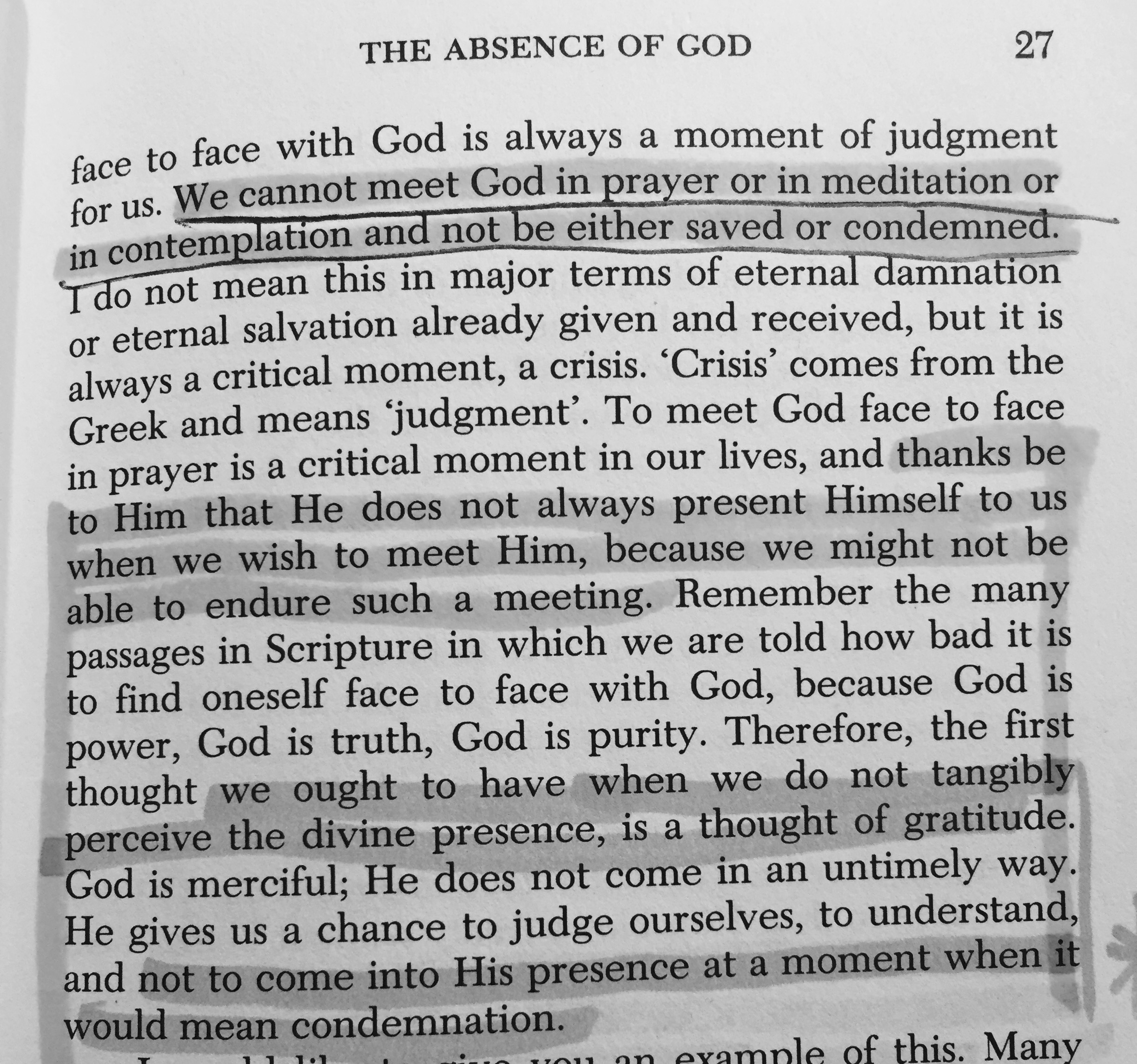
Anthony Bloom’s Beginning to Pray, an Excerpt 

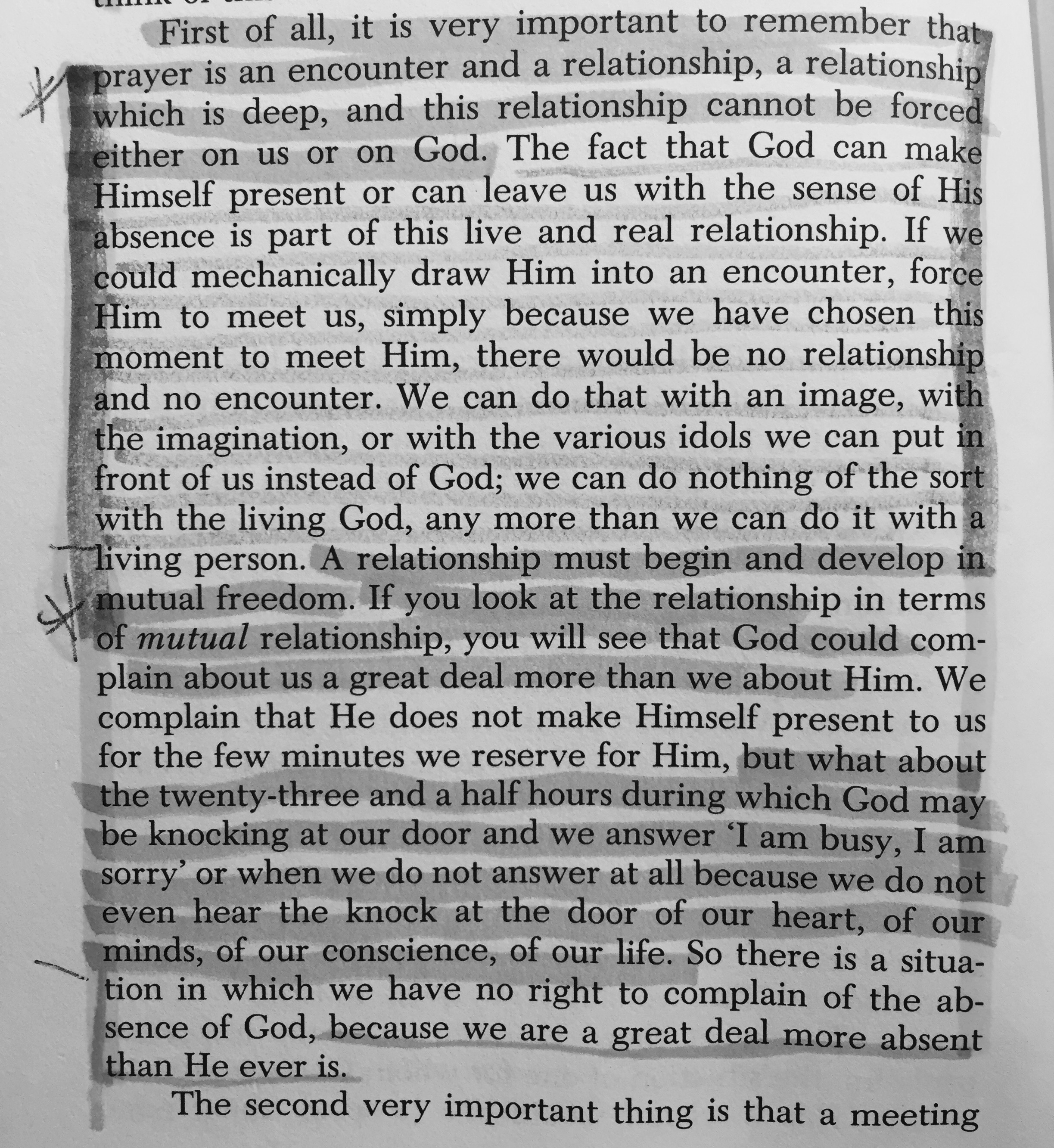
It dawned on me upon reading this that my greatest complaint to God is that He is real.

I’m learning to be thankful for seasons of absence.

Lord, help me through the desert, even if help only feels like heartache, even if your presence feels only like a vacuum filled with infinite longing, even if seeking you leads to an endless search–forsaking all the treasures of Egypt like a fool chasing an Infinite horizon. Even so, let it be.

Only keep me from settling for anything less than all of you.

Learning to Walk Upright

MENEVO

“But the gods, taking pity on human beings–a race born to labor–gave them regularly recurring divine festivals, as a means of refreshment from their fatigue; they gave them Muses, and Apollo and Dionysus as the leaders of the Muses, to the end that, after refreshing themselves in the company of the gods, they might return to an upright posture.”

~Plato

Just listened to NPR radio show that began by announcing the statistic that one in six Americans are nonreligious and then followed with the (somehow related?) question: Is religion becoming obsolete?

Frankly, there is a lot of religion in our country that needs to obsolesce, because in certain contexts the Gospel has become obsolete. My concern at this most superficial level, however, is not to try to salvage the Gospel from its pluralistic bedfellows; it is rather to suggest that those who truly believe in the Gospel of Jesus Christ–that it is the basis of reality, the interpretive key to history and the determinative claim on the future–have a responsibility to enjoy the freedom the Gospel commands we enjoy.

There will be times to bear witness to Christ with our words, more times still to bear witness with our works, but I’m convinced that our most sustained witness in a culture of uncontrollable consumption and feverish distraction and busyness and restlessness and work and worry so work some more is this: rest. It is also called Sabbath. It may be called leisure. It certainly involves feasting and faces, celebration and dancing, giving thanks and being still.

If we do that well, we won’t need so much as reasons for our arguments; we will only need the reason for our rest. We will not need to find arguments in the defensive because people are offensive toward us; we will need only a simple explanation for a way of life that is undeniably attractive–or at least is the fragrance of peace that arises from it. And when they ask why we rest, we have only to say the same thing we’ve been saying since the day our nation began: because God told us when he rescued us out of Egypt that we were no longer allowed to act like slaves; because God is teaching us how to walk upright.

“‘Observe the Sabbath day, to keep it holy, as the LORD your God commanded you. Six days you shall labor and do all your work, but the seventh day is a Sabbath to the LORD your God. On it you shall not do any work, you or your son or your daughter or your male servant or your female servant, or your ox or your donkey or any of your livestock, or the sojourner who is within your gates, that your male servant and your female servant may rest as well as you. You shall remember that you were a slave in the land of Egypt, and the LORD your God brought you out from there with a mighty hand and an outstretched arm. Therefore the LORD your God commanded you to keep the Sabbath day” (Dt. 5:12-15).

It’s a liberating thing to not have to be god.

Let There Be Nothing


“Forget Jesus, the stars died so you could be born” (Lawrence Krauss, Why Is There Something Rather Than Nothing).

There are two types of nothing, two types of darkness, and two types of god.

Everything begins on a canvas that is black to our eyes. The darkness was over the face of the deep before God began speaking his mind, saying things like “light” and “darkness” and “Lawrence Krauss.”

But black to our eyes is only black like a pupil to God’s eyes. To him, “even the darkness is not dark…[and] the night is bright as the day” (Ps. 139: 12); indeed, “God is light, and in him there is no darkness” (1 Jn. 1:5), and “every good and perfect gift is from above, coming down from the Father of lights with whom there is no variation or shifting shadow” (Ja. 1:17). So we should expect the canvas of creation to be a formless void of an outer darkness. How else could Infinite Light create something other but by first creating a no-thing?

He, of course, is not removed from the outer darkness of the no-thing. He withholds his blinding radiance for the express purpose of giving it, indeed, so that the no-thing could become something. That is why “Let there be light…and God separated the light from the darkness” (Gen. 1:3-4) mean the same thing, in the way that will and act can mean the same thing, and why Genesis begins there and only later announces the creation of the creation of the stars.

So God hangs a veil around a space and begins with pinpricks to dot the veil with glimpses into the fullness of the other side. Before long, he has created an entire universe wildly spangled with his glory. And this he does for no reason other than for a creation yet unborn to behold it: the human eyeball.

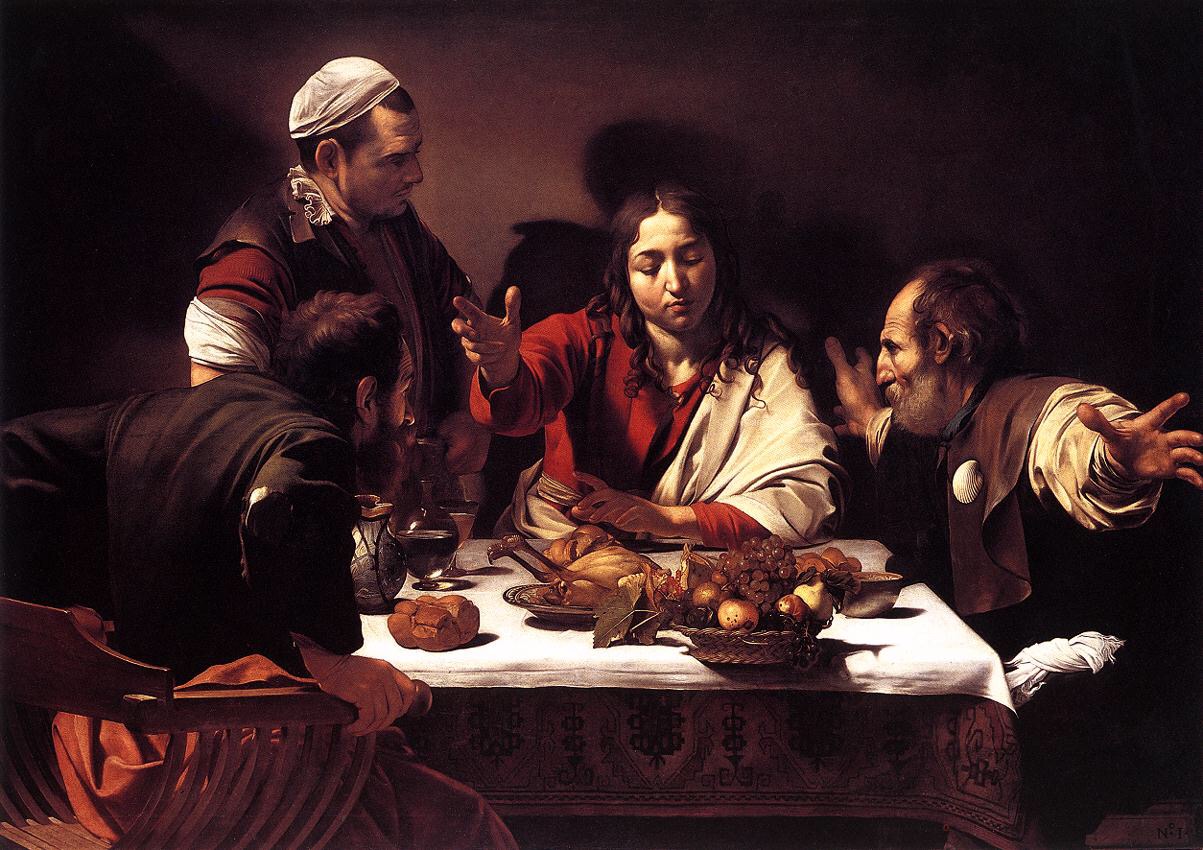
So God begins with a black canvas for the reason Caravaggio begins with a black canvas—to be dramatic with his colors. He wants to make the universe pop, like a firefly in the night or a supernova in outer space. And he delights in both the same because to him they are the same size. This divine wisdom is simply conventional wisdom. The theater always dims before the spotlight is beamed. So even in the darkest of night, we should expect to see the stars dancing all the more promiscuously in their splendor. We might even write an imprecatory psalm and request that God begin judging the meteorites—since in every judgment of God a veil must be torn—but only so we might get to watch him tear through the night with a wound that bleeds with the pixies of his glory.

So the veil does not lessen the beauty of pure Light. It is makes it visible. It makes it possible for God, in whom there is no turning of shadow, yet pour forth his glory like buckets of rainbows on the space he creates for reflection. The whole universe is set up like stage props, and then like a beam—but only like a beam—out came the sight of human perception.

Humans are free to see what they want to see. Humans can look at a rainbow and see nothing more than a number scale in HTML, if they so choose. They can dissect the universe into evidence and confine its energy within a three-letter-equation2, and even be entirely accurate, and fail to see the bigger picture with the self-evident observation that even upon arriving at the very bottom of space or the very end of time (which simply cannot happen), we still have not reckoned with the fact that what there is can give no account for its being there at all, and that if the infinite God is at all, he is all in all, and cannot thus be located apart from anything else. He is the ground of all that there is and the above-ground that makes all things possible—like Christmas. He is here but more than here. We are here and less than here.

And God designed the human eyeball to see as a given that beauty and sight are neither coequal nor coeternal, but rather complementary. That is why the pupil pays its compliments to the iris, but then gives glory to the sun it reflects. But the story of human freedom tells of the rebellion against all that is given and seen as a given. Human beings would learn to love their eyelids and dream that the iris is just a reflection of the pupil, indeed that we only need to cross the veil to see who we truly are. That is what certain physicists imagine they are doing when they speak of a model of the universe, which suggests either that the physical universe is potentially very small or the human ego can perhaps expand to infinite proportions.

So there is another black beginning of an oppositely ordered canvas. There is the no-thing and then there is the no-god; there is night given to Beauty and then there is night given to itself. It is the difference between creation ex nihilo and creation in nihilo, which is the difference between creation and annihilation. And thus the earth would begin filling up with shadows of self-destruction, the heavens overcast with eyelids. God would continue to poke rainbows through the clouds and shoot signs through the night, but humans loved the darkness because they could not simply let there be Light.

I wish Lawrence Krauss could see the Christ that refuses to exist in even his wildest dreams. I used to dream of gods like his, so I am no less blind than he. But my sight came through eyelids heavy with an infinite weight, and that only after dreams of glory led not just to an outer darkness but even to dreams of the outer darkness: night upon night, black upon black, pure and faithful nihilism. It was only then, wrapped up in the folds of the veil, that I was startled to discover my Death at the intersection of a Caravaggio red, painted like a cross from the other side.

Harold and His Purple Hell

herald cover

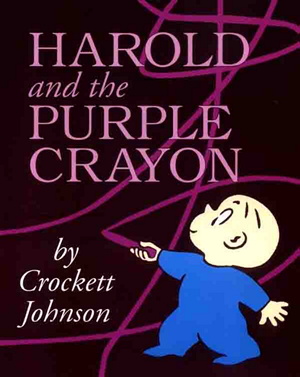
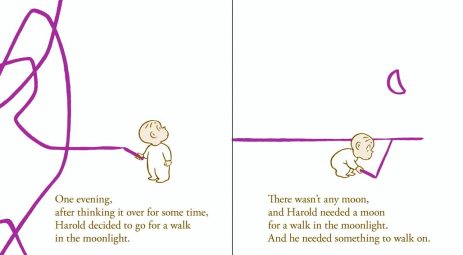
Harold and the Purple Crayon is the saddest book ever written, also the most transparent. It is either a book about a lost son or a book about every man. It begins with scribbles on the first page. We are entering the story on the other side of some unnamed conflict. Order has given way to formlessness. Something has gone terribly wrong. But then: stillness, nay sovereignty. Harold looks away into the direction of the night, turning a blind eye to the domestic disturbance behind. Suddenly he free. He can now escape into the world of unfettered creativity. The night is filled with endless possibilities. Harold has a crayon.

harild-purple-crayon-book-johnson-p1.jpg

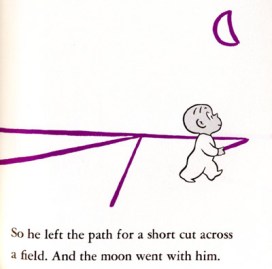
So Harold leaves home to follow the moon on a two-dimensional search for he knows not what. The world is a surface, a canvas for his self-expression. He has his pen of dominion, a life of perfect freedom of the will in the realm of infinite possibility. He begins by creating the ground beneath his feet and the light for his path. Naturally, it begins as a straight and narrow path, but eventually, and just as naturally, he soon wanders off. Now the night is following him. 

path

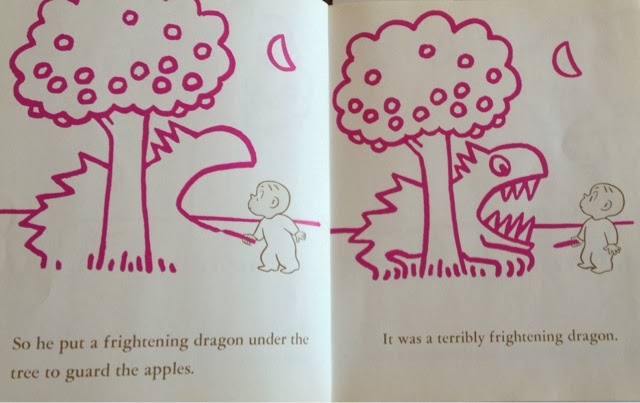
Eventually, he needs a companion–for it is not good for man to be alone–and so begins expressing himself to find a suitable helpmate. But something foreign seems to be embedded in his memory, something that either looks nothing like him on the surface or quite like him underneath. We begin to see what has been lurking about in Harold’s heart. It is a perfect image of Western culture, an artificial tree protected by a very real monster. 

herald monster

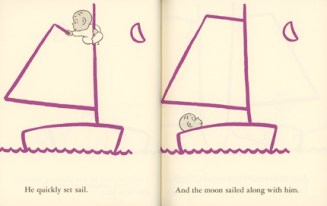
He creates a monster to guard a secret tree but discovers that the monster has a mind of its own and is no respecter of persons. His creation drives him away in fear. He accidentally draws a great deluge but saves himself on a boat. It is still night. 

Harold-and-the-Purple-Crayon_03

Harold makes it to land, and proceeds to draw a tower reaching the heavens. He now begins search for home. But his search never leads him to turn around, to go back, to regress and become like a child. His search leads him upward and onward. But the gravity of the surface eventually pulls him from the top of his tower. He saves himself again, however, and makes it back to the surface, discovering not how high he could reach so much as how far he could fall. 

herald fall

Alone still. He is just a little boy who wants to go home. But he doesn’t know the Way. He begins creating windows and then looking into them, hoping to discover the bedroom mirror hanging on the inside of his door. But every room is empty or filled with the artificial, somehow always seeming at least twice removed once it has left his hand. 

But he puts his hand to the plow again, except not the plow at all. He is now determined, now in the big building business. He has the pure freedom of his creativity and thinks perhaps he can realize new horizons with nothing more than the raw potential of his imagination, the new creation of a world liberated from the thistle-laden ground: Harold’s will be done, on earth as it is in his head. He has still not once considered turning around. Even if home were behind him, there’s no reason to believe he could go back. Time doesn’t work that way, nor the human heart. He can no longer believe that the home he remembers in that latent longing is one he actually belongs to. It is infinite progress, not ancient memory, that must satisfy his infinite longing. So the cure for his aching existence must come by way of forgetting, for while ancient memory always seems to haunt the present moment, it still seems somehow more distant than the promised future that is forever at our fingertips. 

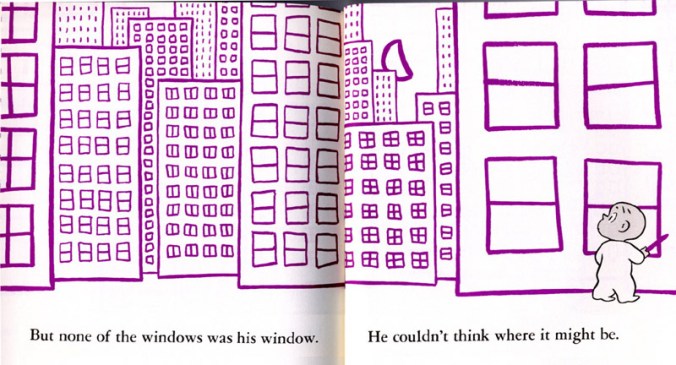
So Harold tries to give form to the haunted hole in his heart in order to create a home to belong to. He builds more windows. He builds an entire city. And in the saddest scene ever illustrated, an anxious little boy climbs his towers with crayon in hand making a kingdom of windows revealing the hollow of homesickness.

It’s as if all of human life were born out of some grand front porch that continually expands in our heart with age. And all we know to do is try to match its grandness with grandiosity. So white-knuckled men scrape the clouds in high flying homes that feel nothing like home. They feel like heartache. But they are not dressed like heartache. For that, one need only to visit the real lifeblood of any city, its subway. The grandiosity of the surface is deflated in its subterranean confessional, where the height of human reach above is curiously incommensurate with height of human beings below. Down there, it feels like an entire world that has been shrunk to an embarrassingly navigable size. Everyone knows exactly where they are going, though never feeling any less lost. This is why it is impossible to ride the subway without wanting to cry a little. There is something human there and something missing. There is proximity, and there are infinite distances. The city somehow feels at once like being in control and being in a cage. It is the longing for transcendence and the consolation of the towers of trade. It is the feeling of a concrete Wilderness, open possibilities filled with sub-ways. 

Harold’s heartache creates an entire city the size of his homesickness. But it didn’t cure it. It is the saddest picture I have ever seen.

har.jpg

But Harold finds help. He turns to a law enforcement officer for help to find his way home, but he is no help. All he can do is enforce the law, which simply reinforces Harold’s constitution of self-governance. Harold must stay the course. To turn back would indeed be unconstitutional.[1] 

yesman

So he settles. He can neither find his home nor the light of day. He accepts that man was not created for the greater Light but for the lesser. The moon is the only reflection of light in his world, for the man is just a contribution to the shadow, whose truest form is occasionally found in a full about-face eclipse. Harold’s self-made home will be framed around the endless night, his only vision of light, something like the vision in Plato’s cave. Refusing to turn around he will never discover the genesis of his sight, the very warmth that always seems to hit him from behind in the memory of a home he no longer can believe is real. So he exchanges the future for the past and builds a shadow of the home he longs for. He is now on the other side of that empty window in which the moon is forever imprisoned.

herald moon

The story ends with the end of all possibility. Harold is not only given to the night, but any possibility of the morning with him. Harold will slip into oblivion, but only because he tried to create his way out of it. The only thing worse than embracing emptiness is denying it, which is the difference between the nihilism of creation and creation in nihilo, between hopelessness and false hope, between godlessness and the no-god, between an honest heralding of despair and today’s bullhorn gospel of progress: between the fall of Adam and the rise of Babel.

It is the far end of self-expression in the triumph of self-discovery, the absolutization of human freedom in rebellion to the Light. Harold has succeeded in constructing his hell.

bed

Hell is the life that immortalizes emptiness as its god and when the paint dries will live forever in its image.

harold

The book concludes thus:

“The purple crayon dropped on the floor. And Harold dropped off to sleep.

“The End.”

Indeed.

_________

  1. Human freedom conceived of as the freedom of choice itself, rather than the freedom to choose the Good, is what the biblical creation account refers to as the knowledge of good and evil. To affirm freedom as such is to commit the primal sin, because it is determining what is good with reference to the contingent self rather than the Absolute Good. It thus has no stable coordinate that transcends the will itself and thus must affirm the will as such as the good, and hence the will to power. God’s absolute freedom is coinherent with God’s absolute goodness, which is to say the Triune God is love, not the effervescent collision of Heraclitean flux, nor even the compromised synthesis of a very large Hegelian circle (even if conceived as a straight line). And thus human freedom is essentially the power of the will to love, which is precisely the power of the will not to. Harold had discovered this raw freedom on the first page, but by this time he has created an entire civilization based on its irreducible nucleus. And so the human family created in the image of the Triune God has parsed out into pixels, gathering only on the highly volatile principle of the sovereign will of everybody’s one-person world: nuclear fission in the nuclear family.

The Sleeping Prince

Disclaimer: The following is a revised version of a fairy tale entitled, “Werewolf,” which was published by the University of Pittsburgh as a story from the Brothers Grimm collection (although in my collection, Grimm’s Complete Fairy Tales, it is absent). This revision changes the meaning of the story entirely. If I were more creative, I would make up my own fairy tales. But since I am not, I enjoy revising ones that already exist. Besides, every fairy tale has evolved to become what it presently is. It only stops evolving when print replaces voice and publisher replaces grandfather. We would do well to rediscover that lost tradition of telling old stories in new ways.

For readers unaccustomed to reading fairy tales, I would recommend reading an article or two that might help you to get oriented, or perhaps just read G.K. Chesterton’s masterful eisegesis of many well-known fairy tales whose hidden (potential) meanings have since been painted over with cinematic flare. Also, don’t read it unless you have time for reflection.

The Sleeping Prince

A soldier related the following story, which is said to have happened to his grandfather. The latter, his grandfather, had gone into the forest to cut wood with a kinsman and a third man, both much younger. People suspected that there was something not quite right about this third man, although no one could say exactly what it was.

The three finished their work and were tired, whereupon the third man suggested that they sleep a little. And that is what they did. They all laid down on the ground, but the grandfather only pretended to sleep, keeping his eyes open a crack. The third man looked around to see if the others were asleep, and when he believed this to be so, he took off his belt and turned into a wolf.

Then he ran to a nearby meadow where there was a wild horse, who during the day was a beautiful young princess, resting after running for hours. She saw the wolf and thought to run away but instead invited him to run with her toward the moon. But the wolf attacked her and ate her, from her mane to her bones. Afterward he returned, put his belt back on, and laid down, as before, in human form.

A little later they all got up together and made their way toward home. Just as they reached the village gate, the third man complained that he had a stomachache. The grandfather secretly whispered in his ear: “Perhaps you should consider a different diet…horses are not made for eating, you know.”

The third man replied: “If you had said that to me in the forest, you would not be saying it to me now.”

The grandfather replied, “Perhaps. But perhaps if I had said that to you in the forest, you now would be a prince…”

After the sun set the old man lay in his bed and wept through the night, for he was unable to sleep.

Searching for The God Within

After about three months of focused reading of a number of ancient spiritual mystics and modern psychologists who would be called spiritual mystics if they were ancient, a clear message has emerged: if you haven’t discovered God, then you haven’t looked and listened deeply enough within your own soul. Discover your true self and there you will discover the God who accepts you just as you are. You need only now to accept yourself just as you are. You may even need to forgive yourself, but mainly just for not accepting yourself.

As much as I have gleaned from what I have read–there is a lot of laudable stuff on the woes of technology and the unexamined life–I cannot help but confess that in my own experience of the infinite inward dive I have never found anything other than an infinite inward abyss. Now it may just be that I am especially void of any inborn divinity or particularly undiscerning of the God who is always within. It could be that my spirituality isn’t mystical enough or my psyche isn’t spiritual enough. I could just be an anomaly of godlessness in a world of demigods.

Whatever the case may be, if there are others out there like me who have looked soberly within to discover God and discovered nothing but the self standing in empty space, perhaps you will benefit from my path toward discovering God. But the following only applies to such as these.

Once you get to the bottom and discover there is in fact no ground beneath; once you see that there is no one else there accepting just as you are; after you’ve carefully listened for that eternal voice saying of you “This is my beloved in whom I am well please” and hear only hissing echoes of your own disguised persuasions; once your exhaustive inward search has led you only to despair–you may then be convinced to give up. If so, you are on the right path. But don’t give up. Instead, stop looking inside yourself for the God who accepts you just as you are, because perhaps God does not accept you just as you are. Stop listening for the voice that calls you beloved and is well-pleased with your life, because perhaps your life is not well-pleasing to God. And if you can entertain the notion that perhaps God does not accept you just as you are, that he is not well-pleased with your life, that you have not lived as his beloved, you really only have one last resort:

Turn around and look at the cross of Jesus Christ.

Once you begin looking, keep looking. I mean really look, like the way you look at yourself. Fix your eyes on him and there begin to listen–not to what the voice says about you but to what the voice says about him. Don’t confuse yourself with him, lest you mistake the well-pleasing waters of acceptance for the displeasing flow of forgiveness. Let the cross be the measure of your life and your love. And when you hold your gaze long enough, as though there were nowhere else to look for God, as though your life and love and hope depended on it, you will inevitably be confronted by just how displeasing you are just as you are, because your life and your love are nothing like the well-pleasing love of God revealed in the displeasing death of his beloved Son.

And if you discover your God there, it is there you will discover your true self–guilty. And when there you discover your true God and your true self, you will discover too that it is not divine acceptance that you need. It is divine forgiveness. But for that, you need not look anywhere else. Neither will you want to.

“Wretched man that I am! Who will deliver me from this body of death? Thanks be to God through Jesus Christ our Lord…For there is no condemnation for those who are in Christ Jesus!” (Rom. 7:24-8:1).

Guilty, yes. Condemned, no.

“Worship the LORD in the beauty of his holiness; tremble before him all the earth” (Ps. 96:9).