The Daring Faith of Doubting Thomas

Incredulity of What?

Thomas did not doubt the resurrection of Jesus. He doubted the death of Jesus.

The Gospel of John is set in a darkened world of disbelief. There is a two-fold problem of blindness and ignorance that this Gospel intends to address with a Light and a Word, with grace and with truth. The prologue (Jn. 1:1-18) orients readers by taking them backstage to witness the Gospel’s main character suiting up (Jn. 1:14) for his role in the ensuing drama to make visible what had become invisible, to make known what had become unknowable. So the one who exists from eternity with God, through whom God sang the cosmos into being, enters from behind the curtain into time and space onto the world’s stage as the Son of God become Son of Man, and thus invites us into the eternal communion of the heavenly table where God the Father becomes “Our Father…” (Mt. 6:9).

“For the law was given through Moses; grace and truth came through Jesus Christ. No one has ever seen God; It is God the only Son, who is in the bosom of the Father, who has made him known” (Jn. 1:18).

And thus the unveiling of God the Father required a veiling of God the Son—the Word became flesh. The Son would have to disguise his own glory in order to reveal his Father’s grace, not simply because the grace of God depends on this incarnate veiling but because the veil as such will become instrumental in making grace visible and knowable to the objects of grace (Heb. 10:20). So this Gospel sets out the specific task of bringing the objects of grace and the Subject of grace into proximity, calling the characters in the story and the readers of the story again and again to believe in a picture of God that becomes harder and harder to believe, as the divine Word and Light of life makes his descent from God to the flesh and from the flesh and to the cross (cf. Phil. 2:5-11). The Gospel of John is thus concerned with the quality of Christian faith, that is, concerned to take us from believing in an out-of-focus picture of God and zooming in on the Son until a decisive moment at which point he will address the reader directly (Jn. 20:29-31), so that through this Gospel we might see what is otherwise invisible and know what is otherwise unknowable and thereby believe what is otherwise unbelievable: that of all people it is none other than “Jesus,” the Crucified One, who “is the Christ, the Son of God, and that by believing [we] may have life in his name” (Jn. 20:31).[1]

[Enter the (peculiar) character of (doubting?) Thomas.]

It is to this end that Thomas’s character is made intelligible. Historically, Thomas has been cast down almost to the bottom of the disciples, second in antagonism only to Judas. Only by the skin of his teeth does he rise above the status of Judas in a last-second moment of belief, which is often looked down upon as a sort of second class faith-by-sight (Jn. 20:29). And if this Gospel portrayed believing in static, black and white terms, this view of Thomas would be justified. But this Gospel does not portray believing in that way. The believing in John’s Gospel is commensurate with the unveiling in John’s Gospel, which sheds its light not like the flick of a switch but the turn of a dimmer. And it is precisely at the most absurd moment, when Doubting Thomas’s finger is buried inside the gaping bosom of the Risen Christ, that the dimmer switch is maxed out, Thomas believes, Jesus becomes “my Lord and my God” (Jn. 20:28), and the readers are called to see what Thomas sees and believe what Thomas believes. It appropriate, therefore, to consider that perhaps Thomas’s character is not there to give us a generic summons to faith in the divine Christ via negativa, that is, an example of the kind of faith not to have. Rather, Thomas’s character is there to give us a particular summons to faith in the divine Christ of the Via Dolorosa (“the way of suffering”, referring to the path from the Stone Pavement to Golgotha). In other words, the purpose of Thomas’s character is less about the general substance of our faith and far more about the particular Object of our faith: the Wounded yet Risen Christ.  


We are introduced to Thomas, the one who is called Didymus by John and Doubter by posterity, in John 11, where he immediately betrays one of these given names. Thomas, Jesus, and the rest of the disciples had been driven out of Jerusalem on pain of death because Jesus had claimed, “I and the Father are one.” Certain of the Jews picked up stones and decried him as a blasphemer, “because you, being man, make yourself God” (Jn. 10:30-31). The cat was out of the bag, Jesus claimed to be divine, and at least one of his disciples, it seems, believed him.  

News had come about Lazarus. He was sick. After hearing of his sickness, Jesus surprisingly stayed put for two days and then ordered, “Let us go to Judea again” (Jn. 11:7). The disciples protested. They had left for fear of death, so “Jesus told them plainly, ‘Lazarus has died, and for your sake I am glad that I was not there, so that you may believe. But let us go.” It is precisely at this point the text introduces Thomas: “Thomas, called Didymus, said to his fellow disciples, ‘Let us also go, that we may die with him” (Jn. 11:16).

Thomas’s opening line certainly betrays his popular name. Indeed, he seems to be ahead of his time, willing to die before even seeing Jesus’ power over death, which he will see when he gets to Lazarus’ tomb. The Thomas of John 11 seems to believe something about Jesus that none of the other disciples yet believe, perhaps in his power over death, perhaps even that his alleged claim was actually true: “You, being man, make yourself God” (Jn. 10:31). At any rate, he at least at this juncture acts more consistently with the name given him by John, the twin, not tradition, the doubter. “Let us go, that we may die with him.” He just wants to be like his Brother (#twinning).

After Jesus was crucified, the disciples locked themselves behind closed doors “for fear of the Jews” (Jn. 20:19),  the same reason they had protested going back to Jerusalem in John 11. Well, all but Thomas–in both cases. The Thomas who was ready to die with Jesus in John 11 was the same Thomas ready to die for Jesus in John 20. Apparently, at least, he was still not living in fear of death. He was out there roaming the streets, looking for who knows what.

Three days later, Jesus walked through a locked door, declared, “Peace be with you”, and “showed them his hands and his side.” The Lord revealed to them something specific, something particular he wanted to show them, his hands and his side. They saw him, though perhaps yet not with the clarity and particularity that he had wanted. “They were glad when they saw the Lord” (Jn. 20:19-20).

The others went to Thomas the Twin and told him about seeing the Lord, but Thomas did not care to see something so general as “the Lord.” He wanted to see something specific, something particular. “Unless I see in his hands the mark of the nails, and place my finger into the mark of the nails, and place my hand into his side, I will never believe” (Jn. 20:25). Thomas wanted to see precisely what Jesus wanted to show.


At this point the reader should ask this question: What do wounds actually prove? 


After hearing this, Thomas joined the other disciples. Eight days later, Jesus again walked through locked doors, declared “Peace…”, approached Thomas, and immediately the text turns to Jesus, who becomes the sole agent of the scene. Thomas is silenced and passive. It is no longer about what Thomas wants to see but what Jesus wants to show, the very thing he wanted to show the other disciples but who failed to focus in on it with the hi-res particularity he displayed: “Put your finger here, and see my hands; and put out your hand, and place it in my side. Do not disbelieve, but believe.” (Jn. 20:27). And, using the finger of Thomas, the Twin, Jesus points deep inside himself in an unprecedented revelation of the heart of God revealed inside his own bosom (cf. Jn. 1:18). Thomas’s response, I believe, should be regarded as nothing less than the precise narrative climax of John’s Gospel. And he will forever remain the only person in the Bible to ever address Jesus with such an explicit, indeed scandalous, combination of divine nouns and possessive pronouns: “My Lord and my God!” (Jn. 20:27).


The narrative has been moving steadily along since it set out to give readers something to believe in (John 1:12), using the verb for believe 98 times, 60 more than Acts (in a distant second of all New Testament books), and taking the disciples on journey of coming to believe again and again in Jesus as he reveals more and more of who he is (cf. chs. 2; 11; 14; 15; 20), and therefore in retrospect who God is. Indeed, John is not just concerned that the reader believes in the Son of God so much as he is concerned who the Son of God actually is and precisely what it is we believe about him, what it means to believe in him, in a way fitting of Thomas’s finger.

And so at this very moment, the narrative freezes in time.

John, taking his cue from Jesus, halts the story with Thomas the Twin caught red-handed, frozen in this frame forevermore. All that is left to happen in this scene is for a summons to be directed beyond this scene, to enter into this scene, to follow the path pointing into the heart of God. So Jesus addresses Thomas and then the reader, after which John follows suit:

“‘Do you believe because you have seen me? Blessed are those who have not seen and yet have believed.’ Now Jesus did many things in the presence of the disciples, which are not written in this book; but these are written so that you may believe that Jesus is the Christ, the Son of God, and that by believing you may have life in his name” (Jn. 20:29-31).


What does John’s depiction of Thomas tell us about his doubt? And what does John’s Thomas, the Twin, tell us about Jesus? First of all, unique to Thomas is a consistent fearlessness concerning death, both in chapter 11 and in chapter 20. The best explanation for that fearlessness in chapter 11, I believe, is that Thomas believed in the divinity of Jesus, which those who were seeking to kill him accused him of claiming. And if that is the case, chapter 11 should be understood as John’s way of providing a unique vantage point from which to see the Risen Christ in chapter 20. Just as John developed the character of Mary Magdalene, Peter, and the Beloved Disciple throughout his Gospel, so that he could bring them all together in chapter 20 to provide a unique perspective for seeing the Risen Christ, so too Thomas’s character in chapter 11 must be the lens that helps situate us in Thomas’s shoes in chapter 20. In that case, one must consider what the crisis of faith/belief would be for a person (Thomas) who believed that (a) another Human (Jesus) was divine, (b) that this divine human had been killed, and (c) that this dead divine human had been raised from the dead. Following that logic, such a person would in a sense doubt the resurrection of the dead divine human, but likely only because he doubts the death of the divine human.

Indeed, the stumbling block for Thomas was not the resurrected life of Jesus. It was the shameful death of God. If Jesus was already in some sense categorically equal with God in Thomas’s mind, then the idea of his crucifixion and death would by far be more difficult to believe than his resurrection and life. The life of God, the power of God is a given; it is the death of God, the wounds of God, over which the world stumbles. 


What is the purpose, then, of Thomas’s character? It could be and has been argued that John’s Jesus was a correction to the docetic “phantom” Jesus. And that may or may not be true. But the sustained value of this reading comes to the readers of any and every generation with much greater immediacy than the solution to a religio-historical riddle, because at the existential center of the Christian faith there are two very difficult things to believe that this reading seeks to address. The second most difficult thing to believe is indeed that a man could be raised from the dead. All four Gospels bear witness to the historic fact of the resurrection, thus serving to validate the Messianic, and indeed divine, claims of Jesus’s lordship expressed through the divine power in his triumph over death. Paul makes this connection in the introduction of his letter to the Romans:

“[Christ Jesus] was descended from David according to the flesh and was declared to be the Son of God in power according to the Spirit of holiness by his resurrection from the dead: Jesus Christ our Lord” (Rom. 1:3-4). 

But perhaps John’s Gospel, which weaves together the themes of our faith and God’s love far more than the Synoptics, is intended to help us to “read into” this fact of history more deeply and thus see the Object of our faith more clearly.

The appropriate question, then, is How should the reader interpret (1) Thomas’s confession at his apparent moment of belief, (2) Jesus’s response to Thomas’s confession, and (3) the purpose statement from John that immediately follows Jesus’s response?

Traditionally, these three statements have been read as a generic exhortation to believe in the risen Lord without having to see risen Lord. The focus is set on the fact that Thomas believed when he saw Jesus and not what Thomas believed, or what exactly he saw in Jesus, which prompted the breathless and verbless confession of a man just on the other side of speechlessness: “My Lord and my God!” (Jn. 20:28).

Given all the evidence, it seems hardly plausible to me that Thomas’s confession essentially communicates that the empirical proof of Christ’s crucifixion, his wounds, had for him finally effected faith in the resurrection, as though he were simply saying in effect, “Now that I have seen and felt your mortal wounds, I believe that you were healed from your mortal wounds and raised from the dead.” Would not the presence of his Person been enough? If not, would not the walking-through-the-wall miracle have been sufficient evidence for a glorified, risen Lord? Besides, the question bears repeating: What do wounds actually prove? And why was Jesus so intent on revealing them?

If indeed they are the wounds of God, then perhaps Thomas’s confession and the object of Thomas’s belief can best be understood as heard within the chorus of that great Charles Wesley hymn, “And Can It Be”:

‘Tis mystery all: th’Immortal dies.
Who can explore this strange design?
In vain the firstborn seraph tries
To sound the depths of love divine.

Amazing love! How can it be
That Thou, my God, shouldst die for me?
Amazing love! How can it be
That Thou, My Lord [and my God!], shouldst die for me?


Indeed, the resurrection of Christ proves God’s power but the death of Christ proves God’s love. John’s Gospel gives readers not simply the nature of the divine Christ. He gives readers the character of the human God. Paul does the same. As he probes more deeply into the meaning of the Christ-event, the his finger begins to move like Thomas’s into the very heart of God: “For God has demonstrated his love for us, in that while we were still sinners Christ died for us” (Rom. 5:8). 


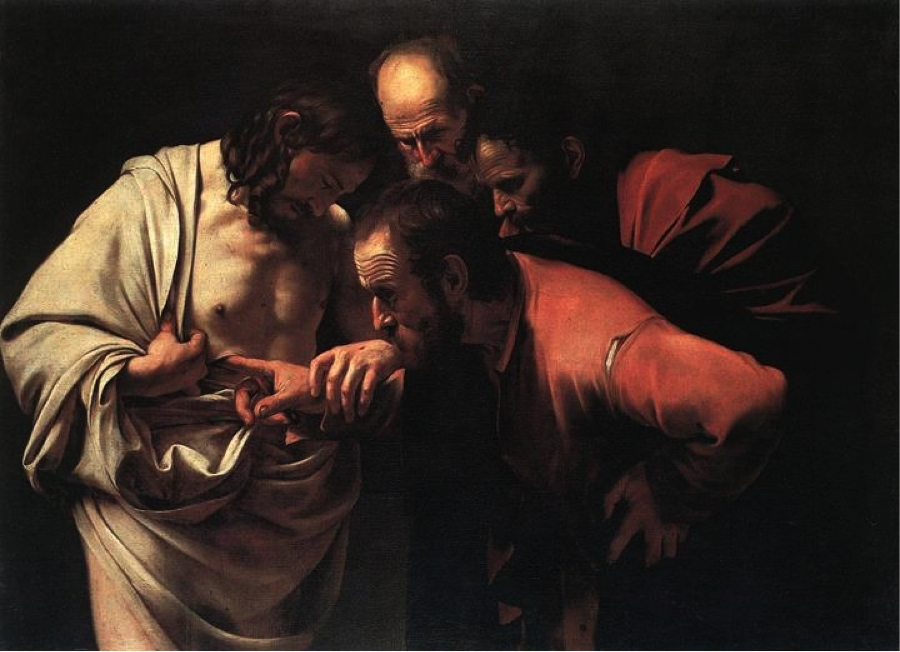
The Italian Baroque artist Caravaggio painted this scene with Thomas and Jesus with the title “The Incredulity of Thomas.” In it he uses an an obvious mirroring effect between the characters of Thomas and Jesus by placing a tear in Thomas’s robe that is level with the wound in Jesus’ side, also by Thomas’s grabbing his own side as he places his finger into Jesus’ side. As he stares wide-eyed at Jesus’ wound and his finger in it, Caravaggio depicts two other disciples peering over his shoulder to see what Thomas sees.

Caravaggio was not only right to immortalize this moment in salvation history, in perhaps the single most important snapshot God has given the world of both his infinite power and infinite love, but he is also right to capture Thomas leading the way for the other disciples and readers of all ages to quite dramatically get a glimpse into the heart of God, that is, to see what could have only been shown by the One who was close to the Father’s heart (cf. Jn. 1:18). So as he buries his hand into the Scarred but Risen Lord, Caravaggio captures Thomas grabbing his own side in pain, suggesting that in the wounds of Christ he discovers his own wounds, or rather than in his own wounds he discovers his truly loving Lord. Indeed, he discovers that “He was pierced for our transgressions, he was crushed for our iniquities; the punishment that brought us peace was upon him, and by his wounds we are healed” (Isa. 53:5).

Perhaps the reader should not be so confused by Thomas’s first words: “Let us go, that we may die with him” (Jn. 11:16). For those words had been spoken once before, yes, even before the foundation of the world. They had been spoken by the One who proved to become Thomas’s Twin, indeed, the Twin of us all, the One who left his throne in heaven, saying to the divine council, “Let us go, that we may die with them.” And so he did. And so we live. 

We need to get Thomas’s name right. He is not The Doubter. He is The Twin. He is Didymus. Because if we fail to see that Thomas is the Twin, we may fail to see who his Brother is, and therefore just who our Brother, and therefore our Father, is as well.

“Go to my brothers and say to them, ‘I am ascending to my Father and your Father, to my God and your God” (Jn. 20:17; cf. Jn. 1:12).


  1. John’s unique concern with the quality of our trusting or believing in Christ is demonstrated by a simple word count of the verbal form of the faith (pisteuo) in the Fourth Gospel over against the rest of the books of the Bible. Of all the books in the Greek New Testament and the LXX, only five books use the word pisteuo 10 or more times: Matthew 10x, Mark 16x, Romans 20x, Acts 38x, and John 98x. Furthermore, John’s Gospel is bracketed within two “purpose statements” of Jesus’ mission in the Gospel (1:12) and John’s mission and writing it (20:31) that ultimately reduce to eliciting faith in the hearer/reader of the Gospel. So between 1:12 and 20:31 John, I believe, is concerned to bring into clear focus precisely what is the Object of Christian pisteuo.

Mirror of Earth, Window to Heaven: The Image of Good Friday

grunewald

Just after Jesus breathed his last breath, one of the Roman soldiers who helped fasten him to the cross uttered the surprising confession, “Truly, this man was the Son of God!”
 
This soldier in one moment forces the nail through the layers of two worlds, staking them together in holy matrimony and pronouncing their union through the piercing ring of crashing metals. But he ‘knows not what he is doing’. He knows nothing of this holiness nor of this matrimony. He knows only his orders: he must kill in order to stay alive. He must destroy Life in order to keep it. He must crucify the ‘King of the Jews’ in order to preserve the kingdom of Rome. He must execute power in order not to be executed by it.
 
But just a moment later, he knows the terrible truth. In the distance a thick veil had torn in two and a cold easterly wind blew out of the center of the city. The moment it hit him, he knew.
 
The death of this life was the death of Life itself. He has just crucified the Kingdom of humankind. He has executed all powers and thrones and dominions. He has committed suicide on behalf of all. The stone will soon be rolled over the Light and the world will be tucked into an eternal eclipse.
 
The only remnant of this Man that can now be salvaged is our confession of him—that he was not merely a man: “Truly, this man was the Son of God!”
 
The wind stops.
 
And thus the soldier is the Church of Jesus Christ. His hands are our hands and our confession is his. We regard this moment as the truest image of the Christian standing at the strained feet of the truest image of God. It is too soon, at this point, to speak of the Day after tomorrow, too soon to speak of Life after today. All we know at this moment is that we have just discovered God a moment too late. Nietzsche is the Church’s prophet on this dark holy day: “God is dead, and we have killed him.” Amen.
 
Whatever else we are looking for from God today, we must first find nothing before we can find everything. We must remember today that the ground on which our faith rests is utterly void of our faithfulness. There is only here the faithfulness of One, but today–He is dead. Today we remember that our faith is hollow and our sin thick. The final analysis of our relationship with God now pools to the ends of the earth as from the cavernous summit of a over-boiled mountain. The concrete substance of our faith streams into the meadow. Grass withers and sad flowers are forced to bow. The lonely Garden weeps as children settle for sidewalk chalk. A whole world is forgotten. Creation’s groaning is reduced to a sigh, then to a silence.
 
The dark lord of the city reigns as Life hangs outside its gates (Gen. 3:24; Heb. 13:12).
 
 
So we dare not rush past this day, eager though we are to claim Sunday for quick, comedic relief, shaking our fists at the unbelieving world. Today, we are the unbelieving world. We cannot claim Sunday morning until we have been laid deeply down into Good Friday’s night. It is not the strain of the eyes that can see past the horizon into the morning. Morning must happen to us, and only after the night has reached its darkest dark, long after our eyes have failed. We must go to sleep after Jesus has commanded us to stay awake (Mt. 26; Mk. 14; Lk. 21). We must die after the living God has commanded us not to die (Gen. 2; Dt. 30:19). We have to look our sin in the face and acknowledge that we cannot overcome it, we cannot help but hammer away. We must hold our gaze long enough that we begin to believe the Truth of our hands staring at us through the empty eyes of our God, now burning our hope of heaven in the shadow of his gaunt, draping face.
 
The silence screams from the Creator’s formless mouth to confront us all with the Truth Pilate asked for. This is the Truth: we are looking at our self-portrait. We draw lines around lands with heroic buckets of red. We make violence a virtue while giving thanks for the Bread and the Wine. And so we must embrace the Truth of our cursed confession today: we cannot confess that Jesus is the Son of God without first confessing that we are the son of the Soldier. Our claim of righteousness and our God’s claim of unrighteousness is the same claim. We speak of the cross of Christ as God’s altar, but it never becomes other than a cross. We come to receive forgiveness from the Fount of Life and we are first handed a hammer and an infinite iron stake. We must tap into this fountain with our own guilt, staking our world together with his. The Christian knows that blood spills out from Jesus’ hands before water spills out of his heart. There is no cleansing that is not the cleansing of blood. Pilate’s basin is filled with a warm, dark red dye.
 
We are Christians, and we sin more passionately than we believe.
 
 
And yet, this is not only the True self-portrait of humankind. There is here, in due time, a deeper Truth. This is the only true self-portrait of God. There is in this mirror of earth a window of heaven. There is, yes, a love that is furious enough to die for the other through the hate that is furious enough to kill for itself. The cross and the soldier face the world and show us both who God is in Christ and who he is not in us. He is not a soldier. He has not come to kill us. He has come to kill the soldier in us. His weapons are his wounds.
 
So hold our gaze we must to this strange image oscillating without interval between ray and shadow, never once changing its form, and yet never ceasing to oppose its form. We must allow ourselves to be repulsed by the darkness of this Death if ever we are going to be seduced by its Light. Like a sunspot in our vision after staring into the naked noonday sky, the Man on the cross, whom we so desperately wanted only to be a man, will stain our vision of the world with a dark truth, that the darkness of the sun in our eyes has come from the light of the sun in our eyes. The Truth that blinds us is the very same which has given us sight. But the Light has come to expose the darkness in us. We love the darkness because we could not become ourselves the Light. We are the jealous moon, ever running from the truth that our Light is not our own.
 
So the Light wrapped himself in darkness and we “beheld his glory, the glory of the only Son from the Father, full of grace and truth” (Jn. 1). But if we want that grace tomorrow, we must embrace this Truth today.
 
So today, let us take up our hammer and follow the soldier. Let us march to the summit of history to fill the air with our clanging confessions. Let this Man be the God he is and let us be the soldier we are. For as long as he is who he is and we are who he is not, today will remain for us the day we become something we are not:
 
“But by the grace of God I am what I am.”
 
“God is dead, and we have killed him! Truly, this Man is the Son of God.”
 
Amen and amen.

Just Passing Through

IMG_5497
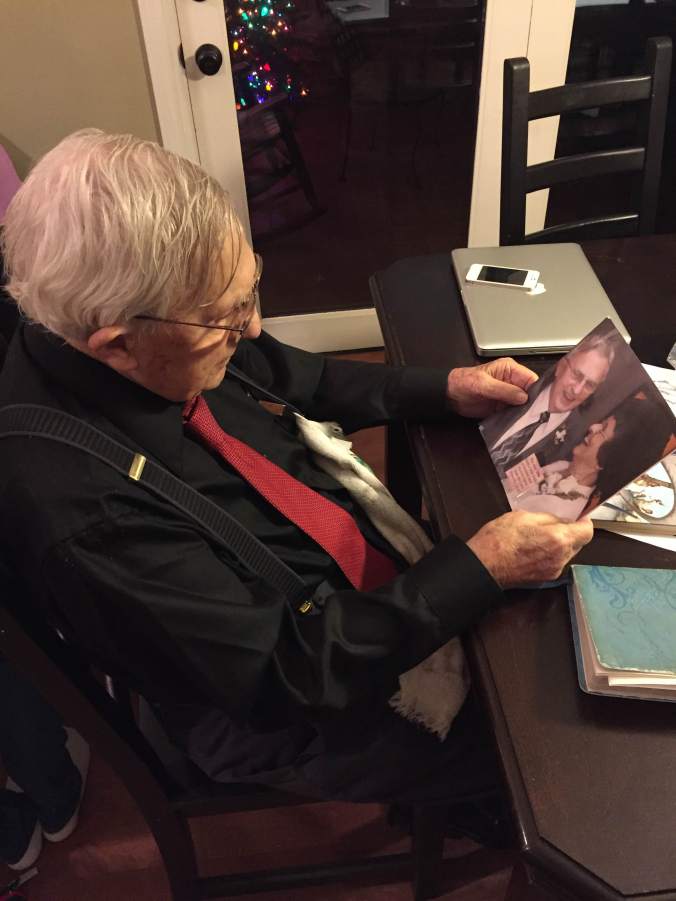
[Seated for breakfast at my grandfather’s table in Trinity, NC.]
Barney: “Have you seen my shoes? I need to put them on before I go home.”
Me: “You are home, Granddaddy.”
Barney: “No I’m not. This is just where I’m staying until I go.”
Me: “But…I understand.”
My grandfather was a minister for 64 years. He began showing signs of dementia many years ago. Since my grandmother passed, his mind has been slipping more rapidly into the void. Watching his decline I have learned that the world of humanity consists in memories. I’ve also learned that memories are married to names. When one is lost, so the other, and whatever piece of the world went with them.

Of all the names that have fallen into that inglorious abyss, which includes mine, it was saddest to see my grandmother’s go. Never again will I get to hear the story about the first time he saw her, standing on a sidewalk in a white dress: “She looked like an angel.” Never again will I get to see her memory become wet in his grieving eyes only to be consoled back into laughter by yet another moment shared still in his mind. She was always visible as a glow in his face, even under the hanging weight of his grief. But now there is neither glow nor grief. That part of his world and that part of his face are gone. And I expect that if he could choose, he would welcome endless waves of that dark ocean of grief if only he could salvage that glowing memory of his of his beloved angel. But she is lost to him.

But she is not lost, and she is not lost to him forever. Because the one Name that still puts color in his face and fills his mouth like lead is the Name of the One whose hands joined them together. And His grieving hands are as stubborn as nails that refuse to let go of the dead. So my grandfather may not have my grandmother’s hand anymore to hold, but he still daily folds his hands in prayer—and he has never forgotten in whose Name his prayers are made. That world still belongs wholly to him, and he wholly to it.

So perhaps in this way, he has forgotten nothing. For those who remember where they are going, not even a single drop of the past will be lost.

~Dedicated to the memory of my grandfather, which has helped untold generations of wonderers remember just where they are going.

Surprised by Memory

FullSizeRender

This morning I woke up and saw exactly what I expected to see. But why does a thick down blanket of freshly fallen snow always make me feel surprised, no matter how much I expected it? Perhaps: a sign.

It will be no less odd in the end if Christians do in fact discover that what they have always believed to be true turns out actually to be true. I am a Christian, and because I am a Christian I have a responsibility to orient my entire life toward the resurrection of my dead body and the dead bodies of those around me. This is odd enough, but not half as odd as the reason I am supposed to do so. Do I really believe that God is going to raise the dead, and more pointedly, to raise me from the dead? All it takes is trying to imagine what that would look like to at least give rise to a little chuckle at yourself over just how unlikely this whole ordeal that guides your life actually is. In any case, I doubt that for even the most devout believer to have ever lived it will come as anything but a surprise.

I can hardly imagine waking up that morning and being only as surprised as I was to wake up this morning. Is the fact that I am expecting to be raised from the dead going to make rolling out of death feel like something I had really just been expecting to do all this time? What if my first instinct on that morning turns out to be the same as my first instinct every morning? Are there even snooze buttons in eternity? And if not, should I be worried about getting up on the wrong side of the dead? That could make for one very long bad day.

In truth, I think if we should anticipate any experience of that morning that can be put in a word, it should be surprise, perhaps also awe, more likely just speechlessness, and maybe even terror except in a good way.

But I don’t think we will be surprised about the morning itself as much as we will be surprised when we remember how we got there.
However memory will work on that day, I suspect it will be quite different than how memory works today. Of course, we live in a culture that has oriented itself wholly toward a one-person-long future. If we live only for this life, we should eat, drink, be merry, build a privacy fence (guilty), and spend our lives toward retiring in a comfortable deathbed. Memories, especially ancient memories that we have to take on loan from some other people’s lives—like the Bible—are parasitic to our progress, especially in the case of the Bible. It is simply inconvenient to remember that all towers eventually go the way of Babel (Gen. 11) and that even the most successful kings discover the meaninglessness of every kingdom built on the sands of time (Eccles.). So we’d be better off living under the illusion that our progress is actually moving us closer to our satisfaction, even though that illusion is the only universal truth that is so damningly and self-evidently an illusion.

But even for those of us who attempt to use the memory of ancient history and poetry as the medium of divine truth, and thus as the abiding context of human life, have to admit that we remember salvation history like one of those memories you aren’t sure comes from a dream or something that actually happened. I know that any time I talk about anything that ever happened, there is a good chance I am remembering something that happened only at night, and it probably happened right after I took off my cape and walked out of the wardrobe. So when the Son of Man comes with the clouds of heaven and every eye sees him whom they have pierced (Rev. 1:7), I find it hard to imagine that all of our memories of his life and death will be anything like they are today.

However it is Jesus will appear to us—[just a logistical question about that: if every eye will see him, just how big will Jesus be? And will I still only be 5’8”? Will he be so big that I will be able to see him from across the curved earth? Or will I be so big that I’ll be able to see everything? Or will God be the light and the Lamb his lamp and I have no idea what that means? (Rev. 21:23)]—there is no way that when he does I will not only be surprised by what I see, and that I see; but most of all, I will be unutterably surprised by what I have always remembered about the One as white as snow with the furnace face and eyes of flame:

Christ Crucified.

The daily news of salvation. There is no greater news. There is no greater surprise. Never, ever forget.

First Communion

Kezek's First Communion

I remember the first time I received Holy Communion.

Growing up, I belonged to a Quaker church, which meant that communion was too spiritual and immediate to be placed behind the interval of the fleshy bread and wine of such a common wooden Table. In fact, my father had been a Quaker pastor, but he had by this time quit being a pastor and become only a part-time father. And this makes my first memory receiving Holy Communion all the more bazaar.

It was in a Roman Catholic church and I was there with my dad. [I once heard a wise Quaker say there are only two options: Quakerism and Catholicism. I actually think he is right, though I am no longer Quaker and still not Roman Catholic, and yet somehow deeply both.] I think my sister was there too. We were quite young. I am pretty sure it was my and ChristiAnna‘s first time stepping foot in a Roman Catholic church. It was, at any rate, the first time I ever felt the two extremes that characterize holy places—I felt at once like I absolutely did and absolutely did not belong there, which is exactly how grace feels.

But I don’t remember the entire experience. Everything I remember is tethered to the moment I received the Elements. That moment has never ceased to shape the way I taste. Vaguely, the memory begins with my father insisting that we proceed from the pew toward the altar. He explained that we would be breaking the house rules by doing so, but only in the name of some other House and some other Rule. I don’t remember the details to that; I just remember that it was my responsibility to act as though I were entitled to receive whatever they offered me up front.

I remember feeling the feelings of a song I had long sung. My heart was filled with the tension of fear and fear relieved the whole time, which is exactly how grace feels and perhaps why it feels amazing. The priest made his way along the altar eventually arriving in my space. It however felt as though I had arrived in his space, or at least Someone else’s space. I can understand why some people take off their shoes in holy spaces. Its because it feels like inhabiting Someone Else’s shoes.

When I reached out and grabbed the wafer, breaking protocol (you’re supposed to receive it passively), three things were immediately clear. First, I had never done this. Second, the priest knew I had never done this. But perhaps in the way only a priest or a father could communicate this without saying anything, the third thing that was as clear was that the priest was glad I was there and happy to help me break the rules. Apparently he and my father imagined some other present Order in that very Present moment.

The wafer tasted like cardboard and had a similar texture too. The wine was so bitter, probably because I had never tasted wine or more probably because the priest said it was blood. (No wonder we were Quakers.) But this wine has never ceased to linger in my memory like only the best wines linger. And it lingers sweetly. It is a favorite memory of mine. Maybe it was the strangeness of it all, the beauty of the cathedral, the fact that I was with my dad—I loved being with my dad—or with this priest—he really was fatherly in his own right. Whatever it was, it was real like a rock and sweet like my mother’s love, and I wouldn’t trade the memory of it for all the cathedrals in Rome.

So you can perhaps imagine how I must have felt last night when I was given an opportunity to stand in the place of a priest as a father and serve my firstborn son Holy Communion. We had just heard a wonderful sermon at Embrace United Methodist Church by John Gallaher on Mark 2 about the man who was lowered by his friends through the roof to receive healing from Jesus. The faith of the community brought the man to Jesus and Jesus gave him more than their faith had asked for. Jesus forgave his sins and proved he could do so by healing his body. The religious leaders complained, but the man carrying his mat walking out the door did not complain. Neither did his friends. Faith always expects something from Jesus, but genuine faith does not complain about the mess of the overflow. I am not a Pentecostal, but I do not complain about Pentecostals.

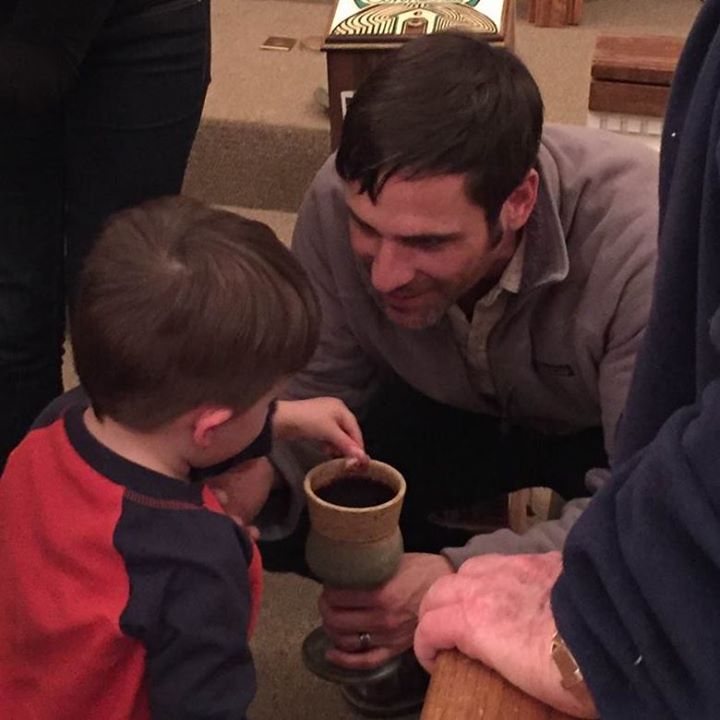
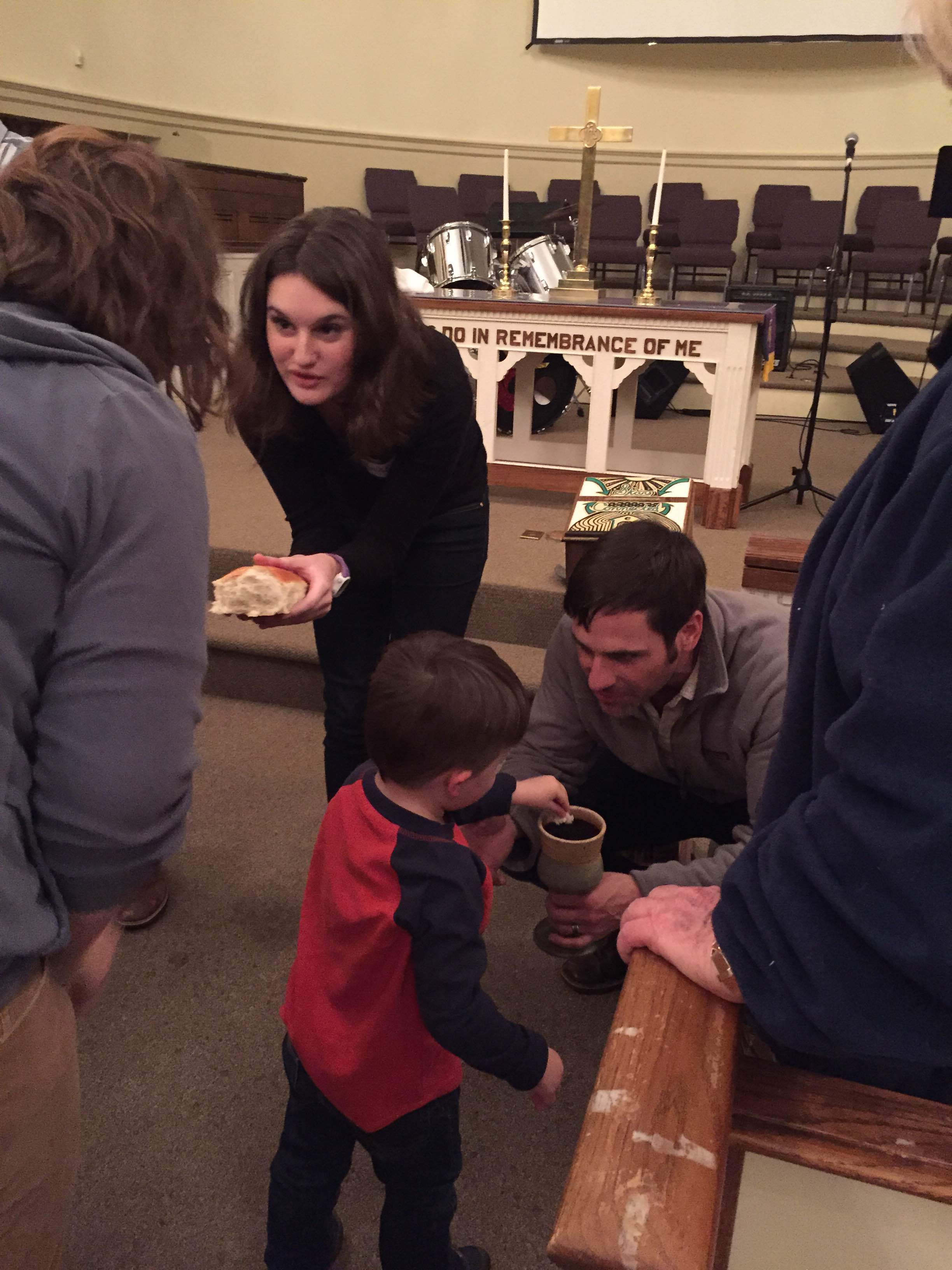
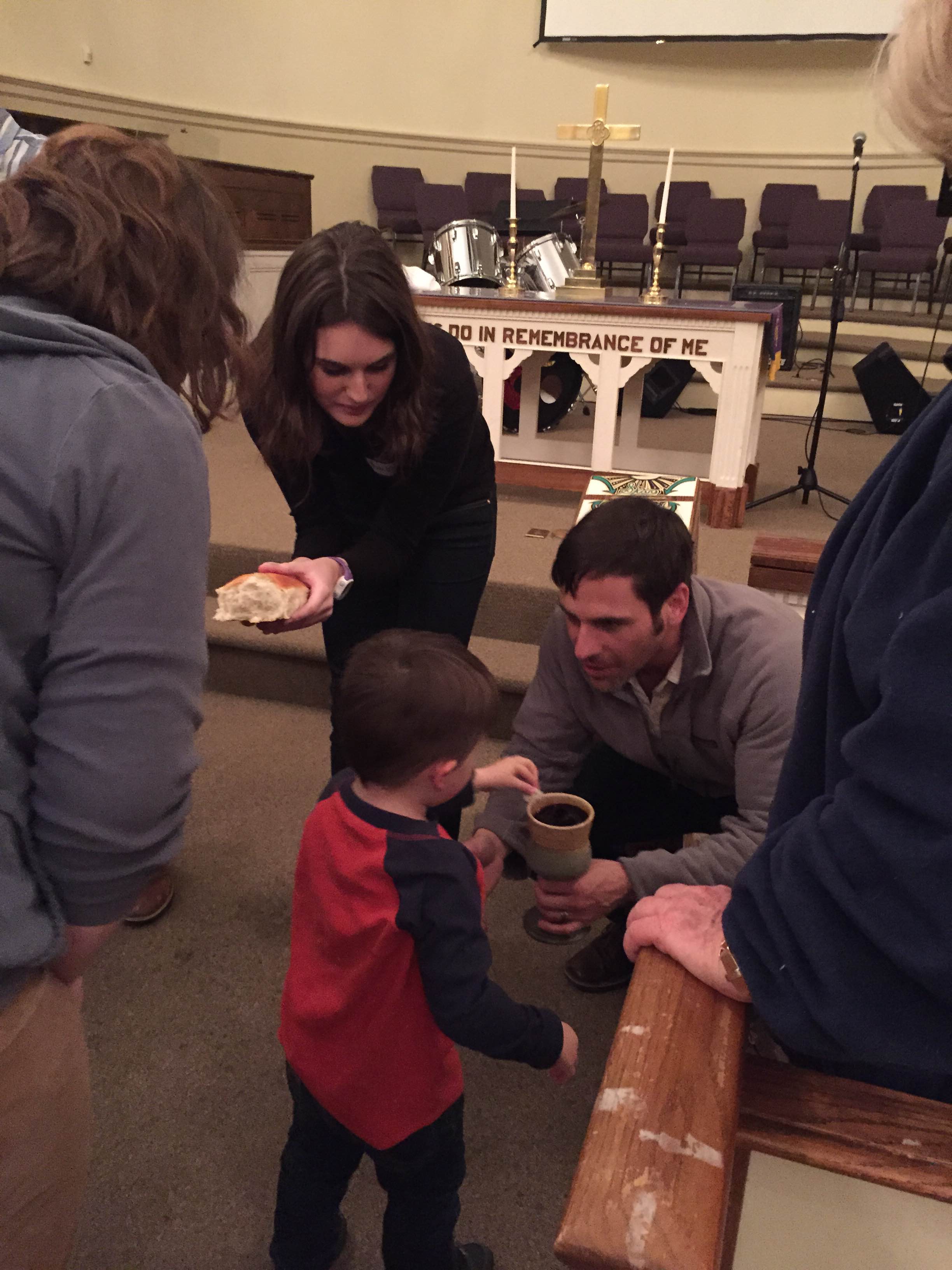
During the sermon, Kezek would not sit still, so I made paper airplanes to keep him busy. By the end of the sermon we had an entire fleet. John had asked a couple of us to serve Communion before the sermon, so after he finished Meredith and I proceeded to the front. Megan and Kezek got in line. Megan guardrailed Kezek forward. When he arrived at the front, Meredith knelt down, extended the loaf toward him and said, “The body of Christ, broken for you.” He reached out and grabbed a piece as though he were entitled to do so. He seemed to know exactly what to do according to the protocol of an open Table, according to some unspoken but known Rule of some unseen but present House.

He then took a couple lateral steps toward me. I knelt, extended the cup, and said, “The blood of Christ, shed for you, Kezek.” He looked at me I swear with a new set of eyes—like I was the same old father but also someone brand new—dipped the bread in the cup, put it in his mouth, took a few more steps and, without instruction, knelt down on the altar (even though most in line were going straight back to their seats after receiving the elements). He knelt there like it was exactly where he belonged. He miraculously stayed still for about ten seconds while the King of the Universe tore an infinite wound in space and time and flooded the heart of a child with grace upon grace. I don’t know if that second miracle actually happened, but I think it did, and it is in any case the best explanation for the first miracle of Kezek staying still for ten seconds. And in a certain sense, it is the only thing I really know that happened last night. And it was a miracle.


If there is a single statement I am willing to die for in this world, it is the statement Jesus makes about children and about his kingdom. It is a statement that must be taken in its plainest sense, I mean plain like the periodic table, plain like the tables of the Law. It is elemental and concrete, smaller than any doctrinal statement and yet every doctrinal statement must bend itself around its basic claim. It is found in Luke 18, Matthew 18, Mark 10, and the entire Gospel of John. In Luke it reads like this: Jesus’ disciples have clocked out but people keep showing up at the office, mothers and kids and all that racket. So the disciples start rebuking them, despite the fact that Jesus had already told them they’d be better off having a millstone tied around their necks and cast into the sea than getting in the way of children coming to him (Lk. 17:2; Mt. 18:6)

[I once heard a Calvinist argue that some babies must be predestined to hell because otherwise Christians shouldn’t be against abortion since if all babies go to heaven Christians should therefore endorse abortion. For the record, babies do not go to hell and Christ still condemns abortion, and probably that Calvinist too.]

So Jesus says to them, “Let the children come to me, and do not hinder them, for to such belongs the kingdom of God. Truly, I say to you, whoever does not receive the kingdom of God like a child shall not enter it” (Luke 18:15-17). If you want to spend the rest of your life trying to wrap your mind around God, that is a good place to begin, also to end. 

The reason last night will exist in my memory as one of the most important moments in my life is because last night I learned that leading children into the kingdom of God is the way God uses children to lead adults into the kingdom of his beloved Son. Last night I grew up and became a priest. But then I learned how to become a child by watching my child enter the kingdom and remembering what it was like to receive the kingdom as though I were entitled to it, by grabbing it as though it were already mine. Last night I remembered that in Christ the whole kingdom is already mine, because it is always already His.

I remembered that God comes to us only as grace, and that children do not complain that God comes to us only as grace. Children do not deny their need for grace, only adults. No child has ever argued against original sin, but a lot of adults have. Because being an adult means defending yourself. Adults can become so powerful in their defense that they manage to hold at bay the entire kingdom of God. The gates of hell will not prevail against the Church, but that doesn’t mean that I can’t keep the gates of my heart locked. It doesn’t mean that I cannot become the gates of hell and reject the gates of pearl. It does not mean I cannot grow old.

I was reminded last night that to enter the kingdom of God I had to open myself up with something like the unquestioning vulnerability of a defenseless child, or that of a crucified God. I had to become open to grace like I needed it. Jesus opened himself up to nails like he needed them. Opening up to grace feels scary like opening up to nails before you do it, but then somehow refreshing like a shower after, like Jesus on his walk up Golgotha but then like the soldier on the way back down.


One time as a child I broke my toe while trespassing with my godless brother and sister and cousins (I was the youngest and therefore the most innocent) in a foam factory that may as well have been Disney World. We lied and said I broke it on a brick pile. After it swelled up like a light bulb my dad came at me with the leather punch out on a Swiss Army knife, like a soldier with a sword but more like a father whose heart hurt like my toe, but worse. As he twisted metal into my flesh out came the crimson flow and with it like a Siamese twin my confession. I confessed that we were all liars and nothing in my life has ever felt as good as that knife and that confession. Nothing has ever felt more like grace either. It was amazing relief in the form of blood spattering all over the place. And it came only when the one I trusted most stabbed me in the place that hurt the worst. I had to open myself up like a vulnerable child, or a crucified God, because I had lied and closed myself up like an old man.

Kezek helped me open up again last night. And I can say that this is one of the few times I did not complain about my need to open up, to be wounded, and to be healed. When my time came to take the Elements, I confessed to God that I am a liar and it felt so relieving and so bloody to do so.

I also remembered last night that there are a lot of things I ask of Jesus, and that Jesus is always giving me more than I ask for, even though sometimes it feels like he’s not giving me exactly what I ask for. I remembered that I need a community of people to lead me to him and to lead my children to him, not because Jesus needs a community to accomplish his work, rather because Jesus’ work accomplishes community, because it is the work of receiving people, which is the hardest work of all. I remembered last night that God’s House is the community of Jesus (Eph. 2; 4; 1 Cor. 6; 1 Pet. 2).

Lastly, I remembered that in God’s house there is only one Rule: Receive the Gift of your life by receiving Jesus’ death: “Eat my flesh and drink my blood” (Jn. 6), and this do as though you are entitled to do it and as though your life depends on it, because you are and it does.

The Table is open. Come to Jesus.

“This do in remembrance of me” (Lk. 22:19).

IMG_2208 IMG_2207 IMG_2206 IMG_2205 IMG_2204 IMG_2203

Can the Church Expect Grace from the State? Honest Questions Regarding the Execution of Kelly Gissendaner

My honest question is this: should Kelly Gissendaner’s conversion / rehabilitation be the reason Christians oppose her execution?

I cannot help but think if there is a specifically Christian appeal for an inmate’s life on death row, it must be an appeal against the death penalty itself. And if such an appeal is made, it should be made for every such inmate and, in a serious sense, all the more urgently for those who have not converted / been rehabilitated–for Saul more than Paul, for Isis more than us. Is that not the scandal of the Christian faith, a faith built on the foundation of a cross, a faith that is expressed when–and only when–the cross of Christ is a cross fit for the likes of me, for us: the guilty lovers of God called the Church? I don’t want to die, but neither do I want anyone to, after they are dead, have their souls cast into hell.

I struggle to know what a faithful perspective is here. I see the Church’s relationship with the state as the proper relationship between grace (Rom. 12) and justice (Rom. 13). To what degree do we want the state extending grace for offenses against other human beings? On what basis and in whose name would they extend grace? And would that not fail to preserve the necessary tension between the church and the world, the tension between two ideals that need one another to remain intelligible? Is this not the difference between between two kingdoms that are decidedly two kingdoms. And until there is only one kingdom to speak of, mustn’t we affirm a just state and a gracious Church, as though God somehow holds both accountable respectively, precisely according to these two distinct organizing principles? –Since he does.

I want Gissendaner to live, but that is because I don’t want anyone to die. I know that I belong on the gurney with her, with everyone. I also know that every deathbed is really just a gurney and no natural causes are natural. There is a judgement and death is its execution.

But Jesus placed himself under this judgment and executed death itself. And he did so by dying at the hands of the state without erecting a kingdom that replaced it–rather, a resurrection, an entirely different order of an entirely differently-ordered and -oriented kingdom, indeed, the kingdom that is established in this world by Christ and his followers giving their lives for a world eager to take their lives from them.

So as a citizen of Christ’s kingdom, I must oppose any execution because Christ is every execution. But as a citizen of the United States, what am I to say? Harsh as it is, this execution cannot be called unjust, can it? Should we impose our standards of grace on the victim’s loved ones? Are we not in danger of endorsing injustice?

I am praying for the peace of God to be upon Gissendaner today; for all the families and friends involved, those of the victim and those of Gissendaner; and for the local church within their reach to be impossibly compassionate at all cost, no matter to whom.

Looking for clarity, not debate. I have no strong position here, just honesty. If there is anything in know to say with certainty at a time like this, it is:

Come, Lord Jesus.

A discussion that ensued:

  • Warren McClendon: I’m with you `Jeremy. The Gospel of Christ demands that we be far more concerned for the welfare of the non-believer, particularly in this situation. But for the record, I oppose the death penalty for the same reason I oppose abortion. The giving and taking of human life is the prerogative of God alone.
  • Jeremy Spainhour: I tend to agree, Warren, but I think a distinction must be made between the function of the state and the function of the Church–and I am not a calvinist, so I probably would see that distinction differently than most folks here. 
         In any case, the ideal function of the state is preserve a just society. I see abortion as a violation of the state’s function. I see the execution of a murderer as an attempt to preserve justice. The two are not comparable in my book.
  •  Warren McClendon: While I am a Calvinist myself, I do distinguish between the role of the state and the role of the church. We render to Caesar what is Caesar’s and to God what is Gods. There are however rare circumstances when I believe my faith compels me to intervene in secular affairs. And one of those circumstances is when the welfare of another human being is at stake.
  • Jeremy SpainhourI agree with that, Warren. I just think the Church, at most, should call the state to be faithful to its own purpose, not to purpose of the Church. So we agree on the abortion issue, I think, because we both believe the state should be expected to preserve justice for the unborn. And yet, I think we agree on the present matter because we both see the state acting consistent with its own purpose. Hence the dilemma.
  • Warren McClendon: Caesar can do with his own house as he desires. But I advocate for the life of the child, the believing killer or the unbelieving killer for the same reason. Their lives are valuable to me and to God as well. Justice is a Biblical concept as well as a secular concept. But I do not think killing falls within the definition of justice from the Biblical point of view. Though I must acknolaged that a secular government frequently views justice differently.
  • Jeremy Spainhour: Let me just press this particular issue, again, not from a strong position but from serious inquiry. 
         Killing simply does fall within the parameters of justice from a particular biblical point of view–particularly, that is, from the point of view of the Old Covenant, hence Jesus’s amendments of, e.g., Deuteronomy 19 (cf. Mt. 5-6). There is a definitive shift in the organizing principle of the Old and New Covenants, namely, the justice commanded in the Old Covenant is preserved and yet transformed into grace in the New, but only by preserving it. It is indeed “a covenant of blood.”
    That said, I see the Old Covenant in principle as God’s standard of justice for the nations. Indeed, Caesar’s “own” are only provisionally Caesar’s. “The earth is the Lord’s and the fullness thereof, the world and all who dwell therein” (Ps. 24:1). This is why the prophets announce judgment on the nations primarily for (a) idolatry and (b) injustice. The coin may be Caesar’s, but Caesar is God’s.
    This is precisely why I struggle with this particular issue. I can’t help but acknowledge that “life for life, eye for eye, tooth for tooth” (cf. Dt. 19:21) is, by definition, the express principle of justice in society.
    The Gospel is a stumbling block because it suggests that the human offense is such that we all belong on death row. “Take up your cross” is not simply a principle of self-sacrifice; it is a confession of guilt–“take up your cross,” not “lay down on your altar.”
    The logic of the church’s preservation of life is not on the basis of the common innocence of human life. It is precisely the opposite. In principle, I can’t escape coming to the following conclusion: (a) the Church agrees with the state that Gissendaner is guilty of her offense; (b) the Church agrees with the state that death is the appropriate punishment for the killing of another person; and yet, (c) the Church does not believe death is the final judgment and therefore grace is available for Gissendaner with reference to the final judgment.
    There is an interval between ‘b’ and ‘c’ that I simply do not know how to resolve, and I have yet to read or hear anyone who has adequately addressed it. How should the Gospel of eternal life for those guilty of sin (everyone) translate to the Church existing in an (ideally) just society? How can the Church call the state to be gracious without (a) endorsing injustice or (b) confusing the two?

Remembering in the Fog, Dreaming in the Clouds

I just read in the news the following headlines: Eight Breakthrough Innovations in Technology.

Here are the breakthroughs of the breaking news:

1. Connecting to Consumers Through Ideas
2. Users Create Unique Social Portraits Based on Facebook and Twitter Feeds
3. A Multicharger That’s Both Stylish & Functional
4. This Week in Brand Strategy and Marketing
5. Text-Enabled Scavenger Hunt Offers A Novel Way to Explore Your City (<–?!?!)
6. Timberland’s Recycled Earthkeepers Micro Shop
7. Seth Godin: Have No Expectations in the Headlines (<—agreed…)
8. Fred Wilson: Program or Be Programmed: Learn how to hack something together so that you can get people interested in your idea…

Irony of Ironies. All is Ironic. And, truly, there is nothing new under the sun. There is only a constant rearrangement of boredom (cf. Eccles. 1:1-9).

A thousand years ago we did not have airplanes, but we did have the sky. We did not have iPhones, but we did have conversation. We did not have 1,000 friends, but we did have friendship.

There are many things that are useful, but there is nothing that is new. And most of what is used in new ways is no longer useful toward their intended ends. Planes were invented with a dream of getting closer to the sky. But nobody flies or dreams like that anymore. Now we fly simply to get further away. And we get upset if there is no inflight movie about a man who can fly.

Phones were invented with a dream of getting closer to people who were further away. But now we use them to get further away from people who are closer than everybody else. Sometimes we even takes flights to see people otherwise live in our phones and while there spend most of our time with people who live in our phones.

Friendship was invented with the dream of creatures who would look at each others’ eyeballs and never get over just how strange a thing is an eyeball and how miraculous a thing is sight. But we have found ourselves wandering through a world much less spherical than an eyeball, occasionally having to thump on the glass to see if our friends will even turn their heads, or if they are even real.

Perhaps, then, it is not our dreams we should pursue, but our memories. Perhaps the life of wisdom is a life spent learning what it is we have forgotten.

We have forgotten that daydreaming about flying always feels more miraculous than an airport. We have forgotten that the people who make airports so miserable are the same ones that fly everyday. But they still seem so miserably ordinary, even though people have from forever been dreaming of their lives. But only people could dream such big dreams and then make plans big enough to crush their dreams. No dog has ever worn a cape at night. But every single man who ever lived has, although most men quickly grow out of capes. Dreams remember that the whole world is magical until they become something other than dreams. Men turn dreams into plans, and exchange their capes for suits. I don’t know much about being a woman, but I do know that every little girl has dreamed of being a Blue Jay. I also know that not a single Blue Jay in the heavens or on the earth has ever dreamed of being something so miraculous as a little girl. They have not even dreamed of flying.

The newsfeed is stimulating, to be sure. But let’s be honest: it is not news and this is not friendship.

I remember the first times I heard news: it was every time I heard my grandfather tell the story of the day he saw my grandmother for the first time. “She was wearing a white dress. She looked like an angel.” And suddenly I couldn’t tell the difference between something old and something new. And in that lapse of time and space I would remember a dream that was either always there or always new. I remembered that angels were the reason I had always wanted to go looking for stars. And that girls in white dresses really are angels.

He would tell of different stories from the farmhouse and the fields and of plain things like being a family. And I would remember for the first time that I am homesick. Not only that, but I would ache with a longing for a home and a family of my own. It felt like the most distant and most ambitious dream of all. It felt like more of an innovation than the Internet or even the strange idea of time travel. I wasn’t sure it wasn’t time travel. In any case, it was the old that I wanted–and it was as old as memory itself, perhaps even as old as Dreaming–and I wanted it because I wanted it to become new.

Perhaps there is nothing as new as the memory of our fathers and nothing as innovative as the dreamworld where that memory can find its new home.

#fogofeden
#hopeofhome
#miracleoffamily

Fifty Shades of Hell: A Personal Letter for the Human Race

Dear Men of the Twenty-First Century,

As a husband and a son and a father of two sons, I am writing this as an open letter to anyone who identifies himself under any of these titles and for all who identify themselves as human. I must confess that you may not be interested in the subject matter, because it is about love and Valentine’s Day, but I assure you it is has plenty of nightmarish scenes and is cast full of Halloween’s shadows. It should potentially, therefore, strike a chord of interest for readers of an array of tastes.

It’s about the upcoming Valentine’s Day release of the film Fifty Shades of Grey and why humans must refuse to watch it, just as humans must refuse to watch pornography. It’s not that I think this film will be particularly pornographic. I frankly know very little about it. When asked to write this letter I proceeded with research about as ambitious as a snooze button. I watched exactly one movie trailer and read exactly two paragraphs from a Wikipedia article. Nonetheless, I am utterly convinced that my judgment of this film, as well as the book, is as informed as if I had compared it with every pornographic film and book ever imagined. There are simply some things that must be judged by their cover–some things that reduce to pure appearances and by all appearances deserve a preemptive No!

But again, it’s not that I think this film is going to be particularly pornographic. I just think our culture is particularly pornographic and that this film is a particularly consistent expression of our culture’s belief that “sexuality” is something that can be and ought to be “expressed.” Any “expression” of “sexuality” is always already a perversion of sex. Discerning the difference between what is essentially sex and what is essentially not is as self-evident as the difference between ray and shadow. It only becomes a confusion when trying to distinguish between shadow and shadow, because the singular shape of hell appears in many amorphous shades.

Humans were not designed to have sexuality. Humans were designed to have sex. This is the difference between a sensation and a conversation, a sneeze and a duet, the image of a lone man (Gen. 5:3) who rules over his wife (Gen. 3:16) and the image of God shared by two who together rule over the world (Gen. 1:26-28).

Beasts are designed to express their sexuality through sex. Humans are designed to express love through sex. Sex can serve either as the purest analogy or tragic parody of love. This is why pornography is the most outrageous form of beastiality. Pornography turns humans into beasts.

All forms of sex that are self-directed, that seek only gratification, deface the soul of another. There are many other ways to do this, but sex is the most conceivably personal context in which to dehumanize another person. The person who has sex to gratify himself is simply having sex with an object, or perhaps with a sensation, or perhaps more simply with himself. Pornography trains you to use others to have sex with yourself. It begins with an appetite, proceeds with consumption, and never shares toast in the morning. Keep feeding it and soon the whole world becomes a screen, people flatten out into pixels, and you become ruler in the fantasy of a one-human universe.

Beasts’ appetites lead them to this type of sex. Men’s appetites do too. But beasts have an excuse. They are beasts. Men do not have an excuse. They are men. But when men treat women like beasts, they become what they eat. Historically, Christians have understood these appetites as the greatest proof of original sin, the common privation of humanness that must be transformed to restore God’s essential human design. Today, appetites are part of the aggregate of one’s identity, which the world cheers forth to express in all its aggregateness. The idea that something is actually wrong with me is actually the only wrong idea. Jeremiah announced the judgment of a people who no longer knew how to blush (Jer. 8:12).The modern world has announced a judgment on blushing.

This was accomplished in part by the term we invented to sanctify the appetite for sex called sexuality, which a person can now “express” because it is now something a person “possesses.” Some people posses a sexual appetite for children and express themselves by possessing children. This is the inhuman logic of “sexual expression,” but it is nonetheless entirely logical. Sexuality in abstraction from sex itself, and therefore in abstraction from another willing human subject, is simply an appetite for sex itself, which is precisely what turns human subjects into humanlike objects and sex into beastlike consumption.

I’m sure women are guilty of this as well, those who look at men with the eyes of a Medusa and the longing lips of a Praying Mantis, but I can only speak on behalf of men as a fellow man who has less-than-human appetites but a healthy fear of full moons.

I suspect this movie will be about as grey the other side of a full moon. Some things really are just plain black and white. Eclipses are like that. The other side of the moon is always an eclipse. This movie is a dark expression of hell itself, which always comes as a seduction to become something other than human by treating others like something other than humans. It rejects the command to love your nearest as you love yourself. You love yourself as a subject. To love others in that way requires you to share their shoes long before you share a bed.

The litmus test for humanness is empathy. It may be the litmus test for heaven too. God did wear human shoes, after all. But it hurts to be empathetic in a human world, sometimes because you feel the pain of another and sometimes because you refuse to consume another to numb your own. Jesus began his ministry fasting in the desert and ended his ministry dying on a cross. And it was a long walk from the beginning to the end. Heaven hurt like hell for Jesus in a world with such a particularly acquired taste and such thinly-soled shoes.

Hell is a place where everybody lives to find pleasure and avoid pain. It is the worship of one’s own body, the denial of everyone’s soul. Hell has hollow eyes and scythe-shaped teeth. It is always empty and always eating. Wolves don’t eat until they are full; they eat until there is no more food. This is not an appetite for life; it is an appetite for death. It is the appetite that turns everything it eats into poison.

The fact of sexual appetites means something has to die, either the appetite itself or the thing it seeks to consume. But the pain of self-giving hunger will eventually turn pain into love. That is why the truest symbol of love is a crucifix. Love’s desire for the other is precisely the desire to preserve the other for the sake of the other’s self. Love does not seek to consume and absorb. It seeks to marry and hold hands. Love longs to open its heart, not to open its mouth. Its desire is to become vulnerable to another, which is the antithesis of the desire to control. It is active passivity and passive activity. Lovers have sex because they love each other. It is their way of saying “thank you,” which is not the same as saying “pass the meat.” It is not two expressions of sexuality. It is one expression of a union. Sex is always a consummation of what is already fully there: a mutually identical self-donation and openness in the interpenetrating, inter-subjective harmony of a wedding. Sex is simply the special analogy of love designed to become transparent unto itself. It’s called marriage, and it is dangerously analogous to the One who created it.

But the taste of self-gratification will eventually turn all things bitter and your gratification will become your hell. Beasts have sex because they hate their sexual frustration, but they never stop being frustrated. Sex is always a consummation of what is always hatefully empty. It is self-expression. It is a life that has immortalized emptiness as its god and when the paint dries will live forever in its image.

It is possible to devour the whole world and lose your soul.

Don’t let this movie whet your appetite. Learn from my mistakes. Be a man. Take up your cross.

Sincerely Yours,

Adam

Love Be Damned: The Atheist Longings of a Christian

Christopher Hitchens was right when he said that raising children comes as a “solid lesson in the limitations of self to realize that your heart is running around inside someone else’s body.”

Perhaps that is why Christopher Hitchens was an atheist. If ever there is reason for anxiety and fear and doubt in this world, it is not for all that is threatening and hideous and evasive in this world–it is just the opposite. There is no better reason for despairing of this world than in those moments when the dark dross of its surface gives way to an eruption of its hidden but essential light. We are enslaved to the glamour of its haunting goodness. We cannot help but being grief-struck by the wonder of love and the love of loving.

That is, the moment we experience the miracle of being human, most deeply revealed in the experience of being a parent and “realiz[ing] that our heart is running around inside someone else’s body,” it is certainly at that moment that we should run from our humanness. Blot out the painted day and the glowing night; ignore the nagging compulsion to kiss your son’s forehead, to gesture to him the embrace of his whole life within your own; curse the day you and he were born because, damn it all, it is all damned to die.

I sympathize with the atheist on this point. The world betrays us. It convinces us we should love it and all that is in it. And yet, it gives no account of the way the fullness its loveliness can only be felt in the simultaneous awareness of the vacuity of its endurance. Hatred for God is born out of the nakedly futile jealousy of love, a jealousy directed to an Object we know not other than that we are not It, a jealousy that is both outraged and imprisoned by its foreboding consciousness of death in a world that lives on only to keep drumming its funeral cadences. We would crucify the One responsible for this world if we could get our hands on him.

How can we deny that feeling when we consider not only the inevitable loss of all things, but, most wrenching of all, that those we love most uncontrollably and mysteriously will themselves discover this lostness and will themselves be pulled into its abyss? How can we not be consumed by sorrow upon seeing the unknowing innocence of our child’s trusting eyes? Why should we pretend that love is something that the world should strive to discover, something to enjoy, something to spread like a flame in the winter’s night. Why should we thrust ourselves into this ocean of embrace in full recognition that we are too weak to not be ejected from it, and until then we will be carried to its edges by wave upon wave of grief? Why should we delight at yesterday evening’s neon Kentucky sky as though it were anything but the repetition of that daily sign that all light will be forced into the dirt? Why does autumn become the fall only as leaves die?

The great plague of love and our loving of love is identical with an acute heartache for this dying world. The creed of the human experience is thus: “God has made everything beautiful in its time. Also, he has put eternity into man’s heart, yet so that he cannot find out what God has done from the beginning to the end” (Ecc. 3:11).We are cursed to love with an eternal love and to do so within a mortal body. We do not fear death because we will lose life; we fear death because we will lose love, and because we know that all love will be lost. And the only thing that could make this worse, the only thing that could add to our torment, is to take it all in and greet it with hope–as though the world around us will one day awake from its comatic state to greet us back for all eternity. That is a pain that will always tempt us with the seduction of atheism: that that which makes us most truly human can be explained away as pure illusion.

The gospel of atheism is the most rational way of coping with the loss of all things. It is the truest “opiate of the masses.” And wherever there are lives that are oriented towards death, whether by building temple-sized coffins for a name to live on or by consuming this world like a prisoner’s last meal, atheism is believed–and this atheism unwittingly or not exists in every religious community. But the honest atheist knows that the sooner he confesses that love is an illusion, the sooner he can get on trying not to love, which does not necessarily imply a kind of violence toward another but does indeed imply a kind of violence toward oneself, a tenaciously willful purging of one’s most uniquely human qualities, which sink like bait into the experience of life without hiding the barbs of mortal futility: the compulsion to care, to embrace, to laugh, to sing, to be still.

The Gospel of Jesus Christ is foolishness. It is the foolishness of the cross, which not only believes in love in the face of death, but discovers love in the Face of death–because in either the greatest deception or the deepest Truth of this world we believe that the Face of Death was worn by the Face of God. And we therefore believe that death has been swallowed up in Life, and that in this death–and only This death!–the truest form of Love is revealed: the Love of the Beloved which dies for the salvation of a world which is also beloved: the Son of God whom the Father gave to the world, the Son of Man who on behalf of the world gave himself back to the Father, together send the Holy Spirit to pour forth himself with the flint-like conviction that Jesus truly is Lord, that God truly has raised him from the dead, and thus that we are free to love the God we once hated and so too the world we once hated to love.

And all this we must believe by embracing the implications of the cross with its infinitely unreconcilable polarities which require nothing short of a miracle to believe: that the death of the world is precisely what world deserves and the death of God is precisely what the world is worth.

It is in this foolishness, we somehow know–beyond our capacity for proving how we know–what everyone intuitively knows but rationally–and quite rationally–refuses to believe: that it should be, that it must be, True: that the setting sun really will rise in the morning, that from the Fall really will rise a new Day, that the eternal nature of love has a future fitted precisely as its home. And in knowing that, we are free to live in full abandon to the radiance of life in the light of love. And we can once again kiss our children without staining our lips with an unbearably bitter wine.

“Therefore, since we have been justified by faith, we have peace with God through our Lord Jesus Christ. Through him we have also obtained access by faith into this grace in which we stand, and we rejoice in hope of the glory of God. Not only that, but we rejoice in our sufferings, knowing that suffering produces endurance, and endurance produces character, and character produces hope, and hope does not put us to shame, because God’s love has been poured into our hearts through the Holy Spirit who has been given to us” (Rom. 5:1-5).

“But whoever blasphemes against the Holy Spirit never has forgiveness, but is guilty of an eternal sin” (Mk. 3:29).

God’s Impossible Commandment

It is easier to believe that Jesus is God than it is to believe that God is Jesus. Or, to put it another way, it is easier to believe that Jesus is the truth than it is to believe that Jesus is the way. Or, still another, it is easier to believe in the promise of the clouds than it is to believe in the command of wood.

We cannot be persuaded to believe either that Jesus is not God or that God is not Jesus, lest we find ourselves worshiping a merely sentimental god on the one hand or a merely powerful god on the other. These two idols of Christian history lead inevitably to something far smaller than the claim of Christian faith, something as pathetic as a social gospel or as idolatrous as a social-less gospel—something that is always reducible to a political ideology—which appears wherever politics are taken more seriously than faith.

Every human affirms the death of humanity. Every religion affirms the life of god. But only the Christian religion affirms the death of God as the life of man, since it situated the resurrection of Man within the life of God. But that Man did not merely call himself the truth and the life, nor did he tell his followers to watch him with empty hands. He called himself the way. He then picked up a cross from a pile of crosses “as numerous as the stars in the sky” (Gen. 26:4) and invited them on a journey. It is there that they discovered who God is and what it means to love. But it is only there, only he is God, and only that is love. Anything less is not Christian, not god, and not love.

If this means anything, it means that being a Christian in a human world will at times be as painful as being God in a human world. Love is neither a sentimental gesture nor an optional command anymore than Jesus is a sentimental gesture or an optional god. Love is as hard as wood and as serious as salvation. And since the potential for love is as present as the existence of wives and husbands and children and neighbors and enemies, then being a Christian is as full-time as being a human.

Lord, help us do the impossible.

“A new commandment I give to you, that you love one another: just as I have loved you, you also are to love one another” (Jn. 13:34).

‪#‎faiththatfollowsalongtheway‬