The Salvation of the World–from Me

The reason the real Jesus is unwelcome in many of the religious institutions that bear his name is that before offering us salvation from sin he demands that we first embrace his definition of sin. But as soon as he does that we discover that none of us truly want to be saved in the way he wants to save us. Save us from death and hell, from hopelessness and fear, save us from our enemies and our obstacles–sure. But don’t save us from our pride and from our selfishness. Don’t offer us liberation from our throne of independence.

It is the same reason so many reject the gift of the Holy Spirit in preference to a doctrine of the Holy Spirit. Don’t offer us the gift of the Holy Spirit when the experience of the Holy Spirit makes us feel unholy, when it is like the experience of nakedness, of having our sins ever exposed to our nagging conscience in the light of truth; the Spirit whose very job description is to convict us of sin and righteousness and judgment (Jn. 16:8); who intrudes on our self-justifying rationalizations for placing ourselves above others; who tells us to sit with the stranger and give time to the nobody; whose alien voice calls us to crucify our pride and say I’m sorry and I forgive; who insists that it is always more right to be humble than it is to be right; who refuses to take our side even when it is the right side when on the other side sits a hurting spouse; the One who comes and buries himself deep inside our ego to bring to our will the true gift of salvation–a cross–and tells us that worship doesn’t begin with a Chris Tomlin album but with a custom fitted cross-shaped altar laid out for our self-worshiping will, so that he can resurrect in us a will that is both Other and other-centered, a will that is generous and gracious and impossibly selfless and forgiving, a will that seems to care about everyone but itself, a will whose dreams and ambitions have been hanged on the eternal prefix: “Not my…”

Salvation by means of the cross means the world needs salvation from me. The good news the Christian proclaims is that Christ was crucified and that I was crucified with him. You no longer have to fear God’s justice and my injustice. The good news only sounds good in the ears of others. But for the one who proclaims it, it sounds like a song of lament, like a prayer of forsakenness; it sounds like Gethsemane. It is good news for everyone but me. 

No wonder they crucified him.

“Have this mind in you which was also in Christ Jesus:
“Who, although he existed in the form of God, did not regard equality with God a thing to be grasped but emptied himself, taking the form of a slave, being born in the likeness of men. And being found in the form man he humbled himself by becoming obedient unto death, even death on a cross…” (Phil. 2).

But I suppose if we allow him to show us the depth of our sin as it truly is, if we allow him to define sin for us inside that grand fortress that has triumphantly protected our fragile ego since the day we were born, if we see ourselves as God sees us, naked and laid bare before the one to whom we must give an account of our life–then and only then will the cross become more than yet another self-serving religious artifact. It will become at once the person we never could have been and the Person we so desperately need. It will become for the first time what it always has been–God’s proof of his love for sinners (Rom. 5:8), my only hope and the hope of the world.

Perhaps then will we be saved from our sin. Perhaps then will we be free to love. And in our freedom to love perhaps others will find freedom to love, and then I will become the ‘other’ for whom the good news was designed and will begin to understand the logic of the cross and the beauty of a community that wears it on its sleeve. And if that catches on, perhaps then the real Jesus will again be welcome in the institutions that bear his name and we will become the real Church he died to resurrect.

‪#‎crucifiedwithchrist


A Response to A Pastor’s Moral Failure

Since the virility of a local pastor’s moral failure has already begun, for my part I would simply like to preempt whatever our initial reactions might be with a word in hopes that we would be kept from and inevitable temptations of gossip and self-righteousness and deception that have already begun to arise.

This crisis should be taken as an opportunity for pastors and Christian leaders to pray for and reach out to a large number of people whose trust has been broken in Jesus’ name–Lord, have mercy! But it is also an opportunity for us make haste to take our self-righteous high horses to the slaughter at the altar of humility–to be honest that it is but for the grace of God that we have not all succumbed in the same way in our behavior, since we have all succumbed in the same way in our heart. And according to Jesus we share the same guilt therefore (Mt. 5:27-30). But the Gospel with which we have been entrusted is nothing less than the announcement that God has shared that guilt with us–and forgiven it. And if Jesus can identify with my guilt at the cost of his blood, how dare I not identify with this man’s guilt at the cost of my honesty? I am guilty of lust, and I say so publicly today because I know that to deny my guilt is tantamount to denying God’s grace. If I evoke the name of Jesus, I do so because I have to, because I’m a sinner, because I am guilty and in need of grace. To deny that is to deny Him.

So let’s get over ourselves real quick and not be satisfied until all of that smugness about this failure has been mortified in our wicked hearts–until we can weep and not rejoice with those who are weeping today–lest we deceive ourselves and the world about the truth of sin and righteousness and judgment, enjoying a facade of innocence in a tomb of secrecy as regards our own complicity with the sin-list of Matthew 5, which will no doubt render us guilty of the unforgivable sin of Matthew 6. It’s one thing to sin in self-indulgence, quite another to lie about doing so while pointing with squeaky clean hands at another who’s sin has been exposed. But I need to warn you today that if you share the basin with Pilate, you can’t share the cross with Jesus.

Hypocrisy is the bread of the devil’s table. Let today be about another Bread and another Table. And for God’s sake, don’t pass the wine. For self-righteousness is wasted blood, and it’s not our blood to waste. 

God, be merciful to me a sinner.

Another World–This One

“In those days Jesus came from Nazareth of Galilee and was baptized by John in the Jordan. And when he came up out of the water, immediately he saw the heavens being torn open and the Spirit descending on him like a dove. And a voice came from heaven, ‘You are my beloved Son with you I am well pleased'” (Mk. 1:9-11).

We cannot see as God sees, for the world is a fallen place. The curtain of heaven has dropped. The world seems to us duplicitous in its grandeur and terror, in its beauty and despair, in its capacity to provide for the unseen sparrow and its capacity to turn to ice. Creation is groaning in labor and in suffocation, the sign that is more than a sign that Mother Nature is ever losing her battle with Father Time. Every life she offers up to the heavens is snatched away and carried by a hand that points up only when it is dark. The heavens are dark this side of the veil. We cannot see as God sees.

But we can imagine. And God has so chosen to enable us to close our eyes and visit with an aching heart and unfettered thoughts a world with no more night, with no more goodbyes, with no more tears, a world with no more fatherlessness and angry seas–another world: this one–this world as he made it to be, this world as he is remaking it to be. And though we have lost our ability to see beyond the night, we have not lost our hearing and He has not lost His voice. Though the curtain has cast its dark shadow over our eyes, we can hear the Voice from behind the curtain ever calling us closer, insisting that we boldly look for the tear, that we charge toward the precipice of darkness believing that there is ground beyond the farthest horizon, light inside the darkest tomb, life in the face of the most faithful clock. The voice is calling us to believe that up there in the middle of the night the curtain is actually bursting at the seams with life, because the alien voice of a God whose name cannot be uttered is one and the same as the familiar voice of a Man whose name is Jesus.

“And the curtain of the temple was torn in two, from top to bottom. And when the centurion, who stood facing him, saw that in this way he breathed his last, he said, ‘Truly this man was the Son of God!'” (Mk. 15:38-39).

“The time is fulfilled, and the kingdom of God is at hand; repent and believe in the gospel” (Mk. 1:15).

Being Human: Just Short of Being God

The serpent never summoned the couple to obey him. Should he have his whole project would have been undermined. No one is tempted to disobey God by obeying the serpent. No one in the palace desires the slum. The serpent does not seduce its prey by convincing them that they too can become as serpents. It is not the serpent the couple is attracted to. Turning them against God would be like turning an ear against music, like turning a heart against love. The couple knew that the glory of everything under the sun was a gift. It was a glory like that of the moon—a mere reflection—adorned with a supreme but alien beauty, clothed in light but naked of itself. The serpent had no raw materials to work with.

The Garden world was therefore free of exterior temptations. It was a safe place with no hidden pitfalls or trap doors. The only command was to not commit suicide. Accidental death was not possible. God made death as tangible as a pomegranate but as appealing as a porcupine. There were life-giving trees and one death tree. But it was not just another tree. It had a name, scarlet letters branded on its branches and a foul inhabitant slithering in its shade. But it of itself was no real threat. Scary though he might have looked, the serpent’s fangs were not as sharp as his tongue nor was his venom not as toxic as his words. This was a petting zoo. And despite the recollection of the woman, God never said the tree could not be touched. The tree, like the serpent himself, was under the jurisdiction of the couple. The threat was real but not accidental, not like a car wreck or collapsing factory or a snakebite in a garden. God forbade the fruit of the tree as a parent forbids Drano. This was not about arbitrary power. It was about divine care for a creature to whom he gave such unfettered dominion that he had even the power to uncreate himself. 

Besides, we shouldn’t be so shallow to pretend like we do not know why he put the tree there. Its presence is not a perplexing mystery, only a convenient mystery. Its purpose is hidden only to those who desire to hide themselves. He made humans so close to himself that, if not for the tree, we might forget who created whom.

Of course, the reason this is important to consider today is not because the presence of the tree is now less obvious but because it is by far more ubiquitous. In the Garden there was only one way to die, but out here in the East there is only one way to live. In the Garden the tree of life defined all but one cursed tree; out here the tree of death defines all but one cursed tree (Deut. 21:23; Gal. 3:13). In the Garden there was only one talking serpent, out here the broods of vipers abound. And yet on both sides of the Garden gate the temptation is still the same. 

“When I consider your heavens,
the work of your fingers,
the moon and the stars,
which you have set in place,
what is man that you are mindful of him,
human beings that you care for them?
You have made them a little lower than God
and crowned them with glory and honor
[and] given him dominion…” (Ps. 8:3-6).

Only a “little lower”…that’s all, just as Zeus was only a ‘little lower’ than his father Cronus; a little lower, that is, until the temptation to become just a ‘little higher’ eventuated Cronus’s dethronement, not to mention his disembowelment. It is not those who are most easily tempted to kill the king that pose the greatest threat. The peasants and the outlaws conspire in vain. It is those who are least tempted. It is those who share in the glory, the royalty, and the dominion, who share everything but the throne itself, because of the position of being just a ‘little lower’ creates the illusion we can reach a ‘little higher.’

In even the most perfect paradise, so long as God creates ‘others’ with the capacity to think and will and love, to perceive and behold and enjoy beauty, the temptation of idolatry will always exist. It is not worshiping idols that tempts us. It is making them. It is not the glory of an idol that compels. It is the thought of crowning them with glory and honor and power, the thought that we of ourselves, of our own breath, can do with dust what God does with dust. The serpent can never tempt us to turn against God, but he may very well tempt us to turn our back to him, to come within a hair’s breadth from the center of his glory only to turn around and take our seat. The world may from here be shrouded in its most splendid radiance, but it will forever be stained with one dark, pitifully small, human shaped shadow. Idolatry can be quite sophisticated, because pride can be quite sophisticated.

“What does it profit a man to gain the whole world and lose his soul” (Jesus).

#youwillbeasgods

Mirror of Earth, Window of Heaven

The-Crucifixion-1Just after Jesus breathed his last breath, one of the Roman soldiers who helped fasten him to the cross uttered the surprising confession, “Truly, this man was the Son of God!” This soldier, who, at one moment, blindly hammers away in the darkness of deception only to, in the next moment, be awakened to see the weight of his sin in the light of truth, acts and speaks for more than just himself. He both acts and speaks for the whole Church of Jesus Christ. Our hands are his and his confession is ours.

And so it is, this soldier is the truest image of a Christian at the strained feet of the truest image of God. It is too soon, at this point, to speak of the day after tomorrow, too soon to speak of life after this moment. All we know at this moment is that we have just discovered God, just after we have killed him. Today Nietzsche is right: “God is dead, and we have killed him.” The only one more helpless than the Christ-corpse are the ones at his feet, we who look to God for strength, for power, for justice, for hope–it is we who today discover utter weakness, powerlessness, injustice: the total eclipse of this world’s future. Our faith today seems so ethereal and phony, so unrewarding as the concreteness of our sin still pools below, splattering our upward gaze with the darkest shade of red. We have blood to show for our sin and nothing to show for our faith. We dare not think of the sweet bye-and-bye in the sky at this moment, because eclipsing our view of the heavens is a gaunt draping face, whose open mouth and hollow eyes cry out to us that we have all sinned more passionately than we have believed. And the blood now flooding this ark-less earth cries out from the ground for justice for an all-consuming justice.

The tomb prepared for the criminal wraps is now a tomb prepared for the world. This Friday, we bury all hope. Like the days of Babel, humankind has come together with its hammers and nails in the concerted effort to conquer God. Rallying behind Judas and Caiaphas and Pilate, our leaders up to this point, we have joined the whole world in the war against God. And we won. But just as soon as he is gone we somehow realize that our victory is precisely our judgment; that our preference for godlessness is precisely our hell; that the enterprise of human rebellion is avenged precisely by its success.

This is our cursed confession: we cannot confess that Jesus is the Son of God without confessing that we are the son of the Soldier. Our claim to righteousness and our claim to judgment are the same claim. We speak of the cross of Christ as God’s altar, but it never becomes other than a cross. We come to receive forgiveness from the fountain and are handed a hammer and a long iron stake. We must tap into this fountain with our own guilt. Blood spills out from Jesus’ hands before water can spill out of his heart.

And thus the cross is for us the truest image of ourselves and the truest image of God: mirror of earth, window of heaven. In it we see at once a love that is furious enough to die for another and an evil that is furious enough to kill for itself. God stayed the hand of Abraham to save Abraham’s son, but he did not stay our hand to save his own Son. The cross and the soldier face the world and show us both who God is in Christ and we are in the soldier. We are drawn in a moment to the contradiction of the strange beauty of Calvary, oscillating between ray and shadow but without ever changing its form. We quickly look away only to realize that we cannot look away. Like a sun spot in our vision after glimpsing the naked noonday sky, the man on the cross, whom we so desperately want only to be a man, becomes the indelible image that demands we affirm either the hammering of the soldier or confession of the soldier, Christ’s condemnation or ours, for we all are that soldier. There is no middle ground on the razor summit of this hill. Jesus came not to bring peace but to bring a sword.

Either way, what we surprisingly discover is that the witness of Jesus Christ was not just a radical picture of the divine life in a herculean human form, a human life so infinitely removed from our own (cf. Heb. 4:15; 2:18). Jesus will one day come out of the clouds of heaven, but when he first came he came out of the thorns of earth. We do not simply look to Jesus and see God; we look to him and see ourselves, and in so seeing we see the sad realization that if the human experience is wholly embraced in the radiant transparency of truth, even God himself cannot escape its sorrow. His call to cross-bearing is as much a call to honesty about the human situation as it is a call to do anything unique. It is not the pain of the cross that we fear–indeed, we already suffer from its pain–it is rather the shame of the cross. We fear exposure. We do not want to identify with the guilty precisely because we know that we are guilty. But to hear the good news of God’s grace can only be heard as God’s grace. Jesus comes not for the righteous but for sinners. We must come to grips with the fact that the way of Jesus is the way of every man, a way which is full of cursed thistles and twisted thorns, and believe the announcement that God has come to dwell with us in the briar patch, indeed, to be crowned its king.

So here we all are, entangled in the thorns. Christ did not come to hover above and offer salvation by way of abduction. Instead, he just got stuck. And in so doing he removed all doubt about how we are to interpret this life and this world. The death of Jesus is hanged before us today as the purest human self-portrait painted against a narrow setting that envelops the universe, the intersection of time and eternity, the finite and the infinite, of man and God. The cross consists of both fragments and lines. It is, indeed, the truest mirror of our world, of God’s world, of another world–this one. In it the veil of heaven is lifted to see the chaos we have made out of the beauty that God made out of chaos (Gen. 1:1-2), to see as reflection what God sees as sight–a world of incongruence: a world whose smiles do not match its anxieties, whose thrones do not match its fears, and, thank God, a world whose present does not match its future.

If Jesus reveals something about the essence of the human experience, it should perhaps alarm us on this day that we never once read in the Gospels that Jesus laughed, but we do read that he cried. We never read that Jesus smiled, that he was happy, but we do read that he was enraged, that he “made a whip of cords” (Jn. 2:15). We never read Jesus found even one piece of fragmented hope as he wandered the dusty streets of Galilee and eventually on into Jerusalem, the city that, if any, would have enshrined the hope of the world in its temple. Even as he approached the city, there was no hint of a glistening reflection of hope as the temple was reflected in his eyes. All hope beaded up and fell to the dirt as “he drew near and saw the city, and wept over it, saying, ‘Would that you, even you, had known on this day the things that make for peace! But now they are hidden from your eyes'” (Lk. 19:41-42).

The curtain had fallen. The eyes were darkened. The temple preserved only an illusion. They looked at the temple and saw God. Jesus looked at the temple and saw godlessness. He marched directly to its courts and announced its end (Mk. 13:1-2; Jn. 2:19). The people condemned him for it (Mk. 14:53-65; Jn. 18-19). And when they crucified his flesh, a startling thing happened, the temple curtain, the dwelling of God, tore in two (Mt. 27:51). We dared to look beyond the curtain and to our dismay found nothing. Then, in a shrieking moment of terror, turned to the Crucified One and saw ourselves. And we saw God. And we saw the tomb. And together, with God and with Hope, we all marched tomb-ward. On Good Friday we discovered the love of God and the power of men, but that is all we discovered. If there were more of God to be shown, there was no possibility of seeing it, for the tomb is absolute darkness. And our eyes had been imprisoned behind its stone. There nothing more to say about this day, nothing else to see. If ever there is, it will require the miracle of a new day. Until then–silence.

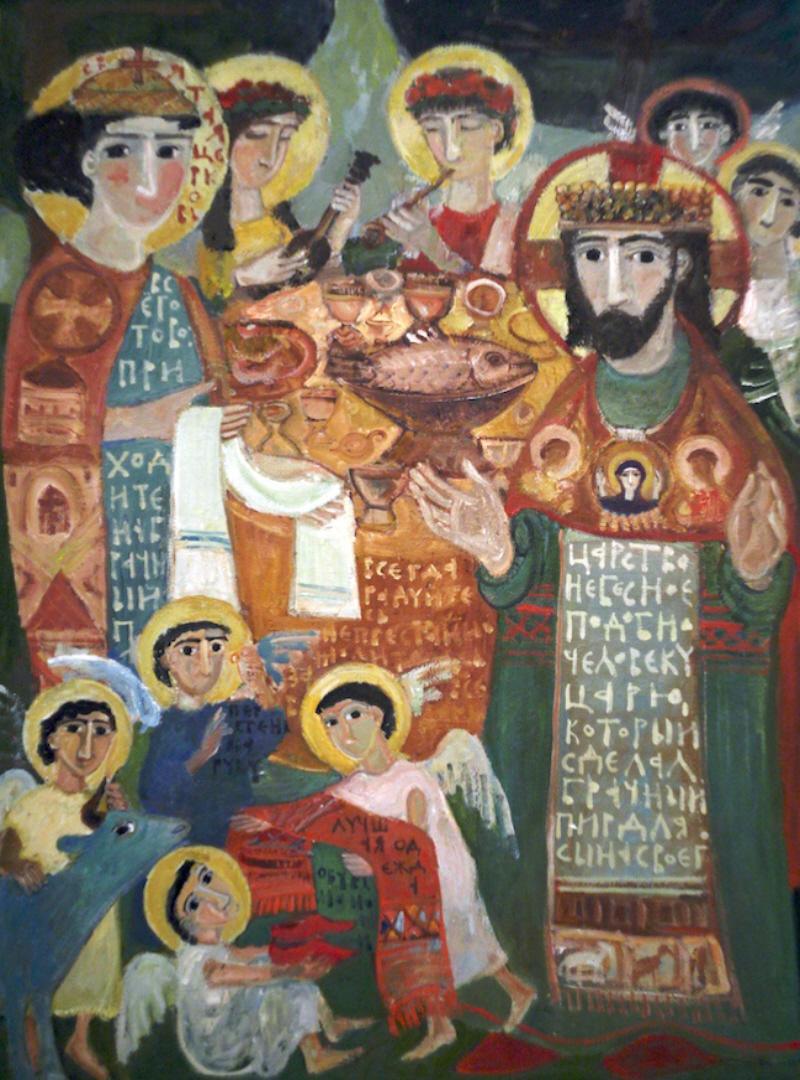
Less is Less and More Is Less: Rescuing Witness from The Hands of Mission

yelena-cherkasova-the-the-kingdom-of-heaven-is-like-unto-the-leaven-hidden-in-the-lump-undated

I recently heard a pastor say, “Invest in people who invest in people.” I’m glad he wasn’t Jesus’ pastor.

I’m pretty sure this is evidence of the growing assumption that the Church’s mission is to ”build the kingdom,” in which case productivity would need to be a priority. Of course, this language of “building the kingdom” is actually never used in the Bible. The closest we get to it is a prayer that our Father’s kingdom would come on earth, so that heaven and earth would find some sort of alignment, which Jesus associated with His will being done. But what people likely mean by “building the kingdom” is “building the Church,” and that language is indeed used; it’s just that the Church is never the subject of the sentence. Jesus told Peter he would build his Church (Mt. 16:18). In fact, even when it came to building a leadership team of workers, he just told them to pray “to the Lord of the harvest to send workers” (Mt. 9:38). You almost get this weird sense that the only way churches grow, people are mobilized, and “the kingdom comes” is when God answers prayer; as though anything we can do for God is only possible if he does it for us; as though the heavy burden of the kingdom is not dealt with by finding “people who invest in people” to share the burden–a burden which mysteriously doesn’t get any lighter no matter how many “share” it–but by recognizing that it is not the Church’s burden in the first place.

The Church’s responsibility is not productivity; it is faithfulness. The illusion that doing more than we are asked is better than doing less than we are asked fails to value to function of witness, of what we are communicating by doing more. Doing less than what God has commanded communicates that we do not take his judgments seriously, but doing more than what God has commanded communicates that we do not take his promises seriously. But they both are expressions of unbelief–one just takes the road of unrighteousness, the other self-righteousness. Both misrepresent Christ, who obeyed God to the bitter end and trusted him even when his entire ‘Church’ had died. Jesus built his Church from 12 to 0 in a matter of three years, because he refused to compromise faithfulness for productivity, which was particularly evident as crowds flocked to him, ready to follow, and he said things like, “Eat my flesh! Drink my blood!”, at which point the flocking crowds, even some of his disciples, scattered like sheep without a shepherd “and no longer followed him” (Jn. 6:66). The witness of a crucified and risen Lord can never faithfully follow conventional leadership principles, because conventional leadership principles are not allowed to account for the God variable. Christian leadership as such has to pretend like God didn’t say he would build his Church and send his workers. It may tell us to pray, but then it will get on with the more serious business of strategizing, and its pupils will take the iron yoke of their strategy and begin proclaiming it like an Amway sales pitch: “It’s as easy as 2x2x2–it’s all about multiplication!”

But it’s not about multiplication. It’s about obedience. And obedience to Jesus, while broad in scope, has a few definite and rather unconventional qualifiers, without which all other forms of obedience are relativized. At the heart of obedience to Jesus is the command to ask for forgiveness and to forgive others (Mt. 9:12-15). In fact, the only thing that can get us in the kingdom is being forgiven by our Father in heaven and the only thing that can kick us out of the kingdom is withholding forgiveness from others: “For if you forgive others their trespasses, your heavenly Father will also forgive you, but if you do not forgive others their trespasses, neither will your Father forgive your trespasses” (Mt. 6:14-15; cf. Mt. 18:21-35). This means that, in a strictly qualified sense, the ultimate form of obedience, which exceeds the “righteousness of the scribes and Pharisees” (Mt. 5:20), is primarily concerned about our being forgiven and forgiving others even more so than our not needing to be forgiven. This forces us to both maintain a permanent posture of humble repentance (“forgive us our trespasses…”) and of gracious forgiveness (“as we forgive those who trespass against us…”), while still asking for help to overcome our losing battles to sin (“lead us not into temptation but deliver us from evil…”), which keeps us from the grave error of thinking that the inexhaustible forgiveness of God is a cheap endorsement of sin. Indeed, with every request of forgiveness we must make our request at the foot of the cross; we must see what forgiveness of our trespasses truly costs, which will free us from ever being tempted to withhold our forgiveness from those who have trespassed against us. And inasmuch as a community is formed by this standard of righteousness, it will be a community that ever and again dramatizes the Gospel, always finding itself on both the giving and receiving end of grace.

So what are we left with? The kingdom of God can only be received. The building of the Church can only be received. The growing of our leaders can only be received. Even our ability to overcome sin can only be received, which is why we ask God himself to deliver us. One would almost think that the mission is not the Church’s at all, only God’s, which would leave us to the category of witness, which is the category Jesus left us in (Acts 1:8), so that all we can do is declare what God has done, is doing, and has promised to do. But we are apparently called to witness not only with our words, but with our works. Indeed, we are told that “unless our righteousness exceeds that of the scribes and Pharisees, you will never enter the kingdom of heaven” (Mt. 5:20). And if we assume that Jesus is just saying that we have to be more righteous than hypocrites, as the scribes and Pharisees are caricatured in the Sermon on the Mount, he goes on to say “You must be perfect, as your Father in heaven is perfect” (Mt. 5:48). Of course, Jesus did not say to “be as perfect as,” which would be a quantitative statement, in which case we would most certainly be hopeless. He said, “Be perfect, as your Father in heaven is perfect.” And he said it just after telling his disciples to love their enemies (Mt. 5:44), which means perfection, and probably such exceeding righteousness, is not quantitative but qualitative. It is a certain way of righteousness and perfection. And it is perhaps that way that gets particularized in the Lord’s Prayer (Mt. 5:9-13) and the following statement (Mt. 5:14-15). It is a righteousness and a perfection that seeks to order a community that does unto others as God has done unto them: to forgive those who don’t deserve it and to love those who don’t deserve it, because God forgives us and loves us, and none of us deserve it (cf. Mt. 7:12). And it is this kind community whose “light will shine before others, so that people may see [our] good works, and glorify [our] Father who is in heaven” (Mt. 5:16). Perhaps if we take seriously what people see when they look at us, we will be able to understand why Jesus did not separate the Great Commission from Christian obedience (Mt. 28:20) or Christian unity from Christian witness (Jn. 17:11-26).

Being witnesses of Christ is not about quantity but quality, not about production but faithfulness, because if our proclamation of the Gospel and practice of the Gospel want to find congruence with the Gospel, we must commit ourselves to the grace of the Gospel, so that everything we say and do communicates the truth that the only thing we can do to see the Church grow, the kingdom come, and the Gospel spread is learn how to receive.

“Truly, I say to you, whoever does not receive the kingdom of God like a child shall not enter it” (Lk. 18:17; cf. Mt. 18:3; Mk. 10:15).

 
Postscript: In response to some questions raised about this article, I need to make clear that I am not suggesting that we need to do away with what we typically call “missions,” but rather that we need to address the role of “witness” in our local congregations. Helping our local congregations take seriously their role as communities of Christ’s faithful witnesses will enable them to see the central role of the local Church in God’s mission of creating a “royal priesthood, a holy nation” (1 Pet. 2:9; cf. Ex. 19:6; Tit. 2:14), of creating a peculiar people who are meant to be put on display for the world to see. It is on the stage of the local Church that our candid honesty to confess, humble willingness to forgive, and unsentimental commitment to love in the concrete ever dramatizes the Gospel we preach. Our observability as such serves as the prevenient grace of our proclamation, just as our observability as a self-righteous, pitiless, shame-perpetuating people serves as the prevenient hypocrisy of our proclamation. Besides, faithfulness to all Christ’s commands (Mt. 28:20) will obviously include an aspect of going and/or sending to the ends of the earth, but not without addressing the role of the Church when it gets to the ends of the earth, as well as when it is in Samaria, Judea, and Jerusalem, because regardless of where a Church is, what its denomination, how new or old its members, it has in common with all the rest the same Lord who gives to it the same commands that are designed to shine the same light to the same world so that all who observe its witness as such “might see [our same] good works and glorify [our same] Father who is in heaven” (Mt. 5:16).

Passion Weekend Reflection 2/3

Saturday: The Tomb and The End of History 

The dismal reality of the crucifixion meant that God was dead, and we had killed him. All hope for life was seemingly lost. The day after the crucifixion the world looked about for evidence of life, for evidence of God, but none could be found; for God lay in a tomb, hidden from the light of day. He truly was dead. Indeed, all evidence was lost, but there was a distant echo of hope…a flittering memory of a faithful God whose promise to dwell with humanity demanded that he live. So we continued searching in hope against hope. We searched and searched the whole world over until there was only one place left to look, in a place we had never dreamed of finding God—in a tomb. So we lit our candles and went to search for God in the darkest and most dreadful place imaginable.

Our search took us into the darkness of death. And it was in that place that we would make our most disquieting discovery. Not only did we discover God there, but we discovered that it was there that God discovered us. The tomb was the place of reunion. We knew not whether to be hopeful or afraid. Had God joined us in death to seal up our fate, to keep us there, to declare that eternity had come into the tomb to secure death as our eternal home? Had the promises of God to dwell with humanity meant not that all things would eventually live but that all things would eventually die? Had our victorious destruction of God ultimately meant self-destruction?

We decided that if we had to wait to find out, we were not going to wait in this dreadful tomb, so we turned to leave only to see the stone being rolled over the entrance. We ran toward the shrinking sliver of light. We ran as hard as we could, striving with all that we had to arise from this tomb, but the dream world took over and everything slowed. The light was approach a seemingly infinite horizon of darkness. We may have been stronger than God but death was stronger than us. And in our haste our candles were overcome by the darkness. Everything, it seemed, had been overcome by darkness. God had been overcome by darkness. Humanity had been overcome by darkness. The world had been overcome by darkness. God was dead. We were dying. And the whole world…it was as though the sun was forsaking us. The world had been flung into a starless universe. The war was over and the prince of darkness had prevailed. History was at its end. This was the end.


A Good Friday Reflection

Today is Good Friday…

Today I woke up at 3:45 am with the pious intention of going to pray for one hour at the so-called Asbury House Of Prayer (AHOP). Well, I made it out of bed and onto the couch. Next thing I knew, it was 5:00 am…

I guess I felt that I needed to earn back my demerit, so I began to clumsily and sleepily unload the dishwasher and reload it with the dishes I had been neglecting for the past few days—one of the few choirs designated to my gracious wife’s “forgetful” husband. As I was attempting to reduce the mountain to a manageable mole-hill, I heard the sharp shattering of delicate glass. The loud shatter broke the morning silence…The cup was broken. 

“They went to a place called Gethsemane; and he said to his disciples, “Sit here while I pray”…And He said to them, “I am deeply grieved, even to death; remain here, and keep awake!” And going a little farther, he threw himself on the ground and prayed that, if it were possible, the hour might pass from him. He said, “Abba, Father, for you all things are possible; remove this cup from me; yet, not what I will, but what you will.” He came and found them sleeping; and he said to Peter, “Simon, are you asleep? Could you not keep awake one hour? Keep awake and pray that you may not come into the time of trial; the spirit indeed is willing, but the flesh is weak…And once more he came and found them sleeping, for their eyes were very heavy; and they did not know what to say to him. He came a third time and said to them, “Are you still sleeping and taking your rest? Enough! The hour has come; the Son of Man is betrayed into the hands of sinners. Get up, let us be going. See, my betrayer is at hand” (Mk 14:32-42).

Twenty-seven years ago, April 9, 1982, I was born. It was Good Friday. For the past twenty-seven years, my birth has been celebrated in the dark shadow of Jesus’ death. Every year, as I reflect on the inaugural day of my being raised into life, I do so with the nagging reminder that on the same day the Lord of life was lowered into a tomb.

Twenty-seven years later…Good Friday.

This morning I was confronted with an analogy of my own life. I had one task: “Keep awake and pray…” I could not do it. For, indeed, my eyes were very heavy; my spirit was willing, but my flesh was weak. Next thing I knew, the cup was broken.

I don’t even remember making the choice to get back on the couch this morning. I remember waking up…but that’s it. When I read the story of Gethsemane, I feel sorry for the disciples. Fighting exhaustion is one of life’s greatest battles. It is a battle that reveals the limits of the human will. It is a battle that must be fought with the hope and promise of relief. It is the cup that by human nature must be passed. Jesus’ command to “Stay awake!” is, in fact, an impossible command. It is a command that reveals only the fact that we cannot stay awake. His command to overcome our slumber reveals only that we cannot. 

So this morning I was confronted with the grimacing fact that my life is marked with the slumber of my own sin. My willing and well-meaning spirit is repressed by weak and tired flesh. There are many today who talk about Jesus as though he came only to show us how to live, that his primary role was exemplar…not Savior. But I find, at least in honest reflection, that the life of Christ is not merely an example to follow, because, quite frankly, we cannot follow his example. If we say we can, we lie (1 John). I think one of the reasons Christ calls us to follow Him is to show us that we cannot. We stumble behind him, napping along the way. But he calls us, nonetheless. He calls us to take up our cross. He calls us to follow him to Calvary. He calls us to be crucified with him. He calls us to drink of the cup that’s been handed to us… But when we arrive at Calvary, we discover that only He is crucified. Our cups are broken. 

It is fitting to be born on Good Friday, because it illustrates something about human life. It illustrates that “human life” is a contradiction in terms. Human life is an impossible achievement, because human life is marked by human death. To be born is to die. The curse of Good Friday is the inevitable fate we all share. Jesus’ command to “Stay awake!” is really a command to “Stay alive!”…but we cannot. The truth is, we need Jesus to stay awake for us. We need Jesus to stay alive for us. The mysterious cup that was given Jesus at Gethsemane is a cup filled with our death. When God hands us our cup, when he calls us to deal with the curse of our own life, the result is always the same. We break it. We pour out our death upon Jesus’ life and Good Friday is born. 

The celebration of Easter is a celebration born out of the darkest day in all of history, today, Good Friday. When we celebrate eternal life, we secretly celebrate Jesus’ death. The colors of Easter are all tinted by the shadow of the cross. In every basket of Easter eggs, which symbolize new life, there can always be found at least one that has been stained with a dark red dye… 

Our call to follow Christ is above all a call to be spectators, to be witnesses of the one whose life was made a spectacle by our death. We are called above all to behold the cost of our own sin, the curse that we embrace in our slumber. We are called to follow Christ so that we can bear witness to the spectacle of a Crucified God. Any attempt to tell of a gospel of life, of love, of following Christ, that is not stained with the dark red dye that splashes upon our gaze, is no gospel at all. It is an Easter without a Good Friday, a resurrection without a death, a favor from God but not his furious love. It is a dispassionate Passion. 

So I encourage you today to celebrate your birthday, because today marks the day that your birth became possible, the day that life became possible. And as we move forward to Sunday’s celebration, let us stumble toward the empty tomb without bypassing the mountain of death, on which all our cups were broken. Smile for Sunday but set aside a tear for today. Embrace the whole Gospel with all its nails and thorns. Behold the God who drank your death. And love him as though your life depended on it…because your life does depend on it.