Advent Reflection 12: Captive

[Another special guest post by ChristiAnna Coats. Check out her new book here.]

“The wilderness and the dry land shall be glad; the desert shall rejoice and blossom like the crocus; it shall blossom abundantly and rejoice with joy and singing” (Isa. 35:1-2)

In approximately 700 BC Israel had found itself under captivity once again.  After the miraculous exodus through the Red Sea, the tribes are scattered, many are enslaved, and hope is fading.

Centuries later in 2010, land has been donated in India for a children’s home and discipleship training center, but the water in the region is so scarce, it seemed impractical to continue what God had called the ministers to do. The task ahead seemed hopeless. They considered giving up…

Is there any emotion quite as debilitating as hopelessness?

Hopelessness is the papers, the final papers, for a broken promise. Forever had seemed so possible. When did that change? Neither one could pinpoint exactly how. She wanted to blame his job, but if she were really honest, it really began before that. Way before that. It was probably the first time she chose to wallow in being right. It had felt so good not to concede that time; compromise had become so uninteresting.

Hopelessness is the fateful oncology report. “…nothing more we can do.” The doctor’s words both before and after didn’t seem relevant. He had been so sure of the trial. Even his practiced eyes shifted when he broke the news to the child’s mother. Not this child, he had assured. Not this time. And now he had nothing more to offer them. He couldn’t do anything…it was hopeless.

“He who made a way through the sea, 
a path through the mighty waters,
who drew out the chariots and horses,
the army and reinforcements together,
and they lay there, never to rise again,
extinguished, snuffed out like a wick:
Forget the former things;
do not dwell on the past.
See, I am doing a new thing!
Now it springs up; do you not perceive it?
I am making a way in the wilderness
and streams in the wasteland.”

Isaiah is bringing hope to his people, a foretelling of the coming Messiah…a promise of a NEW thing coming.  The new thing would be Jesus. And hope would shatter convention, time, and space and would make his dwelling among us.

It would be that same Jesus who would soften the woman’s heart toward her husband. It would be that same Jesus who would grant perfect peace in the pit of the despairing, grieving mother.

It would be the same Jesus who would provide literal streams in a wasteland in India in 2010. He would make a way where there was no way. There seemed to be no way, but they prayed anyway. There was no hope, but they hoped anyway.

What they did not perceive was that across the globe in Trinity North Carolina, a Sunday School class had been urged by that same Jesus to raise money for a well in a developing nation. The two groups made a most unlikely connection, and they began to prepare for the well. Here is an excerpt of the email from the pastor in India to the Sunday School class in North Carolina shortly thereafter:

“Finally we could do the bore well in the place where the Lord enabled to buy the land.  It would be easy to do it in another place, but we wanted to put this bore well in this land because there was so much water scarcity and it was amazing what the Lord did. Yesterday by the grace of God, we found a Bore well company and also a Pastor of ICA who is gifted in finding the water resources.  He came and we all prayed and trust[ed] the Lord to start the machine.

“To God be all the Glory and Honor, we could find water in less than 15 meters (40 feet) and we did up to 100 meters (301 feet). The neighbors of the land came and saw in awe and asking how is it possible, this place is known for dry ground. That’s the reason the land doesn’t produce hardly anything and the prices of the land have dropped. Also the neighbors have dug the ground more than 600 feet (200 meters) and still there is very little or no water.. How come?! We could point them to heaven and said: with Jesus all things are possible.

“He promised we will have water, water in abundance and He did what He spoke. Praise to the Holy Name of the Lord.

“All of them are Hindus, still under the bondage of idolatry, but all they could say was, “Yes, its true. Only Jesus could do that!”
There is no situation so hopeless that God himself cannot manifest into the only answer that matters. When hope is fading, trust in Him. He’s the kind of God that restores marriages, even when the papers have been signed. He’s the kind of God that offers peace, incomprehensible peace, to grieving mothers. And he’s the kind of God that still makes water spring up in the desert. And it’s the kind of flowing Spring that will never, ever run dry (John 7:38).

Advent Reflection 11: Fear

An excerpt from The Magnificat: Mary’s Song of Praise

“And his mercy is for those who fear him
    from generation to generation” (Lk. 1:50).

My five year-old and two year-old call it their “blankey.” My one-year old calls “eeeeh!” (and points). Charlie Brown’s best friend Linus called it his “security and happiness blanket” (Good Grief, More Peanuts, 1956). Child psychologists refer to it as a “comfort object” or “transitional object,” often referring to a (literal) “security blanket” but sometimes to a stuffed animal or other such item. These are objects that are typically used in early childhood as children begin to develop self-awareness and a sense of relative independence. Newborns see the world as an extension of themselves, but soon that illusion is reduced to just the mother, who “brings the world” to the infant. Desire is translated to screaming in the middle of the night; screaming in the middle of the night becomes the faithful mother who is there to satisfy the desire. But eventually, the child must necessarily be disillusioned if s/he is going to make it in the world. The child must learn not only that mom isn’t going to be around forever to bring the world to us but also the world that will be around often isn’t the one we’d hoped for.

This is where blankies and passies and teddies come in handy. It’s about having something familiar to hold onto in a world that often forces the unfamiliar upon us. Ambulances are stuffed full of “emergency blankets” to give to victims of trauma, not because trauma victims are necessarily cold, but because there are times we all need a “blankey.”  Indeed, after polling over 6,000 people trying to track down the owners of about 75,000 stuffed animals in 452 hotels, the hotel chain Travelodge discovered that 35 percent of British adults still sleep with a teddy bear. Life is scary, especially for adults.


That’s why we prefer the illusion. It’s also why we refer to retirement funds as “security blankets,” which is just another way of talking about the “blankey” we take to our death bed. We hold on to the illusion because between recessions, ISIS, corrupt leaders, teenage texting and driving, old-age texting and driving, not to mention the inevitability of death, letting go of the illusion would mean holding on to exactly nothing, except the claim of Scripture that God is in control and, indeed, the promise that Christ is coming to “bring the world” to us.

But I must confess that this promise isn’t all that comforting, at least not like a blankey is comforting. This, after all, is the same one of whom Mary said, “His mercy is for those who fear him.” Nobody fears their blankey; they use it to hide from their fears, to “hide under the covers.” So it’s a terrifying prospect to walk through life empty-handed, armed only with the assurance that the One we fear most is coming for us, like the little boy who daily dreads his father coming home from work, sometimes late from the bar. No wonder it’s hard to let go.

But that’s not the kind of fear we have because that’s not the kind of Father we have. As my good friend, Joe, recently pointed out in an Advent devotional he is writing, fearing the Lord is not the same as being afraid of the Lord. Being afraid is not just about feeling out of control but also about not trusting the one who is in control. It’s the little boy hiding under the covers. It’s the fear of man: 

“The fear of man lays a snare, but whoever trusts in the Lord is safe. Many seek the face of a ruler, but it is from the Lord that man gets justice” (Prov. 29:25-26).

But the Bible does not speak of the fear of the Lord in this way. Precisely the opposite, in fact:

“In the fear of the Lord one has strong confidence, and his children will have a refuge. The fear of the Lord is a fountain of life, that one may turn away from the snares of death” (Prov. 14:26-27).

This is the boy who thinks his father is the strongest man on earth and runs to the door each day to leap headlong into his unrelenting arms, never even thinking twice about the possibility of his father dropping him. And he is the strongest of all men not only because of the immensity of his strength but because he is in perfect control of his strength. He never loses his temper, never comes home late and takes it out on the boy. He uses his strength to hold, not to harm, to embrace, not to abuse. The boy’s reverent fear takes the form of confidence. The only thing he has to fear is turning from his father–and that he should–to jump into the arms of those who are neither strong enough nor good-willed enough to trust with his live. They may be stronger than the boy, but they are not worth the boy’s fear, because they do not compare to the strength or the goodness of his father.

This is the way Scripture speaks of the fear of the Lord. We are called to fear the only One we don’t have to be afraid of, the One who is indeed coming for us, to bring the world to us, as we bring ourselves, open-handed, to him.


So it’s no surprise that when the angels were sent to announce his coming, the first words of their announcement were, “Fear not!” 
In fact, Mary herself was one of the first to hear it (1:30), second only to Zechariah (Lk. 1:13), and then the shepherds (Lk. 2:10). And Jesus himself would say it five more times just in the Gospel of Luke. Fear not, for the One you fear most is coming for you, and he is the One who loves you most fiercely. Indeed, the fear of the Lord is the beginning of wisdom” (Prov. 9:10), but it’s not the end of wisdom:

“There is no fear in love, but perfect love casts out fear. For fear has to do with punishment, and whoever fears has not been perfected in love” (1 Jn. 4:18).

Perhaps, then, we could all learn a little lesson from Linus. Linus was known for being the kid who refused to let go of his blankey. But who can blame him when the alternative is to resort to a life of exchanging one illusion for another, graduating from one fear to the next, but never ultimately finding freedom from fear? But, in fact, Linus did let go of his blankey. He just waited till the appropriate time. He waited till he found something worth holding onto–the One who was bringing the world to him. Advent. 

Just notice the exact moment he drops his blankey.

Now go and do likewise.

Advent Reflection 10: Low

An excerpt from The Magnificat: Mary’s Song of Praise

“He has shown strength with his arm;
    he has scattered the proud in the thoughts of their hearts;
he has brought down the mighty from their thrones
    and exalted those who are low” (Lk. 1:51-52)

I met Joyce on a Monday evening at Embrace United Methodist Church. For about five years I took a group of students to Embrace each month to help serve the community meal, to feast together, and to worship. Over the past few years we’ve developed some great relationships. Mary is my best friend there. She always takes my picture and holds up her phone next to a yellowed wallet sized photo of her late husband, Dave, and asks (re: tells) everyone about the uncanny resemblance. The other day she used the word “reincarnation.”

But this was my first time meeting Joyce. I think Joyce is young, perhaps in her late thirties, early forties, but it’s hard to say. The age of her hair doesn’t match the number of years under her eyes. I’m afraid she has the quality of a face that has learned to love everyone but herself. She is quick to smile, even quicker to look down. Her eyes sink with her shoulders, low.

When I sat between her and Mary on Monday she was accommodating. Mary did the ritual with the phone and the picture. “I can see it,” Joyce convinced herself. (I look absolutely nothing like Dave.) We then began sharing our stories across the table. It turns out Joyce “grew up in this church. This is my church.” A number of churches had in fact passed through the building, but she knew her church as this building. I know, I know. “The church is the people, not the building.” But the fact is, the faithfulness of the building almost always outlasts the faithfulness of the people. People had not always been there for Joyce, but this building had. This was Joyce’s church. 

She spoke about her early days in the way you hear parents talk about children growing up too fast. Her words ached. They made me ache. I’m not entirely sure why, but I think it had to do with the thought of Joyce-the-little-girl running up and down the halls and playing in the sanctuary. It had to do with the thought that there was a time when Joyce had a sanctuary. And it was the awareness that at some point along the way something happened to her, and that sanctuary was gone, or at least the girl who used to play in that sanctuary was gone.

And maybe it also had to do with the memory of Jeremy-the-little boy running up and down the halls in the sanctuary of the place I called ‘my church’ growing up. But the church I grew up in is now part of an irretrievable past that I remember with the same ache in the deep part of Joyce’s eyes and the lost part of Joyce’s words. There was a time when I had a sanctuary, when I was a little boy at home in God’s big house. But at some point along the way something happened, and that sanctuary was gone, and that little boy decided to leave home and grow old. I have so longed to go to that little boy and reassure him, to get him to turn around, to stay, but I cannot. He is back there with that little girl. And now, here we are, older, lower. 

During our conversation Joyce was texting back and forth with someone. With each text she seemed to be getting more anxious, and the more anxious she got the more troubled she seemed talking about ‘old times’. It was as though her cherished past was in confrontation with her very heavy present. Then, out of nowhere, she exclaimed, “I heard the voice of God in this church! I heard the voice of God in that room over there!” She began to weep and repeated, “I heard his voice. I heard his voice.” 

“What did he say, Joyce?”, I asked. 

“I’m not done.” She said it resolutely. “I’m not done!”

I don’t know what that meant to Joyce, but I know she heard it. I know she believed it more than I think most people ever believe anything. I think she believed in those words more than she believed in herself. She believed it like she had to believe it, like if it weren’t true nothing is true, like if there’s no hope in what God is going to do then there’s no hope at all. I also know God said it to her, because that is the kind of thing God is always saying (cf. Phil. 1:6). But it’s something God says on a low frequency. It’s hard to hear God’s hope for the humble when you’re on top of the world.

When It first arrived, Caesar didn’t hear it. Pilate didn’t hear it. Herod didn’t hear it. Annas and Caiaphas didn’t hear it. Scores of scribes and Pharisees didn’t hear it. But Mary heard it. Elizabeth heard it. A peasant named Joseph heard it. A few pagan astrologists (the magi) and some fishermen heard it. Five-men’s-ex-wife-at-a-well and a woman caught in adultery heart it. The town drunks and tax-collecting traitors heard it. A thief on a cross heard it. All the children of the world heard it (Mt. 19:14; Mk. 10:15; Lk. 18:16).

They all heard what God said to Joyce. It’s the message of Advent: I’m not done!  

The message of Advent is nothing if it is not hope in what God is yet going to do (1 Cor. 15:16-19). The world affords no shortage of false hopes, and sometimes we have to be stripped of them all before we find ourselves hoping in God. As Holocaust survivor Corrie Ten Boom once wrote, “You may never know Jesus is all you need until Jesus is all you have.” But the good news is this: we do have Jesus, we do have hope. For Christ has come and Christ is coming again!

So lay low, and keep listening.

And when it looked like the sun
was never going to shine again,
God put a rainbow in the clouds.

Advent Reflection 9: Laugh 


“In those days Mary arose and went with haste into the hill country, to a town in Judah, and she entered the house of Zechariah and greeted Elizabeth. And when Elizabeth heard the greeting of Mary, the baby leaped in her womb. And Elizabeth was filled with the Holy Spirit, and she exclaimed with a loud cry, ‘Blessed are you among women, and blessed is the fruit of your womb! And why is this granted to me that the mother of my Lord should come to me? For behold, when the sound of your greeting came to my ears, the baby in my womb leaped for joy. And blessed is she who believed that there would be a fulfillment of what was spoken to her from the Lord” (Lk. 1:39-45).


I arrived back home in North Carolina yesterday to visit family en route to our new home in Washington State. I wasn’t certain I’d ever get to see my grandfather again. My mom has been taking care of him for the last twelve years. He’s 95. We came here a few months ago not knowing if he would make it through the night. But he seems to have found a second wind—for the thousandth time. So today I got to introduce him to my perfect daughter, Radley, his newest great granddaughter. As soon as he saw her he lit up with buckets of light and began to giggle. When we put her on his chest his laughter and light and life just spilled out all over the place. Mom and I got caught up in the moment. Everything did. We were laughing, they were laughing, the room was laughing, all the children of the earth and all the angels of heaven were laughing. The cosmos itself had cracked open in a fit of sidesplitting joy.

I suppose it was really just a very old man who has lost most of his mind amused by a very young girl who has yet to find most of hers. On the surface at least there wasn’t a shred of evidence of anything out of the ordinary, not even a speck of angel dust. And since humans typically forget to look beneath the surface, these aren’t the types of experiences we spend our lives pursuing or filmmakers spend millions of dollars trying to recreate. It wasn’t exciting, it wasn’t dramatic—and what even was funny? And yet, there we all were, swallowed up in the most naked and sincere laughter. It was somehow both forgettably unassuming and borderline apocalyptic. It was something like the Incarnation. And it was exactly like every experience of God I’ve ever had.

I have personally never had an experience of God that was visible on the surface in any real measurable sense, like a person’s stump growing back into a leg or an Egyptian river turning into blood. But I did just two weeks ago hold out my hands and receive my daughter into this world. I did just this morning look down at her face and see her looking up at mine.

I fully believe God has and will at times continue to use Nile-sized miracles to reveal his power, but I do not believe that is what he is ordinarily most interested in revealing. I think he is still most interested in revealing himself through miracles the shape of the Incarnation, the truly God showing up in the truly human, like infants and old people, because he wants us to pay attention to infants and old people, the least and the last—the only place we are guaranteed to find him (Mt. 25:31-46). And that’s the only real surprising thing about God. No human has ever struggled to believe that God can be as powerful as a god, but we have all struggled to believe that God could be as powerful as a baby.

It was just this kind of disproportionality in the moment that suggested God was in the room. The two mismatched mothers-to-be, one too old to be a mother, the other too virgin to be a mother, standing belly against belly, giggling their way into a prophetic frenzy. It’s the kind of scene that can’t really be seen for through the windowpane. You’ve got to enter in. You have to laugh yourself to hear the angels laughing too. You’re either swimming in it or it’s empty. It’s like the flag-wavers at church who are genuinely dancing in the Spirit while everyone else is genuinely distracted by the flags. The only way to ever start dancing in the Spirit is to start dancing. If you want the pool to be filled, you first have to jump in headfirst.

By this point, Mary and Elizabeth and their unborn babies were all dancing around the room, “filled with the Holy Spirit” and “leaping for joy” (Lk. 1:41-44), while the whole world was looking in through the glass. But from out here it still looks like little more than two women filled with child and a little too much wine. Until Mary opened her mouth and thunder came out (Lk. 1:46-55). There, with only a one-cousin-congregation, Mary stood up on the bar stool, raised her glass, and gave the most revolutionary speech in human history, the ‘Magnificat’, announcing that the Divine revolution had begun—in her belly. Granted, it was still in its embryonic form, a revolution that could still legally be aborted, and sometimes it felt like little more than acid reflux, but It was here nonetheless. God was here. Emmanuel—in utero.

God refuses to be found in the places we insist on looking for him. The center of Israel’s temple and the top of Babylon’s tower both turned out to be empty. The further away humans ascend from the world of the least and the lowest, the further away they get from the world of the Most High God. The Incarnation reveals that there are a number of things humans care about that God doesn’t care about and there are a number of things God cares about that humans don’t care about. God became an unborn child long before he was laid in a manger. And God made sure his mother was not sent to a nursing home just before he was laid in a tomb. Jesus loves the little children. Jesus cares about the old widow.

I once heard a wise man say that the health of a society can be measured largely by how its people treat the very young and the very old. There is hardly much principle difference between the advent of abortion clinics and the nursing homes. They both suggest a mass rejection of the most vulnerable, a refusal to live with the least and the lowest, a refusal to live with God. They are both a rejection of Christmas.

Most of the time God-with-us feels more like us than it does like God. Most of the time it feels exactly as miraculous as taking care of people who can’t take care of themselves, like changing the diapers of ancients and infants. Most of the time the Incarnation just feels very carnal. But then there are times, right in the middle of the mundane, right between the two women feeling each others bellies, right between the face of an old man and the helplessness of a little girl, the heavens opens up and the splendor of the living God fills the room as the waters cover the sea. And you can’t help but laugh, because it feels just like Christmas.

Advent Reflection 8: Homeless

[Special guest post by my sister, ChristiAnna Coats. Check out her new book here!  We’ll be back with Mary and Elizabeth tomorrow.]

“The Lord watches over sojourners; he upholds the widow and the fatherless, but the way of the wicked he brings to ruin” (Ps. 146:9).

I had lied to my mother. I had lied to her about where I was going, who was with me, and what I would be doing. Those were the three questions she always asked and I had lied about each one in order to go on a double date…fully two years before I was permitted to do so.

And I regretted it immediately.

I thought it would be dinner and a movie. Like an episode of Saved by the Bell, where we ended the evening laughing at the diner drinking milkshakes. I was fourteen.

We had ended up at someone’s home. No. Someone’s house. But did anyone really live here? I couldn’t figure out what they were doing with the spoon over the fire. I remember feeling invisible. No one seemed to notice me and I tried not to look directly at any of them. Being invisible was the only solace I had. Should anyone have spoken to me, or attempted to engage me in whatever it was they were doing, I fully expected to become a puddle in the floor. It was the Saturday night before Easter.

I wanted to go home. I was 14, but I may as well have been 5. I longed for the scent of my mother, the creak in our wooden floor, and blankets that would envelope my shame. I imagined that she would be preparing our baskets and the morning would come and it would be the most glorious feeling in the whole world. I couldn’t wait. I looked around the room and knew that no one else there had a mother like mine. I was so close to home, but had never felt so far away. My gut had such a wrenching ache.

This was my first true experience of longing for home.

My second longing, however, is much different from the first. The second longing comes with an assurance that the first longing only dreamt of. There is no longer a hollow ache in my gut. My second longing is accompanied with hope. The second longing is accompanied with peace. The second longing is able to experience the kingdom already but not yet the kingdom to its fullest. The kingdom to its fullest is still yet to come. Until then, we sojourn on. Until then we are all foreigners here, strangers in a strange land. Even when the babies are tucked in tight, and there are soft carols playing, and the glow of the twinkling lights provide the only evening light we need, and I am in my home…I’m not home. Permanence here is illusive. Because for every child nestled all snug in his bed, there is a restless one with no earthly ear to hear his cry.

And in despair I bowed my head
“There is no peace on earth,” I said,
“For hate is strong and mocks the song
Of peace on earth, good will to men.”

I’m not home until there are no more homeless refugees, trying to makes sense of their plight. I’m not home until there is nary a need for a gun, nor a fence, nor a password, nor a calendar, nor antidepressants. I’m not home until the fatherless get evening bear hugs with real touchable beards. I’m not home until babies sleep from a full belly, rather than hungered exhaustion. I’m not home until there are no more orphans smoking in crack houses on the Saturday night before Easter. I’m not home until there is no more night. In his book, Longing for Home, Frederick Buechner writes, “be really at home is to be really at peace, and our lives are so intricately interwoven that there can be no real peace for any of us until there is real peace for all of us.”

——-

Then pealed the bells more loud and deep:
“God is not dead, nor doth He sleep;
The wrong shall fail, the right prevail
With peace on earth, good will to men.”

But there will come a Day!

Until that Day, we wait. We wait as Israel waited. And we wait with the promise that “The Lord watches over sojourners; he upholds the widow and the fatherless…”. Until that Day, we wait not as we wait in line at WalMart, passively biding the moments until we can get on with our day. We wait as we wait for Christmas. We wait in constant preparation and proclamation. We wait, all the while proclaiming to the orphan that she has a Father! We wait, all the while proclaiming to the addict that the void can be filled – filled to overflowing! We wait, all the while proclaiming to the hungry, and the weary, and the worn – hope! And we proclaim to the refugees – all of us longing for a home – there is a home with table prepared, and where everyone has a Father.

And the Father is always, always home (John 14:2-3).

Advent Reflection 7: Unplanned

rembr

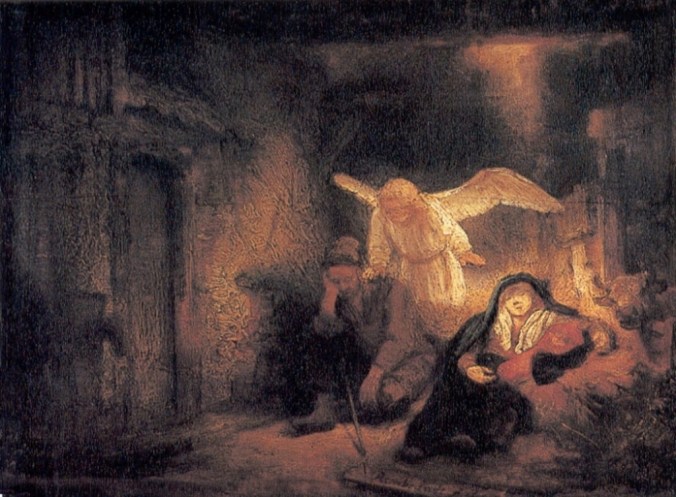
Joseph’s Dream at the Stable in Bethlehem  ~ Rembrandt

In the sixth month the angel Gabriel was sent from God to a city of Galilee named Nazareth, to a virgin betrothed to a man whose name was Joseph, of the house of David. And the virgin’s name was Mary. And he came to her and said, “Greetings, O favored one, the Lord is with you!” But she was greatly troubled…And the angel said to her, “Do not be afraid, Mary, for you have found favor with God. And behold, you will conceive in your womb and bear a son, and you shall call his name Jesus…And Mary said to the angel, “How will this be, since I am a virgin?” (Lk. 1:26-34).


“I’ll take that baby!”

It wasn’t heroic so much as it was impulsive. It just seemed like the only appropriate response to the moment’s need. For weeks, Keldy and I had been talking through a situation with a young gal we were mentoring who was walking through a situation with her friend. Her friend was expecting, it was unexpected—an unplanned pregnancy. The alleged father was not answering the phone. Time was ticking.

She was terrified to get an abortion but more terrified not to. Besides the fact that her secret life would soon swell up and announce itself to the world, she would eventually be kicked out of the Christian University she attended in their ongoing effort to keep campus sins swept under the rug. And when she finally decided to confide in her mother, entertaining the notion of proceeding with the pregnancy despite the costs of doing so, her mother told her she would be left on her own, unsupported, if she got kicked out of school—because that was the most pressing issue.

Our mentee told us that day her friend believed, ironically enough, she was left with “no choice” and so scheduled an appointment at the abortion clinic for the following week. In her mind, it wasn’t a pro-choice decision; it was a no-choice situation. Having no one else she could trust, she had asked her most loyal friend if she would go with her, if she would support her through it all, because “I cannot do this by myself.” It was just a wrenching mess. Now her friend, our mentee, was confiding in us. And my half-hearted, half-brained offer missed the point altogether. It was based on the assumption that this girl didn’t want her baby. She did want her baby. The problem was that no one else wanted her baby—not the father, not her mother, not her Christian academic overlords—and neither did they want an unmarried-and-with-child version of her.

What struck me as I mulled over the situation that day and many days since is that the reason a little baby would end up being aborted by the person it depended on for life is that the baby’s mother was under the threat of being aborted by the people she depended on for life. It indeed takes a village to raise a child, perhaps to abort one too.


And so God forms a village to raise Mary’s Child, God’s Son, while Herod sent an army to abort Him (Mt. 3:16). It was an unplanned pregnancy, at least as regards the young couple’s plans. They had been planning for a wedding but would now have to plan for parenthood. Their only conceivable plan for parenthood up to this point was to become a father and mother after becoming husband and wife, and only after that. But now we have something like a pregnant nun situation. And just as pregnant nuns become ex-nuns, pregnant virgins become ex-virgins, which is grounds for Mary becoming Joseph’s ex-fiancé.

Culturally, Joseph should expose her shame and leave her at the disposal of the community and her unborn child’s father. But she, along with the entire human family from Adam, was already at the disposal of her unborn Child’s Father. And He was going to make sure that she could proceed with the pregnancy without becoming an ex-anything. She need not not fear, for she had “found favor with God” (Lk. 1:30). The young virgin would give birth to the Eternal Son.

“Joseph was a righteous man and did not want to shame her” (Mt. 1:17), but he still wanted to leave her. So God sent an angel to explain the situation and to make sure he took care of her. And Joseph did so until (presumably) he died. She would then, a widow, have to depend on her Son. But He would die young too. Under ordinary circumstances, this would render her among the most vulnerable of society, second perhaps only to the unborn. But the day she stood at her Son’s high hanging feet, his final provision before saving the entire human race was to ensure his mother would be taken care of:

“When Jesus saw his mother and the disciple whom he loved standing nearby, he said to his mother, ‘Woman, behold, your son!’ Then he said to the disciple, ‘Behold, your mother!’ And from that hour the disciple took her to his own home” (Jn. 19:26-27).

The Gospel begins with Mary receiving an unplanned Son and Joseph receiving an already-pregnant fiancé and it ends with the Beloved Disciple receiving another Man’s mother. The family of God would forever hence be defined at the foot of the cross. 


The Church of Jesus Christ, I believe, must be pro-life, but I believe we must be pro-life in the way Joseph was pro-life at Jesus’ conception and the way the Beloved Disciple was pro-life at Jesus’ death. We must embrace the life of the unborn precisely by embracing the life of the mother. Churches throughout America have exactly the same amount of opportunities to abort young women (not to mention young men and young couples together) in need of our support as young women have to abort babies in need of their support. We cannot directly prevent the nation’s abortions, but we can directly prevent our own. And we have every reason to believe that when a community of love and support makes the sincere and sustained effort to gather around young women and couples in a way that demonstrates they are wanted and valued, in a way that assures them they won’t have to try to raise their children all alone, live life all alone, we will prevent far more abortions than we ever could by making a commensurate effort to surround ourselves with other people who agree that abortion is wrong, no matter how loud we shout it.

If we truly want young women to be no less than Mary for every unplanned pregnancy, we can be no less than Joseph for every fatherless child, no less than the the Beloved Disciple for every unsupported mother. But this costs more than the occasional protest. It costs us being inconvenienced by others in the way Mary and Joseph and the Beloved Disciples were inconvenienced by others, perhaps even in the way the unplanned Other in question was inconvenienced by all of us.

If Christ shares the burden of human death, surely he can expect us to share the burden of human life, whether that means adopting babies or adopting mothers—for we all are adoptees (Rom. 8:15; Eph. 1:5). And while this may or may not require a formal adoption process, it will require an effort to make room for others in our lives in very tangible ways. It will require welcoming young women and men into our homes and to our tables, into conversations, into mentoring relationships, friendships, and into our gatherings, and doing so before they find themselves in such desperate situations. But it also means welcoming young women and men in precisely the same way after they find themselves in such desperate situations. It means being committed to making room for others’ lives so that they can commit to making room for life when it comes, planned or unplanned, because this is always God’s plan for human life.

Indeed, God’s ‘planned parenthood’ for the whole human race began with a little Galilean village that committed to raising a Child as though he were their own, only to later discover that through this Child God would raise them, indeed would raise us all, as though we were children of His own. Because in Jesus Christ “that is what we are” (1 Jn. 3:1; Jn. 1:12; Rom. 8:12-17).

“For to us a child is born,
to us a son is given;
and the government shall be upon his shoulder,
and his name shall be called
Wonderful Counselor, Mighty God,
Everlasting Father, Prince of Peace” (Isa. 9:6).

Advent Reflection 6: Barren

“A voice says, ‘Cry!’ And I said, ‘What shall I cry?’ All flesh is grass, and all its beautyd is like the flower of the field. The grass withers, the flower fades when the breath of the LORD blows on it; surely the people are grass. The grass withers, the flower fades, but the word of our God will stand forever” (Isa. 40:6-8). 

Excursus: Elizabeth’s barrenness and the world’s hope.

Barrenness is of course a fertility problem. Biologically it refers to a womb that cannot support embryonic life. Agriculturally it refers to a land that cannot support crop life. Metaphorically it proves to be a most portable word. It was evidently a favorite of the Victorian poet Alfred Lord Tennyson, who spoke of barren efforts and barren shores and barren crags and barren lives and ultimately of a barren Death:

Wiser there than you, that crowning barren Death as lord of all,
Deem this over-tragic drama’s closing curtain is the pall.

Lord Tennyson is right. Barrenness finds its way into every nook and cranny of this world and our experience of it. And that is because theologically barrenness is the state of creation this side of Eden.

The world is duplicitous in its grandeur and its terror, its beauty and violence, in its capacity to provide for the unseen sparrow and its capacity to turn to ice. Creation is groaning in labor and in suffocation, the sign that is more than a sign that Mother Nature is ever losing her battle with Father Time. We live in a world and in bodies and in communities that simply cannot adequately support life. 

Every home so rich with memory will slowly start to lose touch and eventually will be left alone. No more children giggling their way into the master bedroom on Saturday morning. No frenzy of life in the kitchen on Thanksgiving Day frantically filling every dish and basket and platter with an attempt to keep the past alive. No one to say “Mom” or “Dad” or “You’re grounded!” or “Pass the jam”–just the occasional “Mr.” or “Mrs.” when the phone rings. Then calls come only for “Mrs.”, with condolences. Then the phone just stops ringing.

Life inside the walls gives way to a damningly exact proportion of grief. But soon no one is even left to cry. What was home will now house only an empty memory, maybe a few moths. Eventually, even the moths will die. Every birth certificate shares its name with a death certificate. Our alpha is our omega. The world is our womb, and it is barren, every life a miscarriage. 


Yet there is something natural in this–the womb is always empty before it is filled, just as creation was a formless void before it was filled. But God created even the void (Gen. 1:2). He does not just hurl the world into a space sufficient to sustain it. He creates formless void (Gen. 1:2), a barren womb, a world that he would himself have to fill in order for it to be filled with life. Apart from him this world will always return back to the void, but with him there’s no void to return to—the black hole becomes supernova. With him, nothing becomes a feast of life. So God creates from the very beginning a world in which he can be born, and thus a world in which we can be born again. Emmanuel. 

So as we wait upon the Lord, we should not look for him to come to places full of strategy and competence and men in dark suits. He comes where the efforts are barren and the ground is chapped. Slaves in Egypt became a nation in the desert. God had come. Out of barren wombs the child of promise is born to Sarah, the child of prophecy to Elizabeth, the “Voice in the Wilderness” born to a father who could not speak. God had come.

Out of nowhere the substitute came to Abraham for his son on Mount Moriah. Out of the Virgin the Substitute came to Israel for all sons on Mount Calvary. God has come.

And God is coming again. Isaiah says we’ll know it is God because the cracked desert floor will begin blooming like a daisy field in springtime; the groaning ground of the curse will suddenly burst into song (Isa. 35). Scorched war fields will become spring-fed gardens (Isa. 58); swords and spears will be beaten into the shape of life and kept in the barn (Isa. 2). He said that lions and tigers and bears would go vegan and siesta with lambs and yearlings (Isa. 11). There will be life where there can be no life, peace where there can be only blood, a symphony filling canyon winds. Paul says we’ll know it is God because when he comes he will lay death down to sleep, pray the Lord its hell to keep. We’ll wake up one day without aching joints and pressing deadlines. We’ll see mirrors we’re not ashamed of (1 Cor. 13; 15).

John says we’ll know it is God because of what happens to the brokenhearted. The little boy whose dad was sent home in the form of a flag, the young mother of that boy looking helpless at his searching eyes; the little girl who never wore white. We’ll know it is God not because the brokenhearted will suddenly stop crying but because their tears will be wiped away (Rev. 21:4). They will be touched by a real Hand and there will be a resurrection of real hands. Those searching eyes will find what they never stopped looking for. It will be like a world ruled by the real religion that James talked about (Ja. 1:27).

John also says we’ll know it is God because it will be like a Bridegroom and a Father and a Son and like a world full of siblings (Rev. 21-22), like wedding reception and a family reunion all at once (Rev. 19:6). It will just be a mess of an overflow. Loneliness won’t even fit in a crack on the floor. There will be no storm shelters or panic rooms, no sirens or seatbelts, no temples or mosques, no shut doors or closed countries, no walls, no gun control, no guns, no abortions, no greed, no partisanship, no voting booths, no border patrol, no arrogance, no bumper stickers, no child soldiers, no fatherlessness, no websites, no shrapnel, no midnight calls, no divorce, no mistrust, no shame, no shadows, no small caskets, no more God-damned goodbyes: only God, only Light, only peace, only joy, infinite joy drowning the void beneath the weight of the “glory of the Lord that fills the earth as the waters cover the sea” (Isa. 11:9; Hab. 2:14), and us—with a Table there at the center to keep the past alive for good (Rev. 21:21-23).

When Christ comes, he comes to dethrone the one called “barren Death” crowned “lord of all” by burying the crimson of His crown in a deeper crimson bloom of roses. Yes, Death, every knee will bow–so Death, be not proud (Donne)! For He is the “firstborn of creation” (Col. 1:15) and therefore the “firstborn of the dead” (Col. 1:18), so he will again descend into this barren womb, but this time to give birth. When “the Lord descends from heaven…the dead in Christ shall rise” (1 Thess. 4:16). And on that day, the world will be an ultrasound devoid of any dark, born again into the womb of eternal life together with the eternally Begotten Son of God. No more miscarriages.

When he comes…

Advent Reflection 5: Reframe

“But exhort one another every day, as long as it is called “today,” that none of you may be hardened by the deceitfulness of sin. For we have come to share in Christ, if indeed we hold our original confidence firm to the end. As it is said,

“Today, if you hear his voice,
do not harden your hearts as in the rebellion” (Heb. 3:13-15).


“Elizabeth was barren and
both [she and Zechariah] were advanced in years” (Lk. 1:7). The days were tired. Evening never came soon enough.  It’d been a long life under Roman rule. It’s not that they were ready to die. It’s just that they were not ready to start a new life. It was time to slow down. They were at peace with God, they’d lived faithfully (cf. Lk. 1:6), and the burdens of the priesthood would soon be carried out by the next generation. Zechariah had spent these latter years training up young men, seeing in their faces the son he never had. He’d already grieved that unanswered prayer, for now Elizabeth was both very barren and very old. And then God answered it (Lk. 1:13).

By this time, Zechariah’s mind was no doubt made up about a few things. He knew that the world’s treasures were peddled in smoke and mirrors and that human innovation, with all its willful gullibility, is never more than a new arrangement for the same old empty promises. When he was young, life was charged with possibility. His favorite book of the Bible was Joshua. People had called their generation the “Joshua generation.” But he eventually realized that every generation gets called that. It probably has something to do with hope, maybe also regret. 

Truth is, Zechariah had long given up on that naïve faith in the future, or at least that a new future could begin today. His favorite book now was Ecclesiastes. It resonated. It’s not that he had lost faith in God. Indeed, he had faith the strength of an old growth forest, unmovable by the winds of change. It’s just that sometimes God is in the Wind (cf. Jn 3).

Are you sure you’ve got the right address? Zechariah says, in effect, to the angel Gabriel: “How shall I know this? For I am an old man…” (Lk. 1:18). Gabriel is annoyed. “I am Gabriel. I stand in the presence of God…” (Lk. 1:19). How will you know? You will know when an angel who stands in the presence of God comes and tells you. That’s how you’ll know! So Gabriel silences him.

It is impossible to know why Zechariah doubted or exactly what the nature of the doubt actually was. Age was certainly a factor. But it seems to be about more than just a question of fertility odds. Gabriel said that his son would “be filled with the Holy Spirit…and come to turn the hearts of the fathers to the children…” (Lk. 1:15-17). Zechariah was a priest. He knew where that line came from. It’s the very last line of the Old Testament (Mal. 4:5-6), which, for Zechariah, was not yet “Old.” It was just kind of….“on hold.” For it to become “Old” would require it being fulfilled. And given the nature of the prophecy, if that were being fulfilled, everything was about to be fulfilled. Could that really happen…today?

Zechariah had spent his life learning how to believe that God’s promised future would happen—in the future. And in a moment, that future was beginning right now. Maybe the Joshuas of the world are ready for a revolution today, but today Zechariah would do well to have his knees replaced. He identifies more with Methuselah than with millennials. At this stage, it’s time to die quietly trusting that God will fulfill his promises in some distant tomorrow. 

But God is no respecter of daytimers. So Zechariah would have to reframe all he’d ever believed. The time was at hand.

For nine months this teacher of the Law will be unable to speak. He will be removed from any ordinary social roles. He’ll have some alone time. Maybe he’ll may start reading Joshua again. More importantly, his priestly duties–teaching the Covenant, service at the altar, temple staff meetings–all those things will now be put on hold, because all those things were now growing “Old.” 

It’s no wonder that when he does open his mouth for the first time after nine months it is no longer as a priest but as a prophet: “Zechariah was filled with the Holy Spirit and prophesied, saying…” And out came in concentrated form the announcement that all of God’s promised future was at hand (Lk. 1:67-79). The priesthood was being silenced, because the Lamb preparing for the slaughter would need no assistance at the altar (cf. Heb. 7). The old institutions were passing away, behold the world was becoming new (cf. 2 Cor. 5:17).

Sometimes the Lord shakes up our world (a change of frame) to prepare us for repentance (a change of mind). Often these times of reframing are necessary, because all too often we frame God right out of our world. It’s easy to believe in the God of yesterday, it’s easy to believe in the God of tomorrow, but it’s hard to believe in the God of today. It’s hard to believe that God can speak today, answer prayers today, change our hearts and our habits and our homes today. But God will always, and will only, work in our lives and our world today.

“Behold, now is the favorable time; behold, today is the day of salvation” (2 Cor. 6:2).

Even the day Christ comes back, the second Advent, will be a day like any other, a day we call today. The question for us, then, is Does our faith frame the living God in a yesterday that is always gone or a tomorrow that is never here?

Have you talked to God—have you listened to God—today?

“Today, if you hear his voice, do not harden your hearts…” (Heb. 3:7, 15). 

Lo, in the silent night
A child to God is born
And all is brought again
That ere was lost or lorn.
Could but thy soul, O man,
Become a silent night!
God would be born in thee
And set all things aright.

~ Author Unknown

Advent Reflection 4: Expect

“And an angel of the Lord appeared to Zechariah, standing to the right of the altar of incense. Zechariah was troubled when he saw the angel, and fear gripped him. But the angel said to him, ‘Do not be afraid, Zechariah, for your prayer has been heard, and your wife Elizabeth will bear you a son, and you will give him the name John” (Luke 1:11-13).

They’ve been waiting. They’ve been remembering. They’ve been preparing. And now they are expecting.

But let’s be honest, this wasn’t expected (hence Lk. 1:18-20). Even though it was an answer to prayer (cf. Lk. 1:13), it wasn’t one of those prayers you really expect God to answer, like a ‘traveling mercies’ prayer, or that wildly daring one about food being miraculously transformed into “the nourishment of our bodies.” This was a specific prayer. That’s the kind of prayer that leads to trouble, because as soon as you start asking God for specific things to happen, especially things that don’t ordinarily happen, you then run the risk of God specifically saying no. Specific prayers are fighting prayers.

Keeping our prayers generic helps us preserve a professional distance. Nobody’s personal space is violated. Nobody has to expect much from anyone. Praying for God’s will to be done in Elizabeth’s life is one thing, but praying that God would put a baby into Elizabeth’s barren womb is quite another. The answer—yes or no—is empirically verifiable. Everyone’s personal space is violated, God’s, Elizabeth’s, and the one standing in the gap between them trying to build a bridge between heaven and earth. Prayer like that has no social boundaries. That’s why most of us don’t pray like that. We’d rather just agree to live parallel lives and avoid the discomfort that often comes at the intersection.

God answers prayer. God does not answer prayer. Both statements are true.

Word it however you want to try to soften it or stick up for God—“God answers every prayer, just in ways we don’t understand”—but that does no good. That’s just an excuse to never look God in the eye. Sometimes God’s response is precisely no response. Sometimes the Truth is revealed in the eyes of Silence. Just ask Pilate (cf. Jn. 18:38).

Nor is it true that if a prayer hasn’t been answered the problem is the faith of the praying person. The problem is that God didn’t answer the prayer. The only thing worse than people who smear every prayer into an enigmatic “yes” are those who lie about the unambiguous “nos.” I’ve heard people talk about prayer as something that only needs to be “claimed,” as though God had no say in the matter, as though God were not a living and active and real Person, as though God were not free. I’ve even heard people lie about God answering prayer. I’ve seen ministries based on that lie. Those ministries are not about God acting. They are about people acting like they are gods. They are about people reaching up into heaven’s treasury and grabbing whatever the hell they want—if only their faith is tall enough. But human faith gets little larger than a mustard tree. And sometimes God doesn’t answer prayer. People who say God answers every prayer are people who have never prayed.

But Zechariah prayed. And he prayed at the intersection. That’s where my mother prays too. Zechariah prayed for a son to be born who could not be born. Elizabeth was barren. My mother prayed for a son to be found who was irreversibly lost. No enigmatic yesses were possible. God would answer her prayer or God would not. And for at least twelve years, from the volatile ages of 10 to 22, he did not.

I was recently preparing on a sermon about the way people are led to faith through the faith of others (cf Mk. 2:1-11), so I texted my mother (because that’s what sons do when they need something from their mothers—they text them) and asked her what it was like “when your family was going to hell in a hand basket. Please email response.” Below is an excerpt from her response:

Subject line (all caps): “NEVER CONSIDERED FOR ONE SECOND ‘TO HELL IN A HAND BASKET’” (reprimanding tone noted).

…I knew God wanted you more than I did. So, while I was extremely concerned, sad, and experienced many sleepless nights, I never really landed on the thought you would be lost. My prayer life deepened so much during that time to the point of wordless groanings and moanings too deep to be uttered (Rom. 8). But I knew God was faithful…

The curious thing about my mother’s unanswered prayers is that they did not have a distancing effect but a deepening effect. With each unanswered prayer she dug down deeper into God’s heart, so as to say, “Fine. Then I’m moving in—and I’m bringing all my burdens and my baggage with me. And I’ve got A LIST of names!” Her prayer moved from trusting to entrusting. She stormed into the heart of God and drug my name with her day after day after day. I tried my hardest to go to hell, my mom just wouldn’t let me.

I once heard my father in-law say, “Even when you don’t see the hand of God, you can always trust the heart of God.” The only people who say things like that are people who actually pray, because they know the hand of God has a mind of its own. But ordinarily a person’s heart can only be seen through their hands, for hands are expressions of the heart. But this or that answer to prayer can never communicate the depths of God’s heart. And it may threaten to bring us only to look for God’s hand. 


That’s what happened to the Exodus generation. They starting out “groaning” into God’s heart (Exod. 2:23-25) and quickly ended up “grumbling” at God’s hand (Exod. 16). They cried out for freedom and God “brought them out of Egypt with a mighty hand” (Dt. 26:8). But rather than being drawn closer to God’s heart they got addicted to his hand. After he gave them freedom from Egypt they began to turn on him because he wouldn’t give them food from Egypt. They had apparently forgotten the cost of “the fish we ate in Egypt that cost nothing” (Num. 11:5)–it was the cost of freedom. Pharaoh wanted to keep meat on those temple-building bones. 

So God reserves only one place his hands can forever be called the perfect expression of his heart (Jn. 1:18). It’s the one place he commands everyone to look to see his heart right through the center of his red-stained hands (Rom. 5:8). It’s at the intersection, where the Jesus Christ built the only lasting bridge between heaven and earth. That’s where God prays (Lk. 23:34).


Daily prayer, then, is intended to draw us closer to the cross. The cross is like a tuning fork for our prayers. A tuning fork is tuned to only one key. It will vibrate if it gets close enough to something else vibrating in the same key. This is called resonance. St. Augustine once said, “You have made me for yourself, O Lord, and my heart is restless until it finds its rest in you.” He was talking about resonance.

Whether it knows it or not, the human heart is trembling in its longing for a gracious God. That trembling feels like fear, and it should, if in fact God is God and we have sinned against him. And, in fact, he is and we have. That revelation can change the way to think about your next breath. For it is indeed “a fearful thing to fall into the hands of the living God” (Heb. 10:35).

But we have fallen into his hands. And we tremble, in Jonathan Edwards words, as “sinners in the hands of an angry God.” We don’t expect to find any resonance with his angry hands—until we discover that all that anger was poured out on the crime and not the criminal, that God executed his judgment on sin by himself being executed at the hands of sinners. And in so doing, he condemned the sin, not the sinner, so he could continue hating our sin and loving us (cf. Rom. 8:1-4). This is called grace. You might just call it Amazing Grace. It’s how God restores harmony with the godless. So the restless heart finds rest when it finds resonance, not when it ceases to tremble. A heart that does not tremble before the living God has not discovered amazing grace but cheap grace, which is not the grace of a Crucified God. 

‘Twas grace that taught my heart to fear
And grace my fears relieved
How precious did that grace appear
The hour I first believed

God has one Word to so say to this world, and he wrapped It in swaddling flesh to say it (Jn. 1:14-17). In so doing, that enfleshed Word became receptive to God on our behalf. In Christ, we are tuned to the key of God. But this is not a new note. It was just hard to hear the heart of God before Jesus came. But David heard it. David’s salvation didn’t come by asking God “into his heart.” It came by storming his way into God’s heart. David took up residence there. Where else could he go? The Law condemned him. But God didn’t. That’s why you can hear the Gospel resounding before it even sounded in Psalm 51. Resonance.


God uses prayer to bring us close enough to himself that our hearts get in tune with his, because that’s how he changes our hearts. A gracious God wants above all to form a gracious people. How else is a world of sinners going to find hope? So he shakes the grace into us. In time, it is the life of prayer itself that proves God is gracious and can thus be trusted with everything, even and especially with our sin, with sinners. He’s a God who found a place for sinners right at the center of his heart, held in the holes of his hands. We come to know God’s heart when we resolve to bury ourselves inside it, baggage and names in tow. Over time, prayer, even unanswered prayer, becomes our sanctuary from the dread of circumstance, even the circumstance we are asking God to change. Even when the answer is no, even if I am being marched to the sepulcher, even when the sun forebears to shine—Even so…Amen.


But then, one day, God answers—because God does answer prayer—and the circumstances are changed. Zechariah’s world is changed. Elizabeth is expecting. And frankly, he’d stopped expecting it. Zechariah will have to reframe. But that’s tomorrow’s word.

For now, amen.

 

Advent Reflection 3: Prepare

“One who is faithful in a very little is also faithful in much, and one who is dishonest in a very little is also dishonest in much” (Lk. 16:10).

Waiting. Remembering. Preparing. Such was the life of Zechariah the priest, a man who was faithful in a very little who was about to be given very much. Waiting—because it was still “in the days of Herod, king of Israel” (Lk. 1:5), a king who ruled more in the manner of Israel’s Pharaoh than Israel’s Liberator (cf. Mt. 2:16; Exod. 1:22). As long as Herod was Israel’s king, Israel’s King had not come. Remembering—because that was his priestly duty. The priests were tour guides of Israel’s memory. But Israel’s memory was not a museum, because it was not filled only with what God had done but all that God had promised to do. So the priests were called to be the living memory of God’s promised future. They were called to remember, and so prepare

There are different ways of preparing. It all depends on what future you are preparing for. A person who prepares for a race runs. A person who prepares for a dinner cooks. A person who prepares for a test procrastinates studies. Martha Stewart once prepared for the future by selling her shares in a stock

I suppose by a certain stretch of the imagination Zechariah’s preparation was something like Martha Stewart’s. He’d been tipped off. He knew where to put his stock, and where not to. He knew not to put any stock in the kingdom Herod was trying to build and prepared instead for the one God had promised to bring. 

That way of preparing is about the “little things,” being faithful in the “very little” of today because God is taking care of the “very much” of tomorrow. Believing that allows us to enjoy the freedom of living a small life: we don’t have to build and collect and store up for an apocalyptic winter; we don’t have to fight our way to the top; we don’t even have to be angry about who is at the top, because the very top of this world is still only the tip of a footstool that belongs to another world’s throne (Isa. 66:1). And the One seated on that throne has promised to bring that another-world to this one (Rev. 21). 

If God is in charge of all that, we are free to just live little lives that seek to honor him. Zechariah lived like that. He wasn’t known around town for much of anything. Just another priest, not even the”high” one. But he was known by God. Luke said he was “righteous before God, walking blamelessly in all the statutes and the commandments of the Lord” (Lk. 1:6). He prepared for the future by living for the One who promised to bring it. 

If faith were an arrow, it would not be pointing up. That is the popular way to think about faith, likely because up never leads back down to earth, where my boss and my habits live. Faith is far more comfortable in the clouds than it is on Monday morning. But faith is a forward arrow (Heb. 11). It doesn’t point to an ideal. It points to a path. Jesus didn’t say fly away with me. He said follow me. He said, “Lo, I will be with you on Monday” (Mt. 28:20, paraphrased). Faith is found in the “little” things, like my attitude at the office, or at home where only my family and God have to put up with me. That’s where my faith lives, or not. If we are going to prepare for the coming of Christ, it won’t be up there with my exceptions but down here with my rule. It’ll be on Monday. Jesus is coming back on Monday.  

Zechariah was caught “walking blamelessly” through everyday life as he headed to the office that Monday morning. You can tell it was a Monday because Luke says “his division was on duty” at the temple (Lk. 1:8). Duty is Monday talk. That day the lot fell on Zechariah to go into the temple to offer prayers and burn incense. And when he did he saw an angel. The angel told him his barren wife would give birth to a son. He was to name him John. It was an exceptional moment. But Zechariah didn’t arrive at that moment because he was having an exceptional day. He hadn’t specially prepared to receive a miracle from God that day. It wasn’t at a healing conference or a prayer retreat. He wasn’t on a pilgrimage away from ordinary life. He was on duty. He arrived at this exceptional moment because he was living by his everyday rule: to be prepared for God to come on any day of the week, especially the first day of the week.

Maybe that’s why Zechariah was chosen to be John’s father. Maybe all history was waiting for a father like Zechariah, a man of duty and everyday discipline, to raise a son like John, because John would have a special assignment. The angel told Zechariah his assignment would be to “make ready for the Lord a people prepared” (Lk. 1:17). Like father, like son. 

“A voice crying out in the wilderness, ‘Prepare the way of the Lord!’” (Jn. 1:23).