Advent Reflection 2: Remember

Inasmuch as many have undertaken to compile a narrative of the things that have been accomplished among us, just as those who from the beginning were eyewitnesses and ministers of the word have delivered them to us, it seemed good to me also, having followed all things closely for some time past, to write an orderly account for you, most excellent Theophilus, that you may have certainty concerning the things you have been taught” (Lk. 1:1-4). 

Barney: “Have you seen my shoes? I need to put them on before I go home.”
Me: “You are home, Granddaddy.”
Barney: “No I’m not. This is just where I’m staying until I go.”
Me: “But… I see…”

[So I went and found his shoes.]

—A conversation with my grandfather

My grandfather was a minister for 64 years. He began showing signs of dementia many years ago. Since my grandmother passed, his mind has been slipping more rapidly into the void. Watching his decline, I have learned that the world of humanity consists in memories. I’ve also learned that memories are married to names. When one is lost, so the other, and whatever piece of the world went with them.

Of all the names that have fallen into that inglorious abyss, mine included, it was saddest to see my grandmother’s go. Never again will I get to hear the story about the first time he saw her, standing on a sidewalk in a white dress: “She looked like an angel.” Never again will I get to see her memory become wet in his grieving eyes only to be consoled back into laughter by yet another moment shared still in his mind. She was always visible as a glow in his face, even under the hanging weight of his grief. But now there is neither glow nor grief. That part of his world and that part of his face are gone. And I suspect, were it up to him, he would welcome the grief back in endless waves if only to salvage a few glimpses of his long lost angel, forgotten at sea. But she is lost to him.

But she is not lost. And she is not lost to him forever. Because the one Name that still puts color in his face and fills his mouth like lead is the Name of the One whose hands first joined them together. And His grieving hands are as stubborn as nails that refuse to let go of the dead. So my grandfather may not have my grandmother’s hand anymore to hold, but he still daily folds his hands in prayer—and he has never forgotten in whose Name his prayers are made. That world still belongs wholly to him, and he wholly to it.

From this vantage, he has forgotten nothing. For those who remember where they are going, not even a single drop of the past will be lost. 


It was this insight that prompted Luke to compile the memories of of those who had seen Jesus with their own eyes. He wanted to give a friend, perhaps some dignitary, Theophilus, “certainty concerning the things you have been taught” (Lk. 1:4). Typically, if you’re looking for certainty, you look in the future, where forecasts become rain or shine, where promises are kept or broken, where potential becomes actual. But the truth is, the future is a bad place to go looking for certainty, because forecasts are often wrong, promises come with contingency clauses and, besides, as the days go by the future has less and less to offer us. And one of these days, the future will no longer even offer us another day. Of that we can be certain!

So Luke offers Theophilus, and the rest of the human race, certainty by pointing us in the opposite direction. If you want to find certainty, you need to look back and discover “the things that have been accomplished among us” (Lk. 1:1). What Jesus accomplished, among all else, was certainty about our future, because he entered into the only certainty we have about the future–death!–and bust the door open on the other side. Death, then, is not, as Shakespeare once described, that “undiscovered country from whose bourn no traveler returns.” It has been discovered, traversed, exited and exiled. Jesus has gone before us all to come after us all.

And so he meets us through the memories of eyewitnesses, and soon we begin remembering him ourselves. We read about him calling his disciples to follow him, and soon we find ourselves following him, because although we didn’t share the same past as those first eyewitnesses, we are invited to share the same future with them (along with a great cloud of witnesses besides). We cannot be exactly certain about all the future will hold, but we can be certain it will hold us–He will hold us–come hell or high water or a 6-foot hole in the ground, because although death is the certain end of life, Jesus is the certain end of death. 

So as the days go by, don’t forget to keep refreshing your memory with these eyewitness memories of Jesus. One of these days you’re going to see him face to face and you’re going to want to be able to put a Name to that face. And if your memory is married to his Name, your name will be married to his future. 


Advent Reflection 1: Wait

“Be ready for action, and have your lamps lit; be like those who are waiting for their master to return from the wedding banquet, so that they may open the door to him at once when he comes and knocks. Blessed is the slave whom his master will find at work when he arrives” (Lk. 12:35-38).
 
Waiting is hard work. Jesus described it here as the kind of work that allows us to hear. Like children with ears pressed against the bedroom door on Saturday morning waiting for mom and dad to get out of bed, it’s a kind of quiet anticipation. It’s called listening. The blessing in the parable comes to those whose work is proved simply by opening the door–they heard the knock from the other side.
 
This kind of listening is hard work because our kind of world is hard of hearing.
 
We live loud lives: wake up, screen on, eat and run, text and drive, bounce around, fast food, back home, screen back on, plate on lap, back to bed, earbuds in, wake up; rinse and repeat. We have one-click shopping. Pay phones have gone the way of the dodo. The Internet doesn’t make that intergalactic fax machine noise anymore. Now, it could be that all this on-demand efficiency is evidence of a culture that has discovered all that satisfies the longings of the soul—and made it all extremely available. Or it could be just the opposite. It could be an indication that we have found exactly nothing that satisfies our longings. It could be an indication that we’ve just resorted to an abundance of stuff that does not satisfy.
 
We are occupied and preoccupied with stuff that keeps us busy enough to never have to confront the hollowness we discover in the silence. Perhaps we’re afraid to press our ear against the door and do the work of listening, because the first thing we hear when we listen is precisely nothing. And when that is what we hear, we have to wonder if it is because nothing is there on the other side. We have to wonder whether God is dead or we are dying. And this makes us anxious. So we fill our lives with things do, places to go, a world to produce, a world to consume, a world to possess. And so in our efforts to consume an abundance of satisfaction we are consumed by an abundance of distraction–anything to avoid listening to the silence.
 
But shouldn’t the Church, of all people, have a different response to the silence? Shouldn’t the silence of Good Friday shape our longings more than racket of Black Friday?
 
The slaves in the parable who opened the door did so because they heard the knock, but the reason they heard the knock is that they were “waiting for their master to return.” It’s no surprise that the secular world celebrates our Christmas but wants nothing to do with our Advent. Whatever else we might think Christmas is about, Advent assumes it is about one thing: waiting for our master to return. Indeed, Christmas is only worth celebrating because Christmas is coming again.
 
This means that the one thing Advent happens to be about involves the two things our culture knows nothing about: having a master and having to wait. But that is surely because our culture, with which we are all too often complicit, has given up waiting on the things we long for most deeply. Perhaps if we allowed ourselves to listen to the grandiose size of our most basic longings—for universal peace, for boundless joy, for belonging across all tribes, tongues, and nations, for the reunion of all lost sons and daughters, for wholeness of a broken world and every broken heart, our longing for that all-embracing ache that lies at the center of human experience for we know not what—perhaps if we would listen to these basic longings we would begin to understand that we do not have the raw materials within ourselves to satisfy our most basic longings. And neither does the whole world and all that is in it. And when we can recognize that, we will have no choice but to wait. In that case, blessed will we be when our Master finds us ready to greet him at the door.
 
And that is indeed why we need Advent as much as we need Christmas—without the waiting, the listening, of Advent, we may never hear Christmas arrive.
 
Even so, come quickly, Lord Jesus.

Advent: ‘Tis the Season to Wait


ad·vent / ˈadˌvent: the arrival of a notable person, thing, or event; to come to


“From of old no one has heard or perceived by the ear, no eye has seen a God besides you, who acts for those who wait for him” (Isa. 64:4).

It’s almost time for Advent. Advent is both a matter of history and a matter of festivity. It is, in the first place, a matter of history because before Advent is an annual holiday for Christians across the world it is the single event of Christ coming into the world: the Incarnation, the enfleshment, of the Son of God. And Christians not only celebrate Advent annually to remember the coming of Christ into the world but also to anticipate the coming of Christ into the world again. The first Advent came with the promise of a second Advent. We can greet an otherwise uncertain future with hope because we are certain Christ will arrive in the future to receive us. And so the Church’s Memorial Acclamation resounds daily in worship services across the globe: Christ has died! Christ has risen! Christ will come again! Christian memory is at once a form of anticipation. History has taken the shape of a promise.

So Advent is the season especially set aside for waiting, the time we remember how to anticipate God’s promised future and remember that our God is a God who delivers on his promises, even if it means being delivered in a barn and laid in a manger.

That is why Advent is also a matter of festivity. Christian festivity is about both memory and anticipation, about a certain past that promises a certain future. Advent marks the beginning of the Christian (liturgical) year, which revolves around the birth, life, death, and resurrection of Jesus Christ. But the birth of Jesus doesn’t begin with Christmas Day any more than the Bible begins with Matthew’s Gospel. The Gospel was a promise in history long before it was an event in history. And so the Christian year begins with a longing for Christmas. That is what Advent is all about. The most basic meaning of the word advent is to ‘come to’, not simply ‘to come’ but specifically to ‘come to‘. It implies a specific place where anticipation is met with arrival. During the season of Advent, the Church waits for Christ to come again into our world by waiting on Christmas to come again into our world. If Christmas is the time for gifts and celebration, Advent is the time for restraint and anticipation. We are ushered into this season not with the rush of Black Friday traffic but with the Silent Night of Israel’s longing: 

O come, O come, Emmanuel
To ransom captive Israel
That mourns in lonely exile here
Until the Son of God appears
Rejoice, Rejoice, Emmanuel
Shall come to thee, O Israel 


This all begins the fourth Sunday before Christmas and concludes on Christmas Day, which is the Church’s New Year’s Day.  A few months after Christmas the Church enters the season of Lent, which culminates in the Passion Weekend (the Paschal Triduum), concluding on Easter Sunday. Forty days after Easter is the celebration of the ascension of Jesus to his throne in heaven. And finally, fifty days after Easter, the Christian festive year concludes with Pentecost, remembering the day the Holy Spirit flooded the earth and filled the Church.


To remember the event of Pentecost and the story that led to it is to understand what time it is at present in salvation history. It is our orientation for everyday life. God’s Spirit has been poured on all flesh and the Church has been sent as witnesses of Jesus Christ so that those who believe may be saved from their sins and filled with the Spirit. So the Christian Calendar is not merely about festivity—it’s about identity.

The time from Pentecost to Advent is called Kingdomtide (or Ordinary Time in less imaginative traditions). Together the sense of this time can be understood: the Church understands its everyday ordinary world, not just its Sunday religious world or its seasonal festive world, as the context of God’s kingdom. Christians are the everyday ordinary citizens of that kingdom. And so the focus in Ordinary Time is the extraordinary mission of God’s Kingdom advancing through the Gospel to the ends of the ordinary earth.

So the Church spends roughly the first half of the Christian year, in effect, reenacting the Gospel story,  which not only helps older the older generation remember who they are in Christ, which gains a new aspect of importance for dealing with the inevitable experiences of loss in the last chapters of life, but it also helps teach younger generations who they are in Christ, which is critical for establishing their identity in the first chapters of life. And the Church spends the second half of the Christian year focused on taking that story to the streets—the first half on remembering, the second half on continuing. So following the rhythms of the Christian year nurture both education and formation. It is the education of embodiment, the most appropriate for kind of education for the God of Incarnation, the embodiment of the Son of God—Emmanuel. 

Precisely because the Gospel story has not ended, precisely because the Holy Spirit is here and Christ will come again, the Church continues that to-be-continued story by living as witnesses of Christ in anticipation of his return. “How beautiful are the feet of those who bring good news!” (Rom. 10:15; Isa. 52:7). How beautiful, that is, is faith that is embodied. Indeed, faith without legs is dead.


And so it is time. It’s time to wait for the God “who acts for those who wait on him” (Isa. 64:4). It’s time to enter again the world of waiting, the world of promise, the world where God has come with a promise to come again, and to bring with him an incomparably greater world—this one.

A Confession of Violence

This article was recently published at Asbury Theological Seminary’s Seedbed website (here) during the height of conflicts that precipitated largely from the Ferguson ‘incident’. Below is a revised and slightly expanded version that better qualifies the most salient points. 


american-civil-war-abstract-expressionism-zeana-romanovna

American Civil War by Georgiana Romanovna

As a person who regularly tries to encourage fellow brothers and sisters in Christ to try to spend more time concerning themselves with the Good News of Jesus than with the nothing-new-under-the-sun news of the mainstream media, I feel it is necessary at this time to acknowledge a certain need for followers of Christ to speak out publicly with a distinctly Christian voice in response to recent tragedies heralded in the headlines, especially in view to the increasing angst in our nation’s political and cultural climate. 

For that reason, I have a confession to make. It is a confession of violence.


I was reminded this week of what Karl Barth once wrote in his journal at a significant turning point in his life and thought during the First World War:

“It is not the war that disturbs our peace. The war is not even the cause of our unrest. It has merely brought to light the fact that our lives are all based on unrest. And where there is unrest there can be no peace” (Karl Barth: His Life from Letters and Autobiographical Texts, Eberhard Busch). 

As fingers continue to point, defenses continue to rise, and the wilderness is increasingly populated with a rapid influx of expatriated goats (Lev. 16), I hesitate to say what I feel I must say, because I am quite possibly wrong. But with that disclaimer: I want to suggest that there is a very real possibility that the recent tragedies in this nation were not simply caused by a few bad apples in an otherwise innocent bunch. I have to consider at least the possibility that somehow the increased supply of violence in our culture is suited precisely to meet the increase of a cultural demand, of which we are all complicit.

Consider for example the current political circus. There have been no shortage of aggravated complaints and expressions of puzzlement over how, of all the people our nation could have produced, we ended up with Cruella Deville and Leopold II as the two representatives of our nation’s principle values and common visions. And yet, I can’t help but think we are just willfully ignoring the obvious and only explanation; namely, the reason we ended up with the current representatives of this nation is that they are most representative of this nation.

This is not simply a principle of democracy. It is a principle of the more decisive governing factor in our consumerist culture, the principle of supply and demand. We have been feeding on this extended campaign season with an irrepressible appetite. Media networks, profiting outrageously from our patronage, have risen to meet our demand, and we in turn rise to feed on the surplus (a few tweeting feuds, some scandals, and a delicious array of ad hominem attacks). All the while the people blame the networks for the results, while the networks blame the other networks, while the other networks blame the people. Everybody is taking from everybody and then turning on everybody. It’s like a group of smeared-mouth toddlers blaming each other for cookies missing from the pan, but actually it’s a lot more like a twisted praying mantis love triangle.

But all this misses the point, because it is not the candidates we support that have produced this conflict; it is the conflict we support that has produced these candidates. And, indeed, they were perfect candidates for the task.

I think I can say unequivocally, if only because it can be neither proved nor denied, that what has most resonated with this nation in this campaign is its unprecedented rhetoric of violence. A civil war of clumsy words and gasoline passions is raging throughout our nation. We’re not looking for representatives of social values—we’re looking for spokesmen of social angst. Rather than tuning in to anticipate campaign candidates debating principled arguments with regular appeals to the constitution, we tune in to anticipate a surface battle of candidates in the rhetorical coliseum, waiting for a champion to arise who proves most capable of weaponizing trivia and amplifying slander. Who will prove to be the biggest bullhorn for the mob? Who will prove to have the loudest arguments? Who will lead half of this country in a campaign of disgust against the other half of this country?

The nominees may not represent much of what we stand for, but they represent quite exactly what we stand against, which is why we ended up with the two candidates who are supremely competent at attacking the incompetence of the other. It has become far easier in our nation to rally people around whom they hate than what they love. The appeal that resonates with this country’s soul is a an appeal to our restless inner hostility, for which we are miserably fearful or passionately infuriated (a rather pedantic distinction), the only cure of which is blame or blood or some other sacrificial motif. But since we have long rejected “religious” categories to explain “secular” realities, we have nothing to sacrifice but one another. But far be it from me to suggest a source of our violence so outrageous as an existential need for atonement. Suffice it just to say it seems quite evident that we are a nation increasingly naked and commensurately ashamed. 

Indeed, “the [violence] is not even the cause of our unrest. It has merely brought to light the fact that our lives are all based on unrest.”


But perhaps I should be more transparent. The truth is I was confronted by my own complicity with this restless violence this week in a way I wish I could have kept hidden from myself.

If I am uncomfortably honest, I must confess that I have grown completely numb to the pain of the wider world. I don’t think I qualify as a sociopath or anything, but neither will I suggest that I am an accurate representative of the human heart. I know my capacity for pride and self-indulgence, and I should only hope that by and large human nature is at least better than my nature. All that to say, when I read or hear about a person being shot or multiple people being shot or riots breaking out because of all the people being shot, I am sorry to say that that it in no way affects me, at least not in a way that elicits compassion. If I feel anything it is invariably a kind of distracted, yawning anger, which isn’t really concerned with human beings and in fact is quite amused with blood. But most of the time I just don’t care.

I don’t know if I have always been particularly numb to distant tragedies or if I am just particularly sensitive to local misfortunes that hardly rank anywhere near the level of “tragedy,” but the truth is I am more likely to weep with my son weeping while getting shots at the doctor than I am to weep over strangers getting shot at a distance. And I know this to be the case, because I did weep–just a few tears–a few weeks ago when my son got five immunization shots in a single visit, and I did not weep upon hearing about the five police officers killed in a single shooting–not a single tear.

Until this past week. This past week I was confronted with an unlikely encounter with compassion. While watching a newly widowed woman give a public statement regarding the injustice of her husband’s death, suddenly the camera panned over to a young boy (15) covering his face with his shirt. It appeared he was trying to restrain himself at first, but his efforts soon proved futile. He began to weep, loudly. Recognizing the moment’s need, supporters began gently escorting him off stage, at which point his tears found their deepest and purest interpretation in a simple and repeated lament: “I want my daddy! I want my daddy! I want my daddy!”

I think this was the first time I have ever felt real compassion for someone so removed from my everyday life. I am certain it is the first time I have ever wept with such a person so removed from my everyday life. But in that moment it wasn’t about what the cops had done or what the man had not done, or vice versa on either side. It was about the longing of a lost boy’s heart for the presence of a father who is forever gone. That felt too close to home in too many ways for me. And perhaps for a moment I became a little more human and discovered the possibility of a far-reaching compassion.

But my empathy was short-lived, rather short-fused. In a matter of seconds I was moved from a blooming compassion to disturbed desire. I found myself looking up information about the police officers. I am ashamed to say that I wasn’t looking for anything about a “fair trial” or “due process” or “the other side of the story…” I was looking for blood. It was irrational. It was I imagine the way I would act if something were to happen to one of my own children or tribe. At first, I just wanted that little boy to have his father back, but I got over it. Rather than wallowing in that boy’s hopeless pain, perhaps in truth just to alleviate my pain, or perhaps more likely to satisfy my wrath, I grew up. I gave up on the childish hope of redemption, and frankly I wasn’t satisfied with even the rational desire for justice. I wanted revenge.

At some point after scrolling through headline after headline in a trance I snapped out of it. And in a moment I was confronted by my own hypocrisy, my immense capacity not only for violence but for a kind of self-righteous violence, if not a kind of self-congratulatory violence. And as such, I was confronted with the fact that even (or especially) my life is based on unrest, that I have no raw materials within me for peace, because what is in me is death and death must come out in blood (Heb. 9).

But rather than arbitrarily seeking it from a few cops I don’t know from Adam–or perhaps I know them precisely from Adam–I looked up to the print of Grunewald’s Isenheim Altarpiece hanged above my desk, and I acknowledged where I must go for blood if I am ever going to find peace. For there is a Victim whose blood cries out from the ground with a word of Life louder than the word of Abel (Heb. 12:24; Gen. 4:10). But to go to him for blood, I must not attempt to take his side: I must go as the soldier with hammer in hand, for I am the reason for all this bloodshed, I have preferred Pilate’s basin to Jesus’, I am the executor of my own standard of justice, I am the restless criminal, I am the self-righteous murderer, I am the greedy thief, I am the hair-triggered abuse of power, I am the taunting spectator standing safely at a distance with no compassion for the pain of this Man and no tears for the sorrow his mother, for I have refused to be my brother’s keeper (Gen. 4:9) and instead have become his accuser (Rev. 12:10). I am the over-exacting vengeance I too often refuse to hand over to the Lord who demands that I do (Rom. 12).

So I surrendered: I handed over every last drop of my vengeance to him by way of an iron stake.

And I wept again. I wept for myself, for that boy, for my boys and my family, for that boy’s family, for that widow, for all those police officers and all their families and those widows, for all the restless souls caught up the violent whirlwind of our fire-breathing nation.

But I did not weep for Jesus. I don’t know why. I don’t know if it’s because I didn’t feel worthy or maybe because he seemed too distant and strange. But maybe it was just the opposite. Maybe it was the first time I was able to weep with real compassion, the kind that refuses to give way to violence, because maybe it was the first time Jesus was able to weep through me.

Lord, have mercy.

An Inconvenient Truth 

Judging by my last two trips through Chicago O’Hare, or as I like to call it, Hell: for future reference, I guess I should just factor in the cost of a hotel and rental car, as well as an additional 7 hr drive (not to mention the extra 2.5 hrs sitting needlessly on the Tarmac before cancelling the flight at 1:00 am, all the while being scolded by the flight attendant who continually insisted that I keep my one-year old–who was then on his third airplane in the last 12, 13, I don’t know 15 hours(?)–in my lap, because it’s dangerous…because there’s lightning outside…).

Or so went the thoughts I was mulling over in my head last night as I lay in our hotel bed, fuming. And then an unsolicited memory came to mind: the testimony of a Syrian family who stayed with a family in our church, the image of the father of that family having to shield his children’s eyes from the bodies lying all over the place as they aimlessly ran from snipers at the border, of the same father having to throw his children over a fence just hoping they wouldn’t get shot midair, of the same father who upon my welcoming to America said, “We love America!” 

And so I rolled over and with utter insincerity to how I felt, but utter sincerity to what I knew to be true, made my last comment to Keldy on the situation before going to sleep: “We still have so much to be thankful for.” 

#perspective #butistillhateairports #especiallyohare/ell

“Make Disciples”–Said Jesus Never

πορευθέντες οὖν *μαθητεύσατε* πάντα τὰ ἔθνη (Mat 28:19).
 
How have I never noticed, and never been taught, that Jesus did not command his followers to “make disciples of all nations”?
 
He commanded his followers to “disciple all the nations.”
 
“Disciples” is not the object of the imperative “make.” “All the nations” is the object of the imperative “disciple.” This is the difference between being told to “Make potatoes” and “Sow seeds,” or the difference between what Paul and Apollos did in Corinth and what God did in Corinth (1 Cor. 3:5-9).
 
One is focused on the product, the other on the process; one is measured by quantity, the other by quality; one values people to the degree they can be made disciples, the other values the nations and therefore sets out to disciple them; one is successful when the seats of the church are filled with people, the other when the people of the Church are filled with the Spirit of Christ; one sets out to make a factory, the other to build with spires; one calls the Great Commission Matthew 28:19-20a, the other knows that the essence of the Great Commission is its frame (Matthew 28:18 and 20b); one is impossible, the other is too, but it is done with God, and with God all things are possible (Mt. 19:26).
 
Perhaps Christ really will build his Church.

Small God in A Big World

I suspect the horse is long dead and my compulsion to keep beating it is not going to make it look any worse or me feel any better. But if only to keep me from the temptation to start telling lies and riding band wagons and unicorns, it bears repeating: God is small and only does small things in this world. If you understand that, there is really no need to continue reading.
____
 
“‘And this will be a sign for you: you will find a baby wrapped in swaddling cloths and lying in a manger.’ And suddenly there was with the angel a multitude of the heavenly host praising God and saying, ‘Glory to God in the highest, and on earth peace among those with whom he is pleased!’” (Lk. 2:12-14).
 
A lot of people talk about “seeking God” as though on some open-ended quest toward an infinite horizon. But when the shepherds, who had just seen the infinite horizon rend with songs descending, were told to seek God, they were also told they would know they were on the right track when they received another grandiose sign from on high: a baby born in a barn.
 
Some sign…
____
 
Imagine how different the world must have been even 100 years ago. Imagine how much bigger and more mysterious the world must have been without Google Maps and Google Earth, without Buzzfeeds that reduce our ever-shrinking ordinary world to a series of tragic headlines and newsfeeds that reduce our ever-expanding social world to a series of one-way conversations 140 characters-deep and 10,000 friends-wide. Imagine what it must have felt like to not feel like you are at the center of every event and every relationship on earth. Imagine a world with board games and the great big woods outback. Imagine what it would feel like to be as small as a human being.
 
As a thought experiment, I would encourage you to go type “headlines” into your search engine of choice. Read the headlines. Then ask yourself the following question: “What can I do about this?” I’m thinking of specific actions that can actually address specific problems or make specific differences in my life or anyone else’s.
 
I suppose you haven’t thought of much to do either, other than maybe following a rabbit trail of hyperlinks that always seem to end up feeling like the links of a chain. You’d almost think the highest point of our nation’s freedom, that of its speech, is now being used to paralyze us. It’s like the headlines that feed us the bad news of the world have left us no room to speak about anything else, anything less important than politics or less complicated than the economy or less alarming than proofs of the immanent threat of radical Islam. How inconsiderate it would be to speak needlessly about the daylilies beginning to bloom outside with all that other stuff happening outside, which we know is happening outside because inside is a fire-breathing hydrant draining out a steady stream of realtime terror by concentrating all the evil of the world into one place, where we can observe it safely behind the glass in the comfort of our own homes. At a glance, here are the top three current headlines: A bear eats a mountain biker in Montana, a girl is stabbed in her sleep in Israel, bombs in Istanbul: now is no time to waste our words on less important matters, to give thanks for the day that the Lord has made. The day is forever dark.
 
We most certainly have the freedom to speak, and we will do so passionately, if not viscously. It’s just that we don’t have any freedom in what we choose to speak about, at least not any practical freedom. We can speak about the kindness of a friend that led to encouragement or the kindness of God that leads to repentance, but we may as well be speaking to a wall. People only tend to listen to what is loud, and campaign speeches and suicide bombs are always going to be louder than love. But I remain convinced that it’s better to speak to the wall with the small voice of God than to divide up the stadium with the forked voice of the devil.
____
 
Just because it’s a headline doesn’t mean it’s important, that it rightly demands your attention, that it immediately affects your world, that it can add to or take away from your hope. The vast majority of information that comes through the news media serves to do little more than form cultural attitudes. It’s spectacle, a coliseum at our fingertips. But it is certainly not news in any literal sense of the word, just an ever-expanding buffet of rearranged words that are used to say the same thing over and over and over ad infinitum. It’s kind of like Mexican food. There is nothing new under the sun. We’re just moving around the rice and the beans.
 
–Because the unquenchable fires of the nightly news feed only on the world of decay, a world that requires the new to ever become old, a world that skims atop the surface of time desperately groping at what men identify as meaningful today but what moth will identify as food tomorrow. But Christians have been given a cross staked into history’s yesterday and Life raised up into history’s Tomorrow. That news has pierced the soul of the world, and it is the one thing that remains new precisely because it is the only thing that never grows old. It is the news that the angel heralded over history as “the everlasting good news…to every tribe, tongue and nation” (Rev. 14:6). And Christians have been commanded to speak about the news of this cross, because people will always keep killing for themselves until they find Someone to die for them first.
 
____
 
I’m not saying it is bad to be concerned with or aware of the global scene, especially if you are in a position to do something about it–you are probably not–but I do think it is bad to be unconcerned with and oblivious to the local scene. I’m suspicious of a man who decries world hunger but has never offered to buy a local man’s lunch, who endorses love for the world but doesn’t sit down to eat dinner with his family, who rails against abortion but doesn’t teach his son how to respect a woman, his daughter how to respect herself. The greater are our delusions of grandeur, the severer we suffer the sickness of Doestoevsky’s doctor, who “loved mankind…but…the more I love mankind in general, the less I love people in particular. I often went so far as to think passionately of serving mankind, and, it may be, would really have gone to the cross for people if it were somehow suddenly necessary, and yet I am incapable of living in the same room with anyone even for two days; this I know from experience. As soon as someone is there, close to me, his personality oppresses my self-esteem and restricts my freedom. In twenty-four hours I can begin to hate even the best of men: one because he takes too long eating his dinner, another because he has a cold and keeps blowing his nose. On the other hand, it has always happened that the more I hate people individually, the more ardent becomes my love for humanity as a whole (The Brothers Karamazov).
 
The problem with actual human beings, the kind that bleed real blood and eat real fish, is that they get in the way of human ideals, especially our ideal of humankind. That’s why human beings are most hateable precisely in the name of humankind. We hate Hitler so much because we love humankind so much. But if it is an ideal of humankind we are after, we are better off leaving this world to find it. If God himself cannot fix the world without first getting caught up in the thickets of its realism, then neither should we imagine an ideal world void of invasive thorns and heavy-handed crowns, or of some strange combination of the two. Till kingdom come in all its fiery cleansing, humans will continue to erect crosses and blow their noses. And unless we are going to cooperate with the ones holding the hammers, cooperating with the One holding the nails will always be personal, and likely at least a pain in the ass.
 
The truth is, you can’t make your world different until your world becomes close enough to touch, low enough to look in the eye. That is your world. Everything bigger is a mirage. Anything more important is unimportant. And strangely enough, it is in that little insignificant world of yours, with hardly more than an earshot radius, that you will find meaning, purpose and permanence, because it is in that world that you will find God.
 
Q: “When did we see you hungry and feed you and thirsty and give you drink?”
 
A: “When you didn’t see me on a screen and when you gave me more than your opinions.”
 
In fact, when Jesus saved the world, the worldwide web didn’t even exist. I don’t know how he managed to sell his t-shirts. News feeds were word of mouth, and the words were from mouths that were not even miked. Without even the help of K-Love, somehow the love of God managed to squeak by. It was even more primitive than a landline phone call, as old fashion as family dinner. In fact, not a single member of his little lakeside church had a voice loud enough even to cast a Roman vote. How they managed to function without a cultural pat on the back and a governmental stamp of approval baffles the camel staring eye-to-eye with the needle. But as Jesus once said, it’s easier for the Gospel to get into North Korea than for Donald Trump to enter the kingdom of heaven. 
 
So we cannot be deceived to think that the effect of the Gospel increases with an increase in volume. Besides, I don’t know about you, but I tend to avoid sitting next to the guy with the bullhorn, especially if he is carrying a Bible. The Word of God sounds like an invitation, not a pep rally; it belongs at the table, not in the bleachers. If we keep letting it fly off into the airwaves, our best words, like “evangelical,” are going to keep getting bastardized. And that just deepens the mess we’re in now of having to “unspeak” as much as we have to speak about Jesus. God speaks in a still small voice because that kind of speech requires nearness, and God wants us to speak like him when we speak about him, and when we speak about him we speak about the God who is near in Jesus Christ, and the God who is near in Jesus Christ brings near people who are otherwise far apart in the name of so many other gods or nations or denominations or politicians or jerseys or brand names or petty opinions or very serious opinions.
 
The kingdom of God is not revolutionary like a typical change in thrones. It’s actually more evolutionary, like a garden. Jesus may not have been as radical as Karl Marx, but he was just as practical as potatoes. Now I don’t mean evolutionary in the way Mr. Whitehead meant it, nor am I talking about the kind of ‘practical’ found in the mouths of politicians or the most popular preachers. I just mean there is a certain size and speed men have tended to associate with God that God has tended to dissociate with himself. Jesus, after all, was somehow less divine than all the gods of the pantheon and even more human than the Greeks. He is the kind of God who takes almost a week to create the universe and then without apology takes a break. To be sure, of the the things that made the post-Easter highlight reel of the risen Christ, John tells us about Thomas touching his wounds followed by a big ole fish-fry on the beach. Even in the new creation there is good reason to rest.
____
 
The thing I want to say to the wall I am currently speaking to is that it’s easier to care about everything in the world than to care about one single human being. At least as far as the Church is concerned, we don’t need more initiatives than the one we’ve inherited. We just need to take the one we’ve inherited seriously. But that requires believing in a very large gap between the size of your efforts and the size of the difference it makes, but it also requires disbelieving in the size of Washington and Hollywood, so that you don’t waste your efforts trying to change one and look like the other. You can do no such thing.
 
But the Gospel frames the divine revolution of new creation in mustard seed packets. And these mustard seeds are not like Jack’s beans. They don’t magically produce watermelons on vines of Zigguratic proportions. The difference is both bigger and smaller than that–it just depends on how you measure, and I can’t help but think that the Church’s measuring sticks need about as much conversion as the Church’s nonmembers, and exactly as much as its members.
 
Unfortunately or not, the magical mustard seeds of the kingdom turn out merely to produce more mustard seeds, which precisely the way love works (the kind of love that still means something more like active charity than passive acceptance or political activism). People who need love do not need it from the whole human race; they just need it from you. In fact, you are the only one small enough to love with a God-sized love. A cup of cold water in Jesus’ name will always be more satisfying than a free pass at the fire hydrant. So if you want to love a refugee, find one. If you can’t find one without a country, find one without home, or one without a father, or one with a father who may as well not be a father. They are everywhere, especially right next door.
 
If you want to be “missional” and save the world, just make sure whatever world you intend to save is one inhabited by human beings as real (and as sinful) as you are. Even if God sends you across the globe, it will only be in order to send you across the street. But he doesn’t have to send you across the globe to send you across the street, so please don’t wait until you are called overseas to the nations to call the neighbor next door.
____
 
May I offer a simple way to stay grounded in the kind of Gospel that actually touches the ground? Think about a time you received the grandest expression of love. Now go, descend from on high, and do likewise.
 
If you are committed to becoming part of something as small as God’s global mission, going around town proclaiming “good tidings of great joy” to little kids and boring neighbors, I can promise that you’ll experience Jesus as you go. Sometimes that will be as sweet as Christmas morning, other times as sour as a sponge dipped in vinegar; but if we are going to grow in the Hope of a Christmas kingdom, we’ve got to be willing to walk away from the starry evening angels and head crossward toward Easter morning–and there sadly are no detours that allow us to avoid the midday of the Friday before.
 
But neither were there for God. So be small, and know that God is too.

Harold and His Purple Hell

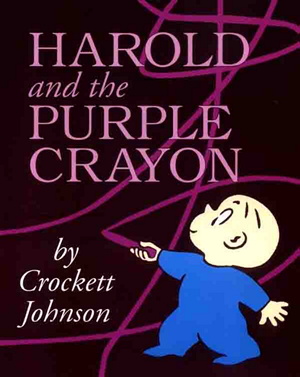
herald cover

Harold and the Purple Crayon is the saddest book ever written, also the most transparent. It is either a book about a lost son or a book about every man. It begins with scribbles on the first page. We are entering the story on the other side of some unnamed conflict. Order has given way to chaos. Something has gone terribly wrong.

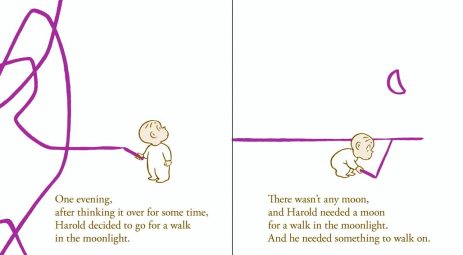
But then: stillness, as if suddenly removed from a world outside his control, into quite something else. Harold looks away to the night, turning a blind eye to the domestic disturbance behind. He is free. He can now escape into the world of unfettered creativity. The night is filled with endless possibilities. Harold has a crayon.

harild-purple-crayon-book-johnson-p1.jpg

So Harold leaves home to follow a moon of his own making, reflecting his own light in a world built around a moon. He descends on a two-dimensional plane in search for he knows not what. The world is a surface, a canvas for his self-expression. He has been crowned with a purple crown as creator, author of life–all ultimately autobiographical–beginning by being scribbled out onto a blank canvas with no edges, no limits, the pure and unbounded freedom of the will. 

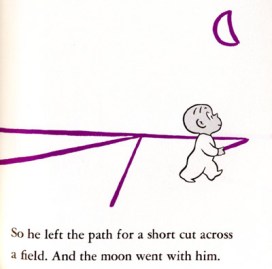
Thus, Harold begins by making a place to stand, the ground beneath his feet, and the light for his path. Naturally, it begins straight and narrow, but eventually, and just as naturally, he wanders off. Now the night is following him. 

path

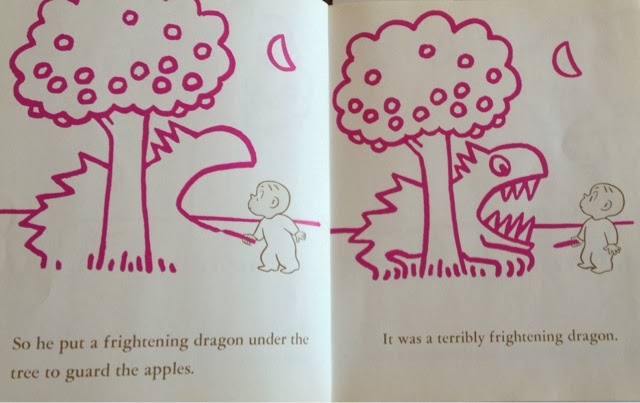
Eventually, he needs a companion–for it is not good for man to be alone–so begins expressing himself to find a suitable helpmate. But something foreign seems to be embedded in his memory, something that either looks nothing like him on the surface or quite like him beneath. We begin to see what has been lurking about in Harold’s heart. It is an image curiously familiar in Western culture, an artificial fruit tree protected by a very real monster. 

herald monster

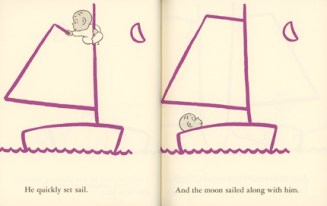
He creates a monster to guard a secret tree but discovers that the monster has a mind of its own and is no respecter of persons. The thing that was inside him now tried to eat him! Driven away in a panic by the creature of his own making, Harold accidentally draws a great deluge but thankfully saves himself on a boat. It is still night. 

Harold-and-the-Purple-Crayon_03

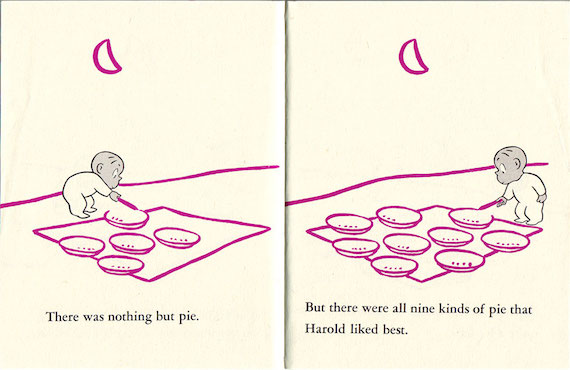
Harold makes it to land. He is famished. So he listens to the voice of his appetites to instruct him in his need for nourishment. Harold lives on pie alone. 

harold-and-the-purple-crayon-thanksgiving-writing-prompts

Turns out he’s got god-sized eyes but only a human-sized stomach. He is left with a surplus of sweets. The producer creates consumers. From the surface of things, you’d never imagine this entire economy were born of a lost little boy’s aimless appetites. It all seems much happier than hunger. Everyone smiles at the pies—of course they smile—because in Harold’s world everyone is starving. 

moose  

Harold feels sick. Maybe it was the pie, but it seems closer to the heart than the gut. He decides to start looking for home. He proceeds to draw a tower reaching the heavens. He now begins search for home. But his search never leads him to turn around, to go back, to regress and become like a child. His search leads him upward and onward. But a certain gravity eventually pulls him from the top of his tower back down to the surface. The height of his power turns out to reveal only  how far he could fall. 

haroldpurplefalling.jpg

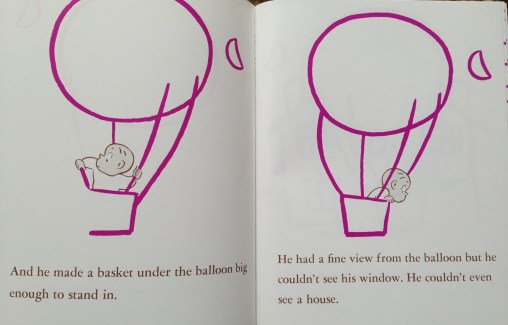
But he saves himself again by making a balloon. He has defied nature itself floating first and now hovering over otherwise abysmal conditions. 

balloon.jpeg

With no ground beneath him, however, floating seemed hardly any different from falling. This caused him to wonder about things like motion and the position of his moon–and the source of its light. But he did not bother long with that thought and drew new ground to stand on. He then thought Why not make make a new home? He drew it exactly how he remembered it, but it was still foreign to him.

home?

But he puts his hand to the plow again, except not the plow at all. He is now determined, now in the big building business. He has set out to realize new horizons with raw materials of mud, metal, and imagination. This new creation has been liberated from the creations of the farm, rather from a life of fighting with thistles and praying for rain. 

He has still not once considered turning around. Even if home were behind him, there’s no reason to believe he could go back. Time doesn’t work that way, nor the human heart. He can no longer believe that the home he remembers in that latent longing is one he actually belongs to. It is infinite progress, not ancient memory, that must satisfy his eternal longing. So the cure for his aching existence must come by way of forgetting, for while ancient memory always seems to haunt every present moment, it still feels somehow more distant than the ubiquitously advertised future that is forever at our fingertips. 

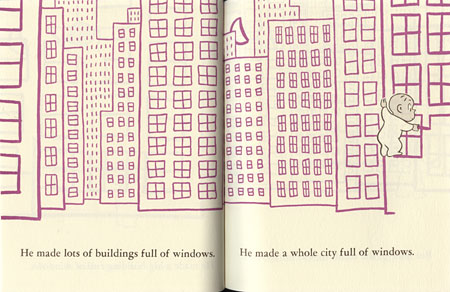
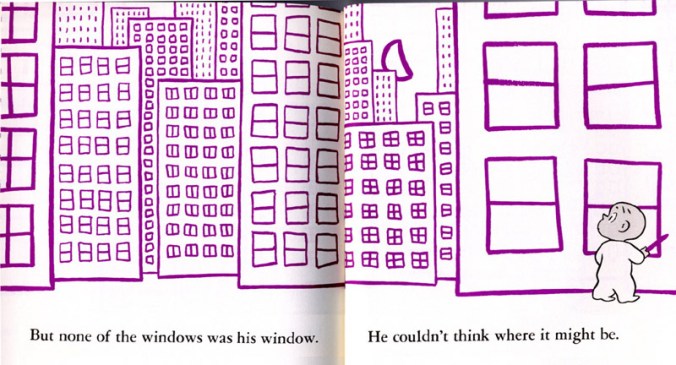
So Harold tries to give form to the haunted hole in his heart in order to create a home to belong to. He builds more windows, hoping against hope that he will discover through one the bedroom mirror hanging on the inside of his bedroom door at home. He builds an entire city. And in the saddest scene ever illustrated, an anxious little boy climbs his towers with crayon in hand making a kingdom of windows that only reveal the gaping hollow of his homesickness. 

johnson_450 (1)

It’s as if all of human life were born out of some grand front porch that continually expands in the heart with age. And all we know to do is try to match its grandness with grandiosity. So white-knuckled men scrape the clouds in high flying homes that feel nothing like home. They feel like heartache. But they are not dressed like heartache. For that, one need only to visit the real lifeblood of any city, its subway. The grandiosity of the surface is deflated in its subterranean confessional, where the height of human reach above is curiously incommensurate with height of human beings below. Down there, it feels like an entire world that has been shrunk to an embarrassingly navigable size. Everyone knows exactly where they are going, though never feeling any less lost. This is why it is impossible to ride the subway without wanting to cry a little. There is something human there and something missing. There is proximity, and there are infinite distances. The city somehow feels at once like being in control and being in a cage. It is the longing for the divine economy and the consolation of towers of human trade. 

Harold’s heartache creates an entire city the size of his homesickness. But it didn’t cure it. It is the saddest picture I have ever seen.

har.jpg

But Harold finds help. He turns to a law enforcement officer for help to find his way home, but he is no help. All he can do is enforce the law, which simply reinforces Harold’s constitution of self-governance. Harold must stay the course. To turn back would indeed be unconstitutional.[1] 

yesman

So he settles. He can neither find his home nor the light of day. He looks up to the lesser light of the night and wonders what makes it shine. He looks down again and sees his shadow, and continues to follow it. 

Harold’s home will be framed around the endless night, his only vision of light, something like the vision in Plato’s cave–before the liberation. Refusing to turn around he will never discover the genesis of his sight, the very warmth that always seems to hit him from behind in the memory of a home he no longer can believe is real. So he exchanges the future for the past and builds a shadow of the home he longs for. He is now on the other side of that empty window in which the moon is forever imprisoned.

herald moon

The story ends with the end of all possibility. Harold is not only given to the night, but any possibility of the morning with him. Harold will slip into oblivion, but only because he tried to create his way out of it. The only thing worse than embracing emptiness is denying it, which is the difference between the nihilism of creation and creation in nihilo, between hopelessness and false hope, between godlessness and the no-god, between an honest heralding of despair and today’s bullhorn gospel of progress: between the fall of Adam and the rise of Babel.

It is the far end of self-expression in the triumph of self-discovery, the absolutization of human freedom in rebellion to the Light. Harold has succeeded in constructing his hell.

bed

Hell is the life that immortalizes emptiness as its god and when the paint dries will live forever in its image.

harold

The book concludes thus:

“The purple crayon dropped on the floor. And Harold dropped off to sleep.

“The End.”

Indeed.

O jealous moon
Don’t turn your back
That glory behind
Is a shadow of black

O jealous moon
Love the light as yourself
If seek your own glory
You’ll become something else

_________

Endnote

  1. Human freedom conceived of as the freedom of choice itself, rather than the freedom to choose the Good, is what the biblical creation account refers to as the freedom to eat from the knowledge of good and evil. To affirm freedom as such is to commit the primal sin, because it is determining what is good without reference to God, the absolute Good whose ‘self-expression’ alone is “very good” (Gen. 1:31), and elevating the contingent self’s will to ‘express itself’ in a groundless realm of a self-centered goodness with no shared referentiality, and thus outside of the realm of love. In such an ‘outer darkness’ there are no stable self-transcendent coordinates that can be identified as ‘good’, and thus the exercise of the will itself becomes the absolute good, that is, the will to power (Nietzsche).
  2. The Triune God’s goodness is expressed in love, which is always self-transcendent and self-fulfilling, always, as a whole, to love and be loved, always including self and other in a shared goodness. Thus, God’s absolute freedom is co-inherent with God’s absolute goodness, not the effervescent collision of a Heraclitean flux, nor the all-consuming Parmenidean Self for whom all otherness is mere illusion and at best, in the end, Nirvana, nor even the compromised synthesis of a very large and progressive Hegelian circle (even if conceived as a straight line).
  3. And thus human freedom is essentially the power of the will to love, which is precisely the power of the will not to. But the power of human freedom, the power of the Imago Dei, exercised in opposition to love is the essence of nihilism—just as God would be the first two die if the Persons of the Godhead erupted against one another in civil war.
  4. Harold had discovered this raw freedom on the first page, but by this time he has created an entire civilization based on its irreducible nucleus he has discovered only the utter isolating effects of his self-centered will to power. And so the human family created in the image of the Triune God parses out into pixels, gathering only on the highly volatile principle of the sovereign will of everybody’s one-person world: nuclear fission in the nuclear family, the death of God and so of us.

Sprinkled With Wisdom: Learning Across the Doctrinal Spectrum 

Pondering infant baptism, believer’s baptism, and the need for Christian unity in an increasingly divided world. The topic is trending on my buzzfeed (‪#‎not‬), so I figured I’d chime in.

As someone serving in a denomination that does not baptize infants, and as someone who at the end of the day remains basically convinced by the best arguments for believer’s baptism as the normative mode of Christian baptism, I was compelled to reconsider the issue the other day when I observed in the Great Commission text (Mt. 28:18-20) that Jesus commands his followers to “disciple (v., imperative mood) all the nations,” and not, as most translations read, “make disciples of all nations” (see reflection on the Greek text of Matthew 28:18-20: “Make Disciples” Said Jesus Never; for a sermon that addresses the issue: Disciple Is A Verb). 

There are any number of implications that follow from turning the verb (and indeed the only imperative/command in this text) into the object of a verb that is decidedly not in this text (“make”). I think the wooden translation of Jesus’ command (to “disciple all the nations”) opens up support for the infant baptism position, because the participles “baptizing…and teaching…” aren’t modifying the object of discipleship but discipleship as such. In other words, the question is not What qualifies as a disciple? but rather What qualifies discipling? If the question is What qualifies a disciple, then the answer will have to draw a hard line between a disciple and not-a-disciple (which has no doubt contributed to the conflation of the definitions of “disciple” and “convert” in English parlance). That line, for many, is baptism.

But if the question is What qualifies discipling, which seems to be the answer Jesus is giving whether we’re asking the question or not, then his answer in Matthew 28 is: baptizing in the name of the Triune God and teaching to obey all he commanded.

As such, the Great Commission should function to qualify what constitutes a true discipling community (a church) and only derivatively to qualify what constitutes a true disciple. Only Jesus can determine who is truly his disciple, or not (cf. Jn. 8:31). The church’s job is not to make that determination but to do what Jesus commanded us to do, trusting that he will accomplish his will through it. He commanded us to disciple, not make disciples, and to do that by baptizing all nations in the name of the Father and the Son and the Holy Spirit and teaching them to obey all he has commanded.

In other words, it is clear that the Church must baptize people as a means of discipling people, but we are not given any formal criteria for baptizing people. We are only given a theological condition (later particularized by Paul) that ensures we communicate the Name of the God into whose life the initiate is being baptized, in whose life the Church participates, because it is from that Name the children of God are given their own–as children (cf. Jn. 1:12). The meaning of baptism is far more important than the mode of baptism. Baptism should thus be regarded a means of discipling, not a qualification of a disciple, and its essential meaning has to do with preserving and extending the (Trinitarian) Name of God from which the believing community and its members derive their name (re: identity): “baptizing them in the Name of the Father and the Son and the Holy Spirit” (Mt. 28:16-20).

But I can’t help but think that perhaps the lack of specificity is intended precisely to be suited to the task of discipling “all the nations” (Mt. 28:19). Remember, this is at the dawn of the Church, a people God envisages consisting of peoples from ‘every tribe, tongue, and nation’, whose universal message of salvation comes precisely through the local Gospel of Jesus Christ, King of the Jews, Lord of all. The Gospel to all nations would thus need, it seems, an initiation rite that is just as translatable as the Gospel to all languages: indeed, the Word of God itself testifies to the Gospel of our Hebrew Lord who spoke Aramaic, whose source documents are written in Greek and will eventually be translated into every language on earth.

In other words, God seems to have done everything possible to situate the Gospel within a variety of cultural expressions (hence the “fullness of time” Paul spoke about was a time when Judaism had been Hellenized within an all-but-consuming Graeco-Roman culture) and to preempt our tendency to divide over secondary and tertiary matters of form rather than uniting over matters of content (or mode vs. meaning). We have the Creeds and the Canon to delineate the people called the Church, and therein we have the most explicit and emphatic command to be a united people as such. But how often has God’s vision of ‘all tribes, all tongues, and all nations’ been shriveled up to many sad and disparate partisan visions of our own. How often have we exchanged harmony for homogeneity.

Could it be that Jesus was not too concerned about contextual forms so long as they were adapted to adequately communicate the internal theological content? Could it be that to take too rigid a position on this matter would be to take the only position that is definitively in error, because to do so would encourage disunity among those who have been baptized into the Name of the One True God, an implicit violation of the only explicit condition given with the command to baptize?

So perhaps we across denominational lines could do our best to embrace the communicative value of, especially, baptism and the Lord’s Supper, the two fundamental sacraments, which St. Augustine referred to as “visible words,” largely based on the way Paul uses them: as embodied Gospel communication (“as often as you eat this bread and drink this cup you proclaim the Lord’s death until he comes” (1 Cor. 11); “you were baptized into Christ’s death…” (Rom. 6)). The salient matter, then, is that we need to make sure whatever contextual forms we adopt in the administration of the sacraments, we do our best to adapt those contextual forms to their theological content in our effort to communicate the Gospel faithfully. This can be done well or poorly no matter what the age or agency of those being initiated. Being on the “right side” of such issues too often provides us with the excuse to do the “right side” wrongly, or often at least carelessly and uncritically. How many services have you sat through in which sacraments seemed, quite literally, meaningless? 

So we would all do well to consider with extreme care ways in which the baptism ceremony functions for the whole community as a “remember your baptism” ceremony: if every baptism is an identification with Christ’s death and resurrection, every baptism is in essence “one baptism” (Eph. 4:5) and is thus an opportunity to cultivate the corporate identity of the people of God as one Body with one Head, as well as the personal identity of believers as members of that One Body.


Imagine if the Church would begin thinking hard about understanding what we can learn from other positions across the ecclesial spectrum rather than thinking so hard about how to prove those other positions wrong. I’ll be continuing to reflect on what I can learn from the infant baptism tradition–it has been fruitful thus far. Lord knows the world has enough examples of people forming an “us” by pointing a finger at a “them.” May it not be so of the people whose Lord was broken so that we who are broken could be made whole, the people who have been taught to pray, “Our Father…” The Lord our God, the Lord is one. May his wholeness begin to restore our brokenness.