Mirror of Earth, Window of Heaven

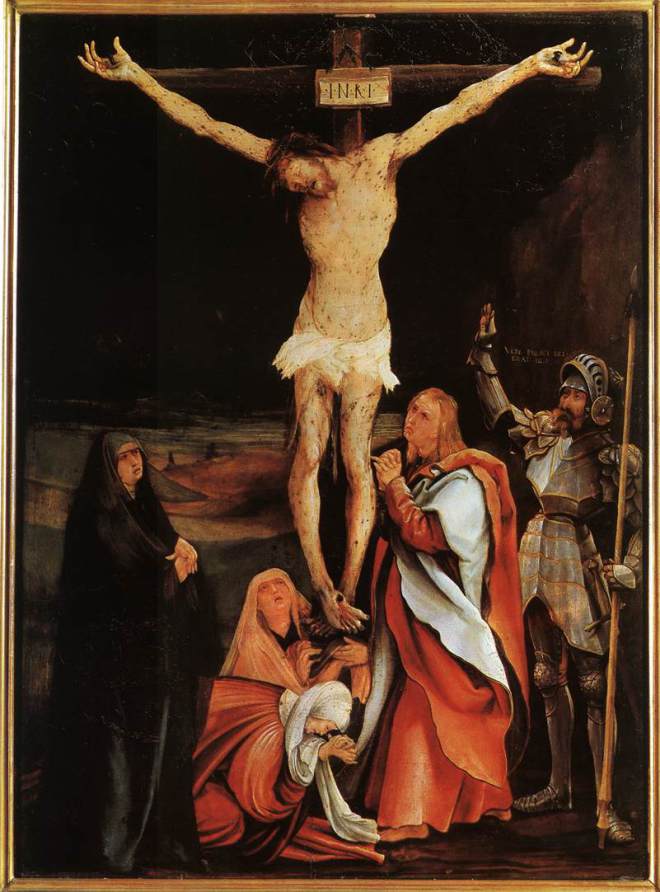
grunewald soldier.jpg

“And so he was raised on a cross, and a title was fixed, indicating who it was who was being executed. Painful it is to say, but more terrible not to say…He who suspended the earth is suspended, he who fixed the heavens is fixed, he who fastened all things is fastened to the wood; the Master is outraged; God is murdered.”

Melito of Sardis (A.D. 180)


Good Friday

Just after Jesus breathed his last breath, one of the Roman soldiers who helped fasten him to the cross uttered the surprising confession, “Truly, this man was the Son of God!”
 
This soldier in one moment forces the nail through the layers of two worlds, staking them together in holy matrimony and pronouncing their union through the piercing ring of crashing metals. But he ‘knows not what he is doing’. He knows nothing of this holiness nor of this matrimony. He knows only his orders: he must kill in order to stay alive. He must destroy Life in order to keep it. He must crucify the ‘King of the Jews’ in order to preserve the kingdom of Rome. He must execute power in order not to be executed by it.
 
But just a moment later, he knows. In the distance a thick veil has torn in two and an easterly winter wind blows out from the center of the city. Suddenly, he is struck by the cold and terrible truth. Heat rushes up the back of his neck. The death of this life was the death of Life itself. He has just crucified the Kingdom of humankind. He has executed all powers and thrones and dominions. He has executed suicide on behalf of all men. The stone will soon be rolled over the Light and the world will be tucked into an eternal eclipse.
 
The only remnant of this Man that can now be salvaged is our confession of him—that he was not merely a man: “Truly, this man was the Son of God!”
 
The wind stops.
 
And thus the soldier is the Church of Jesus Christ. His hands are our hands and our confession is his. We regard this moment as the truest image of the Christian standing at the strained feet of the truest image of God. It is too soon, at this point, to speak of the Day after tomorrow, too soon to speak of Life after today. All we know at this moment is that we have just discovered God a moment too late. Nietzsche is the Church’s prophet on this God-be-damned day: “God is dead, and we have killed him.” Amen.
 
Whatever else we are looking for from God today, we must first find nothing before we can find everything. We must remember today that the ground on which our faith rests is utterly void of our faithfulness. There is only here the faithfulness of One, but today–He is dead. Today we remember that our faith is hollow and our sin thick. The final analysis of our relationship with God now pools to the ends of the earth as from the cavernous summit of an over-boiled mountain. The concrete substance of our faith streams into the meadow. Grass withers and sad flowers fade to a bow. The lonely Garden weeps as children settle for sidewalk chalk. A whole world is forgotten. Creation’s groaning is reduced to a sigh, then to a silence.
 
The dark lord of the city reigns as Life hangs outside its gates (Gen. 3:24; Heb. 13:12).


So we dare not rush past this day, eager though we are to claim Sunday for quick, comedic relief, shaking our fists at the unbelieving world. Today, we are the unbelieving world. We cannot claim Sunday morning until we have been laid deeply down into Good Friday’s night. It is not the strain of the eyes that can see past the horizon into the morning. Morning must happen to us, and only after the night has reached its darkest dark, long after our eyes have failed. We must go to sleep after Jesus has commanded us to stay awake (Mt. 26; Mk. 14; Lk. 21). We must die after the living God has commanded us not to die (Gen. 2; Dt. 30:19). We have to look our sin in the face and acknowledge that we cannot overcome it, we cannot help but hammer away. We must hold our gaze long enough that we begin to believe the Truth of our hands staring at us through the empty eyes of our God, now burning our hope of heaven in the shadow of his gaunt, draping face.
 
The silence screams from the Creator’s formless mouth to confront us all with the Truth Pilate asked for. This is the Truth: we are looking at our self-portrait. We draw lines around lands with heroic buckets of red. We make violence a virtue while giving thanks for the Bread and the Wine. And so we must embrace the Truth of our cursed confession today: we cannot confess that Jesus is the Son of God without first confessing that we are the son of the Soldier. Our claim of righteousness and God’s claim of our unrighteousness is the same claim. We speak of the cross of Christ as God’s altar, but it never becomes other than a cross. We come to receive forgiveness from the Fount of Life and we are first handed a hammer and an infinite iron stake. We must tap into this fountain with our own guilt, staking our world together with his. The Christian knows that blood spills out from Jesus’ hands before water spills out of his heart. There is no cleansing that is not the cleansing of blood. Pilate’s basin is filled with a warm, dark red dye.
 
We are Christians, and we sin more passionately than we believe.


And yet, this is not only the True self-portrait of humankind. There is here, in due time, a deeper Truth. There is in this mirror of earth a window of heaven. For this is the only true self-portrait of God. There is, yes, a love that is furious enough to die for another through the hate that is furious enough to kill for itself. The cross and the soldier face the world and show us both who God is in Christ and who he is not in us. He is not a soldier. He has not come to kill us. He has come to kill the soldier in us. His weapons are his wounds.
 
So hold our gaze we must to this strange image, oscillating without interval between ray and shadow without ever once changing its form, and yet never ceasing to oppose its form. We must allow ourselves to be repulsed by the darkness of this Death if ever we are going to be seduced by its Light. Like a sunspot in our vision after staring into the naked noonday sky, the Man on the cross, whom we so desperately wanted only to be a man, will stain our vision of the world with a dark truth, that the darkness of the sun in our eyes has come from the light of the sun in our eyes. The Truth that blinds us is the very same which has given us sight. But the Light has come to expose the darkness in us. We love the darkness because we could not become ourselves the Light. We are the jealous moon, ever running from the truth that our Light is not our own.
 
So the Light wrapped himself in darkness and we “beheld his glory, the glory of the only Son from the Father, full of grace and truth” (Jn. 1). But if we want that grace tomorrow, we must embrace this Truth today.
 
So today, let us take up our hammer and follow the soldier. Let us march to the summit of history to fill the air with our clanging confessions. Let this Man be the God he is and let us be the soldier we are. For as long as he is who he is and we are who he is not, today will remain for us the day we become something we otherwise could never become:
 
“But by the grace of God I am what I am.”
 
“God is dead, and we have killed him! Truly, this Man is the Son of God.”
 
Amen and amen.
The Lord, The Trees, And I

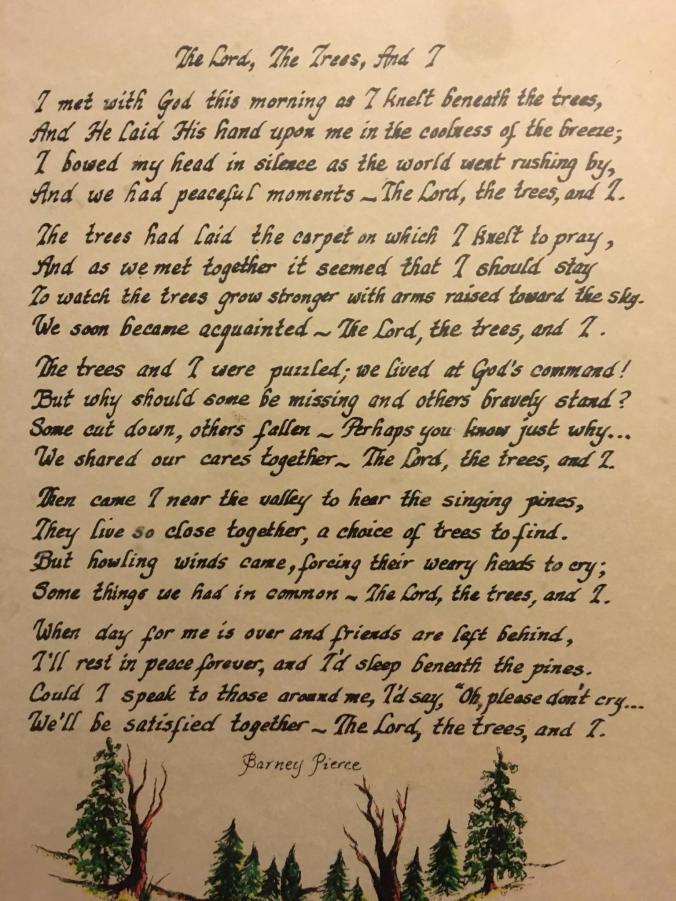
The Lord, The Trees, and I .jpg

With all the sharp-edged words flying around the airwaves like aimless shrapnel in a world of lost boys, I’m reminded by these now aged and well worn words that there is a sanctuary for all who are moved more by the howling winds of creation’s longing (Rom. 8:19) than they are by the passing winds of promise-panting change. There is still a hope that sinks beneath the surface and stretches beyond the skies, but it is a hope that makes no alliances with the pride and violence rolling off the tip of this world’s two-pronged tongue—for, indeed, there are things that simply do not belong in a Garden.

I’m not sure there’s anything left to fight for on the battlefield. Perhaps it is time to begin leading people back to the trees…

Community on Mission

Nothing bands a community together more closely than sharing a common purpose bigger than any one member of the community or even the community itself. One powerful example of this phenomenon can be seen in Band of Brothers, the miniseries based on Stephen Ambrose’s non-fiction book by the same name set in WWII. The story follows the lives of the men who come together and to form “Easy Company,” an infantry battalion assigned to the U.S. Army’s 101st Airborne Division. The series begins by introducing individual characters from all walks of life coming together, like streams dumping into a river, having been called off their individual paths to walk together toward a common goal. By the end of the series these otherwise strangers had become brothers. What banded them together so closely was not what each had in common with the other, but rather the fact that they shared a common purpose that each held in higher regard than himself. Their mission had created community.

This is how precisely how the church was started, when Jesus began calling individuals from all walks of life, from blood thirsty zealots like Simon to tax collecting traitors like Levi (otherwise sworn enemies!), and giving them a higher purpose that could band them together, indeed, as brothers. And so it continued in the book of Acts (cf. Acts 1:8ff), but somehow since then it has become typical to try to work in just the opposite direction: form communities and then do mission. But this is always difficult, if even possible, because while mission requires community, community does not require mission.  

When I was still the youth pastor at FAC I found myself bumping up against the limits of trying to nurture genuine Christian community among the students when I made no appeal to a common purpose that transcended the community itself and the walls of the church. It was really only when students began coming together for various outreach opportunities or training initiatives I offered that I began to see deep, Christ-centered relationships form. At some point it dawned on me that the only way to establish a missional community is by becoming a community on mission. Go figure…  

One of the principles a community on mission is that people moving toward a common end need to be equipped with common means to achieving that end. Every soldier has to learn how to use the same basic weapons, use a common language, and learn how to respond in any number of situations as part of a strategic whole, just as everyone trained in medicine has to learn how to use the same basic instruments, understand a particular vocabulary, and be prepared to respond to any number of situations as a strategic whole. The more clearly everyone understands the mission and their role in it, the more confidence they will have for engagement. But if the mission appears fragmented and unclear, if I people feel like it is up to them to carry the burden alone, confidence will be deflated and engagement avoided. This is true of any organization, but it is especially true in an organization that does not (and should never try to!) enforce its members to do anything.  

Having said that, the staff and leadership of First Alliance have begun asking the question What do we need to do to become a community on mission? Based on our common purpose, to be witnesses of Christ both locally and globally (Acts 1:8), what are the common means, tools, strategies that are equipping us and banding us together as we work toward that end? 

Suffice it to say, we are excited about the developments thus far. At this point, it would be too early to begin talking details, but we certainly do want to get people talking. And perhaps the best way to do that is to introduce a mock-up of one of the three or four tools we are developing. The goal with these simple tools is to establish common points of reference throughout all the ministries of the church, across generations, that will get us speaking the same language and understanding basic and accessible strategies of engagement. In time, our hope is that we would be fully equipped to move seamlessly between our worship-based gatherings to our witness-based scatterings, to move indeed as a community on mission.  

This diagram is a simple way of thinking about conversational evangelism as moving people from “Common Ground” to “Uncommon Ground.” Evangelism isn’t about having awkward conversations with people you don’t already know about a subject you never really talk about. It is more about a way of life through which we can become a living invitation for people to come into a space where brutal honesty can be met with radical grace in the name of Jesus. The world offers no such place. Our prayer is that First Alliance Church will become such a place, and become so well beyond the walls bound by bricks and mortar. 

conv evang.png

Level 4: Common Ground–Acquaintanceship This level describes the typical sphere of our social engagement, where we encounter one another through screens, whether the screens of social media or figurative screens of the facades we create. This level of encounter is simply based on proximity, but there is no personal depth of conversation. Nonetheless, this is an important ground to appreciate, since conversational evangelism moves with people in dialogue and respects their limits. This is where we begin listening and attending to the Spirit’s guidance, rather than charging ahead toward “Uncommon Ground”

Level 3: Uniting/Dividing Ground–Membership At this level we find people of like skin color, like political ideology, like socio-economic class, like opinions, etc. But these groups can only exist as an”us” so long as there is a “them.” They are inherently divisive and create ‘others’ who easily become enemies.While participating in groups on this level is unavoidable, and not necessarily bad, it should not determine the depth of our relationship, and will inevitably produces hostility, pride, and self-righteousness, often undetected. We should be aware of our participation in such groups and continually seek to ‘break new ground’ with people for the sake of the Gospel.

Level 2: Sharing Ground–Friendship This level describes the sphere of vulnerability, life-on-life, honest engagement and self-disclosure. There is a tendency for older generations to avoid this level (in preference for level 3) and for younger generations to wallow in it. There is nothing inherently good about this level, and it can often simply become a self-absorbed ring of hopelessness and angst. However, for a Christian this is the sphere we must continually try to steer our relationships toward for the possibility of sharing our testimony. If we don’t have a testimony to share (How has God changed me? When was the last time he changed me? What is he working on in me now? How is he encouraging me, healing me, convicting me, etc.?), then it would be a good idea to confide in someone who shows evidence of the fruit of the Spirit and be honest with them. Ultimately, we want to be intentional about bringing the name of Christ into moments in time by sharing our testimony, with an ultimately direction toward prayer and the Gospel.

Level 4: Uncommon Ground–Fellowship This is the level of genuine encounter. Truly loving a person ultimately seeks to bring them into an encounter with the living God. This doesn’t mean being a weirdo or pushy or whatever. It simply means that people need Jesus and Jesus wants to give himself to people. For unbelievers, we are just here introducing strangers. For fellow believers, we are gathering in Christ’s name to grow in our faith, seek God together, and to enjoy the fellowship afforded to the family of God. In so doing, we are also becoming equipped for our engagement with unbelievers.

Welcome to Lent: Remember to Die

desert

In ancient Rome, military generals returning victorious from war would be paraded through streets in a chariot to inhabit the praise of the people in celebration. But behind the general, in the same chariot, a slave was placed whose sole responsibility was to whisper in the general’s ear sobering words that served to protect him from the delusions of grandeur that inevitably comes to those who find themselves at the center of human praise: Memento mori. 

“Remember to die.” 

It seems like an odd reminder, considering the fact that none of us have much ‘to say in the matter, and all of us will certainly prove equal to the task when the occasion presents itself’ (D.B. Hart). But of all the facts of life, death turns out to be perhaps the easiest to forget. Or perhaps all of life is oriented toward one long attempt to forget about death, because the moment we become aware of death is the exact moment we become aware of a uniquely human desire: not to die.[1]

Life begins with a desire to eat, to drink, to touch and be touched, but one day we wake up with the desire to be gods, that is, to not die. But since that desire proves to provide little practical counsel for the day-to-day task of being human, we busy ourselves with lesser desires in a pursuit toward satisfaction, expanding our kingdoms, our influence, our bank accounts, our progeny, willfully forgetting that all we value as treasure today the moth will value as food for tomorrow. And eventually, even the moth will die. But we insist on willfully forgetting what we know to be true–that nothing less than immortality could possibly satisfy the most basic longing beneath all the rumblings of the human experience that drive us ‘to distraction from distraction by distraction’ (T.S. Eliot): not to die.

So we live our lives as though we will live forever, often using people likes steps on a Babylonian Zigurat, on an upward trajectory toward nothing other an infinite ‘more’, in all its arbitrary finite forms. But ‘more’ turns out to never be ‘enough’. Desire is always stronger that satisfaction. The abyss of the human soul and its appetite stretches to an boundless expanse. We are not like the burning bush Moses met on the mountaintop, whose fire did not consume; we are like every other fire: everything we consume soon vanishes. Indeed, with every met expectation we discover an unmet expectation that lies deeper in the gut, closer to the heart.

There is an essential desire to be filled with the fullness of God, but that desire of fullness is infested with the emptiness that comes from trying to fill ourselves to the fullness of ourselves (Eccles. 3:11). Adult souls are filled so full of sinful habits, too normal to call sinful, too constant to call habitual, like the sin of pride or the habit of self-preservation, that it becomes impossible to identify one’s own aching emptiness. We are protected by hidden attitudes, hidden from even ourselves, and hardened hearts. 

Eventually life begins to feel like an endless pursuit of escalating goals, with each step up the ladder revealing more clearly only how high even the lowest rung of the Infinite truly is, and thus how low the highest rung of human striving gets us. Every promise turns out to be only half full because we are always left at least half empty. Youth are naïve; their grandparents are bitter. All are forgetful.

And so religion is born out of an ancient memory of death, but it is too quickly whitewashed into another resource for power. Every religious person simply becomes two persons, attending more or less to two essentials drives moving in geometrically opposite directions that tear away at the soul: the drive to hold on to life and the drive to let go, to remember to die and to forget.

Thus, the Gospel of Jesus Christ is our essential reminder—the story of the God who became a backseat slave to whisper into the front of our chariots: Memento mori. The season of Lent, beginning today, is our annual pilgrimage into the desert with Jesus (Mt. 4), where our subterranean temptations to forget rise to the surface with the serpent who seduces us to rise up in war against our mortality. “If you are the Son of God, then eat! (Mt. 4:3) Forsake death! (Mt. 4:6) Rise up in power!” (Mt. 4:9). It is the temptation of Son of God, because it is the temptation of every man: the lust of the flesh, the lust of the eyes, the pride of life, indeed, the forbidden fruit—to be as gods—for the Son of God is the Son of Man.

And so we enter the desert today, where we confront the twisted shape of our two-pronged souls, fashioned after the exact shape of that tempter’s tongue. We desire God, yes, but we also desire praise, to love God and to be gods (Gen. 3); we desire peace but we also desire revenge; we desire community but we also desire exaltation; we desire love but we also desire self-gratification; we have at times a passion for the kingdom of God, but there are other gasoline passions; we desire God’s will but we never desire “not my will.”

And so we must return to the desert fast to search ourselves for areas of amnesia, reminding our obstinate wills to die, to remind ourselves of the direction we are all headed, lest we continue to chase empty upward promises that only push the deeper side of the soul out to the surface, thinning it out, so that life just becomes a series of unreflective actions and reactions, like a restless pinball with an impenetrable surface—no stability, no connection, no depth, no anchors, no stillness, no reflection, no transparency, no exposure of the heart, no communion of the spirit, no deep crying out to deep (Ps. 42): just a shell of a once-human existence in constant commotion.

By moving through this somber season of self-examination we are better prepared to see how fitting is the cross, not for Christ but for us. Indeed, as the thief at Jesus’ side confessed, it is our “just reward” (Lk. 23:41). In our unreflective world, fast-paced and on-demand, there is hardly a more urgent need for the life of faith than this kind of reflection, which inevitably leads us into repentance, since herein we discover no small attempt in our heart to rise up as gods—to live by bread alone, possessions alone, pride alone. Only then can our Good Friday Gospel penetrate to the level of the salvation we actually need—salvation from ourselves. Indeed, only then can we be properly prepared to utter the truth of our Sunday Morning confession: “I am crucified with Christ—nevertheless!”

“If anyone would come after me, let him deny himself and take up his cross and follow me. For whoever would save his life will lose it, but whoever loses his life for my sake will find it. For what will it profit a man if he gains the whole world and forfeits his soul?”

~ The Son of God


Footnote

  1. Of course, all creatures instinctively desire to survive, but only humans desire not to die. That is to say, only humans can conceptualize death as such and in so doing cannot avoid, if even only for a flinching moment, contemplating their own death. Human consciousness is plagued with eternal dimensions. We can travel in our minds beyond ourselves, modeling universes and genesises and apocalypses. But when when we try to travel into the dark void of non-being, of our own non-being, we indeed discover “a bourne from which no traveler returns” (Hamlet). We become aware of the judgment this world is under, for we know that end of my consciousness is for me the same as having never had a consciousness, and that is the same for me as there not being and never having been and there never going to be anything at all (cf. Jenson, On Thinking the Human). And since there is no life apart from consciousness, the inevitability of death leads to the absurd conclusion of a pure and utter negation of being as such.

Lent and the Backwards Ways of God

Ash Wednesday marks the first day of the forty day Lent season that is consummated on Easter Sunday. The symbol associated with Ash Wednesday is a cross, a symbol of death. The symbol associated with Easter is an egg, a symbol of new life, of new birth. The Lent season begins with a death and ends with a birth. God’s ways are backwards.

Lent is a season of living God’s ways through fasting, reflection and repentance.

Fasting. The forty day fast is a gesture of withdrawing into the wilderness with Jesus, the time when the backwardness of God was embodied in the person of Jesus, as he turned down all that the world and its ruler had to offer. In Matthew 4, just after Jesus was led by the Spirit into the Wilderness, the devil tempted him saying, “If you are the Son of God, command these stones to become loaves of bread.” But Jesus answered, “It is written, ‘Man does not live by bread alone, but by every word that proceeds out of the mouth of God.” Lent begins with a fast because through it we acknowledge a hunger that is deeper than what the body craves. The Lent fast is not about self-deprivation as much as it is about becoming a glutton for the Word of God. It is a fast that enables us to feast. Take the time this Lent season to give up one of life’s so-called necessities in order to indulge in the Word of God, acknowledging that your life on earth consists in more than your body and all its cravings. Awaken your soul to the bread of life.

Reflection. Socrates was right when he said that “the unexamined life is not worth living.” Indeed, we hear echoes of Socrates later in Paul’s command to the Corinthians: “Examine yourselves to see whether you are living in the faith” (2 Cor 13:5). Paul’s examination, in contrast to Socrates’, was not an examination of life as an end in itself, but rather an examination of faith, which, for Paul, was the way to participate in God’s life. The unexamined Christian life is more tragic than any other, because Paul’s assumption is that there are people who hold up the banner of faith who do not participate in the life of faith. There are people who call Jesus Lord to whom Jesus will one day say, “I never knew you” (Mt. 7:23; cf. Mt. 25:12). Over two billion people traipse around the world toting this banner; but it is not necessarily clear whether those holding this banner are marching with the parade of this world or the parade of God, that is, whether they are marching the world’s way or God’s way, the backwards way. So we would all do well to take the forty days of Lent to examine ourselves, to really examine ourselves honestly and thoroughly. Let us all ask God to show us the areas in our lives that evince no faith-life, the paths we walk down in the company of the world rather than the company of God. And as such, we can respond by turning around, by repenting, by walking with God the backward way, proclaiming the cruciform way of Christ in light of the coming kingdom of God.

Repentance. In the first century there was a sect of Judaism called the Essenes, who required repentance and conversion to enter their group and who practiced something similar to the rite of baptism that we encounter in the gospels. Some scholars actually think that John the Baptist, whose ministry was the baptism of repentance, was a part of this sect. However, the Essenes were largely a separatist group for whom repentance from the ways of the world consisted to a large degree in dissociation with the people of the world. Jesus might have been identified as a member of this sect after going out to the wilderness of Judea (a place of separation from the world) to be baptized, except for the fact that he did not stay there; except for the fact that his baptism in Matthew 3 was followed in Matthew 4 with his gathering a crew of fishermen to fish for people, which was immediately followed by his contact with “ the sick, those who were afflicted with various diseases and pains, demoniacs, epileptics, and paralytics…[as he traveled throughout] Galilee, the Decapolis, Jerusalem, Judea, and from beyond the Jordan” (Matt 4:24, 25). And this ministry of touching the untouchables, those whom a separatist group would most eagerly avoid, was coupled with a message: “Repent, for the kingdom of heaven is at hand” (Matt 4:17). The season of Lent as a season of repentance is not meant to prepare us for Easter by separating us from the world of humanity, as though the resurrection is about escaping the world. It is precisely the opposite! Our wilderness of repentance prepares us for Easter because in it we acknowledge that God’s world has broken into the world of humanity—for the kingdom of heaven is at hand!—so we can thereafter return to the world to parade through the cities—on the wrong side of the road—proclaiming the Easter message: “It is here! The kingdom of heaven is here! The King has come to rescue us from sin and death and evil!

And, indeed, this message is backwards. It is significant that the ashes that are used to make the sign of the cross on the believer’s forehead on Ash Wednesday are made from the palm branches used in the Palm Sunday celebration of the previous year. The branches that were used to celebrate Jesus’ royal procession into Jerusalem are burned to symbolize the death of our idolatrous definitions of power and glory and honor, all of which were projected onto Jesus when he came to Jerusalem to take his throne. Ash Wednesday calls for a redefinition of all our categories of sovereignty as we remember that our God took his throne on a cross. So let us humbly accept the backward ways of God. Let us allow death to be the beginning of life. And as we move backward toward the Easter celebration, I hope that each of us will have a meaningful Lent season: feasting on the Word of God, reflecting on the life of faith, and repenting from our worldly ways, all to prepare for our proclamation of Easter—Christ is risen! He is risen, indeed!

Lenten Sermon Series: “Subtexts”

“Lent is a double journey—a journey together and alone toward the mystery of God’s redemptive embrace in the death and resurrection of Christ. At the same time, it is a journey into the depths of our humanity.”

~ Don E. Sailers

The Gospel comes to expose two themes of hiddenness in this world: the hiddenness of the kingdom of God and the hiddenness of the human soul. Especially toward the end of the Gospel, this double hiddenness is brought into a dramatic, and ironic, tension. Jesus is received as King of the Jews upon his triumphal entry into Jerusalem. A week later he will be crucified as King of the Jews in his (presumably) defeated exit from life. Between his “ironic entry” into and “ironic exit” from Jerusalem he gives a number of parables that reveal something about the hiddenness of God’s kingdom and the hiddenness of the human heart (esp. Matt. 25), after which come the ironic symbols of the coming kingdom: the burial anointing by the woman (Mt. 26:6-13), the elements of the New Covenant in bodily brokenness and blood (Mt. 26:7-30), and indeed war of two Wills in the Garden (“not my will, but your will be done”) in which victory comes by way of surrender (Mt. 26:36-46).

In retrospect, the Gospel reveals the truth of the human situation in light of the truth of the kingdom of God: we all have an inner world and an outer world, what we say and what we think, who we are and who we portray ourselves to be, motives and ulterior motives. We wear our texts on our sleeves, but there are always subtexts beneath the surface. 

But Jesus makes it clear at the outset of his ministry: the righteousness of the New Covenant does not settle for changed behavior, only for a changed heart (Mt. 5). Our hypocrisy, our duplicity, our lack of transparency and openness with God and with one another—the world of subtexts veiled by the world of texts…and Facebook—thus comes under fire. The Gospel comes with catch. The one condition to receive the grace of God is that the subtexts must rise to the surface. Jesus eats and drinks with prostitutes, tax collectors, drunks, not because they are any better or worse than anyone else, but because their sins were already exposed—they wore their sin on their sleeves, like lepers. They couldn’t hide their sin and therefore were exposed to grace, which is the precise text of the kingdom in the subtexts of the Gospels. But grace comes only to those who confess they need it. Indeed, Jesus comes “not for the righteous, but for sinners” (Mk. 2:17).

The season of Lent is a season of fasting, reflection, and repentance. It is a journey with Jesus into the desert (Mt. 4), where our subterranean temptations rise to the surface with the serpent and begin revealing the twisted shape of our two-pronged souls, which is the exact shape of that serpent’s tongue. We desire God, but we also desire praise, to love God and to be gods (Gen. 3); we desire peace but we also desire revenge; we desire love but we also desire self-gratification; we have at times a passion for Jesus, but there are other gasoline passions; we desire community but we also desire exaltation; we desire God’s will but we never desire “not my will.” There is an essential desire to be filled with the fullness of God, but that desire of fullness is infested with emptiness (Eccles. 3:11), filled with sinful habits and protected by hidden attitudes and hardened hearts. We spend much or our lives numbing ourselves to the emptiness, distracting ourselves from it or simply trying in vain to fill it. But it turns out to be a bottomless abyss. Desire is always stronger that satisfaction. The promises of our temptations always return void, and every empty promise pushes the soul toward the surface, thinning it out, and soon life just becomes a series of actions and reactions, a restless pinball with an impenetrable surface—no stability, no connection, no depth, no anchors, no stillness, no reflection, no transparency, no exposure of the heart, no communion of the spirit, no deep crying out to deep (Ps. 42): just a shell of a once-human existence in constant commotion.

And thus the Lenten fast forces us to look our emptiness in square in the eyes in order to “examine [ourselves] to see whether [we] are living in the faith” (2 Cor. 13:5). Whatever else Paul meant by those words to the Church in Corinth, one thing is clear: they needed to examine themselves for faith-life and it was possible to fail that examination. This is not Paul the evangelist at Mars Hill (Acts 17); this is Paul the preacher on any given Sunday. In other words, the same Paul who was the chief champion of the grace by which the Church was founded and is sustained recognized there would be individuals in the pews whose faith was only skin deep, who were deceived into thinking that being a Christian means being connected with Christ by virtue of our connection with the Church rather than being connected with the Church by virtue of our connection with Christ. So Paul calls each member of the Church to take stock, to look within themselves, because if there is no authentic reflection before the living God, there may be no authentic connection with the living God. 

In our unreflective world, fast-paced and on-demand, there is hardly a more urgent need than for our need than this kind of self-examination. Our Lenten fast thus leads us into the kind of reflection that reveals the ways in which we must turn toward Christ in repentance. By moving through this somber season we are better prepared to see how fitting is the cross, not for Christ but for us! Indeed, as the thief at Jesus’ side confessed, it is our “just reward” (Lk. 23:41). Only then can the Gospel penetrate to the level of the salvation we actually need, because only then can the cross be seen in the true light of our most essential confession: not simply did Christ die for the world, but Christ died for me!

As A.B. Simpson, founder of the Christian and Missionary Alliance, once wrote:

Is it for me to be cleansed by His power
From the pollution of sin?
Is it for me to be kept every hour
By His abiding within?
Wonderful promise so full and so free,
Wonderful Savior, oh, how can it be-
Cleansing and pardon and mercy for me?
Yes, it’s for me, for me!

When that kind of confession comes to the surface out of the depths, then will we see the unrelenting pursuit of this God for his exiled creation, then will we see that the Passion of Christ is not simply a favor from God but God’s furious love, indeed then will our Good Friday be well suited for Sunday Morning.

Dear American Christian, Jesus Christ Is Not Lord Elect


https://www.youtube.com/watch?v=BDTvV_zwpto

“What is good?–All that heightens the feeling of power, the will to power, power itself in man. What is bad?–All that proceeds from weakness.”

“Here we must beware of superficiality and get to the bottom of the matter, resisting all sentimental weakness: life is essentially appropriation, injury, overpowering of what is alien and weaker; suppression, hardness, imposition of one’s own forms, incorporation and at least, at its mildest, exploitation…life simply is will to power.”

“He that humbles himself wishes to be exalted.”

“God is dead…And we have killed him.”

~ Friedrich Nietzsche

“If you win, you need not have to explain…If you lose, you should not be there to explain!”

“It is not truth that matters, but victory.”

“By the skillful and sustained use of propaganda, one can make a people see even heaven as hell or an extremely wretched life as paradise.”

“What luck for rulers that men do not think.”

~ Adolph Hitler

“It will change. We will have so much winning if I get elected that you may get bored with winning. Believe me.”

“My whole life is about winning. I don’t lose often. I almost never lose.”

“The final key to the way I promote is bravado. I play to people’s fantasies. People may not always think big themselves, but they can still get very excited by those who do. That’s why a little hyperbole never hurts.”

~ Donald Trump

“Where the Spirit of the Lord is, there is liberty.”

~ Donald Trump (quoting the Apostle Paul from 2 Corinthians 3)

“But we have this treasure in jars of clay, to show that the surpassing power belongs to God and not to us. We are afflicted in every way, but not crushed; perplexed, but not driven to despair; persecuted, but not forsaken; struck down, but not destroyed; always carrying in the body the death of Jesus, so that the life of Jesus may also be manifested in our bodies. For we who live are always being given over to death for Jesus’ sake, so that the life of Jesus also may be manifested in our mortal flesh. So death is at work in us, but life in you.”

~ The Apostle Paul from 2 Corinthians 4

“Therefore [the Lord] said to me, ‘My grace is sufficient for you, for my power is made perfect in weakness.’ Therefore I will boast all the more gladly of my weaknesses, so that the power of Christ may rest upon me.”

~ The Apostle Paul quoting the Lord Jesus Christ (2 Co. 12)

“Every knee will bow, in heaven on earth and under the earth, and every tongue will confess that Jesus Christ is Lord, to the glory of God the Father.”

~ The Apostle Paul quoting every tongue in heaven and on earth and under the earth (Phil. 2)

“The rulers of the Gentiles lord it over them, and their great ones exercise authority over them. But it shall not be so among you. But whoever would be great among you must be your servant, and whoever would be first among you must be slave of all. For the Son of Man came not to be served but to serve, and to give his life a ransom for many.”

~ Jesus Christ, King of kings and Lord of lords.


Dear Mr. Donald J. Trump, please take the Name of Jesus Christ out of your mouth. The Lord of the universe and his Church need no defense from you, from Hillary Clinton, or from any other representative whose election depends on nothing more than empty persuasions toward an agreeable attitude. To suggest that “Christianity” is in need of “protection” is to deny the power by which it subsists. The only kind of power that Christianity needs, indeed the only kind it in fact has, is the power to not need power, because it is the power that need not fear death. It is resurrection power, which comes by way of a cross, which happens not to be the same thing as a sword, either instrumentally or grammatically or rhetorically. There is a stubborn syntax that comes with being crucified that just refuses to allow the meaning of a cross to be smeared into its opposite, even by the most eloquent (or loudest) of wordsmiths. Those who win by the sword, lose by the cross. Or, to put it in more familiar terms, if one’s “whole life is about winning,” he may gain the whole world but will surely lose his whole soul. 

Of course a sword feels much better in the hand than a cross, so we shouldn’t be surprised that the Church has a long history of attempting to reconcile the two in an unholy matrimony. But to reconcile the two is simply to eliminate the One. Constantine, the first “evangelical” emperor, a man with either a sophisticated taste for irony or an ironic distaste for logic, may have imagined a certain compatibility when he sent his soldiers to fight their enemies with the symbol of a cross on their shields and the metal of a sword in their hands. But it was never compatible enough to be convertible. He never thought to convert the sword with the symbol and send his soldiers to take up their cross, to love their enemies and to pray for those who persecuted them. It appears he never thought much about conversion at all, at least not in the wooden sense of the term. 

Nations must indeed protect themselves in order to survive, but the Church of Jesus Christ must not-protect itself in order to survive, lest it survive by becoming other than itself, lest it take up its cross as a shield of self-defense. This is why martyrdom is never a threat to the Church and is indeed the seed of the Church (Tertullian). It is also why the Gospel in its plain form is so offensive. The moment it is domesticated to fit within some larger controlling narrative that enables its devotees to come out on top, it quickly leads either to a world without its King or a king without his Cross, democracy or tyranny, but never to the Gospel. The Gospel is about the risen King of this world who exercised all his power to die for the world in sacrificial love. It thus abides as an invitation not out of the world but precisely to live in this world for the sake of the world as witnesses to the love of its King.

Christians in America need to make a distinction between the two kinds of representation they are engaged in as citizens on earth and citizens of heaven (Phil. 3:20), and we must be chiefly concerned about the growingly severe problem of misrepresentation. Like everyone else in our Republic, we can vote according to our conscience, or more likely according to someone else’s conscience, or more likely according to some group consciousness that consists of a few common fears and nearsighted hopes; but we must realize that what we are doing is an act of our American citizenship, not our heavenly citizenship (Phil. 3:20). We must realize to call Jesus “lord”–originally a political designation, not a divine name–is to call this world his kingdom and to call ourselves his subjects. I hate to be the bearer of bad news, but the idea of a kingdom and the idea of democracy are exactly opposite ideas. Representation in the kingdom of God is not the representation of the people through their leader; it is the representation of the King through His people. 

We are ambassadors for Christ, not his council (2 Cor. 5:20).

I have bitten my tongue a lot through this extended campaign season, but this kind of rhetoric amounts to the highest form of treason against the Name of the Living God. Vanity of vanities: Jesus Christ is not lord elect. The Kingdom of God is not the flag of the Church for which it stands, because it is not a republic–of the people, by the people, and for the people. The kingdom of God is a kingdom–of God, by God, and for God–precisely because it is a ‘kingdom’ and it is ‘of God’, for the God who happens to be for us. And “us” includes every conceivable “them” on the other side of every arbitrarily conceived wall, because the Incarnation of Christ means that every line has been crossed in order “break down the dividing wall of hostility” (Eph. 2:14) by establishing a kingdom built on the foundation of a cross, from which the King opens the door first for his enemies: “Father, forgive them…” (Lk. 23:34). Indeed, “while we were enemies, we were reconciled to God through the death of his Son” (Rom. 5:10), so that “in Christ God was reconciling the world to himself, not counting their trespasses against them, and entrusting to us the ministry of reconciliation” (2 Cor. 5:18-19), which is quite unlike the ministry of defense.

There are times when the we must make a choice between the greater of the goods, and there are times we must make a choice between the lesser of the evils. But there is never a time we must choose between human power and the power of the living God. For the cross-bearing Church of Jesus Christ, those two powers flow in geometrically and diametrically opposite directions. There is a way up and there is a way down, and never the twain shall meet. Those who humble themselves will be exalted and those who exalt themselves will be humbled. 

If as a Christian there is any doubt in your mind whether the gates of hell will prevail against the Church of Jesus Christ–and I mean this with absolute sincerity and say it in reverence and out of love–it would be best for you to walk away from the Church until you see it for what it truly is. For Christ’s sake, whatever you do, please do not try to defend it by seeking power alliances. For if it is not founded upon, sustained by, and advancing through the living God himself, then it is nothing but a farce and Christians are “most to be pitied” (1 Cor. 15:19). The last thing this world needs is fearful “Christians” playing around as though the Living God were not Sovereign, as though he were dead just because we killed him (Acts 3:15), as though fear were not the exact opposite direction of faith. The world will never see Christ in us until we demonstrate the courage to lose, until we exercise the power to stop seeking power, until the cross begins looking more like an open invitation than a decorated shield.

Put down your sword (Mt. 26:25). Take up your cross (Mt. 16:24).

“Blessed are those who are persecuted for righteousness’ sake, for theirs is the kingdom of heaven.”

~ Matthew 5:10


For more on church and state in relation to marriage, click here.

For more on the description and rationale of the “human-sized” kingdom of God, click here.

First Memories (4): God

It was on my way from the chapel back to the cabins, a short walk through the woods at Quaker Haven Camp in Northern Indiana, that I first was first encountered by God. I was eight years old.

I had just be released–finally!–from the obligatory chapel session where things were obligatorily said like, “Jesus died for your sins.” The camp director gave us an extra hour of free time until lights-out since it was the last night. Unassuming, I began to hurry back to the cabin to get my flashlight and black everything to play capture the flag. Then—I froze.  

I was stuck staring at something invisible and everywhere, at nothing and everything, but not like the Holy Spirit people at church always talked about—perhaps more like the Holy Spirit. There were trees. There was transcendence. The earth had lost its horizons. My vision stretched the present into forever and rebounded back. I saw myself for the first time. I felt like a shadow that had suddenly turned around and discovered just how sad and flat was the world it was stuck hiding in.

I was enveloped in something like the Present tense. It was not an emotion. I did not feel a sensation or get cold chills. It was not a phenomenological impression of the world that translated into interiorly to a sense of spiritual contentment or a strange heart-warmedness, like love filling an inner vacuum or a wooden triangle filling out an idea or a deep itch satisfied by a hard scratch. It was inexplicably the opposite. A vacuum had opened up, an idea had been emptied out, a deep itch became an untouchable ache. I was an inner vacuum, and yet I was not alone. The whole cosmos had been tucked away like a bird hidden in an old man’s inner breast-pocket. It was, in a moment, a rush of wonder and, in the next, the strike of revelation.

And in an experience of unsolicited arrival, I found myself at the crossroads of a longing I didn’t know I had and a joy I didn’t know I could have, a place I wanted to call home–in the way Peter on the mountain wanted to build three tents. And I may as well have been dead, or I may as well have had just been born.

I had just stumbled into the living God. It was the one they had named at chapel. And I knew it in the way you can only know shame or fear or trust or hope. It is not something you can prove but something that somehow proves you. The thing I distinctly remember thinking, and thinking as with letters of lead, was, “God is here.” And not “in here” or “around here.” Just “here.” Also, not separate from the Jesus I had heard about. Jesus had always been there, but that name had just descended like lightening. In a rush of greed, I extended myself to take hold of him, and then—gone.

The most unsettling thing about it all was that the moment I thought I figured it out, the moment I could put Jesus and God into a formal equation, was the very moment it ended. It was the start-and-stop of wonder in capturing the invisible now, like the moment my two-year old son finally seizes the soap bubble to take as his captive-now-vanished. And it was gone not because I had matched it with the wrong name, but I think precisely because it was the right name. I had been nudged by some slippery force who spoke the primal Word in an unmistakable voice and then ran off and called from a distance, as if to taunt me from behind the trees, only to reveal that it was I who was hiding.

It had lasted for maybe ten seconds, maybe for all eternity. I couldn’t tell. And I wasn’t even sure it had happened, or I wasn’t even sure that anything else had ever happened. It only now existed as a longing that felt like a bashfully hopeful heartache. I remember trying to adjust my body, refocus my eyes, send my thoughts back to where they just were, run back in time, stop time, start my whole life over so I could run into this Moment again. But I could do nothing like that. It was gone and I was still there—just me and time and the untamable God who escaped my grasp and was forever on the loose in a world where he was everywhere at once and yet nowhere to be found.

To be clear, I cannot say in any sense that this was a fond memory. The memory remained in my heart like a ghost refusing to die. There was now a hollow that made life in this world always sound like a fading resonance with some song just out of reach. It was like I had heard the all truth of Psalm 19 in a single moment, but could never really believe Psalm 19 about all other moments combined. The heavens had opened the trees in a chorus and the glory of God had sounded, but it now only resounded in my own shallow voice—the echo without the glory, the song without the heavens.

When I convinced myself to let go and continue up the ordinary hill into a now very unordinary world, I may as well have been a stick man with a long nose tearing himself away from his paper kingdom. I wasn’t sure if it was just me or everything other than me, but I was absolutely certain that something about the surface world was either full of miracles or smeared with illusions. And I was at any rate disillusioned by the division between my certainty of knowing something was phony and not being so certain it wasn’t me. There were two kingdoms now, and they had declared a war inside of me, or I had become aware of some invisible war engulfing everything. A strained and constant negotiation was now underway between essence and appearance, heart and surface, shame and pride, fear and bullshit. And while the idea of negotiating has with it a sense of, indeed the goal of, control, the fact of the negotiation was wholly out of my control. Soldiers can be master marksmen but they do not have the power to announce a ceasefire, just as diplomats are master negotiators but neither do they have the power to announce a ceasefire. I was now both duplicitous and diplomatic, like a man or like a cold war. But a man never admits he is two men anymore than a diplomat admits he is a spy, so perhaps it was more like the teenage couple walking back downstairs at the party, now bound for all eternity as one flesh but having never felt so torn at the heart.

So I had now to face the sad world as a man half hiding. I had stolen something sacred and everyone, indeed everything, suddenly became terribly suspicious. The universe had become one giant, illusive conspiracy, a house of mirrors with that had been shattered in a moment by a windows into the Real, a window that somehow provided the first reflection of the naked world as it truly is, and the naked self inhabiting it. I had lost all grounds for trust in the world, in myself, but I did long now to find something to trust. And I wanted only to trust that moment. But that moment was gone. 

So I never told anyone. Not a single person. What was there to tell anyway? That I had seen God? Who would have believed that? And what if they didn’t believe? What if they convinced me not to believe? It was a pearl and the disbelieving world was swine.

But I treasured that moment in my heart like a thief treasures a diamond in his pocket, too afraid of being found out to ever cash it in for its power of purchase, for something else, but never really wanting to anyway. I would have sold all the highlands of earth for this treasure. I was not sick with wanderlust but diseased with a lust of wonder. It was not power I was after; it was Beauty. I wanted to be overcome by its power, to drown like light into a diamond, but never to return again, too greedy to want it to shine for anyone else, not realizing that that was the very greed that buried the world, that turned the star-spangled earth into a lump of coal. I didn’t realize that if God hadn’t stopped shining on me in that moment I would have taken him hostage and crucified the world.

For I did not yet know that creation is a diamond imprisoned in a coal mine, that it is the treasure of God’s giving heart and God is the beauty of its hidden soul. I did not yet know that God would have sold all the highlands of heaven for the power of its purchase, and that he would be plunged into the heart of darkness if only to retrieve one of its treasures. The only way to know that truth in any real sense, I would first have to become well-acquainted with the darkness of my own heart. 

First Memories (3): gods

My first memory of god(s) begins by remembering the time I imagined God as pure imagination itself. For that reason, God was as harmless as cotton candy. Jesus was harmless too growing up, but Jesus was at least solid, like a tree in a garden or the statue of a clown. So God was always somewhere and Jesus was always around. I would use phrases like “God and Jesus.” And even though Jesus never stopped smiling, he was still the manlier of the two in my mind. Neither of them seemed very concerned about things, not because they were necessarily aloof, more because they found the world a rather delightful place to look upon.

Also, although the terms were agreeable to me, I did not really think in terms of God the Son and God the Father. It was just Jesus and God. My father was solid and had a dark black beard and dark brown eyes that looked very real. Jesus had a beard too, but his was lighter brown and his eyes were a very different blue. And my father seemed to be more serious than Jesus. I at any rate took him more seriously. But as for God, he was as invisible as the Holy Spirit.

Until one day, while playing in the tractor tire sand box, I started pointing out to my best friend Greg that the sky that was a zoo. Greg intervened to warn me not to look at clouds because if I saw the face of God I would die. I remember being afraid to look up after that but then not being able to not look up. It felt like the smallest kid on an academic team had threatened me, except it was more like being threatened by the biggest stuffed animal in the sky. I always imagined catching God looking at me and quickly averting his big northerly puffball eyes, as though embarrassed or as though to him I were the most interesting of all creatures, or perhaps as though I kind of made God feel shy. I was amused by the God Greg had convinced me to be afraid of, but in the way amusement and fear are the necessary conditions of adventure. I started to like the incongruity of imagining the God made of pillows coming at me wielding an infinite electric sword. I even remember a few times snapping my head up only to level back out secretly disappointed to be alive. What better way to die than in the lightening of God? 

But Jesus was still Jesus and God was still God and I was okay with the equivocation, something like: Jesus was God’s natural face and God was Jesus’s supernatural heart. Also, we were Quakers, so the Holy Spirit was basically everywhere, especially where there was silence. That made speaking separately of the Holy Spirit far more difficult than grownups speak of the Holy Spirit. Since he was everywhere and didn’t have any red-mud name like father or son, I assumed that when people started talking about him in particular ways they were actually talking about anything but him in particular. A triangle needs to be a single triangle before it can become every triangle. And I was unable to imagine the singular form of “everywhere.” So the Holy Spirit was kind of like the divine atom but also a little like the weather. He was the one you would need to consult should you ever find your heart strangely warmed.

So the Holy Spirit was indeed distinctly God, but only like a triangle was distinctly a triangle before anyone ever saw a triangle, also like a perfect triangle is still a triangle even though nobody has actually seen one in the natural world. Perfect things all seem to be the truest things and like the truest things all seem to be invisible. My math teacher in high school believed the universe needed perfect triangles to exist, but he also didn’t believe in God because only things that can be seen truly exist.

But in my childlike understanding of the world perfect triangles and absolute truths were cut from the same cloth like Jesus and God were cut from the same Spirit, who refused to cut them in two. All I knew for certain is that Jesus was the one with a face, a face I believed was perfect—not like a perfect statue but like a perfect triangle. And I suppose I am in a good company of children that think about the Trinity in similar such terms (something like 2 + = God). The Holy Spirit was the divine ether that somehow holds the clouds of heaven and the face of Jesus within its misty midst.

So without really deciding on the matter I settled early on the assumption that the face of Jesus would suffice as the face of God, and that the one called God would suffice as the stuffing in Jesus’ special heart, and that the Holy Spirit just somehow magically worked out all the kinks in my theory. It is really only the last of the three Gods or God who is for a child the so-called “God of the gaps.” But children seek to bridge gaps wider than even the universe, which turns out to be wider even than the heads of Bill Nye and Ken Ham side-by-side. So children need recourse to the Holy Spirit, even if Bill Nye and Ken Ham do not. And the practical matter at hand was that Jesus was the hard face of God and I wanted to jump on God’s other face like all kids want to jump on the clouds.

But then I saw the face of God. It may as well have been incidental that it was also the face of Jesus. They still belonged together but neither of them were anything like the faces from before. And while I am going to attempt to describe what I saw, I need to preempt my description with something that will sound like an excuse for why the Bigfoot photo is blurry. I once heard a comedian say that every photo of Bigfoot is blurry either because Bigfoot isn’t real or because Bigfoot is just really blurry. And if the latter, it is all an all the more terrifying prospect, because there is a big blurry monster lurking about that no one takes seriously enough to hunt down. 

But it’s not just that the face of God was blurry to me. It was black. It looked something like the naked noonday sun looks to any who dare behold its glory directly with unveiled faces. It is easy to talk about what the sun looks like until you actually see it with your own two eyes. If we are honest, it is black to us. Not only that, but depending on how boldly one dares to stare, the very object that gives light to everything else will for some time after eclipse everything else with a jet black stain. We can enjoy its light as long as we don’t challenge it to a dual. Light gives itself to sight in a way that keeps sight from ever thinking it can see without it. The eyes alone are as blind as a pupil is black, but they are black because God made the eye only to receive, indeed to complement, his Beauty. The eyes don’t really see the world any more than they can see the son–they receive it; they receive floods of photons bouncing around in orderly succession in sound waves of glory. The center of the eye, like the center of man’s soul, is black, but that doesn’t mean that one is as ugly as the other. It only takes stepping into the light and then, and only then, looking in the mirror to see that there is hardly a more beautiful sight than a black spot wrapped up in the horizon of an iris. And even a life-sucking black hole, like the soul, is cradled in a horizon of light. 

And even if it weren’t true that men love darkness rather than the light, it is true that every man wants to radiate his own glory. And the earth is polka dotted with lesser lights imagining they rule the day. So as the moon forever showers in the glory the sun, the earth is eclipsed by its own shaded glory. Perhaps that is why the moon is still naked and not ashamed and why men cut down figs and firs and litter the night with star-spangled streetlights. We all love to imagine ourselves as the Man revealed in the end, holding the lampstands in our hand, but the sun reminds us that unless our eyes are made of its fire there remains a greater light to rule the day. And even the nightlights take on loan their evening dominion.

You might just say, the sun suggests that our eyes have been given dominion over every tree of the garden and beast of the field, and even the birds of the air, but that does mean they have dominion over all things. Indeed, no eye can see the face of the sun and live.

So when I say that I “saw” the face of God, what I am talking about is an experience that revealed more about me than it did about God, and yet God was ever more real and I was evermore stained. So all I can do is try to delineate my experience with words that will at best be like the physicist trying to delineate a black hole by its event horizon or a man in the mirror trying to delineate his sight by his iris. I’m groping at what I know to be the weightiest matter there is, and yet all I really know is that I am not weighty matter and that the black face of God is aflame with the terrible night.

First Memories (1): Life

It is said to be somewhat common to remember one’s first moment of self-awareness, usually around the age of two or three, which can be described in some sense as an awakening. It is a moment not so much of seeing the world outside oneself for the first time, but seeing oneself as outside the world; that is, the world that can suddenly be delineated by what it is not—it is not me. We are suddenly aware that we have been carved out of being as a being among otherness. It is an experience at which point self-transcendence and self-awareness, objectivity and subjectivity, become one identical moment, in shared location. It is the moment we discover, I am not, therefore I am.

Rare is it, however, for one to remember the first moment of becoming aware of one’s own mortality. This is perhaps because life in some sense is organized as a long attempt to forget that particular memory, haunting and heavy as it is. To happen upon one’s own death in the imagination is that sound in the dark that we prefer to hide from than confront, for ignorance shall set us free. If we do approach the subject of death, we typically insulate ourselves from it, putting up certain glass walls in order to see it at a safe distance, which can become a thing of habit with increasing degrees of intensity—from the insect under the magnifying glass to characters behind a screen to the first time seeing what’s left of the car on the side of the road, and staring as intently as humanly possible. It is a most curious thing to be a creature whose experience is plagued with an awareness of the negation of all experience. Eventually, we will have to explore our memories of death, but first we have to remember being alive.

I remember that first moment with living clarity. It is the memory of a kind of still-shot from life that isn’t perfectly still. It is a single image but not a frozen image, a moment in which everything is at rest, choosing to stay still. It is in the kitchen of the parsonage in which I grew up. It is summertime and the house is filled with sunlight. I have sunk into the embrace of my mother, who is wearing a white apron checkered with an abundance of small, red budding flowers. My head is turned to the side, staring into the future that is me staring into the past. I cannot escape my own gaze without tampering with the memory, and even then it is not really pliable like others. So long as I’m thinking about it, it’s there, and even now as I try to change it, it lingers out of reach, not because it is too distant but too immediate. It is a qualitatively unique memory. I’m not even sure that it qualifies as pure memory.

First of all, I cannot be sure that it is the memory of an actual moment, although I think it is. But I do not remember it as the distinct moment I became self-aware, as though in the moment I self-consciously made such a judgment. The reason for the association is that it is my earliest memory, but more than that it is the only memory I have from which I unable to maintain any clear objective distance. It is the starting point of my selfhood which extends into the present and intends a particular future. When I reflect on it, I and the boy staring back at me in the image can have no dialogue, because I and the boy have remained one from that moment, or at least in the memory of the moment. That moment which belongs to my past refuses to die in the present. It insists on belonging to the present. The boy back then is always the identical subject that I am now. This is the memory of subjectivity itself. I remember, therefore I am. 

I imagine it would be an obscure inquiry to pursue, but I cannot help but wonder about the particularities among others who have a memory of becoming aware of themselves. I should at least remark, if only as a token of gratitude, that I consider myself fortunate to have a living memory of myself as one who exists in the embrace of love. It is indeed an accurate representation of my mother, but it also perhaps speaks to the capacity of love to awaken one into awareness.

A mother’s love is the most unique love in all creation. Love, in essence, requires both a giver and receiver. In its truest form it is the mutually identical self-donation and trusting reception of two or more persons. But the mother can both give and receive love on behalf of her child. She is the open recipient (ideally) of her husband’s love, the receipt of which has the potential of taking on a life of its own in the child. A child is thus formed in a woman’s act of openness to the possibility of receiving a life within her own body. In the event that child does form, her body begins loving her child automatically, sharing nutrients, hydration, blood. But even after birth this dynamic continues, of course physically by nursing but so too with the empathy that bonds her to the child and carries the child forever in the womb of her heart.

So I am not surprised, given the mother that I have, that this should be the memory of the life I awoke to as a child—because it is the womb in which I was formed as a child. Love always extends itself to its object in a way that communicates an awareness of its object’s subjectivity. Empathy is precisely that, the capacity of an intersubjective awareness of life. It is indeed the life created in the image of the Triune God. But it is also a life that will eventually be confronted with an awareness of death.