Testimonies Untold 

  
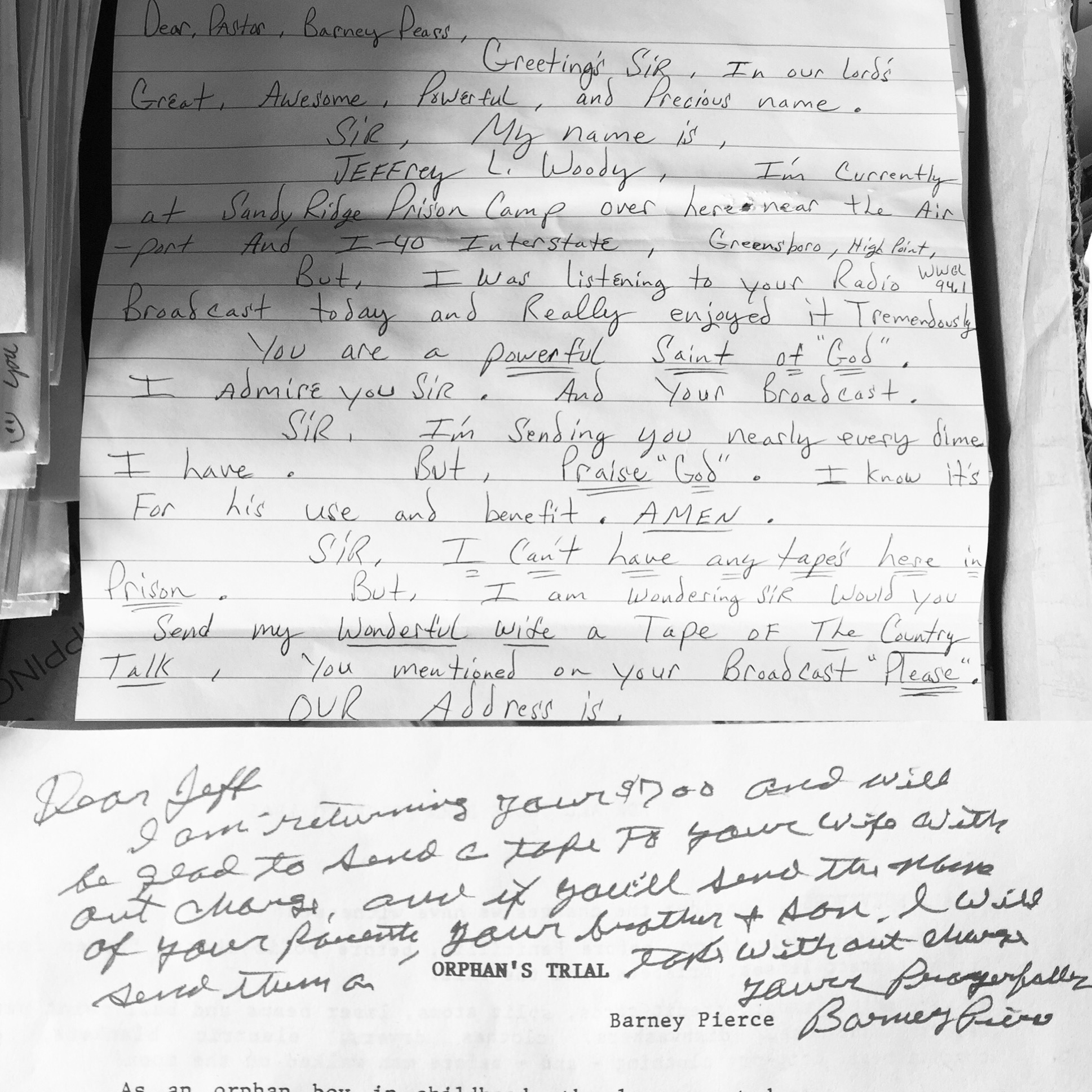
Fourth letter into the hundreds I’ll be going through over the next few days and I find this one, from “Jeffrey L. Woody…at Sandy a Ridge Prison Camp.” This is from the stack that came addressed to my grandfather’s radio broadcast requesting a tape of his “Country Talk” (who knows exactly, other than it’s something about Jesus and something about hope–even for the prisoner). He originally had sent with it “nearly every dime [he had].” 
It was paper clipped to a copy of the response my grandfather sent (copied likely for bookkeeping, likely per my grandmother’s instruction) that read as follows: “I am returning your $7.00 and will be glad to send a tape to your wife without charge, and if you send the address of your parents, your brother and son, I will send them a tape without charge. Prayerfully, Barney Pierce.” He had scribbled that in the ‘heading’ of one of the who-knows-how-many poems he wrote called “Orphan’s Trail” (about a criminal who found an advocate in Jesus). The last line reads: 
“The lawyer was Jesus, the crucified one; 

the judge was his Father, now I am his son.” 

The last letter in the clip was Jeffrey’s response, full of praises to God and addresses for his family. 

And so the kingdom of God advanced. 

If you want to be a part of the stuff God is up to, don’t look for the headlines–look for the Jeffreys. You won’t get much notoriety for it…but maybe fifty years down the road your grandson will find out what you did, the kind person you were, and be filled full of inspiration and conviction, evermore determined to carry on an unspoken legacy of faithfulness to the One he too has come to know as Advocate. 

“He who is faithful in very little is also faithful in much” (Lk. 16:10).

Fear Not: The Death of Christianity is the Birth of the Church (It Always Has Been)

Screen Shot 2015-12-30 at 7.57.54 AM

Let the numbers drop.

The Church of Jesus Christ doesn’t believe in the Church but in Jesus Christ. Neither does the Church believe in this or that side of a very horizontal partisan pole but in the coming Kingdom of our Lord. Christ has never relied on his Church maintaining a moral majority or tax-exempt status to flourish. The blood of the martyrs only makes the blood of Christ more palpable.

Don’t let some trendy new “theologian” (re: sociologist) sell you their book with all its diagnostics and projections and “solutions” for the problem that is ‘the Church’. The Church is constituted by none other than the living God in his sovereign freedom. He can raise up children of Abraham out of stones, probably even out of “liberals” and “evangelicals” as well.

Besides, there is nothing easier for the individual human heart to hide behind than a crowd of people who know why everybody else is wrong. Beware of deriving your identity from whatever Christian subculture to which you belong. God judges by “the thoughts and intentions of our hearts” (Heb. 4:12), not the thoughts and intentions of our t-shirts. And his judgment is clear. There is one thing wrong in this world: every human heart. Nobody wants to buy that t-shirt, but it is the only one that bears witness to a Crucified Lord.

We do not need more strategies or organization, we don’t need more Christians being the “hands and feet of Jesus,” we don’t need more efforts in discipleship or missions or relevance or, for Christ’s sake, politics. We need One thing. We need the living Christ! And if there is any contingency to speak of, it is not the living Christ but our participation in his life. The gates of hell will not prevail against the Church, but they may very well prevail against the place I “go to church” every Sunday or my denomination, or yours. In that case, we need only one other thing: we need repentance. Only repentance can “bear fruit worthy of repentance” (Mt. 3:8).

“The sacrifices of God are a broken spirit; a broken and contrite heart, O God, you will not despise” (Ps. 51:17).

No amount of effective strategizing can replace that. Nor can any amount of effective strategizing make the Lord not despise a self-important spirit and self-righteous heart. There is the humble Christian who prays in the light of the cross, and there is false religion. There is nothing else.

When God has a people with a passion for his Name, a people who “will the one thing,” all the other stuff–organization, mission, discipleship, whatever–will come, but it will come as a matter of means, not a matter of principle, a way to respond to the living Lord of the Church, not a way to preserve a dying relic of Christians. If Christians are indeed a dying relic, we need only remember that the Church was born in a tomb, and then to humbly return to our place of origin, and stay there, that Christ may be born again in us. That alone will save us from the temptation to live for the glory of any other name.

“Unless a grain of wheat falls in the ground and dies, it remains alone. But if it dies, it bears much fruit” (Jn. 12:24).

“For I decided to know nothing among you except Jesus Christ and him crucified” (1 Cor. 2:2).

“I have been crucified with Christ. It is no longer I who live, but Christ who lives in me. And the life I now live in the flesh I live by faith in the Son of God, who loved me and gave himself for me” (Gal. 2:20).

“Fear not, little flock, for it is your Father’s good pleasure to give you the kingdom” (Lk. 12:32).

“You can never learn that Christ is all you need, until Christ is all you have.”

– Corrie Ten Boom

“What we choose to fight is so tiny! What fights with us is so great. If only we would let ourselves be dominated as things do by some immense storm, we would become strong too, and not need names.”

– Rainer Maria Rilke

Levi Ryser: Born in the Shadow of the Savior (12/26/13)

Levi Ryser

The baby was born. They called him James.

There’s not much to say about James. He doesn’t say much about himself in the letter he left for us. The only other thing the Bible says about James is that he was the brother of Jesus (Gal. 1:19). All we get from Church history about James is in fragments, no cohesive narrative. A guy named Hegesippus called him James the Just. It stuck.

But it’s no surprise there’s not much to say about James, because all that is said of him is said under the shadow of his big Brother. James the Just, brother of Jesus the Judge, born in the shadow of the Savior. A hard act to follow.

I wonder if Mary felt guilty. She was found to be with child, again, but not by the Holy Spirit again. This time by plain ol’ unholy Joe. This child surely would not be so godly as her First. I wonder if she felt guilty before James was born, knowing that she could not love him as much as her Firstborn (of all Creation)?

But even more than that, I wonder if she felt guilty after he was born. I wonder if she felt guilty when she realized that she loved her second-born just as much.

I remember when we were expecting our firstborn. All Keldy thought about was the baby. She loved him in I suppose the way only a mother can love an unborn child. I on the other hand felt guilty. I could not relate. For those nine months my reaction to her pregnancy was a kind of surprised “Oh yeah…”, coupled with a nagging fear that I wasn’t going to love him like a father is supposed to love his son. I literally feared that I would love my dogs more than my son. Babies just hadn’t been all that impressive to me, because I am not a woman. The honest men out there know what I’m talking about. Women have no clue.

Except for maybe Mary. Mary knows. Mary had, after all, held at her bosom the one who came from the bosom of God the Father (Jn. 1:18). Mary had indeed “kissed the face of God.” But this second-born would be just another face in the shadow of the Almighty. Mary wasn’t yet used to having children who weren’t God. Middle children already have a syndrome named after them, but what of the one that comes second to the Savior of the world. Mary knows.

When Kezek was born, I started treating my dogs like dogs. I loved my firstborn so intensely that I was afraid I loved him more than God. I was afraid that if anything were to happen to him I would hate God. That fear lingers.

When Keldy told me we were expecting again, I was doubly guilty and doubly afraid. Not only did I love my firstborn more than or as much as God, now I feared that I would not love my second-born as much as my firstborn, perhaps only as much as the dogs.

The baby was born. We called him Levi Ryser. There was no sound. He was blue. The voices of the people in white raised an octave. They stopped looking us in the eye. They were looking at some protocol that was visible only to those who knew some unspoken “code.” Ryser needed decoded.

The doctor handed him to me to carry him to the NICU. It seemed far too much like a formality for my first embrace of my second-born son, like it was a consolation, the beginning of some process necessary for some Contingency Plan Z. It felt like I was greeting my newborn son with a goodbye. They escorted me at an anxious pace. And they apparently could not hear any of the 75 questions I asked in route to the NICU.

There are no words here that will do.

I held him as close to my heart heart as humanly possible. I tried to hold him as close to my heart as inhumanly possible, or as humanly impossible. I tried to pour my life into his. I tried to empty myself to fill him up. I tried to breath for him. I wanted to cut out my heart and put it into his body. I wanted to die so I could raise him from the dead. Anything. Just please…

I think that was the first day I ever actually interceded for someone. I beat on heaven’s door like one of those old grandmothers who’s earned the right to act that way. I was pleading, then I was demanding, then I was crying. I had felt the joy of a father’s love with my firstborn but with my second-born I was brushing up against the prospect of a father’s grief. I was feeling the very sharp other edge of love for the first time. I learned that day something about the sword Simeon told Mary about (Lk. 2:35).

Four days later, he was stable. Over those four days I started to understand what I suppose Mary had come to understand with her second-born: that the love of God and the love of a son are not two separate loves. I started to understand that God is love in a very nounish sense of the statement, or like the nounish sense of the Word Incarnation. She couldn’t compare her love for Jesus with her love for James, because her love for James came from the life of Jesus. There is no love apart from that Life. Indeed, there is no life apart from that Love. If it is in God that we “live and move and have our being” (Acts 17:28), then Love is the ether of all our relationships. To love is merely an act of alignment.

His name has become more fitting than I had intended. Levi Ryser means, by my assignment, death and resurrection, or offering and acceptance, or more simply “Gift of God” (with the intentionally ambiguous genitive). It is the second-born of Mary, after all, by whom we discover ourselves, since we all are second-born of the dead. We discover that unto us a Child is born, to us a Son is given, in order to restore love to its proper form, that we might love our own as we love God, because he loves us as though we were his own. That is the meaning of yesterday’s Birthday and therefore every birthday in the light of its shadow.

Levi was born on the altar, where all gifts are born. He was born without breath, blue. But while he was yet unknown and unknowing, in route to the NICU, he was already being born in the bosom of his father. I think in that moment, if for only that moment, I understood Mary. I think I understood something about motherhood that day. I understood what it was like to carry a life that could not carry itself apart from my own. I understood what it was like to carry life with a sense that if one dies, we all die, if one lives, we all live. I think I learned something about being the Mother of God that day. I’m certain I learned something about being a father that day, maybe even something about being a Son.

We had decided to call him Ryser before he was born. But Levi was Ryser before he was born. He was raised in his mother’s heart for nine months. And he was raised in his father’s for four days. He is now growing up in both. And all this is from God, because he has been raised from eternity in the heart of Love. And my only plea for his life is that he will continue to grow in that Love. God help me.

Ryser is our number two, but he is loved just as much as the Firstborn, even if he was born in His shadow, even if we did use leftover nativity scene wrapping paper for his birthday presents this year.

Happy Birthday, Ryser. You are loved with an everlasting love, my son.

“How precious is your steadfast love, O God! The children of man take refuge in the shadow of your wings.”

~ Psalm 36:7


*Christmas Eve* Advent Sermon (2/2): Here–In No Man’s Land

Here–In No Man’s Land

“Unto us a child is born, to us a son is given; and the government shall be upon his shoulder, and his name shall be called Wonderful Counselor, Mighty God, Everlasting Father, Prince of Peace. Of the increase of his government and of his people there will be no end” (Isa. 9:6).

This is the sermon that completes the Advent series. Advent is over. He is here.

[This was originally preached at the Christmas Eve service at First Alliance Church. I will be publishing this in an extended reflection within the month, so you can checkin in in a few weeks on that if you’re interested. Also, below is one of the many videos that attempt to reconstruct the miracle that happened that Christmas Eve and Christmas Day. Enjoy it. Then go attempt to reconstruct that miracle in your own lives.]

*Christmas Eve* Advent Reflection 24: Salvation (1/2)

Salvation

“Blessed be the Lord God of Israel, for he has visited and redeemed his people and raised up a horn of salvation for us in the house of his servant David.”

It all started with a song. The single most powerful act of war in the history modern warfare started with a song that broke out from the trenches of the Western front. It was Christmas Eve, 1914.

The 20th century was supposed to be the century of possibility. With advances in modern science, industry and medicine, we were entering a new era of human flourishing. Diseases would be cured, life would be extended, and nations would open up in peaceful dialogue. And perhaps most importantly, there was a widespread declaration of independence in the Western world from the shackles of religion. Finally, humankind had the tools it needed to live in harmony together.

But by December 1914, harmony seemed anything but possible. It was the dawn of the First World war. European nations were trying to draw new, dark red lines on the world’s map, expanding and defending their borders. A generation of youth were enlisted to fight “for God and country.” Naive boys kissed their mother goodbye one last time to go off on an adventure that everyone believed would be over by Christmas. But by Christmas Eve, 1914, barely four months into the war, over one million of those young men had been killed.

The First World War was unlike any the world had seen. With the advances in science and industry came a host of new tactics and technologies designed to make destruction more efficient. The capacity to preserve life was met with a disproportionate capacity to destroy life. The unprecedented volume and pace of modern munitions could easily turn seconds of battlefield exposure into hundreds, even thousands, of casualties on both sides. Approaching the battlefield proved to be as dangerous as moving behind enemy lines. There was virtually no way in and no way out.

Prior to this era, shelter was simply a matter of distance. Battlefields generally formed along the borders of two opposing sides. These strips of land were recognized by both sides as “enemy lines,” the place you go to fight, certainly not to go to bed. Rest and refuge were found as far away as possible. But the horizontal war rhythms of fight and flight, advance and evacuate, would simply no longer work in the 20th century. Waves of soldiers were overwhelmed by the constant flood of firepower. The only way to get close enough to kill without inevitably being killed was to stay close—and to lay low. So early on in the war, field commanders learned that digging down was the only way to take survive the advent of modern machine guns. The shovel became the greatest weapon for national defense.  And so began the era of trench warfare.

Trench warfare made for an unusual battlefield situation. Battlefields began to take on a new role, even a new look. War had theretofore been fought in anonymous clashes on the occasion of battles, but now they would be fought with familiar voices. Battlefields had become would be populated, even between the battles. Enemy lines would begin being accentuated by rows of trenches that ran along parallel tracks like neatly-spaced neighborhood sidewalks. Trenches needed to be close enough to the range of a bullet but far enough from the reach of a grenade. On the front lines that was just over a stone’s throw away. Trench warfare thus brought enemies into proximity. Battlefields became neighborhoods. Enemies lived across the street. In the space between was “no man’s land.” But that little strip of land represented infinite distances. No one was safe with the neighbors around. THe aboveground world was unfit for human life. So rest would only be found, life would only be found, around six feet under.

By the end of the war over 12,000 miles of trenches scarred the European landscape with the hollowing memory of incalculable loss. Any talk of gain from the war seemed hardly appropriate as the death toll crept past 17 million. The battlefield neighborhoods became ghost towns. The rows that were once the only silver linings life on the edges of a black nightmare of power were filled in with shared dirt from the space between. It was the sign for the surviving soldiers to return to their aboveground homes, that the world was again fit for life. Or was it the sign that the world itself is homeless, a place unfit for human life, a place we spend our entire lives doing little more than shifting around the dirt of no man’s lands, trying to blend the lines and cover the scars until the day those sidewalks are lined with headstones?

The lines are just too blurred now to tell.

No matter how much we try to forget, we cannot. Too much was exposed, and it has revealed more about human nature than any of us care to know. It revealed not only what we are capable of doing to our enemies, but what we are capable of doing to our neighbors, to people with familiar voices, to people who live just across the street. It revealed, in the end, that there is no human power greater than our power to destroy.

War reveals the greatest strength humans possess. And thus the Western Front has etched deep beneath the surface of its now lush green meadows a self-portrait of the human heart filled with a dark red dye that has stained the memory of Western Civilization as we know it. Indeed, the West is itself merely a front. The whole world lay buried in the trenches East of Eden: No Man’s Land.

So we try to forget, because how can we remember without losing hope?

But we are hopeless. We need a Savior.

But there is a memory of something else. It is a memory that arises from the trenches in the middle of the war. It is the memory of a power so immense that it can only be described as a miracle, because it put a halt to the highest form of all human power. It was found in a song on Christmas Eve, 1914. It was the song that stopped the war.

To hear about that song, listen to the Christmas Sermon from this year’s Christmas Eve service here.

The Formless Void of Absolute Freedom

Theological Footnote “Advent Reflection 23: Peace

“In the beginning, God created the heavens and the earth. The earth was without form and void, and darkness was over the face of the deep. And the Spirit of God was hovering over the face of the waters” (Gen. 1:1-2).

God is the Infinite fullness of Being. There is nowhere and no-when God is not (Ps. 139:7-12). He is Presence itself and Subjectivity itself: He is I AM. 

But God chose to create beings, subjects, otherness, things. How can there be true “otherness” in a place where there is nowhere God is not? How can there be other “presences” when God is Presence? How can there be other lives and movements and beings when God is infinite Life and absolute Being itself. Indeed, how can it be that “in him, we are living and moving and being” (Acts 17:28)?* Doesn’t our living and moving and being simply exist as such as parts of the whole that is God rather than wholes (or holes?) within a wholly (or holy?) other Whole? 

In this vein, and most perplexing of all, how can there be other “subjects” when God is the infinite Subject, subjectivity itself? How can two I-AMs exist in the ‘same space’? How can the creation of subjects be anything more than the predicates of a single Subject, the multi-charactered soliloquy of a single voice, Geppetto’s puppet when it was still wood? Does creation require us all to just be (honest) Calvinists (re determinists)? How could God create a world where things could be said like, “Your will be done” or “Crucify him!”? How can I AM create all those dependent clauses (and put up with such confused subjects): “I think, therefore I am.”

It could happen if God created a space for subjective freedom, which is the fundamental precondition for love. That is the space of Genesis 1:2. God must create godlessness in order to create subjects who can give love and objects who can receive love–human beings, aka “Our Image and Likeness” (the Trinity). [For an extended discussion on the definition of freedom, click here.]

So creation of all things, naturally, must begin with the creation of a no-thing. God must create a space that is not God. Our existence must begin with the creation of a non-existence, the creation of beings with not-being, of light with darkness, of form with formlessness, the creation of daisy fields with a deep, dark void. “In the beginning” God created a non-beginning, a time of timelessness where everywhere there was nothing going nowhere. Absolute zero would have to come before Let there be summer.

So God creates ex nihilo, out of nothing, by first creating nihilum, nothingness. God is not removed from that space; rather, it is a space where he suspends his presence–he “hovers over” it. This is nature in its purest form, and it is utter emptiness, because it is godlessness. But godlessness is then filled with God’s speech, the communication of his presence in absolute freedom. Godlessness is then filled with the proposal to be filled with the fulness of God. God filled the void with form, the darkness with light, the wallless canyon with his living breath. God exhaled, creation inhaled. God spoke, the earth bloomed. God had created the space of the no-god, true distance and difference, and then invited it into harmony with God. It was a space where God could be heard. God said, “Let there by light.” Creation said, “Don’t mind if I do.” But that same space is one where God can be ignored. God said, “Let me be God.” Adam said, “No.”

But godlessness was the inevitable possibility of human freedom. The freedom to love is precisely the freedom not to. Living subjects could choose to deny the Absolute Subject, and thereby deny themselves, to say no to God, and thereby to themselves. We can always choose to die. But we can also choose life. Because the living God loves us, and his eternal Word of Grace is stronger than all our past words of defiance, all our future ones too.

So be still, and listen to God.

“The Word is near you. It is in your mouth and in your heart, so that you can do it. ‘See, I have set before you today life and good, death and evil. If you obey the commandments of the LORD your God that I command you today, by loving the LORD your God…then you shall live and multiply…Therefore choose life, that you and your offspring may live, loving the LORD your God” (Dt. 30:14-20).

*ἐν αὐτῷ γὰρ ζῶμεν καὶ κινούμεθα καὶ ἐσμέν.

Advent Reflection 23: Peace

Peace

“Of the increase of his government and of peace there will be no end, on the throne of David and over his kingdom, to establish it and to uphold it with justice and with righteousness from this time forth and forevermore. The zeal of the Lord of hosts will do this” (Isa. 9:7).

“All humanity’s problems stem from man’s inability to sit quietly in a room alone” (Blaise Pascal, Pensées).

Other than a few proper names, there is no word in the world more important to me than peace. I suppose it is because for a long time I lived without it. Anyone whose world has been stripped of peace knows just how much its worth.

But defining peace is nearly impossible. This is evident the moment you try to think of its opposite. There’s belief and there’s unbelief. There’s happy and sad. There’s hope and despair. There’s good and evil, heaven and hell, holy and unholy, books and Instagram. But what is the opposite of peace? Is it War or is it angst? Is it Chaos? Hostility? Worry? Restlessness? Anxiety? Bitterness? Hatred? Rage? Violence? Revenge? Discord? The Middle East? The nightly news? Divorce court? The human heart? Where is peace located—within or without?

Yes.

Peace is such an all-encompassing word that to not have it is to be both engulfed by and filled with the “formless void.” The formless void is existence with no reference points, not coordinates, no order. To be in a formless void is to be restlessly lost. It is to live in world of darkness that both covers the face of the deep (Gen. 1:2) and hides its face in the dark (Gen. 3:7-8). It is the void within and the darkness without. In fact, in the book of revelation, the second of the so-called four horsemen of the apocalypse was not instructed to impose violence in an otherwise peaceful world, as is sometimes suggested. He was simply “permitted to remove peace from the earth, so that people will slay one another” (Rev. 6:4). There is no more terrible a prospect of God’s wrath than God’s absence. If perfect peace has an exact opposite, it is pure absence. (See this footnote for explanation). In the words of Karl Barth, “The enterprise of the No-God is avenged by its success.” Indeed.

But this is counterintuitive. In our culture, we actually tend to think of peace as a kind of absence. If I could just get some peace and quiet! By that we mean we need a halt, a ceasefire, a break—we need to be absent from all the activity and noise we are surrounded by to find peace. But the real question isn’t why we need some peace and quiet every now and again. The real question is why we need activity and noise all the time. Why are we more compelled to return to the chaos than retreat from it? Why are 63% of Americans stressed, a quarter of which addicted to stress, while people on the other side of the cultural pole are addicted to distraction? Why is it so hard to not fill the void with the noise?

Is it that our abundance of activity contributes to our lack of peace or that our lack of peace contributes to our abundance of activity? 

How long can you sit in a room alone?

I can’t help but think that a “culture of more” is the inevitable product of culture that has poured its foundation in the void. I can’t help but think that in such a culture more can never be enough–because the void wasn’t for us to fill; it was created for God to fill. It is there so that we will come to know our need of God.

About five years back, Keldy and I were meeting regularly with a young gal helping her through some of life’s regulars, a few irregulars as well. One evening we had one of those rare “come to Jesus” moments, because it was pretty clear Jesus had come to her. There were tears, confessions, a white flag slowly being raised from her heart. But I could tell there was still some white in her knuckles as it related to one very destructive relationship she knew she needed to let go of. I tried to convince her that staying in this relationship was like holding on to a ticking time bomb. Her response: “I’d rather die with someone who hurts me than be alone. I just don’t want to be alone.” For this girl, it wasn’t a presence she feared, no matter how destructive, but an absence.

I can’t say that I blame her. I know what all sorts of pain feels like, and there is no pain that hurts more than loneliness. Indeed, “it is not good for man to be alone” (Gen. 2:18), so we would rather die with the ones who hurt us than be left to live alone.

But that’s not our only option.

On October 1, 2014 (an easy day to remember: my mother’s birthday, the day I got my second DUI–I was 18), I got a text from the same girl. It’d likely been a year since I had talked her. She was off to college and I had, quite frankly, given up on her. But Jesus hadn’t.

I saved our conversation:

G: [Her opening line:] “I am ready to give my life to Christ. I’m not sure what to do, so I need your help.”

Me: “Did something happen? What changed?”

G: “I was lying in bed in my dorm room, by myself, and suddenly I just felt at peace. It felt like my room filled up with peace.”

Me: “What do you mean?”

G: “I mean I didn’t feel alone anymore, and the only thing I could think about was Jesus.”

Me: “Go and tell three people what just happened. I’ll call you tomorrow morning.”

Jesus has a special holiday name, Emmanuel, which means “God with us.” The Gift of Christmas is the nothing less than the presence of God. It is God’s gift of God’s self. The King of Kings comes to us as Prince of Peace. 

At the second Advent of Christ, Isaiah says there will be no end to peace, no empty dorm rooms, no empty high school girl hearts, no empty void selling endless fixes for to a culture of more. Jesus will establish a government based on the peace of his presence. But Jesus’ presence is available today. Emmanuel really means Emmanuel.

The question we all must confront is whether our lives are based on a presence or whether our lives are based on an absence. Have you dared to pray for God’s peace?


Be, and Be Thankful

One of the implications of God being Infinite–the Absolute fullness of Being–is that everything that exists that is not God, from supernovas to black holes to subatomic tinker-bells, are always at every moment ‘borrowing’, rather ‘receiving’, their being from God, who is always at every moment donating to them their being out of his own bottomless resourcefulness and generosity. We are just a bunch of dependent clauses leaning on the same needless Subject-and-Verb, who nevertheless continues to extend the sentence: “I AM,” “therefore i am.” In other words, God is always at every moment creating you–in freedom and for freedom–in the unsolicited gratuity of his own freedom.

“Be still, and know that I am God.”

~ God

Advent Reflection 22: Favor

Church_and_Mosque

[For the abridged version of this reflection, click here.]

“The Spirit of the Lord GOD is upon me, because the LORD has anointed me to bring good news to the poor; he has sent me to bind up the brokenhearted, to proclaim liberty to the captives, and the opening of the prison to those who are bound; to proclaim the year of the LORD’s favor” (Isa. 61:1-2).

The verse actually doesn’t end there. It continues: “to proclaim the year of the Lord’s favor, and the day of vengeance of our God: to comfort all who mourn” (Isa. 61:2). “The year of the Lord’s favor” would begin on “the day of vengeance of our God.”

But this shouldn’t come as a surprise to us. This is the way the world works. For one to be favored, another has to be slighted; for one to be triumphant, another has to be defeated; for one to be “us,” another has to be “them.” In Isaiah’s world, the Lord’s favor would be seen when he unleashed his vengeance on Israel’s enemies. It was the same in Jesus’s world, until the day Jesus rewrote Isaiah, or at least rearranged it.

That day began like any other. Turns out it was a lazy Sabbath day, the day the Lord should have been resting. But Jesus was in Nazareth, one of the places he had created when he created the universe, which also happened to be the place he was born on Christmas #1. On this particular morning, Jesus woke up, brushed his teeth, and went to the local synagogue. Shortly after arriving, a man in robes called on volunteers to read. You know how it goes. Some tried not to make eye-contact. Others pretended to pray. John Paul Jr. raised his hand for the twelfth time in a row. The rabbi pretended not to see him. Lots of pretense at church.

But then a man with a half-familiar face stood up. It was the son of the carpenter, the one who had apparently abandoned his father’s business (cf. Lk. 2:49). But it was a break from JP Jr. So he handed him the scroll. The only visible letters were written in bold just under a tattered edge: “ISAIAH.” Jesus began unrolling the scroll, volunchoosing people to hold it up as he stretched it dang near across the entire sanctuary. Finally, just near the end, he put his finger on the passage above and began reading. But then he stopped. Making his way back up toward the top of the scroll, about five pews worth, he dragged his finger to another spot, read a few lines, then stopped again. Taking his sweet time, he then moved back down to toward the bottom to yet another passage, which he took the liberty of paraphrasing (cf. Isa. 61:1-2; 48:8-9; 58:6). He then rolled the scroll back up, gave it to the man in the robes, and shouted: “Today this Scripture has been fulfilled in your hearing!” (Lk. 4:21, cf. vv. 16-20).

It wasn’t only that his choose-your-own-adventure approach to reading God’s Word rather unorthodox, or that he announced he was carrying the fulfillment of Isaiah’s prophecy on his Person; it was that he hadn’t even chosen a favorable ending. He said nothing about “the day of vengeance of our God,” nothing about Rome or Caesar or Herod or any of Israel’s enemies or ISIS or illegals or even those dang Liberals! He simply said that “the year of the Lord’s favor” was commencing “today…in your hearing” (Lk. 4:21). And it was so, it seemed, simply in virtue of his presence.

But where was the vengeance?

That must have been the question the people were asking themselves. And when they didn’t get the answer they wanted, it must have been the reason they “were filled with wrath,” the reason they chased him out of the synagogue and tried to throw him off a cliff (Lk. 4:28-29). It must have been the reason the “year of the Lord’s favor” seemed to set in motion a “day of vengeance.” If so, perhaps the “day of the vengeance of our God” was never about a day God would begin taking his vengeance out on people but The Day people would begin taking their vengeance out on God.

In that case, it’s no wonder just after his announcement about “the year of the Lord’s favor” (in Greek: dektos) Jesus announced that “a prophet has no favor (dektos) in his hometown” (Lk. 4:19, 24). The Lord’s favor was too favorable toward Israel’s enemies, and so Israel made a new enemy out of their unfavorable Lord.

Perhaps those who have the biggest problem with Jesus are not His overt enemies, but rather those who insist He destroy His overt enemies, because by “His” they really mean “theirs” (cf., a person in the Bible called Jonah). The “Lord’s favor” on us is not all that favorable if it doesn’t involve the “Lord’s vengeance” on them–our enemies. When that happens, it’s all too easy to confuse the Lord as an enemy and to unwittingly make him the object of our vengeance, caught up in the crossfire. You’d think that would be a hard mistake to make, except that it turns out to be the hardest mistake not to make, because it’s as easy as making an enemy out of anyone.

No matter how confounded we are by the news of a God who was crucified as an object of human vengeance in order to make his enemies the objects of his love, we humanoids never fail to find ways of taking the objects of God’s love and making them the “rightful” objects of our vengeance and our violence and our grudges and our gossips. The people in Nazareth did it to his face, but we’ve all done it behind his back. That’s why Jesus would later explain in one of his last teachings that the way we treat our enemies and inconveniences, ISIS and illegals, the ones he commanded us to love in one of his first teachings (Mt. 5:44), would in the end be the measure for how we treated him. “As you did it to one of the least of these my brothers, you did it to me…As you did not do it to one of the least of these, you did not do it to me” (Mt. 25:40, 45). He would then say something about sheep and goats.

It’s in this light that the following article, published yesterday by the BBC, should be read as something of a reminder, if not a warning, to the Church:

This is news worth reading: “Kenyan Muslims shield Christians in Mandera bus attack”

“A group of Kenyan Muslims traveling on a bus ambushed by Islamist gunmen protected Christian passengers by refusing to be split into two groups, according to eyewitnesses.”

I can’t help but be reminded upon reading this of the God who wrapped his righteousness in “sinful flesh”(Rom. 8:3; 1 Cor. 5:21) that day he was found wrapped in “swaddling clothes” (Lk. 2:12), because he refused to let Himself and His creation be split into two groups.

If this doesn’t call Christians to their own faith, I don’t know what will. In a few days, we will celebrate the Incarnation of God, the day two infinitely different ‘groups’ became One in the person of Jesus Christ, the day which began The Hour when the “enemies of God were reconciled to God through the death of his Son” (Rom. 5:10). And every week, when we put that piece of bread in our mouths, we remember the One who was made flesh who was broken in order that we who are broken can be made One in Spirit by his flesh.

If Muslims, who do not know Christ, stand with those who do on pain of public execution, then I hope that Christians, who do know Christ, will be willing to stand with those who don’t on pain of public opinion. *And not because everyone just worships the same God anyway(!), but because Christians worship the God who became the same as us, indeed, the God who became a shield for us.* I don’t know the reasons these particular Muslims acted the way they did, but I do know the reason every Christian is called to act this way:

“If anyone is in Christ, he is a new creation. The old has passed away; behold, the new has come. All this is from God, who through Christ reconciled us to himself and gave us the ministry of reconciliation; that is, in Christ God was reconciling the world to himself, not counting their trespasses against them, and entrusting to us the message of reconciliation. Therefore, we are ambassadors for Christ, God making his appeal through us. We implore you on behalf of Christ, be reconciled to God. For our sake he made him to be sin who knew no sin, so that in him we might become the righteousness of God” (2 Cor. 5:17-21; cf. esp. Eph. 2!).

If we are going to be entrusted with the ministry of reconciliation, then we are going to have to take seriously that our witness to Christ has at its very center a way of transforming our categories, so that “enemies” are given a new name. Our witness extends beyond the walls of the Church, even if it compromises the walls of our nation, just as Christ extended beyond the walls of heaven, even when it compromised the walls of Jerusalem. If our Muslim “enemies” are ever going to come to know their Savior, we are going to have to learn that our Muslim “enemies” from some other nation are nothing other than our fellow “neighbors” in some Other Kingdom (Lk. 10:25-37).

How else can we celebrate Christmas with a clear conscience? Is Christmas not the day Jesus crossed enemy lines to set up a neighborhood called the kingdom of God that is no respecter of borders, the day God made his dwelling with sinners?

Christians don’t identify with non-Christians on some higher ground than God–whether it be “humanity” or “peace” or “justice” or “love,” whatever, as is the popular way of our ‘peace-talking’ these days. Rather, Christians identify with non-Christians on the lower ground of guilt, where crosses are raised, because it is there we find our fellow man who has been found by our Fellow God.

“Precisely when we perceive that we are sinners do we perceive that we are brothers.”

~ Karl Barth

“For I determined to know nothing among you except Jesus Christ and him crucified.”

~ The Apostle Paul

“The earth is the Lord’s and the fulness thereof, the world and all who dwell therein.”

~ God
Advent Reflection 21: Hope

“For what is our hope, our joy, or the crown in which we will glory in the presence of our Lord Jesus when he comes? Is it not you? Indeed, you are our glory and joy” (1 Thess. 2:19-20).

The day is drawing nigh. We have been waiting for the coming of our Lord, the Advent of Jesus Christ, for just over two millennia now. But for just over four weeks, we have been waiting for Christmas. The season of Advent is the season we learn again what we have forgotten again: how to wait. But it’s a special kind of waiting, an active waiting. Advent is our dress rehearsal.

Dress rehearsals are the final rehearsals before the main attraction: full costumes, stage propped, spot lights on, everything ordinary strangely dimmed. Reality is altered. Advent is the time for the Church to decorate the world, to create the context to remember, and to deliver, the Advent message.

In ordinary times we brown-bag our Advent message and don’t bother wrapping it in the songs of the heavenly hosts, but only so we can share it at the table of IRS agents and other brown-bagging sinners. If God can wrap himself in swaddling sin (Rom. 8:3; 2 Cor. 5:21) to deliver his message to the world, then surely the Church born of Christ should learn how to become all things to all people in everyday life (1 Cor. 9:22). So in ordinary time, we deliver our Advent message in any and every context.

But the season of Advent is different. ‘Tis the season we insist upon obnoxiously decorating everything around us, because Advent means nothing less than that everything around us will one day be altered. Sure, it at times can be a little forced—the begrudging dog in his jingle-bell sweater, the divorced family in the strained “family” photo, the holiday that invariably requires more work than work since it is a holiday built on relationships—but it’s also somehow irresistible. All the pretense. All the happy. Neighbors walk across the street, strangers talk in lines, people awkwardly sing at the door of others who awkwardly listen, people smile. We all roll our eyes just thinking about it, but we simply can’t resist it. Even soldiers stop shooting each other so they can sing together instead, to pretend, if only for a night, that the world is not at war, to pretend there really were peace on earth, good will to men (cf. “The Christmas Truce of 1914”).

The day after Christmas we may be back in our respective bunkers ready to fill the silence with shrapnel, the house with hostility, but we still can’t get the songs out of our heads. We may hate our ex-spouse till the day we die, but “Nurse, could you please put that ‘family’ photo right next to the heart monitor.” There is a hatred that lives in all of us—an inherent need to create a “them” to secure ourselves within an “us,” the need to accuse and to blame and to gossip—but there is also the love of an idea of not having to hate. We really just want to live at peace in a world that runs on fear, a world where love is always weaker than grief, where Goodbye is more enduring than Hello. The world we find ourselves hoping for just can’t be the one we find ourselves living in. So we settle for the one where we must compete and take and lock the doors and pick sides. Except on Christmas, that day imaginations run amok, the day for pretending peace on earth, good will to men, the day the world is permitted to hope.

Perhaps this is why Christmas festivity is both the most alien and the most contagious thing the Church has ever created. The world won’t copy our theology or our piety or our prayers, but the world will copy our holy days. It will not prepare for Christ’s coming but it will prepare for Christmas. This is simply because the Christmas message is little else than an articulation of the world’s longing from the other side of the promise. We all want peace, joy, love, and eternity more than we want power, but power is more believable on the surface where it is more available than hope. And indeed, the Church’s hope is in the exact the shape of the world’s longing. It’s just that we remember that our Longing was made flesh and dwelt among us (Jn. 1:14). It’s just that we believe Emmanuel (Mt. 1:23)—and so we wait, we hope for, Emmanuel (Rev. 21:3).