On Today’s Headlines

Just because it’s a headline doesn’t mean that it’s important, that it rightly demands your attention, that it immediately affects your world, that it can add to or take away from your hope. In fact, I bet if some of you ignored the headlines for just one day and went out in the woods to have an alien encounter with what our grandparents might have called stillness, one of the few things our world neither can nor ever will try to sell you, you might well begin to consider what it actually is that rightly demands our attention, that immediately affects our world, with reference to which hope can be lost or found. But you won’t find it in the headlines, because the unquenchable fires of the headline news feed only on the world of decay, the world that requires the new to ever become old, the world that skims atop the surface of time desperately groping at what men identify as meaningful today but what moth will identify as food tomorrow. Unless you stop to consider why a man running for mayor of another city matters, what you can actually do about the national debt, how you can protect yourself from Tunisian terrorists, it might never occur to you that it doesn’t matter, you can’t do anything, and that that’s not what is going to kill you; nor will it occur to you that the mayor of your own city, whose name you likely do not know, perhaps does matter, that you can do something about your personal debt, and that your self-indulgence might kill you, your laziness might kill you, your diet might kill you, your stress might kill you, teenage texting and driving might kill you, but a terrorist is less likely to kill you than is your anxiety about terrorism.

Don’t get me wrong, I don’t think it is bad to be concerned with and aware of the global scene, especially if you are in a position to do something about it, but I do think it is bad to be unconcerned with and oblivious to the local scene. I’m suspicious of a man who decries world hunger but has never offered to buy a local man’s lunch, who endorses love for the world but doesn’t sit down to eat dinner with his family, who rails against abortion but doesn’t teach his son how to respect a woman, his daughter how to respect herself. The fact is, you can’t make your world different until your world becomes close enough to touch, low enough to look in the eye. That is your world. Everything bigger is a mirage. Anything more important is unimportant. And strangely enough, it is in that little insignificant world of yours, with hardly more than an earshot radius, that you will find meaning, purpose and permanence, because it is in that world that you will find God.

“The fruit of the spirit is love, joy, peace, patience, kindness, goodness, gentleness, faithfulness, self-control” (Gal. 5). These are the things that abide, the things that sink beneath the breathless and brittle surface world of change, seeds that are rooted in the eternal heart of God and grow in the heart that abides in his, the heart willing to forsake the whole world to discover its soul. If you want to find God-sized meaning you’ll have to look in human-sized places. I know. I know. Pity the man whose significance is as small as a manger and only as wide as a wingspan. Pity even the prospect of such man. They did pity Him, in fact.

Perhaps tomorrow, after you ingest the headline news, you will stop for a moment to put your ear to the heavens and listen for the angel that ancient mystic John once heard, the angel that proclaimed what he called the “everlasting good news” in a voice big and loud enough to thunder over “every tribe, tongue and nation” but still and small enough to fit into John’s ear (Rev. 14:6).

Everlasting good news. News that never gets old. News that ever remains good. I think that is the news the world is longing to hear, and perhaps the only news that is in fact new.

‪#‎pleasenomoreweiner‬

Skinny Jeans…Skinny Gospel

If I could just respond on the record as a so-called millennial to the conference session I just attended. What we DON’T need from you “boomers” is for you to focus on accommodating our cultural forms. There is nothing more pathetic than a boomer in skinny jeans. There’s a reason our generation is so transient and entertainment oriented, hopping from one distraction to the next. It’s because we are looking for something that is not transient, not fleeting and unfulfilling; we are looking for something that abides. When you wear skinny jeans and entertain us in “church,” you are only suggesting that neither have you found anything that transcends the restless hopscotch of the cultural milieu.

We need you to give us the Gospel, which we have proven to be almost entirely unable to articulate. Give us tradition, too. The assumption is that you need to “contextualize” such that there is a seamless transition from culture to church, which of course only communicates to us that there is no difference between the culture and the Church. This ‘felt-needs’ approach to ministry assumes that we actually know what we need and that our feelings and our needs are congruent in the first place. I may only be speaking for myself here, but I would be suspicious of a doctor who attempted to treat my unknown sickness by asking me what I wanted him to prescribe for it to make it better. The Gospel is not only a prescription, but also a diagnosis. And given the fact that part of the diagnosis is the disease of self-referentiality, treating the problem by accommodating our needs with the Gospel may very well only add to our sickness. No doctor treats a diseased heart by trying to keep it alive. There are some diseases for which a heart transplant is the only adequate treatment. The Gospel diagnosis is something like that. And when it is heard for all that it is, the News that is so Good about it is that a new heart has indeed been provided.

We come to the Church with a need to identify the seam, the great chasm we feel in our hearts, and we are desperate for a solution. Don’t try to remove the seam. Please don’t tell us you have nothing more to offer than the world. That’s why we came in the first place. We’re looking for something different. We need a diagnosis, we need a prescription, and we need a special language to talk about it. At some point a burst appendix has to find a category outside that of “stomach ache.” So be bold and proclaim something so alien that you have to describe as revelation, as News, because that is what we dare to hope for anyway–something New. That is why we are here.

So please, boomers, invest in some pleated pants.

‪#‎life2013‬

Love Loses Friends

One of the things I’ve learned this week is that people don’t simply need your love. They don’t simply need to not feel judged by you. They don’t want to be told that everything is going to be okay. They don’t merely want to be told that God loves them just as they are. They aren’t near as concerned with you hurting their feelings as you are, as long as they know you are hurting their feelings because it would hurt them if you didn’t, and that it hurts you to see them hurting.

People want a way out. Some of them–and I quote–“only dream that my life could be different, but we don’t do well with change in my home.” They want you to identify the sin that is destroying them and they want you to tell them that it is sin and that it is destroying them. They want you to tell them that Jesus and Jesus alone offers forgiveness, and that forgiveness and acceptance are not the same thing. They want you to stop loving them with a blanket of acceptance, because they are intuitive enough to know that love is dirtier than that, that love gets in your face and under your fingernails. They know that love without a backbone, love that costs you nothing, is merely a pathetic way of ensuring that you feel accepted, even if it means they have to stay in bondage. They want someone to stand in the middle of their world and declare that ‘This is not God’s world!’, that ‘Jesus is the Way!’, and ‘Where the Spirit of the Lord is there is freedom!’

‪#‎tellthetruth‬

A Tragic Eclipse–The Church Next Door: Breaking the Law to Break in the Light

In 1982, two really awesome things happened: (1) I was born; (2) a garden was born—the first community garden in the city of St. Louis, Metropolitan Village Garden—when Wade Grandberry of Wade Funeral Home turned over the lots at 3111-3115 Franklin St. to seniors living in the Metropolitan Village Apartments, a retirement community just outside downtown. Land designated for death became land designated for life.

But, as in all stories of redemption, thorns and thistles began to invade the garden land and choke out the seeds of life. Being a retirement home, the city address book and city obituary are constantly fighting to claim the names from its list of residents. It only takes one generation of neglect for the garden to be overcome with weeds—just one.

In 2012, the garden had been reduced to a few greens and tomato plants struggling to survive amidst an abundance of weeds. Last year, however, the city recognized the value of the garden, both its immediate and symbolic value, which eventuated the mobilization of a few students from St. Louis University who have been hard at work to bring it back to life. It is now flourishing more than ever before. The work that remains now is just around the edges. There’s just a lot that needs to be done around the edges to let the light in for the plants nearest the fence. There is only one problem: the church next door.

Yesterday, Jacob Dorrell and I took 20 kids from First Alliance Church to participate in the restoration project. Alex Leary, a student at SLU, has been heading up this project for the past year. When we arrived, he pointed us to the east fence line. Our job was to clear the weeds, shrubs, and small trees, and to lay mulch in its place. Over the next three hours, we declared war on the weeds—and won. But the fence line opposite the Garden was just as overgrown. So I asked Alex if we could go to the other side and send the weeds to the hell they belong. We could not. It was church property. The church had been asked to clear the weeds on their side of the fence to let the light in. The community had a light problem. They needed the church’s help. They asked the church to help them see the light.

The church refused.

So the project leaders asked permission to come onto church property to clear the weeds. The church of Jesus Christ was asked if outsiders could come and clear their weeds so that its neighbors could see the light.

The church refused.

They “didn’t want to see the garden.” They did not want to see the garden. The church of Jesus Christ did not want to see the garden—And I am certain of this, the church that does not want to see the Garden will never get to see the Garden. The church next door did not want to see the garden even if it meant that the outsiders could not see the light.

In retrospect, there are a lot of things about my response that probably fall into the category of foolishness, certainly impulsiveness, for how I responded, but it felt right in the moment. Impulsive things always feel right in the moment. I’m well aware that giving money to beggars, telling strangers about Jesus, trespassing on church property and vandalizing their weed garden all run the risk of doing more harm than good, but I also aware of a story Jesus once told of a bunch of strategic world changers who failed to see their neighbor and an impulsive Samaritan who did not. And it was up to that Samaritan in that moment to give that one person a different picture of the Church next door.

Besides, I think it’s at least theologically true that any Church property is my property too. And it is certainly true that all Church property is really God’s property. And I know at least two things about God: he hates weeds and loves light. I also know at least two things about the Church. The Church is called to clear weeds and let in the light. So given these premises and a little—I mean very little—bit of human reasoning, it seemed appropriate to me to make an executive decision: to go to the other side of the fence to give our neighbors, to give Alex Leary, another picture of the Church.

So in keeping with God’s law of love and some command about the Church letting its light shine before the world, I broke the law, “trespassing” and “vandalizing” in the name of Jesus Christ (to be fair to how I am judged for this, I didn’t take any of the youth to the other side…though I’m not convinced I shouldn’t have). I didn’t have much time, but with the little time I did have, I sent as many weeds to hell as I could. I not only wanted the church’s neighbors to see the light, but I wanted the garden’s neighbors to see what happens to weeds. Jesus said that when he returns he’s going to gather up the garden food and cast the weeds into hell, that fiery place where there will be weeping and gnashing of teeth. I don’t want anyone to go to hell, even that church next door.

The weeds will grow back. And if the church next door says anything, Alex has my permission to blame that random Church from Kentucky. I’m not sure they’ll be able to appreciate what has been done to their weed garden. But I know this: even if that community is stuck beside the church next door from now to the end of the age, they at least now have another picture of the Church, one that corresponds to the light it let in, even if only for a moment.

Being Human: Just Short of Being God

The serpent never summoned the couple to obey him. Should he have his whole project would have been undermined. No one is tempted to disobey God by obeying the serpent. No one in the palace desires the slum. The serpent does not seduce its prey by convincing them that they too can become as serpents. It is not the serpent the couple is attracted to. Turning them against God would be like turning an ear against music, like turning a heart against love. The couple knew that the glory of everything under the sun was a gift. It was a glory like that of the moon—a mere reflection—adorned with a supreme but alien beauty, clothed in light but naked of itself. The serpent had no raw materials to work with.

The Garden world was therefore free of exterior temptations. It was a safe place with no hidden pitfalls or trap doors. The only command was to not commit suicide. Accidental death was not possible. God made death as tangible as a pomegranate but as appealing as a porcupine. There were life-giving trees and one death tree. But it was not just another tree. It had a name, scarlet letters branded on its branches and a foul inhabitant slithering in its shade. But it of itself was no real threat. Scary though he might have looked, the serpent’s fangs were not as sharp as his tongue nor was his venom not as toxic as his words. This was a petting zoo. And despite the recollection of the woman, God never said the tree could not be touched. The tree, like the serpent himself, was under the jurisdiction of the couple. The threat was real but not accidental, not like a car wreck or collapsing factory or a snakebite in a garden. God forbade the fruit of the tree as a parent forbids Drano. This was not about arbitrary power. It was about divine care for a creature to whom he gave such unfettered dominion that he had even the power to uncreate himself. 

Besides, we shouldn’t be so shallow to pretend like we do not know why he put the tree there. Its presence is not a perplexing mystery, only a convenient mystery. Its purpose is hidden only to those who desire to hide themselves. He made humans so close to himself that, if not for the tree, we might forget who created whom.

Of course, the reason this is important to consider today is not because the presence of the tree is now less obvious but because it is by far more ubiquitous. In the Garden there was only one way to die, but out here in the East there is only one way to live. In the Garden the tree of life defined all but one cursed tree; out here the tree of death defines all but one cursed tree (Deut. 21:23; Gal. 3:13). In the Garden there was only one talking serpent, out here the broods of vipers abound. And yet on both sides of the Garden gate the temptation is still the same. 

“When I consider your heavens,
the work of your fingers,
the moon and the stars,
which you have set in place,
what is man that you are mindful of him,
human beings that you care for them?
You have made them a little lower than God
and crowned them with glory and honor
[and] given him dominion…” (Ps. 8:3-6).

Only a “little lower”…that’s all, just as Zeus was only a ‘little lower’ than his father Cronus; a little lower, that is, until the temptation to become just a ‘little higher’ eventuated Cronus’s dethronement, not to mention his disembowelment. It is not those who are most easily tempted to kill the king that pose the greatest threat. The peasants and the outlaws conspire in vain. It is those who are least tempted. It is those who share in the glory, the royalty, and the dominion, who share everything but the throne itself, because of the position of being just a ‘little lower’ creates the illusion we can reach a ‘little higher.’

In even the most perfect paradise, so long as God creates ‘others’ with the capacity to think and will and love, to perceive and behold and enjoy beauty, the temptation of idolatry will always exist. It is not worshiping idols that tempts us. It is making them. It is not the glory of an idol that compels. It is the thought of crowning them with glory and honor and power, the thought that we of ourselves, of our own breath, can do with dust what God does with dust. The serpent can never tempt us to turn against God, but he may very well tempt us to turn our back to him, to come within a hair’s breadth from the center of his glory only to turn around and take our seat. The world may from here be shrouded in its most splendid radiance, but it will forever be stained with one dark, pitifully small, human shaped shadow. Idolatry can be quite sophisticated, because pride can be quite sophisticated.

“What does it profit a man to gain the whole world and lose his soul” (Jesus).

#youwillbeasgods

A Sermon: The Bible, A Tale of Two Stories

Sermon preached at First Alliance April 15, 2013 (audio here).


Last week we were taken into the Great Commission to see how the Gospel ended, only to discover that it did not end. It came to a climax in the resurrection of Jesus and the commissioning of disciples, and with the promise that Christ would be with the disciples to the end of the age—well beyond the life-span of the initial 11. And thus it ends with an invitation to the disciples in every age to live into the story of the Gospel to respond to Great Commission.

It may come to us as a surprise, however, when we discover that this is not the only commission that was prompted by the resurrection, nor is it the only invitation into a story that continues to this day. Matthew appears to end with a fork in the road, like one of those Choose Your Own Adventure books we used to read, with an invitation into one story from Jesus and an invitation into another story from the religious leaders.

  • Text: Mt. 28:11-15. This is after the two Marys and discovered and the soldiers were confronted with the truth of the empty tomb, so that both went to tell their respective authorities the truth about what had happened.
  • “While they were going, behold, some of the guard went into the city and told the chief priests all that had taken place. And when they had assembled with the elders and taken counsel, they gave a sufficient sum of money to the soldiers and said, “Tell people, ‘His disciples came by night and stole him away while we were asleep.’ And if this comes to the governor’s ears, we will satisfy him and keep you out of trouble.” So they took the money and did as they were directed. And this story has been spread among the Jews to this day” (Mt. 28:11-20).

The cross of Jesus Christ had been the intersection of two competing plots of two competing stories: the people’s plot to destroy Christ and Christ’s plot to save the people. But the resurrection of Jesus Christ put to rest any question of which story told the truth about Christ and the truth about the people, of which story God had vindicated. We should expect, therefore, that everyone who believed that the resurrection happened would align themselves accordingly. Those who had Jesus crucified presumably did so because they did not believe he was the Messiah, but after being told about the resurrection and thus being confronted with the truth that Jesus was indeed God’s messiah—and they did know it was the truth, because you have to acknowledge the truth to tell a lie—we should expect that when the soldiers told them all that had happened that they would have repented and turned to the one who had declared their forgiveness from the cross… “Father forgive them, for they do not know what they are doing” (Lk. 23:34).

But instead: Tell the people, ‘His disciples came by night, stole the body, hid it away’. But instead, they lied. They made up a story. They said that the disciples themselves had lied and hidden the truth, which of course begs the question: If it wasn’t the truth about who Jesus was that kept them from turning to him, then what was it? I don’t know for sure, but what I do know is that it is certainly much easier to believe that Jesus died for sinners than to say, “I have sinned.” Was it that they were hiding the truth about Jesus as much as it was that they were hiding the truth about themselves?


Do you remember the first time you hid the truth of your guilt? According to my dad, I was 5 years old, old enough to know the difference between right and wrong, old enough to know the difference between what is mine and what is not mine, but also old enough to know the difference between chocolate and spinach. And I swear my mom made me eat spinach every night of my life. And my Dad refused my request when all I asked for was a Peppermint Patty. And besides, Bob Thornburg, the owner of our small town grocery store, had a seeming endless supply. Every time we went, the box was full. So what did it really matter? I would just about give Steve Elliot’s life savings if I could get an audio of the internal dialogue going on in my young mind that day as I gravitated toward that shiny silver wrapper, whose desire was for me, mine for it (cf. Gen. 4:6-7).

But I have to wonder: “Did Dad really say, you cannot eat from any of the food of the market?”

“Did God really say, you cannot eat from any tree of the Garden?”, the serpent asked the woman, who stood there with her husband naked and unashamed (Gen. 3:3-7; cf. 2:25).

“No, no, no. In fact, we have dominion over all of the trees of the Garden and the birds of the air and the beasts of the field and everything that creeps upon the earth, Snake—just not this tree. This is God’s tree. It’s here for the reminder that though we have dominion over creation, we don’t have dominion over the Creator. Though we have are kings and queens of creation we are not gods! He put this tree here so that we would know that our lives are contingent, that we depend on God for the very breath in our lungs (cf. Gen. 2:7). To liberate ourselves from this God would be like a scuba diver liberating himself from his oxygen tank in the name of freedom.”

But the serpent appeals to the dream becoming more than mere human rulers. They could be as gods themselves (Gen. 3:5). It’s the same naïve dream every child has at some point: the dream of having no Father to answer to, the dream which immediately exposes itself as a nightmare for all those children for whom it comes true.

But it worked. We fell for it. We all did: Eve, who gave to Adam, Adam who gave to all of us. And I took it. I took the forbidden candy that day.

The eyes of both were opened and they knew that they were naked. No longer unashamed, they, they looked something like lepers, so they hid themselves (Gen. 3:7). They were diseased with a sickness that would spread throughout their entire family tree. It was a sickness called Sin, and it was terminal.

The road did not fork at the end of Matthew’s Gospel. In fact, it forked here—off of the tip of the serpent’s tongue. The two stories have continued to this very day (cf. Mt. 28:15) and will continue to the end of the age (cf. Mt. 28:20). The two stories the Bible tells divide precisely on the point of how humans deal with the truth of their sin and how God deals with the truth of their sin. Driving the human plot is shame, which deals with the truth of sin by hiding it, so that it won’t be rejected. Driving the divine plot is guilt, which deals with the truth of sin by exposing it, so that it can be forgiven. The goal of the serpent is to imprison the human family in shame, because shame protects the most powerful lie in the history of the world. It is the lie that we all have believed; many of us believe to this very day; many pastors will preach this lie throughout pulpits across the world this morning unwittingly not knowing that it is a lie, because it sounds so close to the truth. The lie is that Sin separates us from God.

But it t is not our sin that separates us from God. What separates us from God is our unwillingness to tell the truth about our sin, indeed, our unwillingness to tell the truth about ourselves: that we, each of us, are guilty, condemned by God to death, each for our own sin. And in any other world with any other God we might associate sin and guilt and death with separation, but in a world where God was himself “made to be sin who knew know sin so that we might become the righteousness of God” (2. Cor 5:21); in a world where “God sent his own son in the likeness of sinful flesh as a sin offering to condemn sin in the flesh” (Rom. 8:3-4); in a world ruled by a “Lamb of God that was slain from its foundation” (Rev. 13:8): In this strange world whose history is pierced with the infinite intersection of a crossbeam that extends its hands to span all eternity—so that a holy God would never have to separate himself from tables of sinners and tax collectors—the only thing that can separate us from God is our unwillingness to receive his grace. It is shame, which hides from grace. It has to, because it hides from guilt.

When they saw their guilt they hid themselves, sewing fig leaves together (Gen. 3:7), hiding from one another, because the “other” in a fallen world threatens to expose the truth of our guilt, so shame began its mission to divide the human family, for fear of exposure. It was the first divorce.

They heard God walking in the Garden and they hid among the trees—for fear of exposure (Gen. 3:8). It was the second divorce they had separated themselves from God, hiding from the only one who could save them, because of the Lie that he wouldn’t save them, that they were not worth saving. This is Storyline number one, and it is a story that continues to this very day (cf. Mt. 28:15).

I was hiding in the living room that day, trying to hide my guilt beneath some couch cushions, but Dad came in and exposed my guilt. Somehow Dad knew. To this day I don’t know how he knew, but Dad always knows. They were hiding in the trees, trying to hide their guilt beneath some fig leaves, but God came in and exposed their guilt. God knows.

“Who told you you were naked?” Adam nervously points down at his wife—exposing her guilt in an attempt to hide his own. “It was the woman, whom you gave me!” (cf. Gen. 3:12). The first sin has made the first smart ass. 

“What have you done?” The woman, desperate, shows us that even when you’re at the bottom in this now staggered world, you can always blame the devil. “The serpent deceived me. The devil made me do it” (cf. Gen 3:13).

The husband and wife, who had become as gods, knowing good and evil but unlike God not consistently choosing good, began creating a story-world of their own, with their own rules. In God’s story-world it was one sin to condemn us all (cf. Rom. 5:12-21). “No one is righteous, no not one” (Rom. 3:11; cf. Ps. 14:1-3; 53:1-3). “For all have sinned and fall short of the glory of God” (Rom. 3:23).  But Adam’s story-world is a world of ladders. Righteousness is achieved by climbing above lesser righteous—it’s a relative righteousness. But it’s all under the illusion that we are getting closer to God as we climb and further from the devil.

But God looks down from heaven like the moon looks down at the waves of ocean, all climbing up but ever crashing down in their desperate attempt to reach its cosmic shores. But from the highest title wave of the sea to the smallest ripple in a pond, there’s really no difference. None stand a chance…unless the moon itself falls from the heavens to drown itself in the heart of the abyss.

God looks down at us fumbling around on our ladders and sees that we’re really all at bottom, with the devil. Our only hope that he falls from the heavens to and takes on our “righteousness” so that we can take on his (cf. 2 Cor. 5:21). God came down to the sickly couple and looked at their pitiful, tattered fig leaves, barely able to withstand the Garden breeze. And he said to them,  “Come to me. I need to see how bad it is. Take off your garments.

“Is it bad?” they ask nervously. He doesn’t respond but calls a Lamb (cf. Gen. 3:21)—the whitest Lamb in the Garden, a Lamb without spot or blemish (cf. 1 Pet. 1:19; cf. Ex. 12:5). It obeys. It comes in silence (cf. Isa. 53:7). They want to look away, but he would not let them look away. They had to see the cost of grace.

A Lamb of Sorrows: Your transgressions, his wounds; his chastisement, your peace; his stripes, your healing. You’ve strayed, but he has come to be slaughtered for your iniquity; innocent, but numbered among sinners (cf. Isa. 53:3-12). The whitest wool in the Garden now forever stained in a dark crimson dye that would forever now remain the color of guilt and the color of grace: the color of the intersection: the intersection where God unites with sinners, where human guilt is covered by the sacrifice of God.  


God formed an entire nation around this intersection. It is this intersection that dominates storyline number two.

The nation was Israel, and he became its very King. He placed the intersection in the heart of their place of worship, in the center of the temple, behind the behind the curtain, where the tablets of the Law sat beneath the mercy seat (cf. Lev. 16)—the only seat fit for God in a fallen world. The Law was given to expose Israel’s guilt. That’s what Paul would later say: “Through law comes knowledge of sin” (Rom. 3:20). “When the law came in sin increased, but where sin increased grace abounded all the more” (Rom. 5:20).

So once a year the High Priest was sent behind the curtain, into the intersection with innocent blood dripping from his fingers that he would sprinkle on the mercy seat (cf. Lev. 16:11-14), so that the crimson flow would drip down onto the tablets of the Law and the people would know the truth about human guilt and the truth about God’s grace, which sought not only to forgive them of their sin but to free them from it. The world would look to Israel and see a people, naked and unashamed before God, meandering in and out of paths of righteousness, not perfectly but headed in the right direction, and only by the grace of God.

But sin had become a slave master, the human heart bent toward sin like an iron arrow; the Garden scene ever and again recapitulated. Every man was in Adam, Adam in every man. And eventually, Israel would want a human king (cf. 1 Sam. 8). They did not want God to rule over them—the Garden scene once again.

David, one of Israel’s worst sinners, was Israel’s greatest king, not because he succeeded in being righteous, but because he succeeded in being honest. The one who danced naked and unashamed before the Lord (2 Sam. 6) did to the tune of his greatest hit that we still sing: “Create in me a clean heart, O God; renew a right Spirit within me; cast me not away from your presence; restore to me the joy of your salvation” (Ps. 51:10-12).

But I think we often conveniently leave off the lines out of which this Psalm was written: “For I know my transgressions and my sin is ever before me…but wash me and I will be whiter than snow…Then I will teach transgressors of your ways, and sinners will return to you, because they have seen you deliver me from bloodguiltiness” (cf. Ps. 51).

David was not a hero because of his successes. He was a hero because he knew he was not a hero, and that God was a hero. He knew that if he would expose his unforgivable sins of murder and adultery that God would forgive them. “Sacrifices and burnt offerings you have not desired, or I would given them. The sacrifice of God is a broken spirit; a broken spirit and a contrite heart, O God, you will not despise. David might not have led the way in pure righteousness. But he did lead the way in humbly honesty.

Nevertheless, humans ruling on God’s behalf proved to be a disaster. Kings saw themselves at the top of the ladder as gods, rather than at bottom with the devil. So God created the office of the prophet to expose the sin of the kings and the nation—by pointing back to the Law—so he could forgive them. But they ignored the prophets, deported them, murdered them—anything to hide from the truth that they proclaimed (cf. Mt. 21:33-46). But another prophet was sent named Isaiah to speak of a greater judgment than they’d ever seen, and of a greater salvation still: A Man of Sorrows: Your transgressions, his wounds; his chastisement, your peace; his stripes, your healing. You’ve strayed, but he has come to be slaughtered for your iniquity; innocent, but numbered among sinners (cf. Isa. 53:3-12).


And he finally finds one. He’d been looking for a tax collector all day, because for a for a first century Jew there was hardly a lower type of sinner, having defected from Israel, collecting taxes from his own people for the enemy—for Rome—and overtaxing for his own sordid gain. It was Levi—a name given only to those from the tribe of priests, whose job it was to collect money for Israel’s religious institutions, and also the other name of the man who wrote this Gospel, Matthew. But Levi was not collecting money for God’s holy institution. He was as ironic and offensive a picture of a man a priest could ever achieve: a tax collector for Roman; a traitor; one of the first men that Israel’s king should kill, making an example of him. And he did make an example of him, an example that would be read about until the end of the age. He made him a disciple, an example of human guilt and an example of God’s grace. Why Levi? Because Levi was already exposed. There was no hiding his sin from the public. It was the public against whom he was so overtly sinning.

So Jesus calls him to follow—he begins numbering himself among sinners according to the prophecy (Isa. 53:12). Levi throws a party. A bunch of sinners come and, oddly enough, some religious leaders come, as well. What are they doing in the house of a sinner?

“Why do you eat and drink with sinners and tax collectors?” they demand (Mt. 9:11). The irony of this picture could hardly be exhausted, because frozen in this moment is perhaps the truest picture of the Church: The house of sinners gathered around the table of the Lord—the only ones who don’t share in the feast are those unwilling to be numbered among sinners. Those who separate themselves from sinners all unwittingly separate themselves from God.

“I have not come to call the righteous, but sinners” (Mt. 9:13): because the difference between the righteous and the sinner is not one of guilt, but one of garments. Both are guilty, but only one is willing to confess it.

Jesus continues along the margins, contaminating lepers with his cleanness, the sick with his wellness, prostitutes with his forgiveness: to those already exposed to declare what God does with guilt: he forgives it; to declare what God does with broken people and broken spirits and broken hearts: he mends them back together.

But he had to eventually go to the city of the King, to Jerusalem, to expose the religious leaders hiding behind their temples and institutions; to expose them so that he could forgive them.

“Woe to you scribes and Pharisee…who tie up heavy burdens, hard to bear, and lay them on people’s shoulders” (Mt. 23:4), when my yoke is easy and my burden is light (cf. Mt. 11:30). “Woe to you, who shut the kingdom of heaven in people’s faces so that neither you nor they can enter into it…Woe to you…who travel across land and sea to make a single convert but when he converts, you make him twice the son of hell as you…you hypocrites…you whitewashed tombs…with beautiful garments covering dead men’s’ bones…obsessed with appearances, appearing righteous but full of hypocrisy…You who murdered the prophets God sent to expose you, so that he could forgive you (cf. Mt. 23:1-36, paraphrased).

“But now he has sent his Son and you will murder him too (cf. Mt. 21:33-46, Parable of the Wicked Tenants). And you will take up the basin with Pilate (cf. Mt. 27:24), and you will wash your hands of his blood, washing away the crimson flow of your forgiveness. You will hand him over to the idolatrous, pagan ruler. And he will go silently for you, like a lamb to the slaughter (cf. Isa. 53:7).

Pilate asks Jesus: “What is Truth?” Jesus remains silent, makes no defense (Jn. 18:38).

Like a sheep before its shearers—they flog him, removing his skin (Mt. 27:26)—he will not open his mouth (Isa. 53:7), he will give no defense. A lamb of sorrows…will go silently for you, whose fingers dripped with the innocent blood, wasted blood (cf. Lev. 16); you who, with Pilate, will take up the basin, and will try to wash your hands of it. But you cannot wash your hands of the blood of this Lamb. This blood will stain the world: with grace for those who confess they need it and guilt for those who don’t.

“O Jerusalem, Jerusalem, the city that kills prophets, how often I’ve longed to gather you like a mother hen gathers her brood under her wings [in a barnyard fire]” (Mt. 23:37; cf. Wright, 2004, p. 108). How I’ve longed to burn for you to save you from the coming judgment. But you hide from me in this temple. You hide from God in a burning house” (Mt. 23:37-39, paraphrase).

Jesus takes up the Basin. His hour had come. After exposing the truth about who people had become, it was time to expose the truth about who God has always been. He stands up from the table and removes his garments, bows down and begins crawling from one to the next (cf. Jn. 13:1-12).

They’re uncomfortable with what he’s doing. Peter crouches down in protest. “No Lord. Let me wash yours! You are the King of the great city!”

Jesus crouches lower—impossibly low. “No, Peter. If you want to find power and might and the pride of royalty, you’ll have to look to the highest ladder. But if you want to find God, Peter, you’ll have to look down, where he is finding you in this moment; down here with the devil…because the kingdom is about to be built on the purest foundation of the truth of God and the truth of this world. It’s going to be built on a cross, the intersection of the guilt of man and the grace of God.

“If anyone would come after me, let him deny himself and take up his cross and follow me” (Mt. 16:24).

“I will die for you!”

“No Peter, the cross is not about you doing something for me but about you confessing something about you: that you are guilty, that you will share in this guilt.”

The shearers come for him (cf. Mt. 26; Isa. 53:7). He is taken away. The disciples scatter (cf. Zech. 13:7). He is taken to the courtyard. Jews and Gentiles unite. The whole world unites to condemn this man. “We have no king but Caesar!” the Jews insist (Jn. 19:15). Pilate sits on the judgment seat (Mt. 27:19; Jn. 19:13) and pronounces the verdict and the sentence: guilty, condemned to death. They suit him up in a parody of royal garb and hammer the crown of thrones into his skull—the only crown fit for God in a fallen world.

The two stories come to an intersection. Three men, three crosses, two sinners, one King. One mocks the king: “’Are you not the Christ? Save yourself and us!’ But the other rebuked him, “Do you not fear God, since you are under the same sentence of condemnation…we are guilty; but this man is innocent” (Lk. 23:39-41). He turned to the man in the middle: “Jesus, remember me when you come into your kingdom…Truly, today you will be with me in paradise” (Lk. 23:42-43). Both men sinners; both asked for salvation; one was saved, the other condemned; one united with Christ for eternity in heaven, the other separated from Christ for eternity in hell. The difference was not their sin—God was with them in their sin. The difference was their confession: “We are guilty…he is innocent.”

And with that, the Lord of life who gave us breath so that we could live stopped breathing so that we could live. Hanging there like a painting frozen in time against the backdrop of an overcast sky is the final exposure. The only thing moving in this frozen moment is the blood that crimson flow that trickles down to the foot of the cross and pools out to Jerusalem, Judea, Samaria, and to the ends of the earth, telling us, telling the world, the truth about God and the truth about us; the truth about a love that is furious enough to die for another and a shame that is furious enough to kill for itself.

The temple curtain tears (Mt. 27:51; Mk. 15:38; Lk. 23:45). Never has the mercy seat been visible to the public. Everyone looks, but to their dismay they see nothing—a desolate temple. They turn to the hill, to the dark silhouette of an intersection, and to their horror they see him. God had found a new mercy seat…outside the temple, outside the city, and we had put him there, allowing us to enthrone him in guilt so that he could take up a throne of grace.

He is buried. But God raised him from the dead, erasing any doubt about who this King was and where he came from; the truth of human guilt and the truth of God’s grace never again in question.  But they wouldn’t tell the truth, not because they didn’t believe the truth about Him but because they refused to expose the truth about themselves. They lied about his resurrection for the same reason they arranged his crucifixion: to hide from their guilt. The storyline had not changed. But the disciples’ story did. They entered into God’s story and followed the one who had come to invite them into it: to be exposed so that they could be forgiven.

I would have never been able to do it, had he not come for me. But did come for me. And he assured me that the store owner was a gracious man. Would that everyone in this house know that the store owner is a gracious man! We didn’t drive. We walked. He led me there—back to place of my guilt, so that I could be forgiven. It was an intersection.

When I wrote and asked my Dad earlier this week what he remembered about that day, this what he said: “We went together. You told Bob. He forgave you. I was beside you holding your hand. I was prepared to take responsibility for you. I was not going to allow you to be punished. All I wanted as your father was for you to confess and Bob to forgive. Your question brought back what I felt that day. I was carrying your shame.”

It will be impossible for us to tell the truth about ourselves and the truth about God unless we see the one who has come for us to carry our shame (cf. Heb. 12:1-2), all the way to the place of our guilt, which he has made the place of God’s grace—all the way to the intersection, the cross of Jesus Christ, where Jesus speaks the final word about who God is. He is a gracious God.

Jesus has come to lead you, to walk with you to the intersection. It is there that God will tell us neither to hide nor to look away. We need to acknowledge our guilt and see the cost of his grace. But in so doing God will show us the greatest truth in a dying world, not merely that God is powerful enough to raise us from the dead, but that God loves us enough to die with us; yes, to associate with the likes of a sinner, so that the one who carries our shame is the one who crucifies it, as well, because if God loves me as I am, I can never again hate myself as I am. I can be forgiven. I can be changed, but only after I know that I am loved.


There are now two stories being told: both about God, both about Sin, both about us. Never believe the story or tell the story that sin is what separates us from God, not if you come to this table week by week. Those who believe that sin separates them from God will never confess their sins to him. They will only continue to hide their sins from him for fear of rejection. They will hide from the only one who can forgive them from the guilt of their sin and free them from the power of sin. In this strange world, it is not sin that separates us from God. It is only our unwillingness to receive his grace.

So if you carry his name, tell the truth about yourself, about God, about guilt, about grace. If you carry his name, never cease to forgive. Never make someone feel that they must hide the truth from you about who they are; that they cannot tell the truth about themselves for fear of your rejection. Not if you carry his name can you cease to forgive; not if you continue to avail yourself of his grace can you veil your grace from others. The Church must be the place where no one has to hide from their sin, because the one at whose table we are gathered has only come for sinners (cf. Mt. 9:13).

If you carry his name, never pass up the opportunity to humble yourself and say, “I’m sorry.” Does that line exist in the storyline of your home? Does your heart allow you to say it when you know that it is true, or is your tendency to hide? Tell the truth about your sin, because every time you shamelessly expose your guilt, you boldly expose God’s grace and declare that we live in a world where all there is is grace for the guilty who confess it.

Speak of the grace of God every day, as though it is the only storyline by which your life can be understood because it is the only storyline by which your life can be understood. Speak about it at the dinner table, at your office, on the jobsite, in the dugouts, so that everyone in your world knows that your world has been saturated with a grace that you believe has come for us all; so that our church, our homes, our marriages, and our lives will find such perfect alignment with this grace that there will be a univocal message embodied from this community: the grace of God has conquered all. And tell the truth of this grace like it is. Do not speak of the death of Jesus as something the world needs. Speak of the death of Jesus as something you need: “He died for me, because I have sinned.” The world is in far greater need of the grace perfect grace than a façade of the Church’s perfection. They will not expose their sins and turn to God’s grace when they see us pretending to walk above the need for grace. They will expose their sins and turn to God’s grace when they see us exposing our sins and turning to God’s grace. They will see that we actually believe what we so desperately want the world to believe: that the truth of our guilt has far less power than the truth of God’s grace.

So tell the truth of grace and live the truth of grace. because in the words of one of the greats who died just two days ago, Brennan Manning,  “To live by grace means to acknowledge my whole life story, the light side and the dark. And in admitting my shadow side I discover who I am and what God’s grace means….[that God has come for me].”


Benediction: “For the word of God is living and active, sharper than any two-edged sword, piercing to the division of soul and of spirit, of joints and of marrow, and discerning the thoughts and intentions of the heart. And no creature is hidden from his sight, but all are naked and exposed to the eyes of him to whom we must give account.

[But] since then we have a great high priest who has passed through the heavens, Jesus, the Son of God, let us hold fast our confession. For we do not have a high priest who is unable to sympathize with our weaknesses, but one who in every respect has been tempted as we are, yet without sin. Let us then boldly go to the throne of grace, that we may receive mercy and find grace to help in time of need” (Heb. 4:12-16).

The World Rarely Seen

Yesterday I sat in rush hour traffic: glaring metal, terse flashes of aggravated lights, occasional aimless horn blasts into the highway echo chamber, drivers chewing on their teeth, holding their steering wheels as though hanging over hellfire, all the while listening to a venomous debate over the fate of Syria and the role of America between two white collared intellectuals who spoke with the kind of vigor that would almost make one believe that what they said actually made a difference to the situation in Syria–it was a “situation,” not human beings, that they were arguing about.

This morning I sat on the couch and drank coffee with my wife as Kezek dipped his spoon into an empty bowl pretending to eat…who knows: worms? gummy bears? leprechauns? gummy leprechauns? I went outside to see the sun just breaching the surface of this day that was being made, stretching out its light to awaken the Daylilies and begin wiping away the morning dew. I saw a different kind of traffic, roadless and free, not a demolition derby but a dance, as all creation was content to play its part rather than driving as gods in giant, fuel burning metal caskets. It looked like a symphony, a haphazard harmony of movement from the trees to the grass to the tomato trellis and finally to a nest the newly wed couple made together on the corner of the fence Keldy and I made as newly weds. And there, a loving mother wiggled into place to give warmth to the four living, misshaped globes that are as blue as the glowing sea above when the sun hangs at midday, just before floating into the western sky to paint the evening with the colors of flame.

Then I came into my office, turned on Mozart’s No. 25, shut my eyes, and listened in the echo chamber of heaven–and I thanked God. I thanked God that there is another world: this one. I thanked God for the world He made and I told him I was sad, too, that it was invisible to so many; that it for so many has been eclipsed by the making of a much harsher world, a world of chaos and conflict and car accidents. Then I prayed for the people in rush hour. I prayed too for the people in Syria. I prayed for their eyes.

“Do you have eyes but fail to see?” ~Jesus
“Be still and know that I am God.” ~Your Father

#rest

Mirror of Earth, Window of Heaven

The-Crucifixion-1Just after Jesus breathed his last breath, one of the Roman soldiers who helped fasten him to the cross uttered the surprising confession, “Truly, this man was the Son of God!” This soldier, who, at one moment, blindly hammers away in the darkness of deception only to, in the next moment, be awakened to see the weight of his sin in the light of truth, acts and speaks for more than just himself. He both acts and speaks for the whole Church of Jesus Christ. Our hands are his and his confession is ours.

And so it is, this soldier is the truest image of a Christian at the strained feet of the truest image of God. It is too soon, at this point, to speak of the day after tomorrow, too soon to speak of life after this moment. All we know at this moment is that we have just discovered God, just after we have killed him. Today Nietzsche is right: “God is dead, and we have killed him.” The only one more helpless than the Christ-corpse are the ones at his feet, we who look to God for strength, for power, for justice, for hope–it is we who today discover utter weakness, powerlessness, injustice: the total eclipse of this world’s future. Our faith today seems so ethereal and phony, so unrewarding as the concreteness of our sin still pools below, splattering our upward gaze with the darkest shade of red. We have blood to show for our sin and nothing to show for our faith. We dare not think of the sweet bye-and-bye in the sky at this moment, because eclipsing our view of the heavens is a gaunt draping face, whose open mouth and hollow eyes cry out to us that we have all sinned more passionately than we have believed. And the blood now flooding this ark-less earth cries out from the ground for justice for an all-consuming justice.

The tomb prepared for the criminal wraps is now a tomb prepared for the world. This Friday, we bury all hope. Like the days of Babel, humankind has come together with its hammers and nails in the concerted effort to conquer God. Rallying behind Judas and Caiaphas and Pilate, our leaders up to this point, we have joined the whole world in the war against God. And we won. But just as soon as he is gone we somehow realize that our victory is precisely our judgment; that our preference for godlessness is precisely our hell; that the enterprise of human rebellion is avenged precisely by its success.

This is our cursed confession: we cannot confess that Jesus is the Son of God without confessing that we are the son of the Soldier. Our claim to righteousness and our claim to judgment are the same claim. We speak of the cross of Christ as God’s altar, but it never becomes other than a cross. We come to receive forgiveness from the fountain and are handed a hammer and a long iron stake. We must tap into this fountain with our own guilt. Blood spills out from Jesus’ hands before water can spill out of his heart.

And thus the cross is for us the truest image of ourselves and the truest image of God: mirror of earth, window of heaven. In it we see at once a love that is furious enough to die for another and an evil that is furious enough to kill for itself. God stayed the hand of Abraham to save Abraham’s son, but he did not stay our hand to save his own Son. The cross and the soldier face the world and show us both who God is in Christ and we are in the soldier. We are drawn in a moment to the contradiction of the strange beauty of Calvary, oscillating between ray and shadow but without ever changing its form. We quickly look away only to realize that we cannot look away. Like a sun spot in our vision after glimpsing the naked noonday sky, the man on the cross, whom we so desperately want only to be a man, becomes the indelible image that demands we affirm either the hammering of the soldier or confession of the soldier, Christ’s condemnation or ours, for we all are that soldier. There is no middle ground on the razor summit of this hill. Jesus came not to bring peace but to bring a sword.

Either way, what we surprisingly discover is that the witness of Jesus Christ was not just a radical picture of the divine life in a herculean human form, a human life so infinitely removed from our own (cf. Heb. 4:15; 2:18). Jesus will one day come out of the clouds of heaven, but when he first came he came out of the thorns of earth. We do not simply look to Jesus and see God; we look to him and see ourselves, and in so seeing we see the sad realization that if the human experience is wholly embraced in the radiant transparency of truth, even God himself cannot escape its sorrow. His call to cross-bearing is as much a call to honesty about the human situation as it is a call to do anything unique. It is not the pain of the cross that we fear–indeed, we already suffer from its pain–it is rather the shame of the cross. We fear exposure. We do not want to identify with the guilty precisely because we know that we are guilty. But to hear the good news of God’s grace can only be heard as God’s grace. Jesus comes not for the righteous but for sinners. We must come to grips with the fact that the way of Jesus is the way of every man, a way which is full of cursed thistles and twisted thorns, and believe the announcement that God has come to dwell with us in the briar patch, indeed, to be crowned its king.

So here we all are, entangled in the thorns. Christ did not come to hover above and offer salvation by way of abduction. Instead, he just got stuck. And in so doing he removed all doubt about how we are to interpret this life and this world. The death of Jesus is hanged before us today as the purest human self-portrait painted against a narrow setting that envelops the universe, the intersection of time and eternity, the finite and the infinite, of man and God. The cross consists of both fragments and lines. It is, indeed, the truest mirror of our world, of God’s world, of another world–this one. In it the veil of heaven is lifted to see the chaos we have made out of the beauty that God made out of chaos (Gen. 1:1-2), to see as reflection what God sees as sight–a world of incongruence: a world whose smiles do not match its anxieties, whose thrones do not match its fears, and, thank God, a world whose present does not match its future.

If Jesus reveals something about the essence of the human experience, it should perhaps alarm us on this day that we never once read in the Gospels that Jesus laughed, but we do read that he cried. We never read that Jesus smiled, that he was happy, but we do read that he was enraged, that he “made a whip of cords” (Jn. 2:15). We never read Jesus found even one piece of fragmented hope as he wandered the dusty streets of Galilee and eventually on into Jerusalem, the city that, if any, would have enshrined the hope of the world in its temple. Even as he approached the city, there was no hint of a glistening reflection of hope as the temple was reflected in his eyes. All hope beaded up and fell to the dirt as “he drew near and saw the city, and wept over it, saying, ‘Would that you, even you, had known on this day the things that make for peace! But now they are hidden from your eyes'” (Lk. 19:41-42).

The curtain had fallen. The eyes were darkened. The temple preserved only an illusion. They looked at the temple and saw God. Jesus looked at the temple and saw godlessness. He marched directly to its courts and announced its end (Mk. 13:1-2; Jn. 2:19). The people condemned him for it (Mk. 14:53-65; Jn. 18-19). And when they crucified his flesh, a startling thing happened, the temple curtain, the dwelling of God, tore in two (Mt. 27:51). We dared to look beyond the curtain and to our dismay found nothing. Then, in a shrieking moment of terror, turned to the Crucified One and saw ourselves. And we saw God. And we saw the tomb. And together, with God and with Hope, we all marched tomb-ward. On Good Friday we discovered the love of God and the power of men, but that is all we discovered. If there were more of God to be shown, there was no possibility of seeing it, for the tomb is absolute darkness. And our eyes had been imprisoned behind its stone. There nothing more to say about this day, nothing else to see. If ever there is, it will require the miracle of a new day. Until then–silence.

Less is Less and More Is Less: Rescuing Witness from The Hands of Mission

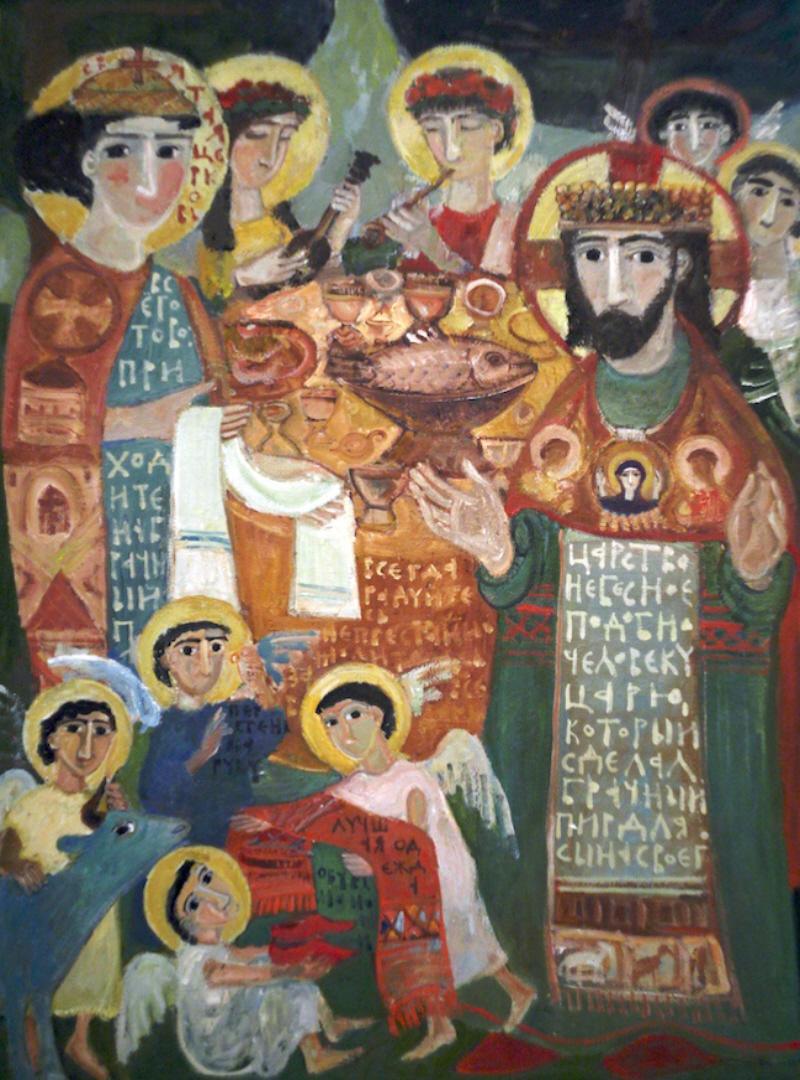
yelena-cherkasova-the-the-kingdom-of-heaven-is-like-unto-the-leaven-hidden-in-the-lump-undated

I recently heard a pastor say, “Invest in people who invest in people.” I’m glad he wasn’t Jesus’ pastor.

I’m pretty sure this is evidence of the growing assumption that the Church’s mission is to ”build the kingdom,” in which case productivity would need to be a priority. Of course, this language of “building the kingdom” is actually never used in the Bible. The closest we get to it is a prayer that our Father’s kingdom would come on earth, so that heaven and earth would find some sort of alignment, which Jesus associated with His will being done. But what people likely mean by “building the kingdom” is “building the Church,” and that language is indeed used; it’s just that the Church is never the subject of the sentence. Jesus told Peter he would build his Church (Mt. 16:18). In fact, even when it came to building a leadership team of workers, he just told them to pray “to the Lord of the harvest to send workers” (Mt. 9:38). You almost get this weird sense that the only way churches grow, people are mobilized, and “the kingdom comes” is when God answers prayer; as though anything we can do for God is only possible if he does it for us; as though the heavy burden of the kingdom is not dealt with by finding “people who invest in people” to share the burden–a burden which mysteriously doesn’t get any lighter no matter how many “share” it–but by recognizing that it is not the Church’s burden in the first place.

The Church’s responsibility is not productivity; it is faithfulness. The illusion that doing more than we are asked is better than doing less than we are asked fails to value to function of witness, of what we are communicating by doing more. Doing less than what God has commanded communicates that we do not take his judgments seriously, but doing more than what God has commanded communicates that we do not take his promises seriously. But they both are expressions of unbelief–one just takes the road of unrighteousness, the other self-righteousness. Both misrepresent Christ, who obeyed God to the bitter end and trusted him even when his entire ‘Church’ had died. Jesus built his Church from 12 to 0 in a matter of three years, because he refused to compromise faithfulness for productivity, which was particularly evident as crowds flocked to him, ready to follow, and he said things like, “Eat my flesh! Drink my blood!”, at which point the flocking crowds, even some of his disciples, scattered like sheep without a shepherd “and no longer followed him” (Jn. 6:66). The witness of a crucified and risen Lord can never faithfully follow conventional leadership principles, because conventional leadership principles are not allowed to account for the God variable. Christian leadership as such has to pretend like God didn’t say he would build his Church and send his workers. It may tell us to pray, but then it will get on with the more serious business of strategizing, and its pupils will take the iron yoke of their strategy and begin proclaiming it like an Amway sales pitch: “It’s as easy as 2x2x2–it’s all about multiplication!”

But it’s not about multiplication. It’s about obedience. And obedience to Jesus, while broad in scope, has a few definite and rather unconventional qualifiers, without which all other forms of obedience are relativized. At the heart of obedience to Jesus is the command to ask for forgiveness and to forgive others (Mt. 9:12-15). In fact, the only thing that can get us in the kingdom is being forgiven by our Father in heaven and the only thing that can kick us out of the kingdom is withholding forgiveness from others: “For if you forgive others their trespasses, your heavenly Father will also forgive you, but if you do not forgive others their trespasses, neither will your Father forgive your trespasses” (Mt. 6:14-15; cf. Mt. 18:21-35). This means that, in a strictly qualified sense, the ultimate form of obedience, which exceeds the “righteousness of the scribes and Pharisees” (Mt. 5:20), is primarily concerned about our being forgiven and forgiving others even more so than our not needing to be forgiven. This forces us to both maintain a permanent posture of humble repentance (“forgive us our trespasses…”) and of gracious forgiveness (“as we forgive those who trespass against us…”), while still asking for help to overcome our losing battles to sin (“lead us not into temptation but deliver us from evil…”), which keeps us from the grave error of thinking that the inexhaustible forgiveness of God is a cheap endorsement of sin. Indeed, with every request of forgiveness we must make our request at the foot of the cross; we must see what forgiveness of our trespasses truly costs, which will free us from ever being tempted to withhold our forgiveness from those who have trespassed against us. And inasmuch as a community is formed by this standard of righteousness, it will be a community that ever and again dramatizes the Gospel, always finding itself on both the giving and receiving end of grace.

So what are we left with? The kingdom of God can only be received. The building of the Church can only be received. The growing of our leaders can only be received. Even our ability to overcome sin can only be received, which is why we ask God himself to deliver us. One would almost think that the mission is not the Church’s at all, only God’s, which would leave us to the category of witness, which is the category Jesus left us in (Acts 1:8), so that all we can do is declare what God has done, is doing, and has promised to do. But we are apparently called to witness not only with our words, but with our works. Indeed, we are told that “unless our righteousness exceeds that of the scribes and Pharisees, you will never enter the kingdom of heaven” (Mt. 5:20). And if we assume that Jesus is just saying that we have to be more righteous than hypocrites, as the scribes and Pharisees are caricatured in the Sermon on the Mount, he goes on to say “You must be perfect, as your Father in heaven is perfect” (Mt. 5:48). Of course, Jesus did not say to “be as perfect as,” which would be a quantitative statement, in which case we would most certainly be hopeless. He said, “Be perfect, as your Father in heaven is perfect.” And he said it just after telling his disciples to love their enemies (Mt. 5:44), which means perfection, and probably such exceeding righteousness, is not quantitative but qualitative. It is a certain way of righteousness and perfection. And it is perhaps that way that gets particularized in the Lord’s Prayer (Mt. 5:9-13) and the following statement (Mt. 5:14-15). It is a righteousness and a perfection that seeks to order a community that does unto others as God has done unto them: to forgive those who don’t deserve it and to love those who don’t deserve it, because God forgives us and loves us, and none of us deserve it (cf. Mt. 7:12). And it is this kind community whose “light will shine before others, so that people may see [our] good works, and glorify [our] Father who is in heaven” (Mt. 5:16). Perhaps if we take seriously what people see when they look at us, we will be able to understand why Jesus did not separate the Great Commission from Christian obedience (Mt. 28:20) or Christian unity from Christian witness (Jn. 17:11-26).

Being witnesses of Christ is not about quantity but quality, not about production but faithfulness, because if our proclamation of the Gospel and practice of the Gospel want to find congruence with the Gospel, we must commit ourselves to the grace of the Gospel, so that everything we say and do communicates the truth that the only thing we can do to see the Church grow, the kingdom come, and the Gospel spread is learn how to receive.

“Truly, I say to you, whoever does not receive the kingdom of God like a child shall not enter it” (Lk. 18:17; cf. Mt. 18:3; Mk. 10:15).

 
Postscript: In response to some questions raised about this article, I need to make clear that I am not suggesting that we need to do away with what we typically call “missions,” but rather that we need to address the role of “witness” in our local congregations. Helping our local congregations take seriously their role as communities of Christ’s faithful witnesses will enable them to see the central role of the local Church in God’s mission of creating a “royal priesthood, a holy nation” (1 Pet. 2:9; cf. Ex. 19:6; Tit. 2:14), of creating a peculiar people who are meant to be put on display for the world to see. It is on the stage of the local Church that our candid honesty to confess, humble willingness to forgive, and unsentimental commitment to love in the concrete ever dramatizes the Gospel we preach. Our observability as such serves as the prevenient grace of our proclamation, just as our observability as a self-righteous, pitiless, shame-perpetuating people serves as the prevenient hypocrisy of our proclamation. Besides, faithfulness to all Christ’s commands (Mt. 28:20) will obviously include an aspect of going and/or sending to the ends of the earth, but not without addressing the role of the Church when it gets to the ends of the earth, as well as when it is in Samaria, Judea, and Jerusalem, because regardless of where a Church is, what its denomination, how new or old its members, it has in common with all the rest the same Lord who gives to it the same commands that are designed to shine the same light to the same world so that all who observe its witness as such “might see [our same] good works and glorify [our same] Father who is in heaven” (Mt. 5:16).

Passion Weekend Reflection 2/3

Saturday: The Tomb and The End of History 

The dismal reality of the crucifixion meant that God was dead, and we had killed him. All hope for life was seemingly lost. The day after the crucifixion the world looked about for evidence of life, for evidence of God, but none could be found; for God lay in a tomb, hidden from the light of day. He truly was dead. Indeed, all evidence was lost, but there was a distant echo of hope…a flittering memory of a faithful God whose promise to dwell with humanity demanded that he live. So we continued searching in hope against hope. We searched and searched the whole world over until there was only one place left to look, in a place we had never dreamed of finding God—in a tomb. So we lit our candles and went to search for God in the darkest and most dreadful place imaginable.

Our search took us into the darkness of death. And it was in that place that we would make our most disquieting discovery. Not only did we discover God there, but we discovered that it was there that God discovered us. The tomb was the place of reunion. We knew not whether to be hopeful or afraid. Had God joined us in death to seal up our fate, to keep us there, to declare that eternity had come into the tomb to secure death as our eternal home? Had the promises of God to dwell with humanity meant not that all things would eventually live but that all things would eventually die? Had our victorious destruction of God ultimately meant self-destruction?

We decided that if we had to wait to find out, we were not going to wait in this dreadful tomb, so we turned to leave only to see the stone being rolled over the entrance. We ran toward the shrinking sliver of light. We ran as hard as we could, striving with all that we had to arise from this tomb, but the dream world took over and everything slowed. The light was approach a seemingly infinite horizon of darkness. We may have been stronger than God but death was stronger than us. And in our haste our candles were overcome by the darkness. Everything, it seemed, had been overcome by darkness. God had been overcome by darkness. Humanity had been overcome by darkness. The world had been overcome by darkness. God was dead. We were dying. And the whole world…it was as though the sun was forsaking us. The world had been flung into a starless universe. The war was over and the prince of darkness had prevailed. History was at its end. This was the end.