The Covenant on The Mount: One Sermon to Damn Us All
I’m becoming convinced that one of the most common (and perhaps willful) fallacies with regard to the Gospel is manifest in two exactly opposite ways, which together hold in tension the opposition between liberal Christians and conservative Christians, speaking here of the hyper- sort. Both groups need to protect the fallacy as a means of self-preservation, because neither group could exist as such without the ‘other’ group to exist against. But, unfortunately for both groups, the Gospel provides no basis to support their opposition as such and therefore neither for their strange and codependent relationship and therefore neither for their group identities as such. The Gospel strips its adherents of any rhetoric that requires a sustained grammar of opposition against a “them” in order to define, and preserve, an “us.”
The Gospel came to all, Jews and Gentiles alike, conservatives and liberals alike, from the Other side of enemy lines. It is only in hearing it declare us its enemies that we can hear it declare us its allies–only the accused can hear their Advocate–because those apparently opposite categories of identity are held together in the Gospel’s one Word of declaration in the death and resurrection of Jesus Christ. Easter Sunday survives only to the degree that it remains staked to the Friday before. The Gospel thus indeed preserves the language of opposition but transforms it within its unique grammar of reconciliation (established in principle in the hypostatic union from which pours forth a new and holy grammar on all flesh, cf. Acts 2:17).
But Conservative Christians tend to sanctify the language of opposition simply by sanctifying themselves, that is, by moving “us” onto “God’s” side and thereby dramatically demonizing the “them.” It is Easter Sunday untethered from Friday’s cross and staked only to an eschatological “us.” And therefore Sunday is no longer Easter and Friday is no longer Good.
And Liberal Christians, on the other hand, tend to, with inexplicable immediacy, stand on the grammar of reconciliation without any word of definition, topsoil for an entirely new language, categorically refusing grounds for any accusation whatever by moving “God” onto the side of “us” thereby erasing the possibility of “them” and gently annihilating the “other.” So the liberal speaks of “acceptance,” not “forgiveness,” of “inclusiveness, not “repentance,” an ever-widening and -accepting circle of “us.” It is a fusion, not a union. But, ironically, an opposition must be maintained, namely against any word of accusation. As such, none are excluded except the excluders, none are judged except the judgmental, none are rejected by God except those whose God rejects anyone. And, it turns, each group ends up balancing out, equally exclusive, and–as a group–equally antichrist.
The underlying fallacy of this circus has to do with a misunderstanding and/or misappropriation of the grace of God under the New Covenant, namely that either:
(a) the grace of God under the New Covenant lowers God’s standard of righteousness (e.g., the sloppy liberal confession that is willing to say “we’re all sinners” in general, according to God’s Word, but unwilling to allow God’s Word to define any sin in particular);
or (b) the grace of God under the New Covenant is an entirely separate category from God’s standard of righteousness (e.g., the militant (but equally as sloppy) insistence that grace means “Jesus is the way, the truth, and the life, and no one comes to the Father except though [‘us’, ahem, we mean ‘Him’]”, on the one hand, and, on the other, that his righteous standard is still based on a Law he established with Israel that the rest of the world should be obligated to apply in principle (or at least a carefully (re: conveniently) selected adumbration of laws), regardless of whether or not they recognize the Law-Giver, which of course suggests that the world needs godliness but doesn’t really need God).
If I may, to both groups, recommend a sermon once preached that addresses this fallacy and both its manifestations found in the Gospel according to Matthew, chapters 5-7. Actually, it is not a sermon. We only call it a sermon, even giving it the formal designation “Sermon on the Mount,” because of a refusal to acknowledge that under the New Covenant God has, in fact, descended to the Mount Himself as the Law, to issue the commands in Person, and thereby reveals an infinitely higher standard of righteousness. As long as we can codify the words uttered on the Mount as mere sermon principles, we can avoid the terrible prospect of hearing them as the codification of a New and binding Commandment. They are nothing less and, indeed, much more.
God’s standard of righteousness, this side of the New Covenant of grace, is no longer defined and established by the Old Covenant of Law—God’s commands to a nation. God’s standard of righteousness is now defined and established in the Person and Work of Jesus Christ—God’s love for the world—who fulfilled the righteousness intended to create a just society and exceeded it with a righteousness intended to create a gracious society. That excessive righteousness is the only way to the Father, which is precisely why Jesus, not Christian fundamentalism, is the the only way to the Father. Only the Grace that comes from the Father can take us back to Him and make us gracious like Him.
So the New Covenant of grace does not effect a decrease in the righteousness God requires but an infinite increase. That is why Jesus said, in effect, the righteousness required to enter his kingdom exceeds the righteousness of the Law-keepers (Mt. 5:17-20); why not-love of another, whether enemy or neighbor or neighbor’s wife, is tantamount to murder; why under His standard all of us are “liable to the hell of fire”; why in the burning light of His love all of us should become one-eyed and dismembered (Mt. 5:21-30); why the self-righteous polarizing rhetoric that identifies one’s own group as sheep by wiping its bloody hands on the forehead of some homogeneously identified other group as goats (whether “liberal” or “conservative” or “fundamentalist” or “skeptic” or “Muslim” or “Christian” or perhaps even, quite ironically, Christ Himself) is tantamount to the kind of scapegoating that can demand holy justice in the world only by permitting the one small exception of its own injustice, the kind of scapegoating the Law revealed was provisionally necessary because it simultaneously revealed that all fall short of its righteous standard, the kind of scapegoating that can be embraced only if the Gospel is rejected.
Christ is either the Lamb slain for a world of goats, or we will simply have to convince God that “we” are of a kind of sheep more spotless than the Slaughtered Lamb and “they” are a kind of goat more stained than Pilate’s hand, the centurion’s hand, the hand not reaching out, the hand clinching tightly to control, to greed, to revenge, to unforgiveness, the hand clicking on the mouse, the hand that is ice cold to the spouse and children that so need its living and loving warmth. We will have to convince God to be more satisfied with a judgment of guilt that exiles the ‘other’ than the judgment of guilt that reconciles the world (cf. Romans 5 and the rest of the Bible).
“Judge not, lest you be judged” (Mt. 7:1).
“Forgive us our debts, as we also have forgiven our debtors” (Mt. 6:12).
“Blessed are the poor in spirit, for theirs is the kingdom of heaven” (Mt. 5:3).
The Voided Form: Why Evangelism Isn’t the Answer to Our Lack of Evangelism
“So they called them and charged them not to speak or teach at all in the name of Jesus. But Peter and John answered them, “Whether it is right in the sight of God to listen to you rather than to God, you must judge, for we cannot help but speak of what we have seen and heard” (Acts 4:18-21).
It Takes A Mother to Carry the Gospel
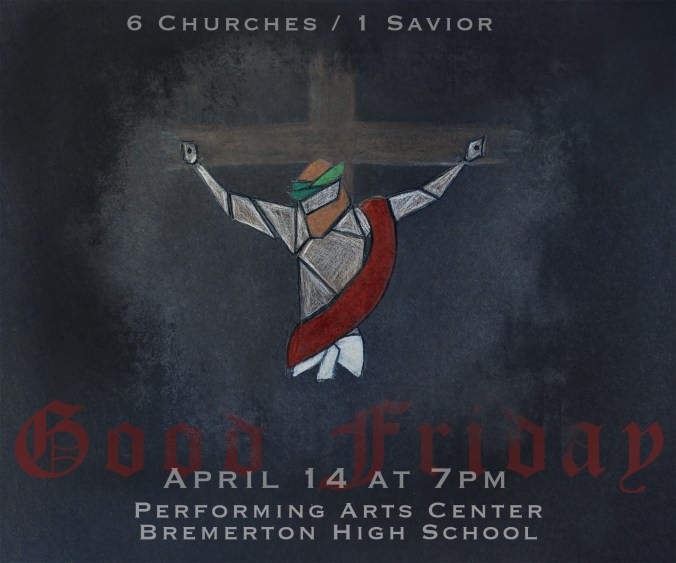
Good Friday Service: 6 Churches, 1 Savior

Easter Eve

Lying here, trying to stop thinking about how I wish I could stop thinking about not being able to fall asleep, I keep circling back to another unsolicited thought: Is the news of tomorrow really good news? Do we really want a risen Lord?
If Jesus stays in the tomb, it means that the world can continue on its course, unaccountable, free of any Absolutes–other than death–shrugging off that nagging Voice of its conscience time and time again. If Jesus stays in the tomb, there is no Lord to answer to, no Voice from without, only fleeting (if competing) echoes from within, and at any rate all voices are moving toward a finality of silence.
That, to me at least, seems much easier to deal with than is the prospect of the destruction of death. It’s much easier to imagine death brings a certain finality to all that I have done and not done, all that I have said and not said, to missed opportunities to love and help and give and forgive, to my violence, my greed, my self-indulgence… I can’t help but think it is easier to make peace anticipating closure to all that than anticipating that my life and my will and my secret thoughts and intentions are wide open to an infinite future, a future in which I am not Lord and death is not an option, a future from which that nagging Voice is issued from a throne, a Voice that alone is Absolute.
There was terror that first Easter (Mt. 28:1-10; Mk. 16:1-8; Lk. 24:36-43). And I suppose we shouldn’t be surprised. The world has lost its autonomy. Death no longer affords any escape routes. Life is laid bare to an infinite future that we know now only as a Voice, often just a faint Whisper–but then we shall see Him face to face.
What a glorious–and terrifying–day tomorrow will be.
Levi Ryser: Born in the Shadow of the Savior (12/26/13)

“And Simeon blessed them and said to Mary his mother, ‘Behold, this child will be laid down for the fall and the resurrection of many, and for a sign that is opposed, (and a sword will pierce your own soul also), so that the thoughts from many hearts may be revealed” (Lk. 2:34-35).
The baby was born. They called him James.
There’s not much to say about James. He doesn’t say much about himself in the letter he left for us. The only other thing the Bible says about James is that he was the brother of Jesus (Gal. 1:19). All we get from Church history about James is in fragments, no cohesive narrative. A guy named Hegesippus called him James the Just. It stuck.
But it’s no surprise there’s not much to say about James, because all that is said of him is said under the shadow of his big Brother. James the Just, brother of Jesus the Judge, born in the shadow of the Savior. A hard act to follow.
I wonder if Mary felt guilty. She was found to be with child, again, but not by the Holy Spirit again. This time by plain ol’ unholy Joe. This child surely would not be so godly as her First. I wonder if she felt guilty before James was born, knowing that she could not love him as much as her Firstborn (of all Creation)?
But even more than that, I wonder if she felt guilty after he was born. I wonder if she felt guilty when she realized that she loved her second-born just as much.
I remember when we were expecting our firstborn. All Keldy thought about was the baby. She loved him in I suppose the way only a mother can love an unborn child. I on the other hand felt guilty. I could not relate. For those nine months my reaction to her pregnancy was a kind of surprised “Oh yeah…”, coupled with a nagging fear that I wasn’t going to love him like a father is supposed to love his son. I literally feared that I would love my dogs more than my son. Babies just hadn’t been all that impressive to me, because I am not a woman. The honest men out there know what I’m talking about. Women have no clue.
Except for maybe Mary. Mary knows. Mary had, after all, held at her bosom the one who came from the bosom of God the Father (Jn. 1:18). Mary had indeed “kissed the face of God.” But this second-born would be just another face in the shadow of the Almighty. Mary wasn’t yet used to having children who weren’t God. Middle children already have a syndrome named after them, but what of the one that comes second to the Savior of the world. Mary knows.
When Kezek was born, I started treating my dogs like dogs. I loved my firstborn so intensely that I was afraid I loved him more than God. I was afraid that if anything were to happen to him I would hate God. That fear lingers.
When Keldy told me we were expecting again, I was doubly guilty and doubly afraid. Not only did I love my firstborn more than or as much as God, now I feared that I would not love my second-born as much as my firstborn, perhaps only as much as the dogs.
The baby was born. We called him Levi Ryser. There was no sound. He was blue. The voices of the people in white raised an octave. They stopped looking us in the eye. They were looking at some protocol that was visible only to those who knew some unspoken “code.” Ryser needed decoded.
The doctor handed him to me to carry as I was paced at an uncomfortable pace en route to the NICU. It seemed far too much like a formality for my first embrace of my second-born son, like it was a consolation, a mere gesture, the beginning of some process necessary for some Contingency Plan Z. It felt like I was greeting my newborn son with a goodbye.
There are no words here that will do.
I held him as close to my heart heart as humanly possible. I tried to hold him as close to my heart as humanly impossible, or as inhumanly possible. I tried to pour my life into his. I tried to empty myself to fill him up. I tried to breath for him. I wanted to cut out my heart and put it into his body. I wanted to die so I could raise him from the dead. Anything. Just please…
I think that was the first day I ever actually interceded for someone. I beat on heaven’s door like one of those old grandmothers who’s earned the right to act that way. I was pleading, then I was demanding, then I was crying. I had felt the joy of a father’s love with my firstborn but with my second-born I was brushing up against the prospect of a father’s grief. I was feeling the very sharp other edge of love for the first time. I learned that day something about the sword Simeon told Mary about (Lk. 2:35).
Four days later, he was stable. Over those four days I started to understand what I suppose Mary had come to understand with her second-born: that the love of God and the love of a son are not two separate loves. The sword that pierced Mary’s heart and the spear that pierced her Son’s were felt first in the love that was laid at the foundation of the world (Rev. 13:8). God is love in a very nounish sense, like the nounish sense of the word creation or the Word Incarnation. Mary couldn’t compare her love for Jesus with her love for James, because her love for James came from the life of Jesus. There is no love apart from that Life. Indeed, there is no life apart from that Love. If it is in God that we “live and move and have our being” (Acts 17:28), then Love is the ether of all our relationships. To love is merely an act of alignment.
His name has become more fitting than I had intended. Levi Ryser means, by my assignment, death and resurrection, or offering and acceptance, or more simply “Gift of God” (with the intentionally ambiguous genitive). It is the second-born of Mary, after all, by whom we discover ourselves, since we all are second-born of the dead. We discover that unto us a Child is born, to us a Son is given, in order to restore love to its proper form, that we might love our own as we love God, because he loves us as though we were his own. That is the meaning of yesterday’s Birthday and therefore every birthday in the light of its shadow.
Levi was born on the altar, where all gifts are born. He was born without breath, blue. But while he was yet unknown and unknowing, en route to the NICU, he was already being born in the bosom of his father. I think in that moment, if for only that moment, I understood Mary. I think I understood something about motherhood that day. I understood what it was like to carry a life that could not carry itself apart from my own. I understood what it was like to carry life with a sense that if one dies, we all die, if one lives, we all live. I think I learned something about being the Mother of God that day. I’m certain I learned something about being a father that day, maybe even something about being a Son.
We had decided to call him Ryser before he was born. But Levi was Ryser before he was born. He was raised in his mother’s heart for nine months. And he was raised in his father’s for four days. He is now growing up in both. And all this is from God, because he has been raised from eternity in the heart of Love. And my only plea for his life is that through our feeble hands he will continue to be held in that Love. God, help us.
Ryser is our number two, but he is loved just as much as the Firstborn, even if he was born in His shadow, even if we did use leftover nativity scene wrapping paper for his birthday presents this year.
Happy Birthday, Ryser. You are loved with an everlasting love, my son.
“How precious is your steadfast love, O God! The children of man take refuge in the shadow of your wings.”
~ Psalm 36:7
Advent Reflection 25: Repent
[An excerpt from Zechariah’s Prophecy, directed to his son, John the Baptist, the forerunner of all truly Christian ministry, the one who led the people in a ministry of repentance]:
“And you, child, will be called the prophet of the Most High; for you will go before the Lord to prepare his ways, to give knowledge of salvation to his people in the forgiveness of their sins, because of the tender mercy of our God, whereby the sunrise shall dawn upon us from on high and to give light to those who sit in darkness and in the shadow of death, to guide our feet into the way of peace.”
I walked into my new office this morning and noticed one of the leftover books on the shelf called A New Kind of Christianity by Brian McLaren. In the wake of McLaren’s growing popularity I familiarized myself with his “work” a few years ago and read this book, as well as A Generous Orthodoxy, and one other forgettable title which I have since forgotten. Let me summarize the major theme found in each of McLaren’s books in this way. The ‘new kind of Christianity’ he is talking about is built on a Gospel without repentance.
The good news of Jesus Christ comes as the free gift of grace, and that sounds exactly like this: “Repent, and believe in the Gospel” (Mk. 1:15). We’re quite happy to talk about the swinging door of the Gospel, but how is it that we so often avoid mentioning the threshold of repentance?
Since grace is free, it is assumed, we mustn’t associate our faith with any costs, any requirements, anything on our end that might be expected of us and so nullify grace as grace. But the fact is: grace is free only because we cannot afford it. Its value is, in fact, infinite, because it is based on the immeasurable worth of Jesus Christ and him crucified. It’s true, God isn’t looking for us to give him any-thing. He’s looking for us to give ourselves.
Grace is spilt blood, not melted ice cream. We should acknowledge, therefore, that while there is nothing of worth we can offer in exchange for the grace of God it is only so because God is not looking for us to barter with him with little pieces of our lives and pocketbooks. That’s no different than the old bartering system of sacrifices and burnt offerings, the one Zechariah was employed by before the first Christmas. But the stakes were being raised from sacrificial lambs on the altar to the sacrificial Lamb on the cross. Herein lies the heart of the Gospel. The Gospel reveals that God doesn’t want our “goods and services”—as though God were in need of anything at all, as though everything weren’t already his (Ps. 24!). Rather, he wants all of us, and so he gives us all of himself.
God has removed the barter system altogether. He removed the distance that that economy creates. He wants us for us because he loves us—like a father but more than father—and only when we are awakened to that basic truth will we be bold enough to unfetter our desires to want him back. This is the desire of a sober heart, which prays along to the tune of A.W. Tozer’s prayer, when he said, “I want the whole presence of God Himself, or I don’t want anything at all to do with religion… I want all that God is or I don’t want anything at all.”
That’s just a soul daring to tell the truth. But when it comes to loving God, we are our own worst enemies, because we continue to try to barter with God. We do “this and that” for God hoping to appease him. We tithe little pieces of our lives as though God were in need of our support. And in so doing, we find ourselves constantly negotiating with our conscience over what is “enough” for God, being tossed about between our own unrighteousness and self-righteousness, wondering why we never feel wholly at peace with God, with one another, and with the mirror. The reason is simply this: nothing is enough.
But Christ is enough!
So what does this have to do with repentance? With Zechariah?
Repentance does not mean “do something differently,” or even the popular definition, “turn around.” It means, quite simply, “change your mind.” It means the world and the ways of God we have always imagined have been invaded by an entirely different world by way of God himself invading ours. Christmas, God with us, the Son of God become Son of Man, the final sacrifice, resurrection of the dead. Zechariah, and the rest of the world, was going to have to repent, because this way of seeing the world and the ways of God is entirely unnatural and unexpected. For Zechariah, the whole priestly bartering system was about to be rendered obsolete. Christ was giving us all of himself. All altars would be closed for business. This Lamb would need no assistance, nor assistants, at the altar of his sacrifice.
So think about what we’re doing when we cheapen the idea of repentance, minimizing the cost of discipleship, making it out as if people can nickel and dime their way to God because, well, grace is “free” so surely our response can be “cheap.” What we are doing is inviting people back into the barter system, putting again distance between them and God, and denying them the truly free grace of God, the only grace that brings true freedom: spilt blood, not melted ice cream. As Bonhoeffer, “When Christ calls a man he bids him come and die.” Therein lies the fullness of life, indeed the fullness of God, true resurrection freedom.
But it’s not quite Christmas yet, so we shouldn’t get ahead of ourselves. For now, we need to think about changing our minds, repentance. How can the Church rediscover the language of repentance, calling people to “Repent, and believe the Gospel”? Because as long as the Gospel doesn’t require whole-life-repentance, as long as it is something we can fit into our budget, the good news just isn’t good enough. And in that case, we need to stop selling ourselves short, and selling others short, and reclaim the cost of discipleship: it will cost you not a penny less than the whole life of God. That is what God sent his Son to give us. So let’s respond by giving him nothing less than all of ourselves.
It’s the old kind of Christianity, which is built on the Good News of Jesus Christ, the only kind of news that remains new, because it’s the only kind that will never grow old.
Advent Reflection 24: Freedom
“Then Herod, when he saw that he had been tricked by the wise men, became furious, and he sent and killed all the male children in Bethlehem and in all that region who were two years old or under, according to the time that he had ascertained from the wise men” (Mt. 2:16).
It is “In the days of Herod, King of Judea” that the the Gospel narrative begins (Lk. 1:5). It’s a historical footnote for the modern day reader, but for Elizabeth and Zechariah, Mary and Joseph, the I-don’t-know-maybe-three wise men, the shepherds and the sheep and the innkeeper, Herod’s kingship meant that Israel’s king had not yet come.
Herod was a king in the way Moses might have been king had he ignored that burning Voice that spoke his name the day his conscience caught fire. Moses was adopted by the daughter of Pharaoh, the wealthiest man on earth, and possibly would have one day been put in charge of some region of grandpa’s empire, perhaps the region where all the Hebrew slaves were living. He looked like them, after all. In that case, he would have been a Hebrew “king” over Hebrew slaves under the king of Egypt.
Herod was something like that, except the Pharaoh was now Caesar and Egypt was now Rome. Herod was a puppet king for Rome—with a Jewish tan. But let’s just say he was one chopstick short of being a fully functional human. So he had a favorite wife, Mariamne I. Then he murdered her. When he was made king over Judea, he made the brother he most respected high priest in Jerusalem. Makes sense. Then he had him drowned at a dinner party. When the two sons he had with Mariamne I grew up he promoted them to a track of royal succession. A nice gesture. Then he had them executed. He made his son Antipater the first heir in his will. Then, while lying in his deathbed, he decided, “Ah, what the heck…” and had him executed too. Then he died.
And of course there was that time the [not so] wise men inquired to him, the “king” of Judea, about the King of Israel being born in Bethlehem, so he had every male child under the age of two executed (Mt. 2:16-17)–a fallen apple not far from Pharaoh’s tree, it turns out (Exod. 1:22).
So it’s hard to say: did Israel need liberation from Caesar’s captivity or from Herod’s? Was it the ruler without or the ruler within that posed the more immanent threat of freedom? Is it Islamic radicalism or is it American consumerism? Or, for that matter, is it American consumerism or is it my compulsory shopping habit? Is it corporate greed or is it my impulsive spending habits? Is it civil strife or the kind that lives in my home, or the kind that lives in my heart? Is it sex trafficking in Thailand or is it the pornography industry, or is it the iPhone industry, or is it the iPhone in my pocket?
The severest form of human slavery on the planet always comes in the form of the human will. We all, deep down, have a Herod in our heart. We all want freedom from sin, except that part of us that wants the freedom to keep on sinning. We want to be healthy, but we don’t want to not feed our habits. We all want people to just love each other and stop firing missiles, except I don’t want to stop keeping a ‘record of wrongs’ on my wife (cf. 1 Cor. 13:5), except I’m going to make sure to fire a comment back right at the heart of her deepest insecurity. How else can I maintain control? Shame is the heaviest chain.
Come give us freedom, Lord Jesus, from death and hell, from hopelessness and fear, liberate us from our enemies and our obstacles. Amen, hallelujah! But don’t save us from our pride and from our selfishness. Don’t offer us liberation from our throne of independence. We all want to do God’s will, except we never want “Not my will…” (Lk. 22:42).
But liberation by means of a cross means the world needs liberated from me, and that I need liberated from me. I need to be raised from the dead, but I first need to be “crucified with Christ” (Gal. 2:20-22). Most of us aren’t like Pharaoh, but all of us are a little like Herod. We all have a great capacity to love ourselves at least a little more than our fellow man, at times even our own family. We also tend to have this habit of holding people captive to our expectations of them; everyone is constantly evaluated according to how they treat me, notice me, benefit me, affirm me, congratulate me, like my facebook posts, heart my instagram pics, tell me that I’m right, or at least never point out why I’m wrong, even if I’m wrong in a way that is inhibiting me or someone else from freedom.
But humans do not typically want freedom. We want control. Control feels like freedom to the one who has it, but true freedom does not enslave others. Control does. Control is freedom that comes by listening to your inner Herod. Pharaoh had freedom like that. And God had to rescue His people precisely from Pharaoh’s freedom.
Paul calls the inner Herod “the lusts of the flesh.” He also says the Spirit lusts within us (Gal. 5). You might think of the Spirit as the inner Christ. The inner Christ and the inner Herod are at war for your freedom, for everyone’s freedom. Paul begins the conversation by saying “For freedom Christ has set us free; stand firm therefore, and do not submit again to a yoke of slavery” (Gal. 5:1). The yoke of slavery, or the lusts of the flesh, inhibits anyone from living in freedom (“sexual immorality, impurity, sensuality, idolatry, sorcery, enmity, strife, jealousy, fits of anger, rivalries, dissensions, divisions, envy, drunkenness, orgies, and things like these”), while the yoke of freedom, or the lusts of the Spirit, enables everyone to live in freedom (“love, joy, peace, patience, kindness, goodness, faithfulness, gentleness, self-control”) . The Spirit lusts to give. The flesh lusts to take. The Spirit lusts to make us like Christ, because Christ loves for the sake of others. The flesh lusts to make us like Herod, because Herod loves himself at the expense of others. The Spirit lusts to free us from our captivity to self-service, the flesh lusts to liberate us from the captivity of self-control, the defining fruit of spiritual freedom. Self-control is only freedom because the self has an inner tyrant. You can call him Herod. Your inner Herod needs to be “crucified with Christ” (Gal. 2:20).
So perhaps today we could dare to be honest with ourselves, like really honest, like put ourselves on trial in the way Rome put Jesus on trial, and ask: Who is living under the burden of my control? Do people feel free around me or do people feel the need to live up to my expectations? Am I a tyrant or a liberator?
Does it feel like “the days of Herod” around me—or does it feel like Christmas?
Truly He taught us to love one another,
His law is love and His gospel is peace.
Chains he shall break, for the slave is our brother.
And in his name all oppression shall cease.
Sweet hymns of joy in grateful chorus raise we,
With all our hearts we praise His holy name.
Christ is the Lord! Then ever, ever praise we,
His power and glory ever more proclaim!

Advent Reflection 23: Hope
“Now after Jesus was born in Bethlehem of Judea in the days of Herod the king, behold, wise men from the east came to Jerusalem, saying, “Where is he who has been born king of the Jews? For we saw his star when it rose and have come to worship him” (Mt. 2:1-2).
The day is drawing nigh. We have been waiting for the coming of our Lord, the Advent of Jesus Christ, for just over two millennia now. But for just over four weeks, we have been waiting for Christmas. The season of Advent is the season we learn again what we have forgotten again: how to wait. But it’s a special kind of waiting, an active waiting. Advent is our dress rehearsal.
Dress rehearsals are the final rehearsals before the main attraction: full costumes, stage propped, spot lights on, everything ordinary strangely dimmed. Reality is altered. Advent is the time for the Church-and-company to decorate the world–street lights, storefronts, living rooms, gutters, sweaters, to-go cups, the airwaves [today I even saw a telephone pole dressed up like Christmas with giant plastic spruce tree branches]–to create the context to remember, and to deliver, the Advent message.
In ordinary times the Church brown-bags its Advent message and tries to be discrete. We want to the world to think we’re relatively normal, so we act like we don’t believe in weird things like miracles and prayer and the resurrection of the dead, so we don’t bother wrapping our message in the songs of heavenly host and superstitious wisemen, but only so we can share it at the table with brown-bagging sinners like Jesus did. If God can wrap himself in swaddling flesh, sinful flesh (Rom. 8:3; 2 Cor. 5:21), to deliver his message to the world, then surely the Church born of Christ should learn how to become ‘all things to all people’ in everyday life (1 Cor. 9:22). So in ordinary time, we deliver our Advent message in any and every context.
But the season of Advent is different. ‘Tis the season we insist upon obnoxiously decorating everything around us, because Advent means nothing less than that everything around us will one day be altered. Sure, it at times can be a little forced—the begrudging dog in his jingle-bell sweater, the divorced family in the strained “family” photo, the holiday that invariably requires more work than work since it is a holiday built on relationships, but it’s also somehow irresistible. All the pretense. All the happy. Neighbors walk across the street, strangers talk in lines, people awkwardly sing at the door of others who awkwardly listen, people smile. We all roll our eyes just thinking about it, but we simply can’t resist it. Even soldiers stop shooting each other so they can sing together instead, to pretend, if only for a night, that the world is not at war, to pretend there really were peace on earth, good will to men (cf. “The Christmas Truce of 1914”–come to this year’s Christmas Eve service at Crossroads for more on that).
The day after Christmas we may be back in our respective bunkers ready to fill the silence with shrapnel, the house with hostility, but we still can’t get the songs out of our heads. We may hate our ex-spouse till the day we die, but “Nurse, could you please put that “family” photo right next to the heart monitor.” There is a hatred that lives in all of us—an inherent need to create a “them” to secure ourselves within an “us,” the need to accuse and to blame and to gossip—but there is also the love of an idea of not having to hate. We really just want to live at peace in a world that runs on fear, a world where love is always weaker than grief, where Goodbye is more enduring than Hello. The world we find ourselves hoping for just can’t be, it seems, the one we find ourselves living in. So we settle for the one where we must compete and take and lock the doors and pick sides to protect ourselves. Except on Christmas, that day imaginations run amok, the day for pretending peace on earth, good will to men, the day the world is permitted to hope.
Perhaps this is why Christmas festivity is both the most alien and the most contagious thing the Church has ever created. The world won’t copy our theology or our piety or our prayers, but the world will copy our holy days. It will not prepare for Christ’s coming but it will prepare for Christmas. Perhaps that is why the first to come and see the original Christmas nativity scene was a group of “wise men” or “magi,” a Christmasy word for something equivalent to New Age pagan astrologists–zoroastrians. But they came, because suddenly the nationalistic Jewish hope had become nothing other than the hope of the world. This is simply because the Christmas message is little else than an articulation of the world’s longing from the other side of the promise. We all want peace, joy, love, and eternity more than we want power and fear driven self-preservation, but power is more believable on the surface where it is more available than hope.
So maybe we should reconsider our brown-bagging approach. Sure, we want to speak the language of the people, but only in order to teach them a new language. We want to “become all things to all people,” like Paul, but also like people we do so in order “that by all means we (rather Christ in and through us) might save some” (1 Cor. 9:22). So perhaps we should more often pull our Gospel out of the bag and deliver it like the strange Gift that it is in all its odd, shiny, Christiany wrapping paper to people who don’t even observe the Church’s Christmas or our Christ by asking simple questions or offering simple statements like: “Can I pray for you?” or “Jesus Christ died for you” or “With God all things are possible.” Or perhaps you can ask a question about hope.
Everyone hopes. But there is only one kind of hope that increases as life decreases, as health declines, as love is lost, because only one kind of hope is based on the claim that all that is lost will one Day be restored. That is the hope of Advent, the hope of Christmas, the hope the world is waiting for the Church to offer. Let’s give the gift of hope this year. Tell someone without hope how you’ve found hope in Jesus.
After all, that’s what they’ve really come to see.