Advent Reflection 22: Bow

“After they had heard the king, they went on their way, and the star they had seen when it rose went ahead of them until it stopped over the place where the child was. When they saw the star, they were overjoyed. On coming to the house, they saw the child with his mother Mary, and they bowed down and worshiped him” (Mt. 2:9-11).

This is a sign I saw in an airport on my way back from Canada. Who knew that water could come in so many brands? We all know that water is nothing more than H2O, but apparently the Hs from Fiji are better than the Os from Iceland, or so the marketing goes. Marketing life’s most basic need, a need that is offered for free at the fountain, requires consumers to think of water not in terms of need but desire. The question is no longer, “Where can I find some water?” but “Which water is best for me?” It is no longer enough for water to simply say, “I am water. Drink me or die.” Water must bow to the particular demands of each consumer.

The alternative, of course, is to bow at the fountain and receive a handout. The fountain offers its content to every man, woman, child, rich, poor and in between at the cost of a bow. But to bow at the fountain is a kind of confession. It is the confession that we need water more than it needs us; that water is not a commodity but a necessity; that we don’t drink water because it meets our demand; we drink water because it demands that we do. There are some things in life that compete for our loyalty, that beg to be purchased, but there are other things that simply demand it. At the end of the day, water is one of them. Truth is another. Both truth and water get packaged in our culture as commodities, seeking our loyalty by catering to desires of the individual. And while the bottling of water is rather inconsequential, the bottling of truth—adapting it to consumer demand—is tragic, because bottling truth fails to recognize a human need that is just as basic as the need for truth itself—the need to bow.

Of course, it’s not the water in the bottle but the message in the bottle that is cause for concern. I’m afraid that we pay for water and end up with a worldview, a worldview that doesn’t like to admit the contingencies of human life, a worldview that presumes we should bow to nothing to receive life—life is our inalienable right! So we purchase the bottle and become its master, drinking it with our heads held high. But we should be warned that truth cannot be sought or sold in this way. We cannot package “Christian truths” to make them more desirable to our culture. When the people resisted the truth Jesus proclaimed, he did not attempt to make it more palatable but more potent. When His audience was offended that He called himself the bread that came down from heaven, he didn’t backpedal but pressed in deeper, more graphically, more offensively: “I tell you the Truth, unless you eat the flesh of the Son of Man and drink his blood, you have no life in you. Whoever eats my flesh and drinks my blood has eternal life, and I will raise him up at the last day. For my flesh is real food and my blood is real drink…After this many of his disciples turned back and no longer followed him” (Jn. 6:53-54, 66).

Jesus is not the Christ of Black Friday. He is the Christ of Good Friday. His truth cannot be purchased, only received, and received only on its own terms. It comes not to those who have enough to pay for it, but to those who know they cannot afford it, that there is nothing of equal value to it. It comes to those who are simply willing to bow to receive. To such he gives freely and abundantly.

It profits a man nothing to receive a “truth” that makes no demands of him, as though truths are something we can tuck away into our pocket and use at our convenience. While people search for this kind of bottled truth, there remains an ancient fountain, ever-flowing but never changing. It refuses to change to meet the demands of its consumers, but it does change those who meet its demands. For all the truths competing for our loyalty, begging us to purchase them at the cost of compromised convictions, we will know we have heard the Truth of the fountain when it simply says to us, “I am Truth. Drink me or die.” We will know it is truth when it calls us to receive it not with nose up but with face down.

There is only one source and one way of receiving the truth. We must bow at the fountain of the Word of God. The truth of the Word of God can only be received by those who come to it come to it thirsty, needy, desperate, broke and broken, those who know they need it more than it needs them and who can offer nothing for its purchase other than a bow. No one can drink from a fountain the way they drink from a bottle, but there will always be those who try, those who will come to the fountain and miss their mouths. So this year I would encourage you not only to go to the fountain to receive some truths but to go expecting that its truth will change you. I encourage you to go to the fountain and bow as though your life depends on it…because, again, your life does depend on it.

Advent Reflection 21: Children

[Originally published in March 2015 as “First Communion”]

“The wolf shall dwell with the lamb,
and the leopard shall lie down with the young goat,
and the calf and the lion and the fattened calf together;
and a little child shall lead them” (Isa. 11:6). 

Kezek's First Communion

I remember the first time I received Holy Communion.

Growing up, I belonged to a Quaker church (sorry ‘meeting’), which meant that Communion was apparently too spiritual and immediate to be placed behind the interval of the fleshy bread and wine of such a common wooden Table. Traditionally, Quakers aren’t much for rituals and rites, even if such anti-sacramentalism has at times led to throwing the Baby out with the baptismal water. Regardless, my father had actually been a Quaker pastor in the early days, but he had by this time quit being a Quaker pastor and resigned to being only a part-time father. And this makes my first memory receiving Holy Communion all the more bazaar.

It was in a Roman Catholic church and I was there with my dad. I guess that is where Quakers who fall off the wagon go. [I once heard a wise Quaker say there are only two options: Quakerism and Catholicism. I actually think he is right, principally speaking, although I am no longer Quaker and still not Roman Catholic, and yet somehow deeply both.] I think my sister was there too. We were quite young. I am pretty sure it was my and Christi Anna’s first time stepping foot in a Roman Catholic church. It was, at any rate, the first time I ever felt the two extremes that characterize holy places: I felt at once like I absolutely did and absolutely did not belong there, which is exactly how grace feels.

But I don’t remember the experience in its entirety. Everything I remember is tethered to the moment I received the Elements. That memory still lingers like the strongest of wines.  

Vaguely, the memory begins with my father insisting that we proceed from the pew toward the altar. He explained that we would be breaking the house rules by doing so, but only in the name of some other House and some other Rule. I don’t remember the details to that. I just remember that it was my responsibility to act as though I were entitled to receive whatever it was they were offering up front.

The priest made his way along the altar eventually arriving in my space. It however felt as though I had arrived in his space, or at least Someone else’s space. I can understand why some people take off their shoes in holy spaces. It’s because it feels like inhabiting Someone Else’s shoes. I also remember feeling perhaps for the first time the experience described in a song I had long sung. My heart was filled with the tension of fear and fear relieved the whole time, which is exactly how grace feels and perhaps why it feels amazing.

When I reached out and grabbed the wafer, breaking protocol (you’re supposed to receive it passively), three things were immediately clear. First, I had never done this. Second, the priest knew I had never done this. And perhaps in the way only a priest or a father could communicate this without saying anything, the third thing was that the priest was glad I was there and happy to help me break the rules. Apparently he and my father imagined some other present Order in that very Present moment.

The wine was so bitter, probably because I had never tasted wine but more probably because I was pretty sure someone said something about drinking blood. At any rate, this new wine has never ceased to linger in my memory like only the best wines linger. And it lingers sweetly. It is a favorite memory of mine. Maybe it was the strangeness of it all, the beauty of the cathedral, the fact that I was with my dad—I loved being with my dad—and with this priest—I also enjoyed this very odd man—and the fact that I felt more at home in that moment than I had in a very long time. Whatever it was, it was real like a lead bullet and sweet like my mother’s love, and I wouldn’t trade the memory of it for all the cathedrals in Rome.

So you can perhaps imagine how I must have felt last night when I was given an opportunity to stand in the place of a priest as a father and serve my firstborn son Holy Communion. We had just heard a wonderful sermon at Embrace Church by John Gallaher on Mark 2 about the man who was lowered by his friends through the roof to receive healing from Jesus (the same text I preached on for my candidating sermon at Crossroads). The faith of the community brought the man to Jesus and Jesus gave him more than their faith had asked for. Jesus forgave his sins and proved he could do so by healing his body. The religious leaders complained, but the man carrying his mat walking out the door did not complain. Neither did his friends. Faith always expects something from Jesus, but genuine faith does not complain about the mess of the overflow. I am not a Pentecostal, but I do not complain about Pentecostals.

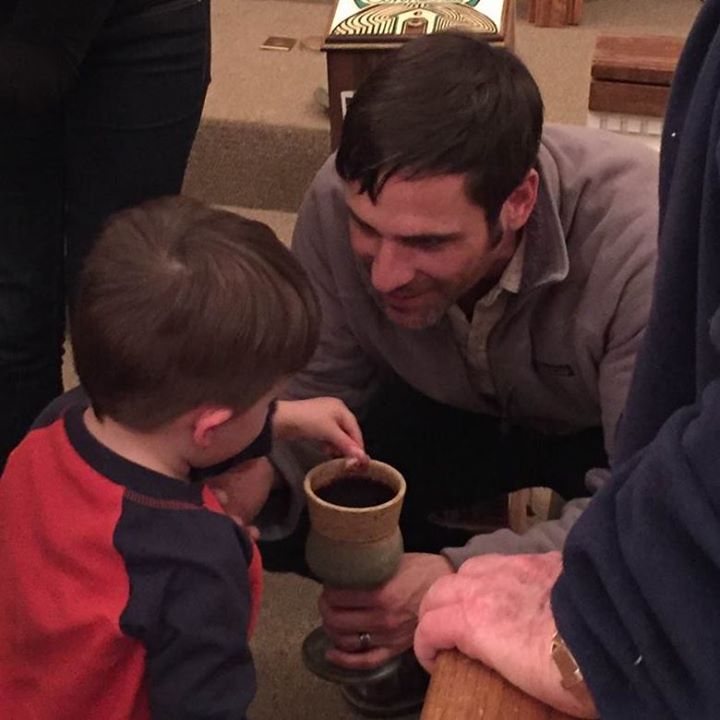
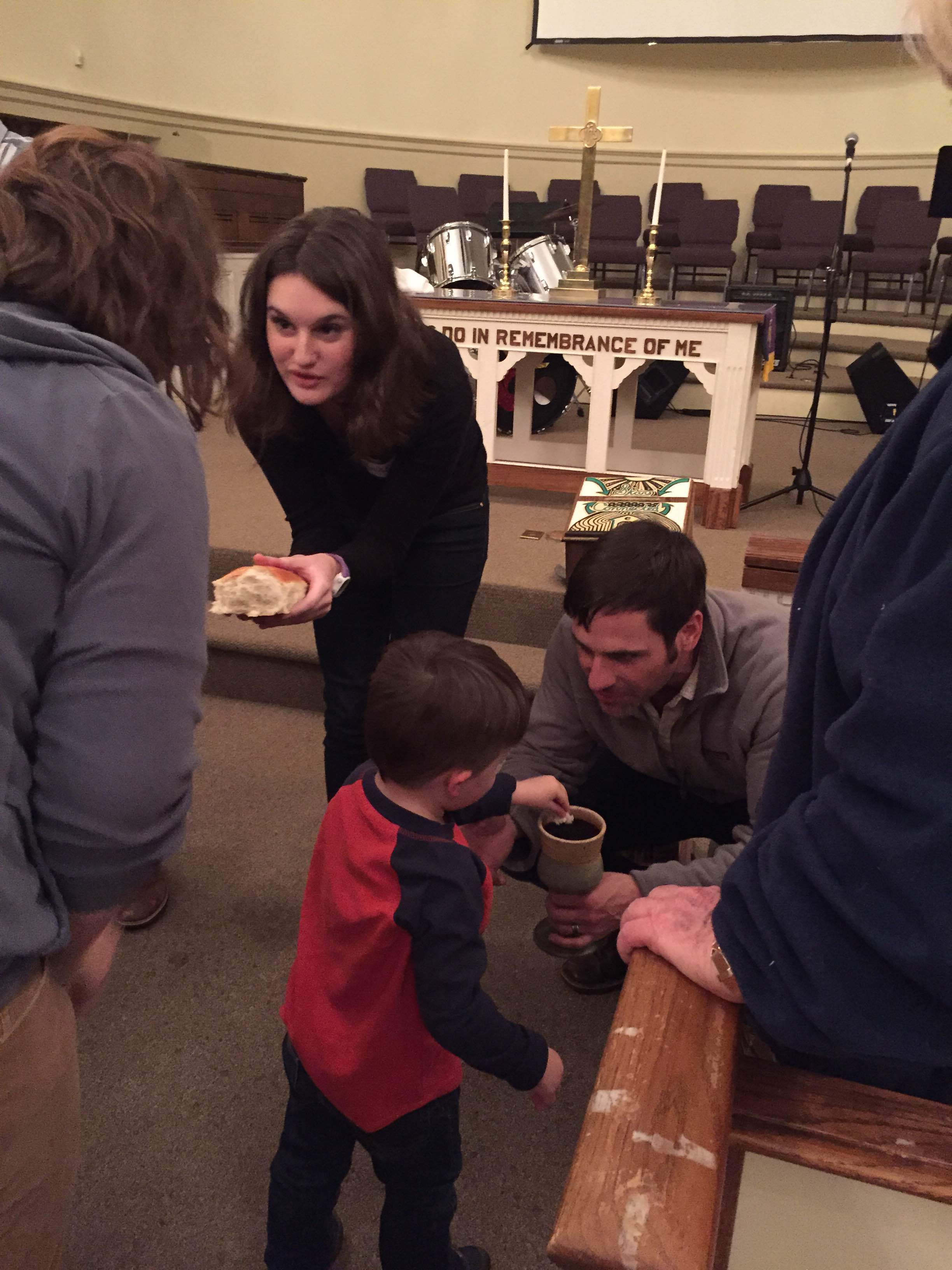
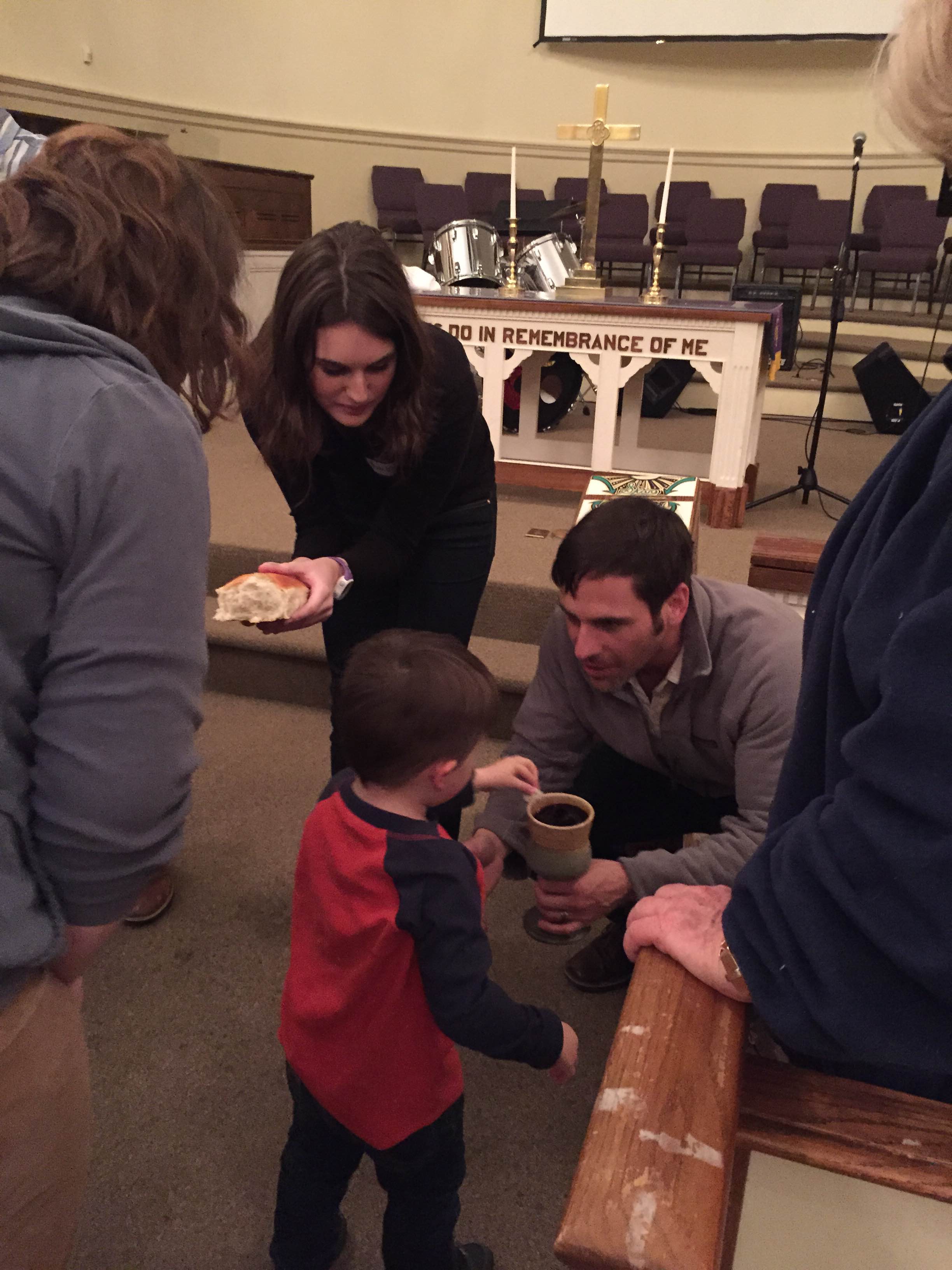
During the sermon Kezek would not sit still, so I made paper airplanes to keep him busy. By the end of the sermon we had an entire fleet. John had asked a couple of us to serve Communion before the sermon, so after he finished Meredith C. and I proceeded to the front. Megan W. and Kezek got in line. Megan guardrailed Kezek forward. When he arrived at the front, Meredith knelt down, extended the loaf toward him and said, “The Body of Christ, broken for you.” He reached out and tore off a piece as though he were entitled to do so. He seemed to know exactly what to do according to the protocol of an open Table, according to some unspoken but known Rule of some unseen but present House.

He then took a couple lateral steps toward me. I knelt, extended the cup, and said, “The blood of Christ, shed for you, Kezek.” He looked at me I swear with a brand new set of eyes—like I was the same old father but also someone somehow entirely new—dipped the bread in the cup, put it in his mouth, took a few more steps, and knelt down on the altar. He knelt there like it was exactly where he belonged. And he miraculously stayed there, still, for about five seconds, while the King of the Universe tore an infinite wound in space and time and flooded the heart of a child with grace upon grace.

I can’t prove that that second miracle actually happened, but I believe it did, and it is in any case the best explanation for the first miracle of Kezek staying still for five seconds. And in a certain sense, it is the only thing I really know that happened last night. And it was a miracle.

If there is a single statement I am willing to die for in this world, it is the statement Jesus makes about children and about his kingdom. It is a statement that must be taken in its plainest sense, I mean plain like the periodic table, plain like the tables of the Law. It is elemental and concrete, smaller than any doctrinal statement and yet every doctrinal statement must bend itself around its basic claim. It is found in Luke 18, Matthew 18, Mark 10, and the entire Gospel of John. In Luke it goes something like this:

Jesus’ disciples have clocked out but people keep showing up at the office, mothers and children and all that racket. So the disciples start rebuking them. [I once heard a Calvinist argue that ‘some babies must be predestined to hell because otherwise Christians shouldn’t be against abortion since if all babies go to heaven Christians should therefore endorse abortion’. For the record, babies do not go to hell and Christ still condemns abortion, and probably that Calvinist too.] Jesus said, “Let the children come to me, and do not hinder them, for to such belongs the kingdom of God. Truly, I say to you, whoever does not receive the kingdom of God like a child shall not enter it” (Luke 18:15-17). In Matthew’s account He mentions tying a millstone around their necks and throwing them into the heart of the sea if they ever pull a stunt like that again. Jesus loves the little children, all the little children of the world.  

If you want to spend the rest of your life trying to wrap your mind around the Gospel of God that comes in the form of Christmas, Jesus’ teaching about children is a good place to begin, also to end. 

The reason last night will exist in my memory as one of the most important moments in my life is because last night was the first time I really understood that leading children into the kingdom of God is the way God uses children to lead adults into the kingdom of his beloved Son. Last night I grew up and became a priest. But then I learned how to become a child by watching my child enter the kingdom and remembering what it was like to receive the kingdom as though I were entitled to it, by grabbing it as though it were already mine. Last night I remembered that in Christ the whole kingdom is already mine, because it is always already His.

I remembered that God comes to us only as grace, and that children do not complain that God comes to us only as grace. Children do not deny their need for grace, only adults. No child has ever argued against original sin, but a lot of adults have. Because being an adult means defending yourself. Adults can become so powerful in their defense that they manage to hold at bay the entire kingdom of God. “The gates of hell will not prevail against the Church” (Mt. 16:18), but that does not mean I can’t keep the gates of my heart locked. It doesn’t mean I can’t enter the gates of hell just as freely as I can enter the gates of heaven. It does not mean I cannot grow old.

I was reminded last night that to enter the kingdom of God I had to open myself up with something like the unflinching vulnerability of a defenseless child, or that of a crucified God. I had to become open to grace like I needed it. Jesus opened himself up to nails like he needed them. Opening up to grace feels like opening up to nails before you do it, but then somehow feels like a shower after, like Jesus on his walk up Golgotha but then like the soldier on the way back down (Jn. 19:34).

One time as a child I broke my toe while trespassing with my godless brother and sister and cousins (I was the youngest and had not yet, like them, lost my innocence) in a foam factory that may as well have been Disney World. We lied and said I had broke it while playing on a brick pile. After it swelled up like a light bulb my dad came at me with the leather punch out on a Swiss Army knife to drain the fluid, like a soldier with a sword but more like a father whose heart hurt like my toe, but worse. As he twisted metal into my flesh out came the crimson flow and with it like a Siamese twin my confession. I confessed that we were all liars and nothing in my life has ever felt as good as that knife and that confession. Nothing has ever felt more like grace either. It was amazing relief in the form of blood spattering all over the place. And it came only when the one I trusted most stabbed me in the place that hurt the worst, the place full of blood and water and sin and death. That was the place I received grace, dark red forgiveness. But I had to make an effort to open myself up like a child again, because I had lied and lost my innocence. I had closed myself up like and begun to grow old.

Kezek helped me open up again last night. And I can say that this is one of the few times I did not complain about my need to open up, to be wounded, and to be healed. When my time came to take the Elements, I confessed to God that I am a liar and it felt so relieving and so bloody to do so. It was amazing relief. 

I also remembered last night that there are a lot of things I ask of Jesus, and that Jesus is always giving me more than I ask for, even if that means sometimes he does not give me exactly what I ask for. I remembered that I need a community of people to lead me to him and to lead my children to him, not because Jesus needs a community to accomplish his work, rather because Jesus’ work accomplishes community, because it is the work of receiving people, which is the hardest work of all. I remembered last night that God’s House is community (Eph. 2; 1 Cor. 6; 1 Pet. 2, etc. etc. etc.), and that Jesus is our Host (Mt. 26:26-27; Mk. 14:22-23; Lk. 22:19-20). 

Lastly, I remembered that in God’s house there is only one Rule: “Eat my flesh and drink my blood” (Jn. 6:53-56), and this do as though you are entitled to do it and as though your life depends on it, because you are and it does.
 
The Table is open. Come for Jesus. He is coming to us.
 
“For as often as you eat this bread and drink the cup, you proclaim the Lord’s death until he comes” (1 Cor. 11:26).

IMG_2208 IMG_2207 IMG_2206 IMG_2205 IMG_2204 IMG_2203

Advent Reflection 20: Control

[After it was announced to Joseph that his life was spinning out of control: that his soon-to-be bride was ‘with [God-]Child’, and that he was to name him Jesus, and that this sort-of-Son-of-his would take away the sins of the people in fulfillment of Isaiah’s prophecy about Immanuel]:

“When Joseph woke from sleep, he did as the angel of the Lord commanded him: he took his wife, but knew her not until she had given birth to a son. And he called his name Jesus” (Mt. 1:24-25).

I hate airports. [At this juncture, to avoid a rant please skip to the next paragraph.] It’s not even a love-hate relationship, like “I love the benefit flying affords the modern-day traveller but hate this or that aspect of airports.” It’s a pure hate-hate thing. I know it’s unreasonable, I know I’m a hypocrite because, yes, I will continue to travel long distances by plane rather than car or covered wagon, but still, I hate it all: the busyness, the restlessness, the confusion of constant rushing and waiting all at once, taking my shoes off and laptop out, stickin’em up for that virtual strip search machine, the not-reclining until it’s somehow magically safe to recline upon reaching 10,000′, the speech about using the seat as a flotation device in the event that the plane nosedives 10,000′ into the earth, people in front of me reclining, the people in first class (it’s not you, it’s me), the in-flight smells, my borderline-claustrophobia-compounding-the-in-flight-smells, the blow-the-speakers loud *ding* followed by some redundant announcement and sometimes followed by nothing at all (especially on overnight flights–why?) other than thoughts better kept to self, the dried up snot, the ear issue, the $4.00-bottled-water-that-I-will-never-buy-but-over-which-I-insist-on-being-disgusted, the fact that somehow my departure gate is literally always at the absolute farthest end of wherever I happen to be at any given time in any given airport (and, for that matter, the fact that my invariably delayed flight(s) leave me (and my almost invariably pregnant-or-nursing wife and however many children I happen to have at the time) approximately 20 minutes to make it to the next departure gate (after taxying on the Tarmac for half an hour, waiting at least 10 minutes for the you-can-all-stand-up-now-and-wrestle-reach-for-your-carry-on-luggage-in-the-overhead-bin-at-the-exact-same-time-and-then-stand-there (touching…everyone is touching)-and-breath-down-the-back-of-the-person’s-neck-in-front-of-you-who-leaned-back-on-your-lap-all-flight-as-you-deplane *ding* to go off, waiting another 10-20-30 minutes for everyone else to deplane because I have too many kids to make hurrying a reasonable option)–I could go on, but I don’t want to start sounding complainy or anything. 

More than anything, though, the reason I hate airports/airplanes so much is that I love control so much. And most of that unnamable airport angst that I blame on any number of things (hence the above) is really caused by having lost all sense of control. People who love control hate losing their sense of control. This becomes most evident to me as I’ve noticed that something so banal as driving suddenly becomes the most satisfying experience of my life when I’m driving home from an airport—the feel of the (over-gripped) steering wheel, the feel of the (over-depressed) gas pedal, the cracking sound of whatever song I choose to blast through my (now blown) treble-heavy minivan speakers, the sense of immediacy between cause and effect, the sense of agency, the satisfaction of speeding and unnecessarily changing lanes and turning corners aggressively. Control.

[More ranting: In fact, twice in the past year and a half I have actually rented a car and driven home to Kentucky from Chicago O’Hare, despite the added expenses and despite it taking longer to get home than waiting would have (perhaps…although I’m not entirely convinced I wouldn’t still be there at this very moment had I not taken matters into my own able hands), because of delays, cancellations, delays that end in cancellations at 1:00 am after needlessly sitting on the Tarmac for two and a half hours with erratic, restless, kicking, achy, moaning, crying, kids, and a completely unreasonable flight attendant (👈🏻 that actually happened), etc. I digress.]

Actually, I should say that I love the illusion of control and that commercial flying is always an active exercise in disillusionment. There’s typically no one you can blame and nothing you can do to actually change your circumstances in an airport. You are just a cog in a system of ever churning wheels: small, out of control. 

And that’s truer of everyday life than we’d like to admit. In everyday life where we drive cars and keep day-timers and make appointments–and sometimes delay appointments–we find all sorts of people to blame and all sorts of things to do to bolster our illusion of control. But blaming a person can never change a person and the things we do rarely change what we most need to change, which happens to be the only thing we have any real power to change, namely ourselves. I can’t, for example, change the flight delays and my flight attendant can’t either, but I can change my attitude toward her. I can treat her like a human being stuck in the same complex set of circumstances outside any- and everyone’s control. 

And perhaps that’s just the point. Perhaps God uses all the stuff we wish we could change but mostly can’t to reveal what he wants to change in us but often won’t–because we won’t let him, because that would mean giving up what little control we actually have.

Consider marriage, for example. Hypothetically speaking, of course, there are at times all kinds of inner violence and turmoil and shame and discontent in my soul for reasons known and unknown. At the end of the day, most of that inner stuff is there because, directly or indirectly, I put it there and I store it there for safekeeping. Now, there are plenty of things within my power I can do change myself. I can, in the first place, confess out loud my sins to Jesus, who alone has the power to change me, and confess to my brothers and sisters in Christ, who can hold me accountable and hold my feet to the fire from time to time. I can humble myself and confess to my wife all that inner stuff that all too often comes out as irritability or coldness or withdrawing and almost always comes out as some form of blaming or projecting. I can recognize that she is 97% light and when I insist on seeing her 3% darkness 97% of the time what I’m really seeing is a mirror. What I’m really seeing is not something in her soul but something in my eye, not her speck but my log (Mt. 7:3-5). And perhaps the reason I insist on seeing that is because as long as the problem is located in her I don’t have to deal with the problem located in me. But that’s the only problem I really can deal with. I am out of control of everything else. 

In fact, it has only recently dawned on me that while I’ve spent most of my life trying to transform my circumstances, God has spent most of my life using my circumstances to transform me. I’m the circumstance that needs to change. I’m the bad attitude that needs to change the circumstance of the flight attendant having to deal with with an ungrateful patron. I’m the judgmental eye that needs to change the circumstance of my wife having to deal with her hard hearted husband. I’m the short temper that needs to change the circumstance of my kids having to listen to a father who yells. I’m the greedy hands that needs to change the circumstance of a world who needs more open-handedness. I’m the problem. And If everyone on earth would take responsibility for that problem and focus on the changes needed to address it, perhaps the world truly would be changed. Perhaps airports wouldn’t be so miserable. 

But ultimately we can’t fix that problem by changing ourselves. We can, however, go boldly to the only One who can fix that problem, who has fixed that problem, who by the power of his Spirit can and will change us, if we will be honest about what that problem actually is. But to do that we must confess that we are broken, that we need changed, that we are the problem. 

And so that is my confession this morning. I am broken, I do need changed, and I am the problem. Change me, O Lord, so that the circumstances of this cruel world may be changed. 


So what did Joseph do about his circumstances? He didn’t complain. He didn’t demand his money back. He didn’t become an embittered passive-aggressive husband who treats his wife as a conjugal object of his gratification. “He did as the angel of the Lord commanded him: he took his wife, but knew her not until she had given birth to a son. And he called his name Jesus” (Mt. 1:24-25). 


“Instead of hating the people you think are war-makers, hate the appetites and disorder in your own soul, which are the causes of war. If you love peace, then hate injustice, hate tyranny, hate greed – but hate these things in yourself, not in another.”

~ Thomas Merton, New Seeds of Contemplation

Advent Reflection 19: Absence

The troubling thing about God in a nation that is so overstuffed with stuff is that God seems to prefer to come when and where nothing else is coming. Advent is the season that the Church points to the One who came out to the open air. There was no room in the inn when he arrived (Lk. 2:7), so Life was born out of doors, in a manger. There was already a king in Israel (Lk. 1:5), so Christ was enthroned outside of Jerusalem, on a cross. He was born and he died in no man’s land, because the God who comes cannot be contained in one one man’s land, or one nation’s land. He came to every man, to every mother, to every child, but first to a Virgin.

So there must be vacancy for God to come, not like an empty room in an otherwise room-filled inn, but a place where the living God cannot be confused with any of the ordinary gods. Ordinary gods aren’t laid in mangers and in tombs. Only the living God can come where there is no life. God acts where there is no other activity, lives where there is no life. God’s presence is learned by way of God’s absence, but it’s hard to know God’s absence when everything else is stuffing the presence of the present.

I’m learning to be thankful for seasons of absence. I’m learning that absence is the place where God’s hand can be most clearly seen. I’m also learning that God’s absence is evidence itself of the reality of God (see excerpt below).

Today’s reflection concludes in deference to a man who speaks on absence with authority–from the other end of life:

From Anthony Bloom’s Beginning to Pray

It dawned on me upon reading this that my greatest complaint to God is that He is real.

Convict me, Lord. I want my absence to remain empty until you fill it, rather than keeping a steady an influx of alternatives to get me by. Help me to keep seeking you in and through the desert, even if seeking you leads to an endless search–forsaking all the treasures of Egypt like a fool chasing an Infinite horizon (Heb. 11). Even if your presence feels only like a vacuum filled with infinite longing, may my longing remain fixed on your presence even when my experience seems to remain in your absence. 

Even so, let it be. Only keep me from settling for anything less than all of you.

Advent Reflection 18: Wonder

An Open Letter to My Skeptic Friends

Dear Friends,

I am writing this letter to try to help you see where I am coming from when we debate and why I will likely never be able to satisfy your questions with my arguments.

The elephant in the room of every Christian-nonchristian debate is there because Christians have not only been asked to affirm an apparent contradiction, but we have been asked to base the universe on that contradiction. God was not oblivious to this design. He set it up so that the contradiction would have to run its course before it can do the work of drawing people back in. We must first look away only to realize we cannot look away. We must be repulsed by the death of Christ only to be seduced by it. We must see who God is in Christ, so that we can see decisively who God is not in us. We must first see the infinitive qualitative distinction of Christ crucified in order to see the infinite qualitative beauty of Christ crucified. We must behold the One lifted up as we behold the ceiling of the Sistine Chapel, as an unattainable spectacle of impossible grandeur, as something that is kept from our reach but given to our eyes, as something so absolutely alien but somehow so absolutely at home. We must learn not only to handle the truth of God, to follow the goodness of God, but, perhaps at the very center of it all, to behold the beauty of God. But we cannot run to the academy for proofs of God’s beauty, because, in Von Balthasar’s words, “Beauty is the last thing which the thinking intellect dares to approach, since only it dances as uncontained splendor around the double constellation of the true and the good and their inseparable relation to one another.”

I find that what I’m really trying to do when I share the Gospel is not something that is possible for me to do, because the Gospel itself suggests that those who believe it do so because God himself compels them to, because he will speak to your heart in a way you will not be able to deny, in a way similar to your inability to deny the beauty of a sunset or the delight of a shooting star. So what can I do but point away from myself into the infinite space between us and God and declare a deep mystery. What context is there for me to describe this cosmic enigma but in the gap of the otherwise unknowable? It’s not like I can ever assume a direct correlation between what I say and how you respond, so if you are going to really hear what I’m trying to say, you will simply have to listen for Someone Else’s voice. And if He doesn’t speak, I have nothing to say.

For future reference, I want to put out a disclaimer, so as to not mislead. I want to say that the distance between the Gospel of Jesus Christ and the highest link on the chain of reason is like the distance between the highest tidal wave and the moon. And yet, for all lack of appearances, and in an act of self-humiliation, I am still commanded to proclaim that there was a day that the moon plunged itself into the heart of the sea, only to return three days hence to rule the night sky. I do not expect that I can prove this actually happened, nor do I pretend it is not a foolish story, as though we should have expected it to happen, as though Via Negativa should always lead to Via Delarosano matter the God, no matter the universe. More foolish still, I need to concede that I was not even there when it did happen, and yet I have been commanded to proclaim it as though I witnessed it myself, because I did witness it myself.

It is such an absurd story indeed that if you ever do find yourself believing it, it will be nothing short of a miracle, and your faith will not rest in the wisdom of men but this miracle of God (cf. 1 Cor. 1-2), so please don’t try to persuade yourself into believing it, and neither will I try to persuade you. When you do believe it, it will only be because you cannot help but believe it, only because it is in your head not like people are in an airport but like busyness is in an airport. It will be in your head unlike any other idea or fact or truth is in your head because it will be in more than just your head, as though its roots have grown down and wrapped around your heart and your gut and begun sprouting its life in a way that distorts your vision, like the suddenly permanent image of the sun after you foolishly behold its beauty too directly. Even in your doubt, you’ll have to stop and have a little chuckle at yourself after suddenly realizing you are in an impassioned argument with the God whose very existence you are questioning. You won’t be able to doubt him like you can doubt every other god. You will always find yourself doubting him to his face. He will be for you like the presence of a fresh memory, always just an immeasurable moment away from being as tangible as the bread and wine in your mouth–invisible but indelible.

And you would rather it be so, because you will know that anything nearer than that would be confined to time; that the permanence of his presence as such is precisely why his presence is not fleeting, why the Bread of Life must hide itself from our tongues to remain hidden in our hearts. You will know that to keep from being objectified and made into an idol, God mustn’t objectify himself to those who desire nothing more than to make him an idol, to make him a possession so as to avoid becoming His possession. Indeed, you will know that his single pendulum swing through time in Jesus Christ was his perfect, unrepeatable form, so that his cruciform temporality is as necessary to behold as his reigning eternality–for it is The Infinite whose form is perfectly revealed by his becoming The Mortal–the reality of which will become for you so irresistible, so radiant, so beautiful, that you will long for others to see as you see, not because it makes you feel so large and in control, but precisely because it makes you feel so small and out of control; precisely because it will have restored for you a vision of the wonder and mystery that you had only as a child tromping around in an infinitely large and wonderful world; precisely because you have again become a child. And indeed, unless you become a child, you will never see it (cf. Mt. 18:3).

So my only hope of your understanding why I must speak of him to you, is that you see him for yourself. And you will know when you have really found him with your eyes because you won’t be able to keep him out of your mouth. But you won’t speak of him as a man with a unified theory of the universe, rather as a child pointing aimlessly into the night sky, not with great confidence but with great delight. You will not do it because you think you’re right about Jesus and others are wrong about him. That’s just not the point. You will do it because you think Jesus is beautiful and will eagerly want others to see in him what you see. But, I must warn you, there will be moments of heartache, the kind of heartache that is felt the day the most splendrous sunset begins to fall into your vision, but you’ve no time to find someone to share it with; the kind of heartache the anxious museum curator feels as he begins fumbling over desperate words trying to capture the attention of a distracted group of teenagers, who at some point will have to realize that nothing can persuade a person to see Beauty but Beauty itself. But never stop pointing and naming what you see, even as you concede the great gap between the end of your finger and the beginning of the moon. And never stop praying that naïve prayer, as naïve as a child’s birthday wish, that the moon would once again descend from the heavens and land in the abyss of another’s heart, that is, of course, if you ever do find yourself believing. And that is my prayer for you even as you read this: simply that you would be able to see his glory and unable not to.

Advent Reflection 17: Evangel

“And in the same region there were shepherds out in the field, keeping watch over their flock by night. And an angel of the Lord appeared to them, and the glory of the Lord shone around them, and they were filled with great fear. And the angel said to them, “Fear not, for behold, I bring you good news of great joy that will be for all the people. For unto you is born this day in the city of David a Savior, who is Christ the Lord. And this will be a sign for you: you will find a baby wrapped in swaddling cloths and lying in a manger.” And suddenly there was with the angel a multitude of the heavenly host praising God and saying, 

“Glory to God in the highest,
    and on earth peace among those with whom he is pleased!” (Lk. 2:8-14). 

Not too many months back a well-meaning man and his son knocked on my door, awkward, tracts in hand. Below is the conversation as I remember it. I don’t think it is far from verbatim.

Me: “Hi. May I help you?”

Man: “If you died today, do you know for certain you would not go hell?”

Me: “No.”

Man: “Would you like to be certain of that?”

Me: “Yes.”
Man: [Handing me tract] “Read this. It tells you how you can be certain you will not go to hell.”

Me: “Jesus said not to be anxious about tomorrow. I feel like you are trying to make me feel anxious about tomorrow.”

Man: “I thought you said you didn’t know for certain whether or not you would not go to hell when you died.”

Me: “I did. But I’m not anxious about hell. My faith is in Jesus, not in heaven, and certainly not in not going to hell. At any rate, Jesus is the Judge, so I’d rather put my trust in the Judge than in the verdict. Wouldn’t the latter just be mistaking myself as judge? Don’t you think this approach to evangelism makes you out to be the judge and everyone else out to be on trial?”

[Very long, awkward pause–I waited.]

Man: “Okay, well I hope you get a chance to read this.”

Me: “Thanks. Have a good one.”

When the angels proclaimed the first Advent of Christ it came with a message: “Fear not!” And I can’t help but think that our evangelism about the second Advent of Christ should sound similar. Below is an example of what I think that might look like, singing with the angel’s and whatnot:

I’ve probably watched this video 100 times. I love it. To me, it is a symbol of true evangelism, of what it should look like to herald good news: not a hit-and-run proposition of ‘the kingdom-of-God-and-way-out-of-hell hereafter’ but a public declaration that ‘the kingdom of God at hand’. Its aim is not to promote the wretchedness of man or the rightness of the Church but rather to proclaim the glory of God, for which the most appropriate mode of communicating is song.

Now, to be clear, I do believe in heaven and hell, and I reject the notion that God forces eveyone to accept his Christmas Gift to the world in the end (a la Rob Bell and co.). But I also reject the notion of a Gospel that is grounded in hell and not in Jesus Christ, because that is not the Gospel found in the New Testament. In Acts, for example, the New Testament book that should be used above all for the Church’s precedent for evangelism, the word “hell” (hades here, rather than the more common Gehenna, Acts 2:27, 32) is only used twice, both in reference to where Jesus went but where God didn’t leave him. So if the only thing good about the Good News we believe is that we aren’t going to burn in hell because we believe it, we would do well to go back to Scripture and listen again the message as heralded by the angels and the early Church. 

All evangelism is imposing, but true evangelism like is imposing in the right way, like a sunset is imposing on the western horizon, like stars are imposing on our attempt to gaze only into the dark matter of the universe. It’s an imposition of of light, of beauty, of joy–whoever has complained of such an imposition? And whatever else the world hears the church saying, they should if nothing us else hear us saying ‘Hallelujah!’ Our worship is the backbone of our evangelism. 
And, indeed, worship offered up to God–be it in a life lived, a sacrifice made, a song sung–will have a certain gravitational pull, not polarizing push, because it seeks to articulate not how fear-worthy hell is and afraid we should feel about it–-that’s just not the point–-but how love-worthy God is and how peaceful we should feel about Him.It should indeed function to point to the One who was lifted up on a cross to “draw all people to himself” (Jn. 12:32).

So the grammar of worship is not ‘If…then…’ as much as it is ‘Hallelujah!…because:

“The kingdom of this world is become
The kingdom of our Lord,
And of His Christ!
And of His Christ!
And He shall reign for ever and ever!
And he shall reign forever and ever!

And he shall reign forever and ever!
King of kings–forever and ever–Hallelujah! hallelujah!

King of kings–forever and ever–Hallelujah! hallelujah!

This must have been similar to what John saw and heard from the angel that flew over “all tribes, tongues, and nations,” singing “everlasting good news” (Rev. 14:6): News that is always here. News that is always good. Indeed, the only news that is actually new because it’s the only news that will never grow old. This: in Christ, God with us!

Advent Reflection 16: Reorient

“Now the time came for Elizabeth to give birth, and she bore a son. And her neighbors and relatives heard that the Lord had shown great mercy to her, and they rejoiced with her. And on the eighth day they came to circumcise the child. And they would have called him Zechariah after his father, but his mother answered, ‘No; he shall be called John.’ And they said to her, None of your relatives is called by this name.’ And they made signs to his father, inquiring what he wanted to be called. And he asked for a writing tablet and wrote, ‘His name is John.’ And they all wondered…” (Lk. 1:57-63).


The first half of life we long after a vision of the Kingdom. The second half of life we long after a dream of Home. We spend half our lives trying to grasp at a future that never fully arrives and the other half of our lives trying to hold on to a past that was never fully there. Those who stop short of the kingdom of God will be lead away from joy into an increasingly acute restlessness, and those who stop short of our eternal homecoming will be led away from peace into an ever deepening heartache. We are diseased with both wanderlust and homesickness, and nothing short of the infinite horizon and all eternity to both settle in it and explore it can satisfy the longings of the soul anchored in the living God who gives it breath (Eccles. 3).  

Why is the high school student aimlessly charged with a need to just “get out of the house”? Why does same high school student twenty years later find himself trying to recreate the home he grew up in? Why do boys resent their moms more than anyone when they are young and love their moms more than anyone when they are old? Why is it that in childhood we long for adulthood and in adulthood we long for childhood? Why do young girls and old women both want to be twenty year-old models, even though twenty year-old models don’t want to be themselves? Why does life teeter between restless pursuits and just as restless arrivals?

Why does Christmas make us feel the way it does?

The number one problem concerning the Kingdom that was about to enter Zechariah’s world–in a manger–was not that it was too small but that it was too large. The grand vision of the kingdom of God had been reduced to the grandest vision of the kingdom of Israel. And that just wasn’t grand enough to accommodate God’s vision for the world. But this is always the rub.

Visions of national sovereignty satisfy enough the kingdom-shaped longings of our youth and protect enough the home-shaped longings of later life. So we settle, indeed, for the small. We want peace in our nation, absolutely, but world peace is reserved for the wishful thinking of hippies on earth and religious thinking about heaven in the hereafter.

Maybe that’s why the angel gave Zechariah’s son a name that came out of nowhere (wasn’t a family name; the neighbors thought it was odd, Lk. 1:60-61) and why John never went by his given name. He simply called himself “A Voice.” He was “the Voice crying out in the wilderness: ‘Prepare the way of the Lord’.” None of the accepted categories for what God was planning to do were big enough. They never are. 

So God brings life forth through Elizabeth’s barrenness, a messenger from Zechariah’s silence, and “A Voice” crying out in the wilderness, because this life and its voice were preparing the world for a kingdom-shaped world as big as the earth and a home-shaped life as eternal as heaven. The world had given up on such a grandiose hope. A truly new Voice was required to proclaim the infinite horizons of a kingdom that should be too good to be true. This required a reorientation.

Advent is our reorientation to the Voice of the one who tells us to listen to our deepest longings and announces the Gospel of God’s infinite kingdom as our eternal home. But this Voice always has to come from the silence, because even the Church is in the habit of losing its voice and settling for status quo. Advent silences that old cynicism and says listen up! There is One coming! Prepare the way! Don’t sell yourself short! The world always wants to give up on that grand of a kingdom but God always raises up a Voice that refuses to let hope be silenced.

There is a Voice that calls out in the wilderness of your heart, the same wilderness that leads you looking for a vision of the kingdom but too often leaves you aching with a dream of home. That Voice comes to the wilderness to announce the One who is greater than us because he is before us, whose shoes we are unworthy to untie. It is the Voice that comes in opposition to our righteousness, that tells us to bear fruit worthy of repentance. It is the Voice of Advent that says: ‘Prepare the way of the Lord; make straight his paths in the desert?’ (Isa. 40:3; Mt. 3:3; Mk. 1:3; Lk. 3:4; Jn. 1:23). And it is the only Voice that will lead to the Kingdom that won’t leave you in the desert without a home.

I think the words of Frederick Buechner’s echo that Voice well. I’ll end in their wake…

“The world floods in on all of us. The world can be kind, and it can be cruel. It can be beautiful, and it can be appalling. It can give us good reason to hope and good reason to give up all hope. It can strengthen our faith in a loving God, and it can decimate our faith. In our lives in the world, the temptation is always to go where the world takes us, to drift with whatever current happens to be running strongest. When good things happen, we rise to heaven; when bad things happen, we descend to hell. When the world strikes out at us, we strike back, and when one way or another the world blesses us, our spirits soar. I know this to be true of no one as well as I know it to be true of myself. I know how just the weather can affect my whole state of mind for good or ill, how just getting stuck in a traffic jam can ruin an afternoon that in every other way is so beautiful that it dazzles the heart. We are in constant danger of being not actors in the drama of our own lives but reactors. The fragmentary nature of our experience shatters us into fragments. Instead of being whole, most of the time we are in pieces, and we see the world in pieces, full of darkness at one moment and full of light the next.

“It is in Jesus, of course, and in the people whose lives have been deeply touched by Jesus, and in ourselves at those moments when we also are deeply touched by him, that we see another way of being human in this world, which is the way of wholeness. When we glimpse that wholeness in others, we recognize it immediately for what it is, and the reason we recognize it, I believe, is that no matter how much the world shatters us to pieces, we carry inside us a vision of wholeness that we sense is our true home and that beckons to us. It is part of what the book of Genesis means by saying that we are made in the image of God. It is part of what Saint Paul means by saying that the deepest undercurrent of all creation is the current that seeks to draw us toward what he calls mature humanhood, to the measure of the stature of the fullness of Christ….Joy is home, and I believe that the tears that [come] to our eyes [are] more than anything else homesick tears. 

“Woe to us indeed if we forget the homeless ones who have no vote, no power, nobody to lobby for them, and who might as well have no faces even, the way we try to avoid the troubling sight of them in the streets of the cities where they roam like stray cats as we listen each night to the news of what happened in our lives that day, woe to us if we forget our own homelessness. 

To be homeless in the way people like you and me are apt to be homeless is to have homes all over the place but not to be really at home in any of them. To be really at home is to be really at peace, and our lives are so intricately interwoven that there can be no real peace for any of us until there is peace for all of us.” 

Buechner, The Longing for Home: Recollections and Reflections

Advent Reflection 15: Peace

“Of the increase of his government and of peace there will be no end, on the throne of David and over his kingdom, to establish it and to uphold it with justice and with righteousness from this time forth and forevermore. The zeal of the Lord of hosts will do this” (Isa. 9:7).

“All humanity’s problems stem from man’s inability to sit quietly in a room alone” (Blaise Pascal, Pensées).

Other than a few proper names, there is no word in the world more important to me than peace. I suppose it is because for a long time I lived without it. Anyone whose world has been stripped of peace knows just how much its worth.

But defining peace is nearly impossible. This is evident the moment you try to think of its opposite. There’s belief and there’s unbelief. There’s happy and sad. There’s hope and despair. There’s good and evil, heaven and hell, holy and unholy, books and Instagram. But what is the opposite of peace? Is it War or is it angst? Is it Chaos? Hostility? Worry? Restlessness? Anxiety? Bitterness? Hatred? Rage? Violence? Revenge? Discord? The Middle East? The nightly news? Divorce court? The human heart? Where is peace located—within or without?

Yes.

Peace is such an all-encompassing word that to not have it is to be both engulfed by and filled with the “formless void.” The formless void is existence with no reference points, not coordinates, no order. To be in a formless void is to be restlessly lost. It is to live in world of darkness that both covers the face of the deep (Gen. 1:2) and hides its face in the dark (Gen. 3:7-8). It is the void within and the darkness without. In fact, in the book of revelation, the second of the so-called four horsemen of the apocalypse was not instructed to impose violence in an otherwise peaceful world, as is sometimes suggested. He was simply “permitted to remove peace from the earth, so that people will slay one another” (Rev. 6:4). There is no more terrible a prospect of God’s wrath than God’s absence. If perfect peace has an exact opposite, it is pure absence. (See this footnote for explanation). In the words of Karl Barth, “The enterprise of the No-God is avenged by its success.” Indeed.

But this is counterintuitive. In our culture, we actually tend to think of peace as a kind of absence. If I could just get some peace and quiet! By that we mean we need a halt, a ceasefire, a break—we need to be absent from all the activity and noise we are surrounded by to find peace. But the real question isn’t why we need some peace and quiet every now and again. The real question is why we need activity and noise all the time. Why are we more compelled to return to the chaos than retreat from it? Why are 63% of Americans stressed, a quarter of which addicted to stress, while people on the other side of the cultural pole are addicted to distraction? Why is it so hard to not fill the void with the noise?

Is it that our abundance of activity contributes to our lack of peace or that our lack of peace contributes to our abundance of activity? 

How long can you sit in a room alone?

I can’t help but think that a “culture of more” is the inevitable product of culture that has poured its foundation in the void. I can’t help but think that in such a culture more can never be enough–because the void wasn’t for us to fill; it was created for God to fill. It is there so that we will come to know our need of God.

About five years back, Keldy and I were meeting regularly with a young gal helping her through some of life’s regulars, a few irregulars as well. One evening we had one of those rare “come to Jesus” moments, because it was pretty clear Jesus had come to her. There were tears, confessions, a white flag slowly being raised from her heart. But I could tell there was still some white in her knuckles as it related to one very destructive relationship she knew she needed to let go of. I tried to convince her that staying in this relationship was like holding on to a ticking time bomb. Her response: “I’d rather die with someone who hurts me than be alone. I just don’t want to be alone.” For this girl, it wasn’t a presence she feared, no matter how destructive, but an absence.

I can’t say that I blame her. I know what all sorts of pain feels like, and there is no pain that hurts more than loneliness. Indeed, “it is not good for man to be alone” (Gen. 2:18), so we would rather die with the ones who hurt us than be left to live alone.

But that’s not our only option.

On October 1, 2014 (an easy day to remember: my mother’s birthday, the day I got my second DUI–I was 18), I got a text from the same girl. It’d likely been a year since I had talked her. She was off to college and I had, quite frankly, given up on her. But Jesus hadn’t.
I saved our conversation:

G: [Her opening line:] “I am ready to give my life to Christ. I’m not sure what to do, so I need your help.”

Me: “Did something happen? What changed?”

G: “I was lying in bed in my dorm room, by myself, and suddenly I just felt at peace. It felt like my room filled up with peace.”

Me: “What do you mean?”

G: “I mean I didn’t feel alone anymore, and the only thing I could think about was Jesus.”

Me: “Go and tell three people what just happened. I’ll call you tomorrow morning.”

Jesus has a special holiday name, Emmanuel, which means “God with us.” The Gift of Christmas is the nothing less than the presence of God. It is God’s gift of God’s self. The King of Kings comes to us as Prince of Peace. 
At the second Advent of Christ, Isaiah says there will be no end to peace, no empty dorm rooms, no empty high school girl hearts, no empty void selling endless fixes for to a culture of more. Jesus will establish a government based on the peace of his presence. But Jesus’ presence is available today. Immanuel really means Immanuel.

The question we all must confront is whether our lives are based on a presence or whether our lives are based on an absence. Have you dared to pray for God’s peace?

Advent Reflection 14: Small

[Disclaimer: this was actually written in the wake of the recent political campaign season. If it sounds a bit aggravated, it’s because it was. But just know: it’s not you, it’s me 🙂 ] 

“And this will be a sign for you: you will find a baby wrapped in swaddling cloths and lying in a manger.’ And suddenly there was with the angel a multitude of the heavenly host praising God and saying, ‘Glory to God in the highest, and on earth peace among those with whom he is pleased!” (Lk. 2:12-14).

A lot of people talk about “seeking God” as though on some open-ended quest toward an infinite horizon. But when the shepherds, who had just seen the infinite horizon rend with songs descending, were told to seek God, they were also told they would know they were on the right track when they received another grandiose sign from on high: a baby born in a barn.

Some sign…


Imagine how different the world must have been even 100 years ago. Imagine how much bigger and more mysterious the world must have been before it got entangled in the World Wide Web–a world without virtual friendships and virtually shared insta-moments of presence, a world without Buzzfeeds that reduce our ever-shrinking ordinary world to a series of tragic headlines and newsfeeds that reduce our ever-expanding social world to a series of one-way conversations 140 characters-deep and 10,000 friends-wide, a world without Google Maps and Google Earth and Google Sky and Google Multiverse (forthcoming). Imagine what it must have felt like to not feel like you are at the center of every event and every relationship on earth. Imagine a world with board games and the great big woods outback. Imagine what it would feel like to be only as large as a human being. Do you remember what it was like being small? 

As a thought experiment, I would encourage you to go type “headlines” into your search engine of choice. Read the headlines. Then ask yourself the following question: “What can I do about this?” I’m thinking of specific actions that can actually address specific problems or make specific differences in my life or anyone else’s.

I suppose you haven’t thought of much to do either, other than maybe following a rabbit trail of hyperlinks that always seem to end up feeling like the links of a chain. You’d almost think the highest point of our nation’s freedom, that of its speech, is now being used to paralyze us. It’s like the headlines that feed us the bad news of the world have left us no room to speak about anything else, anything less important than politics or less complicated than the economy or less alarming than proofs of the immanent threat of radical Islam. How inconsiderate it would be to speak needlessly about the daylilies beginning to bloom outside with all that other stuff happening outside, which we know is happening outside because inside is a fire-breathing hydrant draining out a steady stream of realtime terror by concentrating all the evil of the world into one place, where we can observe it safely behind the glass in the comfort of our own homes, i.e., a TV. At a glance, here are the top three current headlines (at the time of this writing): A bear eats a mountain biker in Montana, a girl is stabbed in her sleep in Israel, bombs in Istanbul. So surely now is no time to waste our words on less important matters, to give thanks for the day that the Lord has made. The day is forever dark.

We most certainly have the freedom to speak, and we will do so passionately, if not viscously. It’s just that we don’t have any freedom in what we choose to speak about, at least not any practical freedom. We can speak about the kindness of a friend that led to encouragement or the kindness of God that leads to repentance, but we may as well be speaking to a wall. People only tend to listen to what is loud, and campaign speeches and suicide bombs are always going to be louder than love. But I remain convinced that it’s better to speak to the wall with the small voice of God than to divide up the stadium with the forked voice of the devil.

Just because it’s a headline doesn’t mean it’s important, that it rightly demands your attention, that it immediately affects your world, that it can add to or take away from your hope. The vast majority of information that comes through the news media serves to do little more than form cultural attitudes (cf. G.K. Chesterton’s sobering work, What’ Wrong with the World). It’s spectacle, a coliseum at our fingertips. But it is certainly not news in any literal sense of the word, just an ever-expanding buffet of rearranged words that are used to say the same thing over and over and over ad infinitum. It’s kind of like Mexican food. There is nothing new under the sun. We’re just moving around the rice and the beans.

–Because the unquenchable fires of the nightly news feed only on the world of decay, a world that requires the new to ever become old, a world that skims atop the surface of time desperately groping at what men identify as meaningful today but what moth will identify as food tomorrow. But Christians have been given a cross staked into history’s yesterday and Life raised up into history’s Tomorrow. That news has pierced the soul of the world, and it is the one thing that remains new precisely because it is the only news that never grows old. It is the news that the angel heralded over history as “the everlasting good news…to every tribe, tongue and nation” (Rev. 14:6). And Christians have been commanded to speak about the news of this cross, because people will always keep killing for themselves until they find Someone to die for them first.


I’m not saying it is bad to be concerned with or aware of the global scene, especially if you are in a position to do something about it–-most of us are not-–but I do think it is bad to be unconcerned with and oblivious to the local scene. I’m suspicious of a man who decries world hunger but has never offered to buy a local man’s lunch, who endorses love for the world but doesn’t sit down to eat dinner with his family, who rails against abortion but doesn’t teach his son how to respect a woman, his daughter how to respect herself. The greater are our delusions of grandeur, the severer we suffer the sickness of Doestoevsky’s doctor, who

loved mankind…but…the more I love mankind in general, the less I love people in particular. I often went so far as to think passionately of serving mankind, and, it may be, would really have gone to the cross for people if it were somehow suddenly necessary, and yet I am incapable of living in the same room with anyone even for two days; this I know from experience. As soon as someone is there, close to me, his personality oppresses my self-esteem and restricts my freedom. In twenty-four hours I can begin to hate even the best of men: one because he takes too long eating his dinner, another because he has a cold and keeps blowing his nose. On the other hand, it has always happened that the more I hate people individually, the more ardent becomes my love for humanity as a whole (The Brothers Karamazov).

The problem with actual human beings, the kind that bleed real blood (Jn. 19) and eat real fish (Jn. 21), is that they get in the way of human ideals, especially our ideal of humankind. That’s why human beings are most hateable precisely in the name of humankind. We hate Hitler so much because we love humankind so much. But if it is an ideal of humankind we are after, we are better off leaving this world to find it. If God himself cannot fix the world without first getting caught up in the thickets of its realism, then neither should we imagine an ideal world void of invasive thorns and heavy-handed crowns, or of some strange combination of the two. Till kingdom come in all its fiery cleansing, humans will continue to erect crosses and blow their noses. And unless we are going to cooperate with the ones holding the hammers, cooperating with the One holding the nails will always be personal, and likely at least a pain in the neck.

The truth is, you can’t make your world different until your world becomes close enough to touch, low enough to look in the eye. That is your world. Everything bigger is a mirage. Anything more important is unimportant. And strangely enough, it is in that little insignificant world of yours, with hardly more than an earshot radius, that you will find meaning, purpose and permanence, because it is in that world that you will find God.

Q: “When did we see you hungry and feed you and thirsty and give you drink?”

A: “When you didn’t see me on a screen and when you gave me more than your opinions.”

In fact, when Jesus saved the world, the worldwide web didn’t even exist. News feeds were word of mouth without the help of microphones or bullhorns. Without even the positive encouragement of K-Love, somehow the love of God managed to squeak by. It was even more primitive than a landline phone call, as old fashion as family dinner. In fact, not a single member of his little lakeside church had a voice loud enough even to cast a Roman vote. How they managed to function without a cultural pat on the back and a governmental stamp of approval baffles the camel staring eye-to-eye with the needle. But as Jesus once said, it’s easier for the Gospel to get into North Korea than for Donald Trump to enter the kingdom of heaven. Or Hillary Clinton for that matter. 

So we cannot be deceived to think that the effect of the Gospel increases with an increase in volume. Besides, I don’t know about you, but I tend to avoid sitting next to the guy with the bullhorn, especially if he is carrying a Bible. The Word of God sounds like an invitation, not a pep rally; it belongs at the table, not in the bleachers. If we keep letting it fly off into the airwaves, our best words, like “evangelical,” are going to keep getting being emptied of their power (cf. 1 Cor. 1:17). And that just deepens the mess we’re in now of having to “unspeak” as much as we have to speak about Jesus. That is in part the great evangelical task of the Church in America today, and it is no small task.

But it is necessary if we are to speak truthfully of God. God speaks in a still small voice because that kind of speech requires nearness, and God wants us to speak like him when we speak about him, and when we speak about him we speak about the God who is near in Jesus Christ, and the God who is near in Jesus Christ brings people near who are otherwise far apart in the name of so many other gods or nations or denominations or politicians or jerseys or brand names or petty opinions or very serious opinions.

The kingdom of God is not revolutionary like a typical change in thrones. It’s actually more evolutionary, like a garden. Jesus may not have been as radical as Karl Marx, but he was just as practical as potatoes. Now I don’t mean evolutionary in the way Mr. Whitehead meant it, nor am I talking about the kind of ‘practical’ found in the mouths of politicians or the most popular preachers. I just mean there is a certain size and speed men have tended to associate with God that God has tended to dissociate with himself. Jesus, the eternally begotten Son of God, was, after all, was somehow less divine than all the gods of the pantheon and even more human than the Greeks. He is the kind of God who takes almost a week to create the universe and then without apology takes a break. To be sure, of the the things that made the post-Easter highlight reel of the risen Christ, John tells us about Thomas touching his wounds followed by a big ole fish-fry on the beach. Even in the new creation there is good reason to rest. 

The sign of this God is that they’d find a baby, lying in a manger.


The salient point is this: it’s easier to care about everything in the world than to care about one single human being. At least as far as the Church is concerned, we don’t need more initiatives than the one we’ve inherited. We just need to take the one we’ve inherited seriously. But that requires believing in a very large gap between the size of your efforts and the size of the difference it makes, but it also requires disbelieving in the size of Washington and Hollywood, so that you don’t waste all your efforts trying to change one and look like the other. You can do no such thing.

But the Gospel frames the divine revolution of new creation in mustard seed packets. And these mustard seeds are not like Jack’s beans. They don’t magically produce watermelons on vines of Zigguratic proportions. The difference is both bigger and smaller than that–it just depends on how you measure, and I can’t help but think that the Church’s measuring sticks need about as much conversion as the Church’s nonmembers, and exactly as much as its members.

Unfortunately or not, the magical mustard seeds of the kingdom turn out merely to produce more mustard seeds, which precisely the way love works (the kind of love that still means something more like active charity than passive ‘tolerance’ or political activism). People who need love do not need it from the whole human race; they just need it from you. In fact, you are the only one small enough to love with a God-sized love. A cup of cold water in Jesus’ name will always be more satisfying than a free pass at the fire hydrant. So if you want to love a refugee, find one. If you can’t find one without a country, find one without home, or one without a father, or one with a father who may as well not be a father. They are everywhere, especially right next door.

If you want to be “missional” and save the world, just make sure whatever world you intend to save is one inhabited by human beings as real as you are. Even if God sends you across the globe, it will only be in order to send you across the street. But he doesn’t have to send you across the globe to send you across the street, so please don’t wait until you are called overseas to the nations to call the neighbor next door.

May I offer a simple way to stay grounded in the kind of Gospel that actually touches the ground? Think about a time you received the grandest expression of love. Now go, descend from on high, and do likewise.

If you are committed to becoming part of something as small as God’s global mission, going around town proclaiming “good tidings of great joy” to little kids and boring neighbors, I can promise that you’ll experience Jesus as you go. Sometimes that will be as sweet as Christmas morning, other times as sour as a sponge dipped in vinegar; but if we are going to grow in the Hope of a Christmas kingdom, we’ve got to be willing to walk away from the starry evening angels and head crossward toward Easter morning–and there sadly are no detours that allow us to avoid the midday of the Friday before.

But neither were there for God. So be small, and know that God is too.

Advent Reflection 13: Immanuel

“As he considered these things, behold, an angel of the Lord appeared to him in a dream, saying, “Joseph, son of David, do not fear to take Mary as your wife, for that which is conceived in her is from the Holy Spirit. She will bear a son, and you shall call his name Jesus, for he will save his people from their sins.” All this took place to fulfill what the Lord had spoken by the prophet:

“Behold, the virgin shall conceive and bear a son,
and they shall call his name Immanuel”

which means, God with us” (Mt. 1:20-23). 


I know you weren’t there, but you may remember anyway…

It was on my way from the chapel back to the cabins, a short walk through the woods at Quaker Haven Camp in Northern Indiana, that I first had a glimpsing experience of God. I was eight years old. I had gone to the obligatory chapel session where things were said like, “Jesus died for your sins,” but now we were now released–finally!–for a few hours of free time until lights-out. Unassuming, I hurried up the hill toward the cabins to get my flashlight and black everything to play capture the flag but suddenly—I froze.

I was stuck staring at something invisible and everywhere, at nothing and everything. There were trees. There was transcendence. The earth had lost its horizons. My vision stretched the present into forever and I saw myself for the first time, like my shadow had turned around and discovered itself in new dimension, only then realizing how sad and flat was the one it had unwittingly been hiding in.

I was enveloped, but not I alone. The whole cosmos had been tucked away like a bird hidden in an old man’s inner breast-pocket. It was, in a moment, a rush of Wonder and, in the next, the strike of Revelation. And in an experience of unsolicited arrival, I found myself at the crossroads of a longing I didn’t know I had and a Joy I didn’t know I could have, a place I wanted to call home–in the way Peter on the mountain wanted to build three tents (Mt. 17; Mk. 9).

I had just stumbled into the living God. It was the one they had named at chapel. And I knew it in the way you can only know hope or trust or fear or shame. It is not something you can prove but something that somehow proves you. The thing I distinctly remember thinking, and thinking as with letters of lead, was, “God is here.” And not “in here” or “around here.” Just “here.” Also, not separate from the Jesus I had heard about in chapel. Jesus had always been there, been “around,” but that Name had just descended like lightening in a way that proved I had never really seen Lightening up close. And in a rush of greed, I extended myself to take hold of him, and then—gone. 

The most troubling thing about it was that the moment I named my experience was the very moment it disappeared. And not because I had identified it with the wrong name, but I think precisely because it was the right name. It was like the start-and-stop of wonder in capturing the invisible now, gone the moment you begin thinking about, or like the triumph-and-disappointment my boys experience upon capturing one of those oh-so-elusive soap bubbles. I had been nudged by some slippery Force who spoke in an unmistakable voice and then ran off and called from a distance, as if to taunt me from behind the trees, as if to reveal that it was, in fact, I who was hiding and the world was lost (Gen. 3:9).

It had lasted for maybe ten seconds, maybe for all eternity. I couldn’t tell. And I wasn’t even sure it had happened. It only now existed as a longing that feels like a bashfully hopeful heartache. I remember trying to adjust my body, refocus my eyes, send my thoughts back to where they just were, run back in time, stop time, start my whole life over so I could run into this Moment again. But I could do nothing of the sort. It was gone and I was still there. Just me and time and the uncertain future. My experience was now over, my memory now haunted. 

As I proceeded up the hill I felt like I had stolen something and everyone, indeed everything, suddenly became terribly suspicious. The universe had become one giant, illusive conspiracy. So I never told anyone. What was there to tell anyway? And who would have believed me? It was a pearl and the disbelieving world was swine.

But I treasured it in my heart like a thief treasures a diamond in his pocket. Except that I never wanted to use my treasure to purchase something else. I only wanted to discover it again, along with it my infinitely unfindable heart. Born in me that day was a deep awareness that something had been found and something had been lost. It was beautiful. It was tragic. It was and would forever remain henceforth the only longing my soul ever knew, like the pure and faithful longing of my lungs, or the singular longing of loneliness. My only consolation was in this: from that point forward, my Longing had a Name.

Remember?

What we choose to fight is so tiny!
What fights with us is so great.
If only we would let ourselves be dominated
As things do by some immense storm,
We would become strong too, and not need names.

From “The Watching Man,” by Rainer Maria Rilke