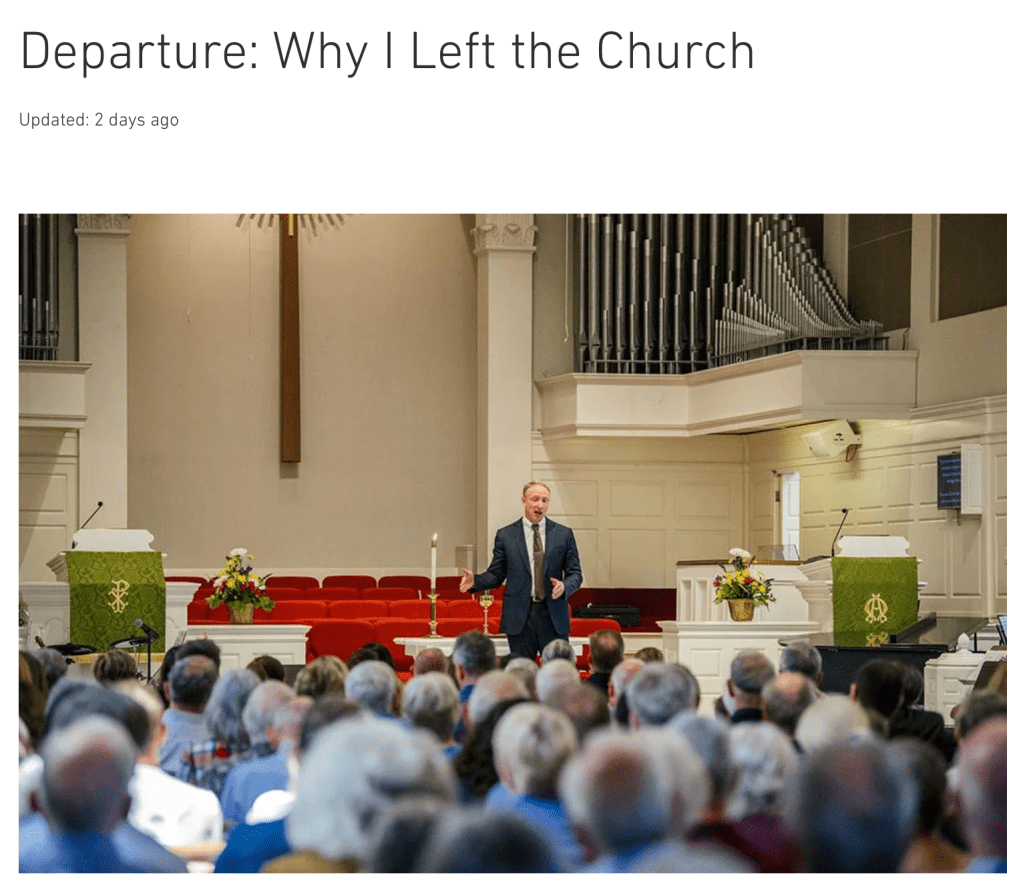
I have seen this article (and many like it) being shared by many pastors and ex-pastors alike (click the image above to link to it). For what it’s worth, I’d like to offer a counter-narrative as a pastor who actually has grown to love being a pastor, after reluctantly becoming one, and found the church community to be quite opposite to what this ex-pastor describes—an all too familiar description regularly echoed throughout the airwaves that needs to be exposed for what it is. Pardon my french.
Perhaps a more helpful title for orienting readers to the value of this article might have been “Another Resentful Resignation: Lessons the Hard Way from A Pastor Lacking Conviction (hence the ‘thousand bosses’) and Boundaries (hence the ‘seven roles’).”
It’s one thing for a pastor to leave a church silently, with dignity, because the responsibilities turned out be beyond his capacity to fulfill them (or even because of the self-imposed burnout from fulfilling them at the expense of his health), quite another for a pastor to leave the church with a sentimental (and rather self-congratulatory) message only to walk away and start hurling grenades at it.
All the complaints detailing his heroic efforts to love and serve the church—to “shoulder the responsibility of caring for [the church] 24/7” (which he tellingly compared to parenting a child, an unhealthy way of seeing himself in relation to his church, to say the least)—gave way to what seemed to me the more honest cause of his burnout: resentment, the telltale sign of which were all the totalizing statements he made about “most Christians,” void of any concreteness or particularity, statements that reveal nothing about the actual Christians he’s talking about and everything about his jaded perception of Christians in general, summing “most Christians” up in a few simplistic motives and mindsets that erase all the complexity of their personhood, as well as all the nuanced and varied ways “most Christians” engage in the life of the church. Generalizations about a large number of people’s internal drives and thought life are obviously inherently baseless (though increasingly utilized), if not necessarilly untrue, and so expose absolutely nothing other than the log in the eye of the beholder.
He writes, for example, “What I have learned over the last 10 years is that…the majority of people who attend churches are in the fixed mindset category.” And again:
“Most Christians don’t want their thinking challenged. They come to church to reinforce what they’ve believed their entire lives. From their perspective, the job of the pastor is not to push them to grow, but to reassure them that they are already on the right track. Any learning should support the party line and comfort them that their investment of resources in the church will result in a payoff somewhere down the line, particularly once they reach the afterlife.”
With all due respect, this is simply bullshit. (I mean that in the technical, not the expletive, sense (see Harry Frankfurt’s On Bullshit).) It’s a statement so generic that its deception is more insidious, and indeed contagious, than that of a lie. A lie acknowledges, even fears, the truth in its defiance to it. Bullshit acknowledges and fears nothing and no one. It is utterly self-referential, regardless of its feigned content. Bullshit is the narcissism of speech. At least when a lie is exposed it reveals the truth it was trying to conceal. Bullshit-speak like this conceals nothing and so can reveal nothing, other than the platitudinal tropes that have been playing on repeat in this pastor’s ego about the people he was called to know and love and nourish with his Oxford education (which he reminded them about in his message).
Which, I suppose, is what makes him so unique compared to “most pastors,” whom he also roundly summed up for us at the end:
“Whereas most pastors eschew nuance in favor of black and white thinking, I believe we discover God’s presence by digging into the complexity of those details.”
I suppose if this guy is willing to make a public statement explaining “Why I Left the Church” that includes judgments about “most christians” and their motives, not to mention “most pastors” and theirs, he should expect someone to speak up in response who may want to offer a humble counter-interpretation as to why he left. Perhaps his own motives are not entirely transparent unto himself, as is the case for all of us to the degree our judgments are mired in the kind of generalizations evident in his. Besides, all the accused need an advocate.
A more plausible explanation to me based on the evidence of his own words is that this pastor didn’t leave the church because he burnt out from loving them. He burnt out because he didn’t love them. How else could he have so quickly turned to publicly malign them, or at least “most” of them, while promoting himself both as their benefactor and victim? Stress in the workplace comes from relational hostility far more than work load (see Edwin Friedman, Failure of Nerve). Marriages don’t fail because life gets hard but because love grows cold. Some pastors grow bitterly icy over the years, while others grow like grandpas with soft and generous hearts and lightness of step. Some people take responsibility for how they grow, others blame it on winter weather and politics and the like. The difference is not the burden they were given to carry but how they carry it (and certainly whom they are yoked to as they do, but I won’t speculate on this point, regardless of the song selection from his final “worship” order lol).
Being a pastor has its challenges, just like being a teacher, being a power line technician, a social worker, a factory worker, a single mother who works as a cashier at Walmart by day and waitress at Denny’s by night, just trying to make ends meet. Some crosses are heavier than others. Pastors have no reason to elicit extra pity on public forums. Even if it’s a mixed bag, I imagine most pastors typically get far more encouragement from their congregations than those Walmart cashiers get from their customers.
Some pastors just need to own the fact that they either aren’t competent for the role, and step down humbly, or that the role has become detached from its proper function in the church, in which case it is their job to set personal boundaries and lead the church through a transition and reorientation accordingly. They might be surprised by the support they find—I have found “most Christians” to be quite reasonable, in fact. But if they do leave the pastorate, they should never do so telling themselves (and the world) it’s the church’s fault. There’s too much of that thinking going around.
If the church needs to be led through reform and renewal—as it always does—we need to stop excusing pastors for (loudly) quitting on account of the church’s need for reform and renewal. A doctor may need to quit his job because he’s sick of it, but not because his patients are too sick. It’s just not a valid reason. So with pastors.
Pastors, don’t quit because the church needs reform and renewal. Quit because you need reform and renewal, and tell the world about that, about your mistakes, so that you might help other pastors avoid them as they step in to shoulder the burden of working with Christ to build his church in an overcrowded and understaffed hospital, a burden that won’t go away until he is finished. The patients are plenty, but the doctors are few. So, for Christ’s sake, quit because of your sickness, not theirs.
That would certainly be better than “leaving the church” full of resentment after having “seven jobs” with a “thousand bosses” for ten years, only to join the chorus of church critics who echo the voice of their accuser night and day before the throne of God. It would certainly be better than leaving the role of advocate to assume the role of adversary.
 Dim Reflections For Now
Sometimes when a pastor leaves the pastorate it is very much the fault of a church. I know from personal experience that some congregations have a longstanding history of toxicity (mean sheep and clergy killers). Their higher denomination bodies allow them to get away with it because, in these days of rapidly declining church memberships, it’s far easier to replace a pastor than it is to replace a church.
I know, too, from my first church. Shortly after my wife and I married, we announced we were expecting our first baby, a baby we conceived on our honeymoon. Someone started a rumor that we had conceived the baby before wedlock. That was the moment my love for that church died. Less than a month after our baby was born, I was fired for seeking employment with another church. Apparently I was supposed to love them unconditionally, but they didn’t think they had to love me. Love was a one-way street at that church. Thankfully, God came through for me, and I was called to a new church three weeks later. My wife and I are glad to be in a healthier situation and well away from such a toxic, stiff-necked, wicked congregation as the one that gossiped about me and ran me off.
Wow! So well said. Thank you for taking the time and effort to compose a thorough and accurate rebuttal to the “Great Pastor’s” farewell essay. It was indeed bullshit. It left a terrible taste in my mouth.
🎯😇🙏
Thank you for taking the time to craft this message. In many ways, my heart breaks for the author of the original post. The hurt he is feeling is evident in what he says, who he says them about, and how he says them. With that being said, his own pride and sin is on display as well. I wish he had been able to discuss this with mature brothers who could help him process this privately instead of displaying it publically.
Unfortunately, the enemy will use his post as ammo for the crowd that rages against the church. It is hard for me to see how his actions were ultimately divisive rather than productive. Thankfully, God is able to redeem and restore anything and everything.
Thanks again for this response!
You don’t sound very nice.
I don’t know if ‘nice’ is always the appropriate response. Paul wasn’t nice when he rebuked Peter to his face on account that his judgments toward the Gentile church were “out of step with the truth of the Gospel” (Gal. 2). Sometimes incisiveness and directness are in order.
“Most Christians don’t want their thinking challenged. They come to church to reinforce what they’ve believed their entire lives. From their perspective, the job of the pastor is not to push them to grow, but to reassure them that they are already on the right track. Any learning should support the party line and comfort them that their investment of resources in the church will result in a payoff somewhere down the line, particularly once they reach the afterlife.”
I don’t think it’s fair to say “most Christians”, but there are many professing Christians and churches that are like this. The first church I pastored was like this. It was a fundamentalist “Bible church” that didn’t want to be told that the King James Version wasn’t infallible. When I challenged their unbiblical assumptions and beliefs, they complained about me behind my back. And they did other despicable things to me and to my wife.
I’m now at my second church that is conservative (but not fundamentalist), willing to grow and hungry to know what the Word of God says, and where the people are open to reorienting their worldviews and assumptions to better line up with what the Bible says.
You so beautifully wrote exactly what I was thinking. Thank you!!!