Unplanned Parenthood

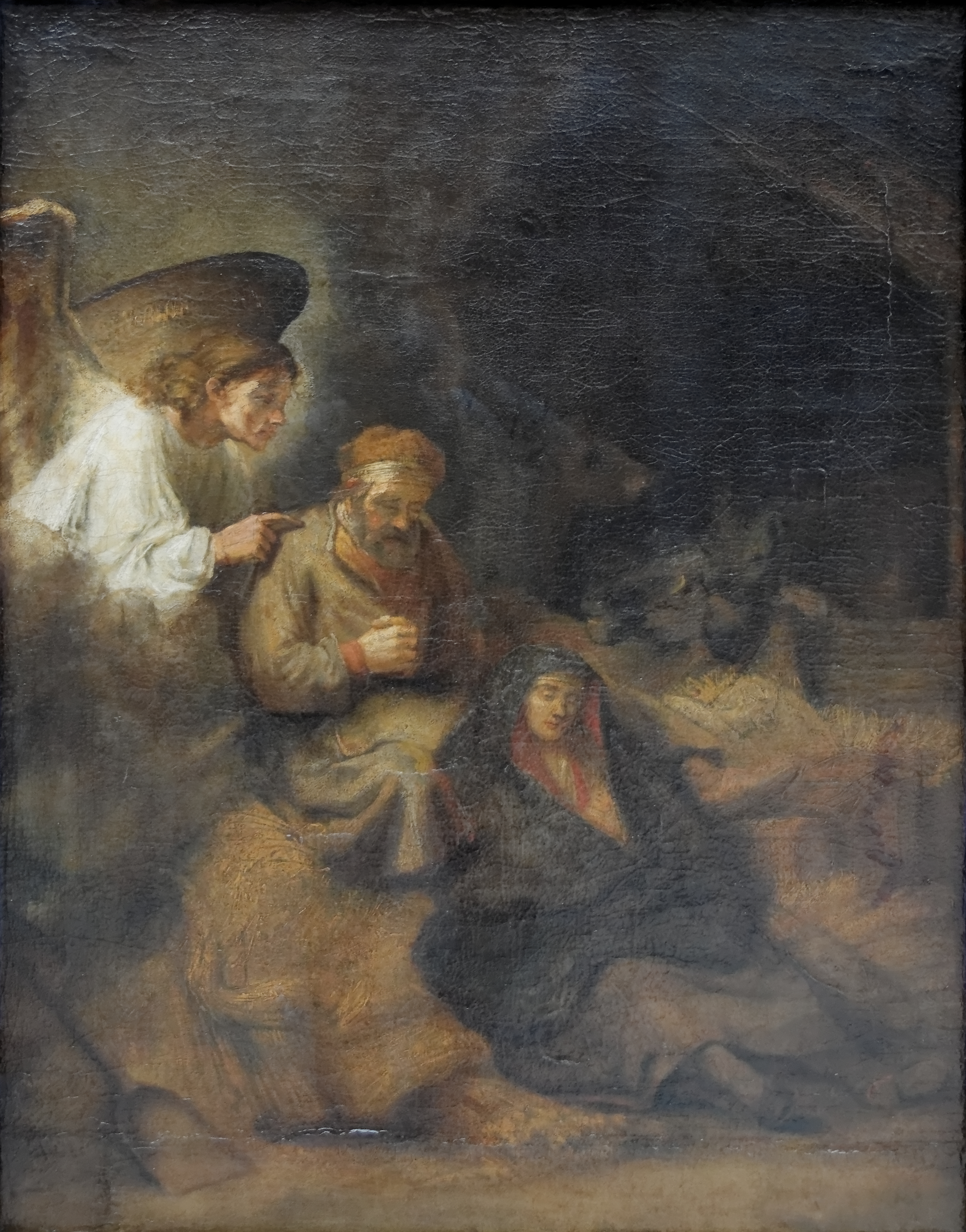
Joseph's_dream_Rembrandt

Joseph’s Dream, Rembrandt

Unplanned Parenthood

In light of yesterday’s congressional hearing–

I’m thankful not only that the virgin Mary embraced her Unplanned Parenthood but also that “Joseph was a righteous man and did not want to disgrace her” (Mt. 1:17). I’m thankful that Mary consented to mother the Son of an unconsented conception and that Joseph consented to father a Son of another Father.

I’m thankful too that when Mary received word of her pregnancy from God that with it came the assurance that she need not fear, that she had found favor with God (Lk. 1:30). She had found special favor with God because in the life of her unborn Son, who had already been named, was the Life of every son and daughter (Jn. 1:4), whose Life made flesh proved that every life made flesh has found special favor with God (Jn.1:14; 3:16)–for the kingdom of God belongs to such as these (Mt. 19:16; Mk. 10:14; Lk. 18:14).

I’m also thankful that when her Unplanned Son was hanging on a cross, the moment before he was able to declare all his work “finished” (Jn. 19:30), that his final provision for the human race was to ensure that his mother would not be left alone, that she would be cared for by the beloved disciple: “When Jesus saw his mother and the disciple whom he loved standing nearby, he said to his mother, ‘Woman, behold, your son!’ Then he said to the disciple, ‘Behold, your mother!’ And from that hour the disciple took her to his own home” (Jn. 19:26-27). If Christ shares the burden of human death, surely he can expect us to share the burden of human life, whether that means adopting babies or adopting mothers–for we all are adoptees (Rom. 8:15; Eph. 1:5).

Jesus became the Son of Man so that we could become children of God (Jn. 1:12-14; cf. 2 Cor. 5:21; Rom. 8:1-4, 28-29), but if we embrace God as Father and claim our right to be his children in Christ, we must embrace one another as family (Eph. 2:19; cf. 1 John–the whole book), “welcom[ing] one another as Christ has welcomed [us], for the glory of God” (Rom. 15:7; cf. Eph. 4:32). That means the embrace of every potential life of a baby, planned or unplanned, for indeed these are the least of “the least of these” (Mt. 25:40); but it means no less the embrace of every potential mother. When Mary found herself with an Unplanned Pregnancy, she did not find herself alone. She found herself within the embrace of God and the community he placed around her, and so was empowered to embrace her seemingly uncertain future.

The Church of Jesus Christ must be pro-life, but it must be pro-life in the way Joseph was pro-life at Jesus’ conception and the way the beloved disciple was pro-life at Jesus’ death. We must embrace the life of the unborn precisely by embracing the life of the mother. We can be no less than Joseph for every fatherless child and no less than the the beloved disciple for every lonely mother. But that’s costly. It means making room in our homes–literally. It means welcoming young guys and gals before they find themselves in such a situation. It means welcoming young guys and gals during and after they find themselves in such a situation, as well. It means: we make room for their lives so they can make room for life when it comes–planned or unplanned.

Indeed, Jesus’ Plan all along was to send that defining message to the disciples, that “I am ascending to my Father and their Father, to my God and their God” (Jn. 20:17), so that “those who believe in his Name would be given the right to be called children of God” (Jn. 1:12). So our calling, indeed our right, is to “conform to the image of the Son…the firstborn among a large family (Rom. 8:29).

I’m thankful that the Gospel announces God’s Planned Parenthood for all humanity: Jesus Christ, Son of God and Son of Man.

Give Them Christ!

    The Word of God, Jesus Christ, is the vantage point from which the Church views itself, the world, and God. Christ is the revelation of God that is transparent to the truth of God’s being in eternity and to the truth of human beings in history (John 1:1-14; Col. 1:15-20). If we have seen the Son, we have seen the Father (Jn. 14:9), and if we have believe that the Son is indeed God’s Son, then we are “given the right to be called children of God” (Jn. 1:12; Rom. 8:29; Col. 1:18; Heb. 1:6; 2:11). Thus, the Gospel claims that human beings participate in the divine life in Christ.[1] This becomes transparent to us only by means of the Holy Spirit, who makes divine perception a human possibility, for he is the divine Subject, the Spirit of Truth, who reveals Christ interior to human subjects (1 Cor. 2:6-16). It was indeed better for us that Jesus should go and send the Helper (Jn. 16:7), for creation is not in its essential form apart from our sharing, however limited, in the intersubjective life of God: “…I will ask the Father, and he will give you another Helper, to be with you forever, even the Spirit of truth…You know him, for he dwells with you and will be in you” (Jn. 14:15-6).

     Thus, the God who is Father, Son, and Holy Spirit, who is “I AM who I AM” from all eternity (Exod. 3:14), stands at the center of every “I think, therefore I am” in history as the “Word made flesh” (Jn. 1:14). Indeed, I AM, therefore I think is the more appropriate formula for Christian thought and speech. Absolute Being relativizes all contingent beings, and to the degree we can speak of the revealed form of Being as such, which is precisely what Christian proclamation presupposes, we must speak of Jesus Christ as the particular historical truth who is the absolute and eternal truth for humankind.

     Christ is the Light that is come to me without ceasing to remain above, the union of the eternal Subject and created subjects without either losing their proper names; he is God’s gift to me and my gift to God (2 Cor. 5:21; Rom. 8:1-4). Christ is in us, but Christ is not us; we are in Christ, but we are not Christ. Human life in Christ by the Spirit is nothing less than the subjective participation in the divine life as coheirs of salvation with Christ, the firstborn of creation (Col. 1:15) and thus the firstborn of the dead (Col. 1:18). And thus from a well that is deeper to us than we are to ourselves and extending up into infinite heights, “We cry Abba! Father!” (Rom. 8:15). And he hears us—his children.

    The Church thus abides in history according to its message heralded as the “eternal Gospel” (Rev. 14:6): (a) from the vantage point the divine Subject: “the mystery of [God’s] will, according to his purpose, which he set forth in Christ as a plan for the fullness of time, to unite all things in him, things in heaven and things on earth” (Eph. 1:9-10); (b) from the vantage point of the human subject: to “make known among the nations…the riches of the glory of this mystery, which is Christ in you, the holy of glory” (Col. 1:27); (c) and thus the principle relation that can be described as the actuality of human participation in the divine life: “Beloved, let us love one another, for love is from God, and whoever loves has been born of God and knows God. Anyone who does not love does not know God, because God is love. In this the love of God was made manifest among us, that God sent his only Son into the world, so that we might live through him. In this is love, not that we have loved God but that he loved us and sent his Son to be the propitiation of our sins. Beloved, if God so loved us, we also ought to love one another. No one has ever seen God; if we love one another, God abides in us and his love is perfected in us” (1 Jn. 4:7-12). The Gospel thus opens us up both to receive God’s life of love and to extend our lives in love. This is indeed the Alpha- and Omega point of creation, of salvation, of new creation–and thus necessarily too of our proclamation. 

Give them Christ!

Footnote

  1. In Christ we participate in the divine life through his “interior” (immanent) relations within the Godhead and his “exterior” (economic) relations within creation (cf. Jn. 17). And this is so precisely because the immanent Trinity is the economic Trinity and vise versa (Rahner, The Trinity, 22), which means we do not participate in a degraded form of his life, altered as it had to be in order to save us. Rather, since the essential life of God is love, the economic Trinity revealed in salvation history is simply divine love toward his creation–even when it had to sink its way down into death and back to effect love for us. [See my article on the Incarnation and the Trinity on Asbury’s Seedbed here.]

The Don’t-Beatitudes

“Blessed are the blessed in spirit, for theirs is the kingdom of heaven.

“Blessed are those who smirk, for they shall be comforted.

“Blessed are the proud, for they shall inherit the earth.

“Blessed are those who hunger and thirst, for they shall be satisfied.

“Blessed are the just, for they shall receive mercy.

“Blessed are the pure in affiliations, for they shall see God.

“Blessed are the compromisers, for they shall be called sons of God.

“Blessed are those who are persecuted for morality’s sake, for theirs is the kingdom of heaven.”

Said Jesus never.

Heaven: An Acquired Taste

Some time back I decided that my distaste for olives must mean that something was wrong with my palate, not with olives. There are many fine people who seem to know something about how things should taste, I reasoned, who are quite enthusiastic about a well-prepared olive. So, in protest to my uncultured palate, I began to eat olives. Now I’m quite enthusiastic about a well-prepared olive myself.

And the exact same thing happened with classical music, art, philosophy, poetry, literature, beer, and coffee—black. I guess I just assumed that there really are some things that are objectively better than others and that some “tastes” are, well, uninformed. My suspicion arose out of an observation of American culture at large, namely, that ours is a culture driven more by its brute appetites than ‘informed’ tastes. The fact that “dollar menu” is synonymous with “value menu” should give us pause, should it not? Call me pretentious, but I really do think $10 spent at the olive bar is more valuable than $10 spent at any value menu. I would go so far to say that I think God doesn’t only look at the heart of the artist (though he surely does), and that he has his own tastes in our music—I think God likes Mozart more than Nickelback. There, I said it. If Nickelback makes it to heaven, God forbid, I’ll bet my salvation they will not be invited to join the choir.

I don’t know that I have much of a point here, only to suggest that if you like Nickelback over Bach, Tim LaHaye over T.S. Eliot, Thomas Kinkade over Claude Monet, Bud Light over almost any beer that doesn’t taste like Bud Light, then you may be well on your way to getting “Left Behind.”


The psalmist said, “Taste and see that the Lord is good” (Ps. 34:8). I must say, as a Christian formed by a particular brand of American Christian culture, for a number of years “the Lord” put a bad taste in my mouth. I liked salvation, heaven, resurrection, and I really liked grace, and (or because) all these are made widely available, or at least advertised, on the “value menu” found at your average  grab-and-go Sunday morning drive through. Without “the Lord,” I could smear all these items like icing over ongoing habits without having to have a conversion of palate—I could have my cheap grace and eat it too. But “the Lord” isn’t always easy to find at church, not because he’s not there but because, as far as consumers are concerned, “the Lord” ain’t really in high demand.

I wonder if we should consider that our distaste for “the Lord” means that something is wrong with our wills and our hearts, not with the Lord. Maybe if we just assumed that there is a better Lord for our lives than we are, we would discover something worth getting enthusiastic about. And maybe if churches would stop serving up the gospel in the most palatable, convenient, economic package they can devise, according to the felt-needs of a culture that feels no need for a Lord, they wouldn’t be preparing so many people to be disappointed by “the rapture.”


“After this I looked, and behold, a door standing open in heaven! And the first voice, which I had heard speaking to me like a trumpet, said, ‘Come up here, and I will show you what must take place after this.’ At once I was in the Spirit, and behold, a throne stood in heaven, with one seated on the throne” (Rev. 4:1-2).

The Creation of A Good Idea: A Grammar

The tree of the knowledge of good and evil is not the tree of evil, nor is it the tree of good and evil, nor is it the tree of knowledge, nor is it merely the fact of the knowledge of good and evil and that whole breakdown—it is the tree of the knowledge of good and evil. The knowledge of good and evil was not about information the couple was otherwise not privy to. God’s world was very good. The only thing we know that was not good was the lone man, before the woman was created, and besides that evil is by definition merely a privation of the good. God did not create evil. The only conceivable evil is thus the possibility of a lone way, and the freedom which makes love possible—the man’s love for God and the man’s love for his wife—is the same which makes the lone way possible. Love is free to love and therefore free not to. Freedom can turn away to the lone way and God’s good world can turn evil. But the lone way wither?

“For God knows that when you eat of it your eyes will be opened, and you will be like God, knowing good and evil. So when the woman saw that the tree was good for food…” (Gen. 3:5). The great irony is, of course, that the serpent should tempt the couple to be something they already are: like God. Indeed, God declared that he made them “in our image, after our likeness” (Gen. 1:26). The image of God and the image of themselves were already visible in the eyes of the other. Everyone one shared subjective space, although they were all truly ‘others’. Empathy was a matter of fact, like DNA or like joy or like autumn. “Us” did not really mean “them” under their breath. “Bear one another’s burdens” and “rejoice with those who rejoice” were not only not ignored in Church, they were the reason Church didn’t yet need to exist.

But the temptation to become like God by means of the knowledge of good and evil is the temptation to inhabit God’s subjective space by sitting on God’s throne. God gave the couple dominion over the whole earth, unlimited salads, every tree minus one, to say: “Though you’ve been give dominion over all creation, you have not been given dominion over your Creator.” It was simply a command that kept the couple sane and sober. No one who has ever attempted to become God suffered because God wouldn’t them. They suffered from exhaustion. God did the best he could. David said “He made us a little lower than God” (Ps. 8). But unfortunately we we continually fall into the deception that being made a little lower means we can reach a little higher. And we do that every time we think we can determine what is good and what is evil, eating from the tree that same old God-damned fruit..

Good and evil are judgments, the good itself being the absolute by which evil is measured via negativa. Thus, when the rich young ruler addresses Jesus as “Good Teacher,” Jesus retorts, “Why do you call me good? No one is good but God alone” (Mk. 10:17-18). It’s not that Jesus isn’t good—Jesus is God. The problem was that this man saw himself fit to judge whether Jesus is good or not, as though he were himself the standard by which such judgments could be made. Every man in Adam, Adam in every man.

The problem with the knowledge of good evil is not that it exposes us to evil that we are then disposed to pursue. It is that it presumes to determine judgments of good and evil by excluding God from the equation. It is calling universal peace anything other than Babel, as though universal peace is possible apart from God and as though all towers built by human cooperation within an economy of peace do not, at bottom, stand on a foundation of violence. As though all towers of trade were not made to fall.

To attain the knowledge of good and evil is to “place” God, the Infinite Subject of Absolute goodness, exterior to oneself and oneself exterior to God. (It is to create a distance that only God himself can create; only the Infinite Subject can create subjects by delineating finitude around a name; and only He can do so and withdraw himself in order to create true freedom and the possibility of encounter, the true structure of personhood, and hence the true Trinitarian structure of humankind.) And hence now they can “hear God walking,” which is itself a pretty good reason to hide (Gen. 3:8). But hiding was now a way of life—it was the first thing they did with their new knowledge, using fig leaves to try to separate. The naked and not ashamed couple were now just naked like the rest of us, pointing out how strange everyone else looks naked but only because we’re growing old and insecure about our own bodies—there’s nothing much to brag about on a body that’s growing old.

They had attempted to become like God by replacing God, which required objectifying God, in whose space (subjectivity) human life as human life subsists. Subjectivity is the realm of consciousness. “I think” may be “I am” but it is always standing in Someone Else’s shoes. Maybe that’s why Moses took off his shoes the day his Consciousness starting talking back. Consciousness wouldn’t be such a burden if we could get rid of its Conscience. But the couple confused the formula. “I think, therefore I AM” is precisely the logic of the fall, the idea that Being is predicated on my being. The net effect is that the intersubjective immediacy of the image-bearing one flesh couple, whatever that was like, has now been divided. It was the great divorce. The capacity for empathy is strained, if not destroyed, and they had liberated the will from its proper aim toward love. They lived now in perfect freedom to exercise power according to their own judgments. It was the negation of love, the beginning of long road along the lone way.

And thus, the same potency that can fruitfully multiply and fill the earth began to rapidly divide and kill the earth. It began with fig leaves, Men would become the most vicious beasts of the field with this kind of freedom. And such is the world east of Eden. That thin line has torn an infinite chasm. The great divide that runs from the center of creation runs straight through the heart of every man. Every man is split at his nucleus, a sort of Adam bomb waiting to explode. Freedom has become our greatest resource for slavery. Sex has become the decisive parody of love. Indeed, when sin got ahold of the mutual freedom of our primal parents it quickly turned their egalitarian rule into a tyrannical patriarchy: “Your desire will be husband, and he will rule over you” (Gen. 3:16). The very good image-bearing couple created to rule as one has now become two. It is survival of the fittest, and the crown of creation will now have to await her liberation by the only true Man, the one who writes the truth in the sand, the one who will bear the burden of all “Us” all, the one who will take up a tree and call it the evil that it is, the one who will weep in our tears so we can rejoice in his joy. For he will pour out his Subject, his Spirit, on all flesh—all flesh—because he has interred into the the subjective sphere of humankind in a quite Personal, quite amazing, way, called grace.

The Creation of Red Meat: A Biology

.

In the beginning…

Genesis 1, bird’s eye-view: the divine community creates an image-bearing community. “Very good.”

Genesis 2, worm’s eye-view: God creates Adam. “Not good.”

“It is not good for man to be alone.” This is a remarkable claim–that God created something not-good. Surely this not-good man of Genesis 2 cannot be said to be the same very good image-bearing creation of Genesis 1.

Indeed, Adam is not yet fully human, at least not in the way that God is fully God.

So God killed him.

He ripped open Adam’s chest. He broke off one of his ribs, that place that guards the heart, and then raised him from the dead–and with him his beloved: “Bone of my bone and flesh of my flesh” (Gen. 2:23). It was the first hypostatic union. [One might even say it was kenosis as an invitation into perichoresis!]:

Now I don’t want to press the point, because I really don’t know what happened, but I do know the imagery is less than idyllic (although, if I would entrust my death to anyone to bring from it fullness of life, it would be God). Adam had been formed from red mud, a perfectly cooperative impress of his maker’s hands, before being thrust into the kiln. But Adam was not complete, because it takes at least two+love to make something like the image of the One God who is Three. No man is an island, because no God is an island. So God took from the heart of this red-mud man and formed the woman out of his red bones:
“The body of Adam broken for Eve, the blood of Adam shed for Eve.”

Adam had found a companion fit for him and God had founded a couple fit for love.

And now: very good.

#theFirstAdaminlightoftheLastAdam

The Creation of Red Clothes: A Genealogy

Every particular sin, no matter the color, has the same genealogy. Sin is aways the product of (a) a desire (b) based on a deception (c) organized against love. All desires based on deceptions organized against love (i.e., ultimately displaced desires) can be called temptations. Temptations are experienced as an appeal to freedom, but they are precisely the opposite because they ultimately function to enslave freedom to desire, not to satisfy desire through freedom. Such temptations are not an appeal to freedom but an appeal to pride. Pride always feels like the freedom because pride always gets to say, “My will be done.” But human freedom is not simply the power of the will to act; it is the power of the will to love, because love is the ultimate and essential human desire. With the will not oriented toward its proper end the power of the will to act is nothing more than the will to power, the drive of life toward infinite desire rather than infinite satisfaction. It attends to an indefinite future without ever reaching the present moment; it is the urgent now, not the eternal now. It is about survival, not life, the will’s appetite for more, not the will’s concern for you. Pride may draw a crowd, but it struggles to make eye-contact.

The awareness of death gives occasion for freedom to be confused with pride. Despite the intuitive reflex of this awareness to open us up toward others in longing, and ultimately to open us up to that longing into which God can breath hope against hope in order to make a space into which he can breath faith, it also closes us up in fear. Life exists in oscillations—expanding, contracting, expanding, contracting, trusting and giving, closing up and self-preserving. It is always in process, but in the final analysis life in the face of death is bent toward pride, mistrust, self-preservation. Fear of death has more gravity than fear of God. Indeed, it is “through fear of death” that we are “subject to lifelong slavery” (Heb. 2:15).

And thus, pride is the counterfeit of freedom and the antithesis of love. Its essential structure is pure inwardness. It operates on a disordered appetite for power without aim according to a primal mistrust and withdraw. Its goal is isolation—by way of either retreat or triumph. It can be felt as hollowing shame or gasoline powers, but both are pride.

Pride can wear crowns at the top of towers, but shame is merely pride in sheep’s clothing.

The eyes of the couple were opened and they are now naked and very ashamed. So they hide from one another. Bone of Adam’s bone is now just plain ol’ flesh of Eve’s flesh. No longer are they one flesh–it was nuclear fission in the nuclear family. They hear God-sized footsteps. They hide. God confronts Adam. He points away, to the woman, as if God would be judge at divorce court?! But Adam tries, as we all try, to distance himself from the greater guilt—as though human guilt can be separated; as though the two weren’t a hypostatic union; as though Eve were not bone of his bone and flesh of his flesh; as though we are not all the seed of Adam’s loin; as though it weren’t through one man’s disobedience that sin enters the world and death through sin; as though it weren’t through one man’s obedience that the many will be made righteous.

But God does not simply put the blame on Eve, nor does he simply put the blame on the serpent. Nor does he simply put the blame on all three, although he does condemn all three, because all three are guilty. But he finds a place to put the blame, a willing party.

Looking down at the pitiful couple, hiding behind tattered fig leaves barely able to withstand the Garden breeze, he calls forth a lamb—the whitest lamb in the garden, a lamb without spot or blemish. It obeys. It comes in silence. They want to look away, but he does not let them look away. They need to see the cost of grace. “A Lamb of Sorrows: your transgressions, his wounds; his chastisement, your peace; his stripes, your healing. You have strayed, but he has come to be slaughtered for your iniquities; innocent, but numbered among sinners.”

The whitest wool now forever stained in a dark crimson that would forever remain: the color of guilt and the color of grace, the color of the intersection—the intersection where God unites with sinners.

Love wears thorns at the top of the intersection–it is grace in sheep’s clothing.

On the Definition of Marriage 


Regarding the Kim Davis debacle.

As someone who believes in the traditional definition of Christian marriage, I would just like to remind Christians how our tradition, or at least our Bible, actually defines marriage. It does not define marriage by means of a triangulation between male, female, and a representative government; it defines marriage by means of a triangulation between male, female, and the living God.

I feel sorry for Kim Davis and her tormented conscience. It’s hard to know how to be an American Christian in a country that has for so long con-fused those two categories. In such a grey world it is hard to discern whether one’s conscience echoes the voice that issues from the throne of a King or the much louder voice of a crowd, a crowd that invariably defines itself as white and its opposition as black–with only shades of pretense. Conscience has a funny way of adapting to tribal affiliations, and American politics–more precisely, political rhetoric in America–has a funny way of speaking of everyone as belonging to one of two tribes. Of course, neither of these tribes are able, either historically or ideologically or constitutionally, to trace their steps back to a cross nor demand allegiance to a throne. And that shouldn’t matter in a country that affirms a separation between church and state. The reason it does matter, however, is because we do not live in such a country.

We live in a country that decided it wise to require a government signature on a religious covenant. And the moment we reduced the union ratified and sustained by the living God to a contract ratified by a disinterested representative and sustained by the consensual whims and wills of two supremely entitled individuals was the very moment we fundamentally changed the definition of marriage. From that foundation, the definition of marriage begins its inevitable (and perfectly self-consistent) evolution to whatever else the people of the republic want to make of it–from ’till death do us part’ to no fault divorce to gay marriage (curiously, the more explicitly antichrist concept of no fault divorce has not evoked the same moral outrage among Christians).

The real problem with this whole debacle is not that marriage has to be licensed by the state to be recognized by the state; it’s that marriage has to be licensed by the state to be recognized by the Church.

If I can make an appeal to that great generation of Boomers who truly worked with remarkable fervor to shape a nation that we Millennials so often take for granted:

As it relates to the Church, the ‘good fight’ we have to fight for the Church is not going to be the same as the ‘good fight’ you fought. You fought for representation in a sociopolitical context in which it made perfect sense to do so. But that fight is becoming a more vacuous and wearying effort. The fight for us is not going to be the accurate representation of an American majority but an accurate reflection of the Christian minority. The fight for us is going to be learning how to fight without reference to power, learning how to be a Christian when being a Christian affords no materially measurable benefits, learning how to be a Christian when being a Christian looks increasingly like a cross. And, truly, we need your wisdom and your help. We lack a clarity of conviction and thus too the resolve to stand for much of anything truly–and distinctly–Christian. We need to be convinced there is something distinctly Christian worth standing for. We need to see a Church willing even to compromise its unnuanced, whitewashed tribal commitments (no matter the tribe) for its allegiance to a higher Government that calls all tribes, tongues, and nations to repentance, to grace, to the fellowship of Christ. We need more than anything for you to show us where to stand on earth as it is in heaven, and to call us to fight our fight with the same grit you fought yours–lest we shrivel up for lack of a backbone under the weight of hurt feelings in the namelessness of cynical indifference.

I Think, Therefore I Am Not

“In the beginning…”

~ Genesis 1:1

“The fool says in his heart, ‘There is no God.'”

~ Psalm 14:1

For as long as men have had eyes to see and ears to hear, the world has seemed a strange place. There is an interval between the seeing and hearing human and the seen and heard world—and only between the human and the world—in which many inexplicable things happen, things like: self-awareness, meaning-making, evaluating, self-evaluating, making judgments, intending actions, willing actions, keeping secrets, plotting lies, plotting stories, hoping, despairing, delighting, beholding, adoring, worshiping. There are occasions of jealousy, forgiveness, unforgiveness, hatred, love in all its reckless forms, the crushing loss of love, gasoline passions, moments of unprovoked bliss, and the downright insane experience of Déjà vu.

The human looks at the unassuming world and finds nothing quite like himself. A man sits down for dinner in his apartment. An unsolicited image of the front porch of his boyhood home comes to mind. Unsolicited tears swell his eyes–he doesn’t know why this is happening. He looks down at his dog, wagging its tail. The phone rings.

Human beings are haunted by their own lives. Memory and anticipation are peculiar enough, but added to these are forms of longing—of what was or what might have been, what might be or may never be. We carry with us nostalgia and regret, hope and despair. We are somehow located at the center of a unified subjective experience in a physical body that has no objective unifying principle. What is man that we are mindful of him? A human being, say a neuroscientist, at one level of analysis reduces to physical elements and accidental biochemical processes but that same being, as a neuroscientist, has to suspend any such reduction in order to conceive of himself as such. At what juncture do those neurons rise up in a collective voice and begin speaking in the first person? Where is the hidden cellar in the physicalist’s brain where the metaphysical screen of the mind’s eye is ever before the mind’s ‘I’? Why am I a strange collection of matter that cannot help but think I am more than matter? I know my brain and mind are inextricably bound, but I also know that there is no causal narrative that could possibly bind the former to the latter, because the latter is always a metaphysical conclusion, and it seems axiomatic to recognize metaphysics is either the mere illusion of physics or its cause, never its effect or conclusion. It’s conceivable that a mind could shape an existing brain, but not that a brain could create a mind ex nihilo.

I am a finite subject and my subjectivity necessarily depends on my body and more than my body. And that is a terrible prospect, since I have no reason to assume that I am in good standing with whatever Other or Thou holds me together, and since human consciousness is held together only by death I have in fact good reason to assume that I am not in good standing with whatever it is upon which I am contingent. This is a description of human angst, that which gives birth to the will to power that, unlike all other creatures, must take a personal shape. We do not kill to survive. We kill to conquer. Only humans go to war.

This uniquely human impulse and its subsidiary appetites are more savage than any of those among the other beasts of the field. There are no beasts morally opposed to killing for survival, but there is only one beast inclined to kill for jealousy. Unlike the other beasts, humans alone use others of their species for “meat” only when they are alive. And when we do kill, we it is always a waste of meat. But this is truly unnatural. We are the most unnatural born killers, especially as regards the unborn. There is at least something to be said about that common moral impulse in the beastly kingdom that judges with sheer immediacy that no life is more precious than the potential life of the unborn–every mother in this kingdom is prepared to die to protect posterity (except my childhood pet hamster who ate her babies–I suppose some evolution leaked: Adam in God’s image, Seth in Adam’s…and hamsters in whom-/whatever’s). If we are going to transcend moral standards of mere humans, we must look either to the chimps or to the gods.

But humans are the most reckless and wasteful of beasts in this regard. We orient our lives in a rebellion against death, but we then give it a proper ceremony when it arrives. This truly is a pathetic, if precious, thing–insisting on decorating our deaths with meaning, marking the ground with immortal memories that attest merely to the futility of mortality.

–And that we cry. For no good reason, we cry.

And thus consciousness is burdened with a conscience. But what is it that in my brain that transcends the flow of chemical impulses giving rise to the “I am” of yesterday and today and its hope for tomorrow? What is that cohesive identity of a past and a future chained in the interim of the eternal present with all its magical qualities and single relativizing plague–the infinite freedom of thought and its certain awareness of death?

Whatever it is, it is in all of this that we continually shape and discover, are shaped and are discovered, first with reference to other humans and then with everything else “out there.” We are objective bodies in time aware of the timelessness of subjective awareness.

This unavoidable interval, where the human subject exists, is the only thing that constitutes human existence uniquely as such. Beyond that, there is no substantial difference between the brain of a man and a monkey and a dodo. We are animals that are aware of ourselves and of a world as though from the outside, subjects who perceive ourselves as objects. We are somewhere but not merely there, and we are not everywhere but we are not merely here. Self-perception and self-transcendence are one identical moment. The human experience is always at once awareness and oblivion, revelation and mystery, the inescapable inside placed within the inescapable outside: “I am” is always also “I am not.”

Behind the veil there exists either an infinite quantity or an infinite quality, pure immanence or genuine transcendence, nothing or something, bricks forever or the face of God.

“He has made everything beautiful in its time. Also, he has put eternity into man’s heart, yet so that he cannot find out what God has done from the beginning to the end.”

~ Ecclesiastes 3:11