The Gift Is: For Us

Jesus did not die for us, nor was his death an expression of love for us. It is infinitely better than that. In fact, it is as good as Christmas.

The Spirit descends from the Father in his approval of the Son at his baptism: “This is my Beloved Son, in whom I am well pleased.”

The Spirit ascends from the Son in his approval of the Father at his death: “Father, into your hands I commend my spirit.”

The logic of the cross is not: God stopped loving Jesus for a moment so that he could love me forever. In fact, the cross is not what the Father did to the Son but what the Son did for the Father–on our behalf. It was not a form of oppression from God, making God no different from Caiaphas and Pilate and Judas and the rest of us, but the demonstration of God’s freedom to love humans despite humanity’s utter rejection of his love: “Crucify him! Crucify him!” “We have no king but Caesar!” — “Father forgive them, for they know not what they do.”

The motion of the Father toward the Son by the Spirit and the motion of the Son toward the Father by the Spirit which the Gospel reveals is nothing less than a window into the eternal subsistence of God-as-Love, the historical event of our salvation which reveals, by way of analogy, the eternal event of the Triune God who saves us. The world becomes the stage on which we behold something like a single dramatic rotation of the divine exchange in Trinitarian love, an exchange which is in truth always perfectly and simultaneously identical: the infinite extension of ‘oneself’ toward the infinite reciprocity of the ‘another’; not the Son’s turning from the Father to the world but his continual turning to the Father through the world; not a departure from what he had done up to that point but the culmination of all he had ever done–simply one thing: “Sacrifices and burnt offerings you have not desired, but a body you have prepared for me; behold, I have come to do your will (Heb. 10). The cross was the triumph of the Son’s uninterrupted and unremitting openness to self-love consisting in the love of the Father and the refusal to withdraw from the Father even when the love of the Father so willed to sweep down into the bottomless abyss of human evil with a Word–with an act–of forgiveness.

And it is our forgiveness precisely because it is done on our behalf. The Son takes his disciples to Gethsemane, but the Son prays alone: “not my will.” Everything that follows appears to be the triumph of the will to power, but Jesus stays the hand of Peter and the hands of 10,000 angels. And thus the world’s greatest will to rebel is undermined by God’s greater will to forgive: Judas betrays the Son with a kiss, and the Son remains faithful to his Father on Judas’ behalf; Peter denies the Son three times, and the cock crows as Jesus proceeds crossward on Peter’s behalf; the soldiers crucify the Son, and soldiers are the first to see what God does for the Son on their behalf. It is the stuff of legend when men kill a god, but it is the stuff of something much stranger when that god leads their charge.

The life of God is the infinite freedom of Love existing in divine personhood and in Christ we are caught up in that very life by the Spirit: “…that they may all be one, just as you, Father, are in me, and I in you, that they also may be in us…I made known to them your name, and I will continue to make it known, that the love with which you have loved me may be in them, and I in them.”” (Jn. 17). In Christ, we live within the freedom of Triune love that surpasses our lovelessness, in the way infinity surpasses six feet tall, so that we are part of the unbroken motion of a trust and entrusting that knows no horizons, the eternal harmony of three notes that refuse to be anything other than one chord, three voices that refuse to ever sing alone, three choices that refuse not to choose the other, three wills that remain one by singing the eternal refrain: “Not mine but yours.” And indeed, the Son sings it with a human voice. We just need to work on our harmony.

It is therefore a distortion to say that Christ demonstrates his love for humanity by doing thus and so for this leper and that prostitute and then especially by dying for all, as though the divine life is subject to the ebbs and flows of love that exists on earth among cloudy men in the way that rays of light exist on earth among cloudy skies. Rather, God demonstrates his love for humanity by his participation in humanity. The only way that which is pure Love and nothing else could do anything other than love is by withdrawing Himself. Indeed, hell is godlessness in its most proper sense. Hell is quite simply God honoring the infinite gift of human freedom to reject the infinite gift of Christmas.

But as it is, Christmas means that this world is not godless and so the gift remains. Christmas means that God has not withdrawn, that Love has come and dwells among us. Indeed, Christmas means that “the word is near you, in your mouth and in your heart” (Rom. 10:8; Dt. 30:14)–even when your mouth can’t get that godforsaken song out of its head: “Not yours but mine.”

Christmas means: God is for us what we cannot be for Him. The gift is indeed: for us!

“Behold, the virgin shall conceive and bear a son, and they shall call his name Immanuel, which means, God with us” (Mt. 1:23).

‪#‎merrychristmas‬

Reasonable Doubt in Mark O’Mara

Mark O’Mara: “I think people need to understand that when someone says to you ‘You’re under arrest’, the argument is over. At that point you have to acknowledge the authority of the police officer. The court system will take care of whether or not it was a proper arrest.”

Mark O’Mara’s syllogism:

a. Police officers have the authority to arrest citizens.
b. Court systems have the authority to acquit citizens.
c. Therefore, Eric Garner was justly killed.

This embarrassing truncation of logic, which sadly seems quite at home in the rhetoric of popular news media, grants that this police officer was not violating Eric Garner’s fourth amendment rights. Fine. Perhaps it was a reasonable search. Perhaps not.

But either way, is it not perhaps appropriate to consider that Eric Garner might have had reasonable doubt that his constitutional rights would have actually been defended by the court systems which have the power to acquit him if wrongfully charged, the same courts which have the power to indict him if wrongfully charged–simply by stating he was rightfully charged? Is it not an appropriate time in light of current events at least to question the legitimacy of the relationship between a and b in the above argument? Is there no evidence to suggest that the profile of a guy like Daniel Pantaleo is weighted favorably against the profile of a guy like Eric Garner in our court systems?

In any case, I’ll avoid commenting on the fact that Eric Garner’s crime was being suspected of selling loose cigarettes and officer Pantaleo’s crime is being suspected of murdering Eric Garner; I’ll avoid pointing out that according to NYPD policy police officers not allowed to use chokeholds; I’ll avoid pointing out the ludicrousness of O’Mara speaking of this case as though Eric Garner is the one who should be on trial; I’ll avoid pointing out that Eric Garner is dead. And I’ll certainly avoid pointing out that this Mark O’Mara is the same Mark O’Mara who represented George Zimmerman in the murder trial of Trayvon Martin. That would just be too damning a coincidence to point out at such a time as this. And I surely want to be sensitive to Mark O’Mara. I wouldn’t want anyone to go and start picking on lawyers…

‪#‎icantbreath‬e

Looking for a Home

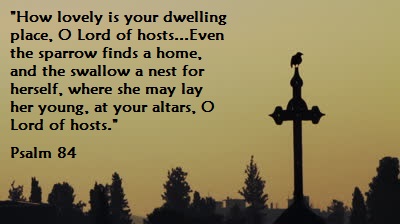
psalm 84

The sparrow and the swallow look down to the world of men, seeking to find a place safe enough to lay their young until they too can fly away from the world where revenge is heavy and fear is horizontal. It is a surprise, therefore, that it is on an altar of all places, that place stained with the color of the borrowed innocence of sparrows and swallows, that the most vulnerable of all are the safest of all.

“Blessed are the pure in heart, for they will see God” (Jesus).

It is not God the sparrow fears. God’s altar is as peaceful as the morning snow for those whose heart knows no violence. It is, in fact, men who make the bird’s home a human altar. It is only when God’s sparrows come to the altar in human hands that nests are destroyed in a lust for grace.

But God does not delight in broken bones of the innocent (Ps. 40; 51; Heb. 10) anymore than Jesus delighted in the cross (Lk. 22:39-46). He delights only in broken spirits, broken spirits and contrite hearts (Ps. 51), in the sacrifice of remorse–for the loss of innocence and the cost of grace; for empty nests and red-stained hands; for violent murders and violent protests; for unjust courts and unjust streets; for weeping mothers and fatherless children; for all those hugless homes that harden little boys and undress desperate daughters, malnourished nests where the broken-winged fall to the ground as blood-thirsty snakes. God delights not in bleeding hands but in a bleeding heart, in the human who learns how to love like him or at least how to cry like the sparrow.

How costly for God is the gift of innocent blood. How outrageous is his decision to kill everything that is pure to redeem everything that is not. How sad is the place where the morning song has been silenced by the hammering night.

How tragically precious is that place where God laid his Young so that we could find a home.

God is Love ≠ Love is God

Disclaimer: pardon the grumpy tone and naming names, but I feel like someone has just tried to rob me of all my joy.

God is love ≠ love is God.

When the apostle John spoke of love as a predication of God’s being, it was not, either grammatically or theologically, independently intelligible. “Anyone who does not love does not know God, because God is love” (1 Jn. 4:8). In other words, John speaks of God’s quality of love as a way of determining a quality of godlessness in humans. It was the second part of his discussion on how to “test the spirits to see whether they are from God” since “many false prophets have gone out into the world” (1 Jn. 4:1). There is a godless way of speaking and a godless way of living. Speaking of God without reference to Christ renders the speaker a false prophet inspired by the “spirit of the antichrist” (1 Jn. 4:3). Those who are unloving are not particularly inhumane but particularly human, because to love is the exception in this world, not the rule, and therefore points to something extrinsic to this world, namely that we have come to believe “not that we have loved God but that he loved us and sent his Son to be the propitiation for our sins” (1 Jn. 4:10).

When the prophet Rob Bell and his disciples speak of love as a predication of God’s being, on the other hand, it is both grammatically and theologically independent from the rest of what John the Apostle and the Holy Bible says about both God and false prophets.

I only want to point out that the trend to speak of the love of god as an abstract and totalizing quality against which all other statements of god must be measured and judged is a textbook example of idolatry—imprisoning god to a human ideal and thereby denying him the most self-evident quality of his being: freedom.

The love of God is not that eternal quality in the nature of God that is commensurate to some eternal quality in the nature of Gandhi or homosexuals or tax collectors or the woman at the well or Judas or heterosexuals or republicans or born-again Christians or, worst of all, me; some inherent quality in us that makes God’s love for us our just reward, as though we should have expected nothing else, as though there is anything less surprising about the love of God than there is about the death of God.

Love does not win. Grace wins–for the God who is perfect love in himself to extend himself to we who are love’s negation, love’s form had to exteriorize itself in the form of its negation in order to embrace its negation in its ‘deeper still’ infinite depths. Hence: the Incarnation. 

But even grace has become a prostitute in service of the increasingly watery and vapid English god-speak.

The prophetess Nadia Bolz-Weber assures that “grace is not defined as God being forgiving to us even though we sin. Grace is when God is a source of wholeness, which makes up for my failings. My failings hurt me and others and even the planet, and God’s grace to me is that my brokenness is not the final word” (Pastrix: The Cranky, Beautiful Faith of a Sinner & Saint). The cross itself, for B-W, was not really a necessary instrument for our salvation so much as it was a superfluous gesture of divine love, like two dozen roses from heaven. It is truly unfortunate that she was not there to speak on behalf of God when Jesus pled for “any other way” to avoid the inconvenience of those roses coming with so many damned thorns (Mt. 26:39).

In any case, for those of us who struggle with our self-esteem or feel that perhaps our “failings” might render us in some way deficient or needy, like something is wrong with us, we can rest assure that the cross exists to wrap the world up in a big, fluffy, divine hug and tell us that we are just fine the way we are and we better not let anyone tell us we need to change, especially some bastardized Son with bleeding hands, what with all his suggestiveness about our imperfections such that we might expect following him requires some self-denying change, as though there is almost certainly something wrong with us.

But God’s love, which comes as grace, and God’s grace, which comes as a cross, refuses to give us God’s Son without first painting the sky black. If we are going to believe what is good about the news of Jesus Christ, we must swallow what is bitter about the news about, say, Brian McLaren: that not even the nicest guy in the universe is anything remotely like God. Those who have sought but not discovered the wickedness of their hearts have simply given up too soon. One only needs to reconsider that selfishness is the most antithetical quality to the God who exists as Father, Son, and Holy Spirit, and it happens to be the most ubiquitous quality in the man who exists as a man.

God’s love in the cross of Christ does not suggest the loveworthiness of God’s creatures. It suggests quite alarmingly that the space the cross inhabits in this world is so utterly vacant of love that it could only be filled by an absolute source, no longer hanging on any human contingency, hanging all human contingency on public display for the world to see the truly human possibility. It is the single-most pessimistic statement about the nature of humanity, within which we discover the spitefulness of God’s love, which comes to us only as an imposition, as a nuisance, as a pearl in pig-slop or a fly in soup. It comes to us as the gift we would not receive and the gift we would not offer, the apology we have never uttered and the forgiveness for which we have never asked. Christ is the soldier who disarmed himself and crossed enemy lines holding a white flag on a wooden pole. And we are the enemy who took full advantage of the whiteness of his flag and the woodenness of the pole.

The closest thing in measure that we might use as an analogue to God’s love in this world is our hatred of it. We hate it in the way we hate all the good qualities of a kind boss who truly deserves the position we obsessively desire. But thankfully, God’s love finds no equal in its opposites. God’s love is not a reflex cooperating to some impersonal balancing principle of energy inherent in the universe, the yin to our yang. It is, instead, a lavish overflow of his own infinite resourcefulness and self-sufficiency, his decision to act according to who he is in spite of who we are. It is his choice to love us because he is God not because we are humans. And we receive love not because we have the capacity to receive love but because he has the capacity to enforce it, not just with a volume that fills the human void but with a gravity that bursts our dammed resistance. Grace is the bottomless logic of both the content God’s love and our capacity to receive it.

“God has demonstrated his love for us, in that while we were still sinners, Christ died for us. Since, therefore, we have now been justified by his blood, much more shall we be saved by him from the wrath of God. For if while we were enemies we were reconciled to God by the death of his Son, much more, now that we are reconciled, shall we be saved by his life.” (Rom. 5:8-10).

It is only if we understand ourselves in this way and God in that way that we can understand love in any way. And only when we understand that will we be able to come together to celebrate more than the self-congratulatory occasion of our coming together (Gen. 11). Indeed, only then will we be able to truly “rejoice in God through our Lord Jesus Christ, through whom we have now received reconciliation” (Rom. 5:11).

A Longing with a Name

I know you weren’t there, but you may remember it anyway…

It was on my way from the chapel back to the cabins, a short walk through the woods at Quaker Haven Camp in Northern Indiana, that I first had a glimpsing experience of God. Christ had been obligatorily named in the obligatory evening chapel service and we were now released–finally!–for a few hours of free time until lights-out. I was eight years old. As I hurried up the hill cabin-ward something terrifying happened. I froze.

I was stuck staring at something invisible and everywhere, at nothing and everything. There were trees. There was transcendence. The earth had lost its horizons. My vision stretched the present into forever and I saw myself for the first time, as if my shadow had turned around and discovered itself in new dimension, only then realizing how sad and flat was the one it had unwittingly been hiding in.

I was enveloped, but not I alone. The whole cosmos had been tucked away like a bird hidden in an old man’s inner breast-pocket. It was, in a moment, a rush of Wonder and, in the next, the strike of Revelation. And in an experience of unsolicited arrival, I found myself at the crossroads of a longing I didn’t know I had and a Joy I didn’t know I could have, a place I wanted to call home–in the way Peter on the mountain wanted to build three tents.

I had just stumbled into the living God. It was the one they had named at chapel. And I knew it in the way you can only know shame or fear or trust or hope. God was there with me and throughout me. I extended myself to take hold of him. And then—gone.

The most troubling thing about it was that the moment I named my experience was the very moment it disappeared, like when my two year-old chases a bubble and loses it the moment he captures it. And not because it was the wrong name but because it was the right name—it seemed. I had been nudged by some slippery Force who spoke in an unmistakable voice and then ran off and called out to me from the distance, almost taunting me, as if I had been tagged and was now ‘it’.

It had lasted for maybe ten seconds, maybe for all eternity. I couldn’t tell. And I wasn’t even sure it had happened. It only now existed as a longing that feels like a bashfully hopeful heartache. I remember trying to adjust my body, refocus my eyes, send my thoughts back to where they just were, run back in time, stop time, start my whole life over so I could run into this Moment again. But I could do nothing like that. It was gone and I was still there. Just me and time and the uncertain future. My experience was now over, my memory now haunted.

As I proceeded up the hill I felt like I had stolen something and everyone, indeed everything, suddenly became terribly suspicious. The universe had become one giant, illusive conspiracy. So I never told anyone. What was there to tell anyway? And who would have believed me? It was a pearl and the disbelieving world was swine.

But I treasured it in my heart like a thief treasures a diamond in his pocket. Except that I never wanted to use my treasure to purchase something else. I only wanted to discover it again, along with it my infinitely unfindable heart. Born in me that day was a deep awareness that something had been found and something had been lost. It was beautiful. It was tragic. It was and would forever remain henceforth the only longing my soul ever knew, like the pure and faithful longing of my lungs, or the singular longing of loneliness. My only consolation was in this: from that point forward, my Longing had a Name.

Remember?

The Parable of the Forgetful Son

I’ve always read the so-called Parable of the Prodigal Son as basically a parable about God’s effort to deliver us either from the outer life of unrighteousness (the younger brother) or the inner life of self-righteousness (the older brother). On the basis of that reading, the older brother refuses to join the celebration thrown on the occasion of the younger brother’s return because the younger brother was undeserving of the Father’s favor by the standard of his own deservedness. But there is a glaring inconsistency with that reading and an honest reading of both the Gospel and my own life. In the latter two, the older brother’s problem is not ultimately that he is indignant about the Father’s treatment of the younger brother, but that he forgets what that treatment was like when he himself returned from the distant country.

The Gospel introduces us to the God who comes not for the righteous but for sinners (Lk. 5:32), and the one who comes for sinners introduces us to a Father who goes out to both sons (Lk. 15:20; 15:28). The older brother only grows old when he forgets he is the younger brother.

Perhaps as much as any temptation we face in the journey of discipleship, we must confront with a shameless audacity the temptation to graduate from the celebration thrown in our own honor to something more somber and serious. For all of our service is like the clanging of a symbol soloist in a grain bin if we insist on doing it apart from the joy of the party in the house, a party which is never-ending and ever-beginning, because the Father recommences his eternal celebration with every sinner who repents. It is the very celebration he commenced anew the day you and I repented after finding ourselves found by the One who did not wait for us to find Him (Lk. 15:6-7; 15:10; 15:23)–by the Father who came to us in the Son.

The day we withdraw from our own celebration in order to become smile-less disciples is the day we lose touch with the motivation to be disciples–the joy of being found by a Father who enjoys finding his children, the joy of being loved by a Father who celebrates and belonging to a family that sings. And if that happens, it will not be long before we become indignant of the occasion altogether and forgetful of our place of belonging in it, leading us to the restless life of tallying up merit to heap before the world we are trying to compete with, becoming children whose home feels like the distant country and whose father feels like a distant master.

A joyless disciple is an enemy of the Gospel. Celebrate your salvation. That’s what God is doing.

When A Name Dies

“What we choose to fight is so tiny!
What fights with us is so great!

If only we would let ourselves be dominated as things do by some immense storm, we would become strong too, and not need names.”

~Rainer Maria Rilke

Jacob wrestled with God for a blessing and prevailed over Him (Gen. 32:28). Only then did Jacob become Israel; only as Israel did Jacob receive his blessing. In that very moment his victory over God was suddenly reinterpreted as deliverance from God’s victory over him (Gen. 32:30).

On that day, a name was buried and a nation was born. On that day, we met the God who would deliver us by letting us prevail over Him. Indeed, on that day, the God of Israel proved to be the God of the Cross, whose tragic defeat would become our scandalous triumph.

God help us to take our towering names and let them fall on the razor summit of Calvary’s hill, so that world might see in us something other than ourselves, something as tragic as death and as scandalous as love, something befitting to the only name under heaven by which we must be saved, the name of the God who let us prevail over him so that he would not have to prevail over us: Jesus Christ.

The Ditch Next Door

Lawyer: “What must I do to inherit eternal life?”
Jesus: “What does the law say?”
Lawyer: “Love God. Love your neighbor.”
Jesus: “Yep.”
Lawyer: “So who’s my neighbor…technically speaking?”
Jesus: “Some guy got his butt kicked and was left for dead in a ditch. Two passed by, another–a foreigner–stopped and helped. Which of the three proved to be a neighbor?”
Lawyer: “Wait…that doesn’t address my question.”
Jesus: “That’s the point. Well, who was it?”
Lawyer: “The one who wasn’t hung up on whom he was obligated to help.
Lawyer: [Awkward pause]
Lawyer: “I suck at life…”

Sometimes Jesus has to call our questions into question before we can get the right answer.

The Good Samaritan: loving neighbors = making neighbors.

The Good News: The God of heaven is making a neighborhood on earth.

‪#‎JesusStoppedForYou ‪#‎ChristNeighborToAll‬ #‎TheKingdomNextDoor‬

Kevin Sorbo’s Palatable god

You’ll need to watch this circus and read about the racket to know what I’m responding to: http://www.foxnews.com/opinion/2014/10/14/city-houston-demands-pastors-turn-over-sermons/

I’m sorry…but as much as I would like to avoid sharing this this article/video only to comment on it in the way I feel is necessary, the fact that it is ‘trending’ with a hootin’ and hollerin’ and gunz-a-blazin’ sentiment is somewhat troubling to me. As I mentioned in comments regarding this post on a friend’s newsfeed, my concern is not what the government might do–and inevitably will eventually do–to silence the Church. My concern is what the Church will do in an effort not to be silenced: the alliances we will seek, the compromises we will make, the witness we will give as a Church that has forgotten how to exist without any access to power, forgotten how to speak of its Lord when speaking of its Lord becomes a costly prospect. I hate to point out the obvious implication of worshiping a risen Lord who was crucified before he was risen, but if we have forgotten how to be a powerless Church, then we have forgotten how to be a cross-bearing Church; and if that, what exactly have we remembered?

And regarding the video in the link, I hope I am not the only one who sees something wrong with the fact that the first collection of evidence cited as relevant data for measuring Christian vitality in America was the amount of revenue so-called Christian movies had generated in Hollywood. The assumption, I suppose, is that by describing a movie as “Christian,” as though there is such a thing, the numbers it produces will provide a roughly accurate measurement of people in America who are committed to following Christ. But that is like using the recent sales numbers from Slim-Fast to provide a measurement of people in America committed to losing weight. It’s not that the supply doesn’t correspond accurately to the demand. It’s just that the supply doesn’t correspond accurately to the advertising claims. The success of the one depends on the unhealthiness of the other. I can’t help but wonder if the capacity for Christianity to generate revenue and become popular by conforming to Hollywood’s entertainment standards reflects not an increase in Christian vitality but either a decrease in Hollywood’s entertainment standards or an increase in prostituting out the word “Christian” to bedfellows of all sorts.

I probably wouldn’t feel so strongly about this had I not read it against statistics that consist of what some might call relevant data–like biblical literacy, divorce rates in the Church, belief statements of self-identifying Christian adolescents, etc. But apparently while Kevin Sorbo’s popular god of Hollywood is alive and well, the One with that antiquated message about a narrow gate and a wooden cross is still dying a slow and shameful death–and so are His followers.

Can I Be A Christian Without Going to Church? No.

After a podcast interview with Gabe Lawson today, I couldn’t help but process his question about why I continue to go to church–what’s the point? Can’t a Christian be a Christian without the Church? And isn’t the Church the people, not the building? I think I answered in a more palatable way in the interview, but what follows is something of a response to the notion that we can exist individually as Christians apart the Christian community, so screw the building and the godless institution that the church has become! The short of it: no. No Christian is an island. The long of it…
——————————————
Of all the things Southerners get wrong about the English language, we do get one thing right. For some reason, we seem to be the only ones who take seriously the problem of not distinguishing between the second person singular and plural pronouns. Y’all, for a Southerner, is a necessary word. I have no real hard evidence to support the following theory, but let the reader examine himself.
Whenever I heard Paul’s words growing up—“Do you not know that you are God’s temple and that God’s Spirit dwells in you” (1 Cor. 3:16); and, “Do you not know that your body is a temple of the Holy Spirit, whom you have from God” (1 Cor. 6:18)—I always heard him speaking directly to me, solo. I always heard the pronouns as singular. I am a temple of God, in whom the Holy Spirit dwells, solo. This notion compounded with the convenient myth about accepting Jesus into our hearts, which together constitute the role of the Son and the Spirit in the economy of salvation, has led me to believe that the role of the Son and Spirit in the economy of salvation is commonly misunderstood. It’s just a hunch. But I think it would be alarming to tell most Christians that Jesus does not live in their heart, nor is a holy spirit possessing them within the confines of their epidermal boundaries, as though we are all individual temples with individual mini-christs who, when we come together constitute a collection of temples, with a collection of lords.
My theory is that y’all heard Paul in this way too, such that Christian gatherings have only quantitative, not qualitative, value. My theory, moreover, is that, when read in this way, these texts lose their essential meaning, which is that God dwells in his people corporately, so that preserving unity and fellowship with the body of Christ is to preserve unity and fellowship with Christ himself—“one Lord” in whom we all share “one faith” and into who we all share “one baptism” (Eph. 4:5), And as those “joined to the Lord” we have become one spirit” (1 Cor. 6:17), and hence: “Don’t you know that the body of you [re: y’all—it is plural] is a temple of the Holy Spirit (singular) within you [re: y’all—plural], whom you [y’all—plural] have from God?” (1 Cor. 6:17-19). And hence, “in one Spirit were all baptized into one body…and all were made to drink of one Spirit” (1 Cor. 12:12-13), so that “Christ is the Head of the body, the church” (Col. 1:18; cf. 1 Cor. 10:15, 12:12; Eph. 5:23; Rom. 12:5).
This has an obvious negative corollary. If Christians believe that we are many bodies with many members, that we are many temples of one God, not only will that “one god” become suspiciously accommodating to the personalized “décor” of each “temple”, but also we will almost inevitably assume that we can depart from the body without losing our Head. Every Christian can become an island, every Christian—a Church. However, we need to be clear that Paul never once refers to the temple of the Spirit or the body of Christ as existing or even potentially existing in an individual without reference to the community of faith. In fact, in those very temple passages, Paul is saying precisely the opposite of what “you” have likely heard if you have heard him speaking to “you” and not “y’all.” To paraphrase, “Do you not know that your status as God’s temple, as Christ’s body, is based solely on your corporate being, so if you truly desire to remove yourself from the body, the only appropriate instrument for such a procedure is a guillotine?” Any amputation of the body of Christ is tantamount to a decapitation.
This reading offers a weighty critique to Western individualism but also to a functional ecclesiology, which assumes that each individual Christian is, as Jesus was, the whole microcosmic package of the temple. If that were the case, then getting individuals saved, transformed, and sent would be the appropriate function of the Church, for all the fullness of God would dwell in each of you. Right? Errrrrr! Wrong. Both passages where this is asserted (Eph. 3:19; cf. Col. 2:10)—also plural, also “y’all!” We are never told that. Paul is suggesting that individuals are not fully Christians without reference to other Christians. This is why the emerging popular definition of a Christian as a follower of Christ, an individual who believes in and lives like Jesus, is misleading. There is no one-on-one analogy between Jesus and an individual believer. We are not called many bodies with many members. We are one body, together, a plurality that constitutes a unity. Why?


Necessary Aside:
One aspect of Christ’s godness that is often missed is that he was not simply divine as an individual, that is why there is both a hesitation in Scripture to flatly called Jesus “God” and an insistence that he belongs within the divine category. His status as divine neither does nor ever has existed from all eternity without reference to the godhead. The Son is not God without reference to the Father, just as the Father is not God without reference to the Son, just as neither are God without reference to the Spirit. God is from all eternity himself a unity of plurality, the perfect union of divine personhood, indeed, the very image that the first human community was given and expected to reflect to the world, having been given dominion over it. God is the community who created a community that would create community: “Let us make man in our image. In the image of God he created them, male and female he created them…And he blessed them, saying, be fruitful and multiply and fill the earth and subdue it and have dominion over [it]” (Gen. 1:26-28). Dominion over the earth in the hands of a self-giving, other-loving, mutually defining community, is the kind of dominion that rules without the need of self-preservation, without the fear of the “other” that fuels every divorce and every war.
So in when Genesis 2 rewinds and retells the Genesis 1 story from a worm’s-eye-view, God looks at the pitiful man standing in the buff and says: nope… “It is not good for man to be alone,” which of course makes it impossible to think that man in his aloneness constitutes the image of God, since in his aloneness his constitution is “not good.” So God tears out the stuff of Adam’s person to make two persons, one substance, two persons, who are then expected to make more persons, which can only happen in their coming together in mutual self-giving intimacy, wherein they are paradoxically most fulfilled. Now the man stands there in the buff with a big stupid grin on his face, looks at his wife and sees…himself but another, in the most important way: perfect complementarity. She was for him “bone of my bone and flesh of my flesh,” indeed they were “one flesh” (Gen. 2:23-24), something like the way Christ regards himself as “one flesh” (1 Cor. 6:16) with his Bride (Eph. 5:22-23).
But the unthinkable happened. Rebellion from God had the most unexpected consequence. The shameless naked couple now scrambled to hide from one another. The discomfort of nakedness is of course only experienced in the presence of an “other.” The shell had cracked and two apparently unequal yokes were exposed. They are uncomfortable in front of one another, uncomfortable as a community. They had exchanged their constitution as the image-bearing community in order to become “as gods” according to a different criteria, an individual pursuit. But it was not good for any man or any woman to be alone. They just weren’t created that way. Each were created incomplete apart from the other but given the gift of the other. The individual person valued the other as subject just as much as they valued themselves as subjects, because they were only the human subject together. But now the other would become the object of blame, separation becoming the necessary strategy in the name of self-preservation. “It was the woman, whom you gave me,” says the shameful man, referring to his wife whom he treated now like any other beast of the field, a suitable helper only now as a scapegoat.
And so as the image bearing community, rebelling against God was an inadvertent rebellion against the community, and it was first felt as such. The experience of separation from God is always first felt as separation from other, the need to compete with others, blame others, conquer others. They sew fig leaves together. They ratify their separation. What God had joined together, the couple had separated. It was the first divorce. A His section and Her section is created in the Garden. The trees that brought the community together to the table now become instruments of division. They cover themselves with fig leaves. The one body becomes two. The Garden community becomes island individuals. So God kills an innocent beast and uses it to clothe the couple—they would not be able to cover their own guilt, and perhaps too they needed different garments. Leaves just look too complete on their own. They need something that had to be torn in two, like two halves of one animal, two pieces of one curtain, two pieces of one loaf, like something looked broken unless it was held together closely like a hug.


And thus Christ came to reconcile the world to Himself and to entrust his name-bearers with the ministry of reconciliation, coming together in Christ and thereby becoming again human, the self-giving, other-loving, mutually defining image-bearing community. So Christ, we should not be surprised, cannot refer to himself without referring to the Father; to see one is to see the other. He and the Father are one. And thus the Spirit that indwelt him as an individual is not a picture of how the Spirit indwells us. Christ individual is always Christ the community. The indwelling Spirit we see in the form of a dove at his Baptism in conjunction with the Father’s loving endorsement is a mere glimpse into the eternal being of the natural mode of the godhead’s Being. As such, Christ alone bears the status of God’s temple without reference to others.
We, however, do exist in isolation, outside communion with the Father and one another in our sin and self-preserving, other-fearing pride. In ourselves, we have nothing to enjoin us with heavenly and earthly others. At the beginning of Jesus’ ministry, he formed a community around himself, a community he would eventually send into the world precisely as a community formed around him. He enjoined heaven and earth in himself and therefore also in the community enjoined to him. He then sent his community, as his community, to do the same. Hence the so-called High Priestly prayer in John 17 describes Christians being sent into the world in Christ’s name to put their unity on display, implying that the clearest witness to Christ would be the witness of a perfectly united community: “I in them and you in me, that they may become perfectly one, so that the world may know that you sent me and loved them even as you loved me” (John 17:23). The witness of the Church is not just to a man, such that each person can adequately bear witness alone, but to the holy Trinity, such that the community is the most appropriate witness of God. A commitment to Christian witness thus begins with a commitment to Church unity. This is perhaps the primary work of the Spirit, to enjoin heavenly and earthly others, and why the effect of the Spirit in the New Testament writings most often finds expression in bringing the body of Christ together.
Furthermore, this reading of the Corinthian temple passages is congruent with the Ephesians 2 and 1 Peter 2 temple passages, where the image is of separate stones coming together to build one house in which God dwells. It is also congruent with Jesus’ promise in Matthew 18:20, “Where two or three are gathered together in my name, there I am in their midst,” which suggests that Christ is uniquely present in Christian fellowship in a way that he is not in isolation. There is thus a qualitative difference between an island Christian and urban Christians. Christian fellowship cannot be an optional part of Church life. Fellowship has more than a ceremonial and sentimental quality. Forsaking fellowship with believers is tantamount to forsaking fellowship with Christ.
Suppose, therefore, we take seriously Paul, Peter, Jesus, and the rest of Scripture which is concerned to bring God and people into the same space, concerned to bring heaven and earth into the same space. Suppose we truly believe that the mystery of God’s will is to unite all things together in Christ (Eph. 1:10), and suppose this process begins in the coming together of people who are being joined together around the cornerstone, growing into a holy temple in the Lord (Eph. 2:20-21). If we start there, what we will end up with is not a functional ecclesiology but a sacramental ecclesiology. The Church’s mission will not begin by what we do “out there” but first “who we are in here.” It will concern itself first with quality of its own community before it goes out hollering this and that in Christ’s name. And thus, the gathering of believers will not be peripheral but central. Incarnation will not be what happens primarily on the streets but what happens in our fellowship, a fellowship that is then taken to the streets for all the people to see. The celebrations we have will not be primarily about personal transformation and equipping us for mission, not about appointing priests for service, but about feasting before the Lord. The Lord’s Table will not be an afterthought, but the foundation of thought, where we come as close together as a hug to partake of the elements that become closer to us than the breath in our lungs.
———————————————-
Can you be the church without going to church? No. Yes, the Church consists of the people of God, not the building, but don’t throw out the Body with the baptismal water! And let’s not decry the building all that much. I mean, I like the idea of a purified, buildingless church, but it’s raining right now, winter is coming, and August in Kentucky sucks. So, for my part, I’m thankful for a building where I can gather together with others who are for me more than others and celebrate the Other who became for us more than an Other.