Advent Reflection 2: Remember

“Take care lest you forget the Lord your God by not keeping his commandments and his rules and his statutes, which I command you today, lest, when you have eaten and are full and have built good houses and live in them, and when your herds and flocks multiply and your silver and gold is multiplied and all that you have is multiplied, then your heart be lifted up, and you forget the Lord your God, who brought you out of the land of Egypt, out of the house of slavery” (Deut. 8:11-14). 

Barney: “Have you seen my shoes? I need to put them on before I go home.”
Me: “You are home, Granddaddy.”
Barney: “No I’m not. This is just where I’m staying until I go.”
Me: “But…I understand.”

My grandfather was a minister for 64 years. He began showing signs of dementia many years ago. Since my grandmother passed, his mind has been slipping more rapidly into the void. Watching his decline, I have learned that the world of humanity consists in memories. I’ve also learned that memories are married to names. When one is lost, so the other, and whatever piece of the world went with them.

Of all the names that have fallen into that inglorious abyss, which includes mine, it was saddest to see my grandmother’s go. Never again will I get to hear the story about the first time he saw her, standing on a sidewalk in a white dress: “She looked like an angel.” Never again will I get to see her memory become wet in his grieving eyes only to be consoled back into laughter by yet another moment shared still in his mind. She was always visible as a glow in his face, even under the hanging weight of his grief. But now there is neither glow nor grief. That part of his world and that part of his face are gone. And I suspect that if it were up to him, he would welcome the grief back in endless waves if only he could salvage that glowing memory of his long forgotten angel. But she is lost to him.

But she is not lost! And she is not lost to him forever. Because the one Name that still puts color in his face and fills his mouth like lead is the Name of the One whose hands first joined them together. And His grieving hands are as stubborn as nails that refuse to let go of the dead. So my grandfather may not have my grandmother’s hand anymore to hold, but he still daily folds his hands in prayer—and he has never forgotten in whose Name his prayers are made. That world still belongs wholly to him, and he wholly to it.

So perhaps in this way, he has forgotten nothing. For those who remember where they are going, not even a single drop of the past will be lost. 

This Advent, may the Lord of Life marry our memory to the Name above every Name who has married himself to the lowest of every low. May we remember where God has come, lest we forget where we are going. 

O come, O come, Emmanuel
And ransom captive Israel
That mourns in lonely exile here
Until the Son of God appear
Rejoice! Rejoice! Emmanuel
Shall come to thee, O Israel.
Advent Reflection 1: Wait

“Be ready for action, and have your lamps lit; be like those who are waiting for their master to return from the wedding banquet, so that they may open the door to him at once when he comes and knocks. Blessed is the slave whom his master will find at work when he arrives” (Lk. 12:35-38).

Waiting is hard work. Jesus described it here as the kind of work that allows us to hear. Like the children pressed against the bedroom door on Saturday morning waiting for mom and dad to get out of bed, it’s a kind of anticipation that draws you into the work of listening. The blessing in the parable comes to those whose work is proved simply by opening the door–they had heard the knock from the other side.

This kind of listening is hard work because our kind of world is hard of hearing. 

We live loud lives: wake up, screen on, eat and run, text and drive, bounce around, fast food, back home, screen back on, plate on lap, back to bed, earbuds in, wake up; rinse and repeat. We have one-click shopping. Pay phones have gone the way of the dodo. The Internet doesn’t make you wait through that intergalactic fax machine noise anymore. Now, it could be that all this on-demand efficiency is evidence of a culture that has discovered all that satisfies the longings of the soul—and made it all extremely available. Or it could be just the opposite. It could be an indication that we have found exactly nothing that satisfies our longings. It could be an indication that we’ve just resorted to an abundance of stuff that does not satisfy. 

We are occupied and preoccupied with stuff that keeps us busy enough to never have to confront the hollowness we discover in the silence. Perhaps we’re afraid to press our ear against the door and do the work of listening, because the first thing we hear when we listen is precisely nothing. And when that is what we hear, we have to wonder if it is because nothing is there on the other side. We have to wonder whether God is dead or we are dying. And this makes us restlessly anxious. So we fill our lives with things do, places to go, a world to produce, a world to consume, a world to possess. And so in our efforts to consume an abundance of satisfaction we are consumed by an abundance of distraction.

But shouldn’t the Church look different than the world in this regard? Shouldn’t Good Friday shape our hopes and desires more than Black Friday?


The slaves in the parable who opened the door did so because they heard the knock, but the reason they heard the knock is that they were “waiting for their master to return.” It’s no surprise that our culture celebrates our Christmas but wants nothing to do with our Advent. Whatever we might think Christmas is about, Advent assumes it is about one thing: waiting for our master to return.

Christmas is only worth celebrating because Christmas is coming again.

This means the one thing Advent happens to be about involves the two things our culture knows nothing about: having a master and having to wait. But that is surely because our culture, with which we are all too often complicit, has given up waiting on the things we long for most deeply. Perhaps if we allowed ourselves to listen to the size of our longings—for universal peace, for boundless joy, for belonging across all tribes, tongues, and nations, for the reunion of all lost sons and daughters, for wholeness of a broken world and every broken heart, our longing for that all-embracing ache that lies at the center of human experience for we know not what–perhaps then we would begin to understand that we do not have the raw materials within ourselves to satisfy ourselves. And neither does the whole world and all that is in it. And when we can recognize that, we will have no choice but to wait. In that case, blessed will we be when our Master finds us ready to greet him at the door. 

Yes, we are dying, but no, God is not dead!

And that is indeed why we need Advent as much as we need Christmas—without the waiting, the listening, of Advent, we may never hear Christmas arrive on the other side.

Even so, come quickly, Lord Jesus!

O come, O come, Emmanuel,

and ransom captive Israel,
that mourns in lonely exile here
until the Son of God appear.

O come, thou Dayspring, come and cheer
our spirits by thine advent here;
disperse the gloomy clouds of night,
and death’s dark shadows put to flight.

O come, thou Key of David, come,
and open wide our heavenly home;
make safe the way that leads on high,
and close the path to misery and night.

O come, O come, Emmanuel,
and ransom captive Israel,
that mourns in lonely exile here
until the Son of God appear.

Rejoice! Rejoice!
Emmanuel shall come to thee, O Israel.

Rejoice! Rejoice!
Emmanuel shall come to thee, O Israel.

Advent: In the Meantime

“Be ready for action, and have your lamps lit; be like those who are waiting for their master to return from the wedding banquet, so that they may open the door to him at once when he comes and knocks. Blessed is the slave whom his master will find at work when he arrives” (Lk. 12:35-38).

Waiting is hard work. It may be the hardest kind of work. Jesus described it here as the kind of work that allows us to hear. The blessing comes to those whose work is proved simply by opening the door. This is the work of a special kind of waiting. It’s called listening.
But isn’t this an awkward way for Jesus to talk about his second coming? How odd would it be if when he got here he knocked before coming in?

[Knock, knock]

Slave: “I’m in the middle of something. Your name please?”

Master: “Oh, I beg your pardon. It’s the Alpha and Omega, who was and is and is to come. You can call me Almighty for short. I’ll answer to ‘God’ too. May I come in, please?”

We probably all imagine—and probably prefer—the more imposing image of Christ returning in all his glory, something that does justice to the name tag. The manger approach is nice and all, but we’re hoping for a little more fireworks next time around. This may be because that’s the kind of Christ we want our enemies to have to face (since he’s clearly on our side), but more so because that’s the kind of Christ that can’t really be missed—he’s easy to see. In that case, we are free to live our loud lives without listening for him to come—wake up, screen on, eat and run, text and drive, bounce around, back home, screen back on, eat again, lie down, earbuds in; repeat.

But what if he is coming then for those who are listening for him now?

It’s one thing to agree to wait for someone to come and raise us from the dead after we die—not much to lose there—but the men in the parable were not waiting on just anything or anyone. They were waiting for “their master.” The Bible says that when Jesus returns every knee will bow and every tongue will confess that he is Lord (i.e., Master of all). But there is nothing particularly special about bowing down to a guy with a giant sword shooting out of his mouth whose eyeballs are on fire (John said he’d kind of look like that, Rev. 12-20. By the way, John only saw him after he heard his voice—“I turned to see the voice that was speaking to me”, Rev. 1:12. John, like the guys in the parable, heard the second coming before he saw it too). At any rate, at that point I doubt any of us are likely to quibble over which guy in the room is really in charge. This parable is not concerned with who will recognize that Jesus is the Master when he arrives. It is concerned with who will recognize him as their Master in the meantime. That’s why it spoke of the men who were listening for “their Master” (Lk. 12:36) before he arrived but then spoke of “the Master of the house” once he was there (Lk. 12:39). Jesus is Master of the house regardless of how we feel about it on any particular day, but we are free to live as though he were not, at least until he returns…

Now most Christians like pretty much everything about Jesus. The one thing we do tend to struggle with is the part about him being the Lord, that whole Master-slave bit. It just doesn’t seem very democratic. It’s not so much that we don’t like the idea of Jesus being in charge of the universe—we want him to end wars and conquer death and all that—it’s just that we don’t like the idea of not being in charge of ourselves. “Your kingdom come, your will be done…” just somehow seems to roll off the tongue a lot easier than “Not my will.”

But what if we were convinced he is a better Master of our lives than “My will?” What if we were convinced that his perfect will is always for our greatest good? What if “My will” has no clue what it is doing? What if there is a STRONG correlation between “My will” getting exactly what it wants and a whole host of problems in the world? What if “My will” is my greatest enemy? After all, “My will” is behind every addiction. It created the porn industry. Every divorce? “My will.” Every affair? “My will” Gossiping? Bullying? That sneaky passive-aggressive stuff? Laziness? Everything associated with the thing called regret? My will x 5. The fall of mankind? Yep.

What if, in fact, we really are not god? What if we actually need a Master? What if the freedom of “My will” is the only thing keeping me from my freedom? Would we then perhaps listen for the voice of another Master?

Perhaps.

By the way, what kind of Master is it that knocks on the door of his own house? I think it’s the kind who comes in after his slave opens the door to him and “dresses himself for service and has his slaves recline at table, and he will come and serve them” (Lk. 12:37). It’s the kind of Master who will set his slaves “over all his possessions” (Lk. 12:44).

The kind of Master who puts his slaves in charge of his house and then knocks when he comes home is the kind of Master who doesn’t need slaves, or anything for that matter, and has no desire to enslave anyone (making him exactly not like any of us)–because everything is already his.

The only kind of Master who knocks at the door of his own universe is the one who created the universe to give it away. It’s the kind of Master whose slaves know they don’t make good gods for themselves or anyone else simply because they are not God, and have thereby discovered the joy of living for a God who is for their good and a kingdom for the good of all, one they don’t have to try in vain to create, where they don’t have to fight their way to the top, always be right, earn their value, pretend not to be insecure, hide how they really feel, worry about belonging… It’s the kind of Master whose slaves know what it means to be free. And they know it because he told them—and they were listening.

“I stand at the door and knock. If anyone hears my voice and opens the door, I will come in…And I will grant to sit with me on my throne, as I also conquered and sat down with my Father on his throne. Whoever has an ear, let him hear what the Spirit is saying to the churches” (Rev. 3:20-21).

The World Within Reach: Refugees Made Flesh

Why has so much Christian rhetoric gone the way either of sentimentality or anger, of loving everyone, which is not possible, or hating liberals, which is not permitted? Why have we capitulated to little more than echoing or refuting nothing more or higher than the nightly news? Why is that the news that determines our categories, our moods, our hopes? Why have Christians forgotten how to bring “good news of great joy” (Lk. 2:10) even if we are living “in the days of Herod, king of Judah” (Lk. 1:5). Why have Christians forgotten about Christmas?

Just because it’s a headline doesn’t mean that it’s important, that it rightly demands your attention, that it immediately affects your world, that it can add to or take away from your hope. The news media serves to do little more than to shape our attitudes, and to give us a constant buffet of rearranged words that we use to say the same thing–it’s like Mexican food. There is no nothing new under the sun. We’re just moving around the beans and rice.

…Because the unquenchable fires of the nightly news feed only on the world of decay, a world that requires the new to ever become old, a world that skims atop the surface of time desperately groping at what men identify as meaningful today but what moth will identify as food tomorrow. But Christians have been given a cross staked into history’s yesterday and Life raised up into history’s Tomorrow. That news has pierced the soul of the world, and it is the one thing that remains new precisely because it is the only thing that never grows old. It is the news that the angel heralded over history as “the everlasting good news…to every tribe, tongue and nation” (Rev. 14:6).

Don’t get me wrong, I don’t think it is bad to be concerned with and aware of the global scene, especially if you are in a position to do something about it–you are probably not–but I do think it is bad to be unconcerned with and oblivious to the local scene. I’m suspicious of a man who decries world hunger but has never offered to buy a local man’s lunch, who endorses love for the world but doesn’t sit down to eat dinner with his family, who rails against abortion but doesn’t teach his son how to respect a woman, his daughter how to respect herself. The fact is, you can’t make your world different until your world becomes close enough to touch, low enough to look in the eye. That is your world. Everything bigger is a mirage. Anything more important is unimportant. And strangely enough, it is in that little insignificant world of yours, with hardly more than an earshot radius, that you will find meaning, purpose and permanence, because it is in that world that you will find God.

Q: “When did we see you hungry and feed you and thirsty and give you drink?”

A: “When you didn’t see me on a screen and when you gave me more than your opinions.”

In fact, when God saved the world, the worldwide web didn’t even exist. News feeds were word of mouth, and the words were from mouths that were not miked. It was even more primitive than a landline phone call.

If you want to find God-sized meaning you’ll have to look in human-sized places. I know. I know. Pity the man whose significance is as small as a manger and only as wide as a wingspan. Pity even the prospect of such man. He was a pitiful Man, indeed: his platform as little as a lakeside church, a voice not big enough even to project a Roman vote.

If you want to love a refugee, find one. If you can’t find one without a country, find one without home, or one without a father, or one with a father who may as well not be a father. Jaques Ellul’s axiom is instructive: “Think global but act local.” Do that and you can be guaranteed two things: first, you won’t get any public praise, because public opinion doesn’t care about small things, like persons; second, you’ll be a part of how God is actually preparing the world for global restoration: sending people across the street to bring “good tidings of great joy” in the way He himself did it that first Christmas Day, by making eye contact with a world of refugees.

#iknowitsnotyetadvent #sorrynotsorry #opinionsmadefleshanddweltamongliteralneighbors

Good Grief: Prevenient Grace and the Human Need for Death

Good Grief: Prevenient Grace and the Human Need for Death

Human beings were created for love–to share in God’s life of love and extend that quality of life to a world of ‘others’. The fundamental condition for love is freedom. We call this particular freedom the human will. But the very freedom which makes love possible is precisely what makes love vulnerable, because the freedom of the will to love is precisely the freedom not to, since love can only exist without necessity or coercion, indeed in freedom.

Whatever else can be debated about the fall of humankind and the doctrine of original sin, what cannot be debated is that the human condition is one in which the human will invariably finds itself bent in towards itself, freedom’s liberation from its true object–others–and therefore its essential energy–love. Since the true object of our freedom (others) has been exchanged for the self’s declaration of independence, the energy of our freedom (love) has been exchanged for the power of self-determination. And in this regard, nobody has better articulated the doctrine of original sin than the most formidable critic of the Christian faith, Friedrich Nietzsche, when he wrote that “A living being wants above all else to release its strength; life itself is the will to power.”

When the object of freedom is freedom itself, when freedom is not understood as the power of the will to love but simply the power of the will to act–self-determination as such–then the world is no longer good and indeed must die. Death, in this world, can thus be seen as the necessary first step in restoring the world for love.

Death, the judgment for this abuse of freedom, is intended to limit the destructive potential of human life and the will to power. However, it also serves to preserve the structure of human life, namely, the desire for oneness and our capacity to love, because the awareness of death has the power to awaken in us love’s eternal longing. It takes the mysterious experience of empathy (the objective basis for love and the subjective suspicion of self-sufficiency) and amplifies it, indeed immortalizes it, in the experience of grief. The nagging impulse to embrace others, however few, only swells in its gravity as the inevitable eclipse darkens final days over clinching hands. Nothing reveals the terrible power of love like the reckless desire to forsake all this world affords and dive into the infinite abyss just to remain with one’s beloved in death. But death affords no withness. So what does it profit a man to lose the whole world and then also his soul?

Thus death preserves the possibility of love in a world bent toward power by revealing the futility of all pursuits of power. It is the governor on the throttle of an otherwise infinite acceleration that drives even the most powerful men to create a place of respite where they can stop pretending, a place to be weak, to love and to grieve. This place is what we call home, which is the only place we are allowed to be human, because it is the only place where grief will find a permanent place to lay its weary head. A man may ascend to the “judgment seat” beyond the reach of even the gods, but Pilate is still under the judgment of his wife (Mt. 27:19).

The deepest human longings are disproportionate to human limitation. And thus it is the awareness of death that turns all human longing for love into the longing for God. It is the gift of sobriety that reveals to us that the true nature of our confused longing to become God is, in fact, the more intoxicated longing to become a small inclusion within God’s universal embrace. We long for a God who will dive into death and bring all life up from the abyss. We long for God who will not merely save us from death but save love from death. We long for a God who can unite all things back together in himself, a God who will restore for us a final liberation from our own power and allow us truly, and un-euphemistically, to rest in peace. We long for a God who will be powerful for us, so that we can be free to love.

Of course, all of this is either too good to be true or grief is God’s prevenient grace.

“In Christ we have redemption through his blood, the forgiveness of our trespasses, according to the riches of his grace, which he lavished upon us, in all wisdom and insight making known to us the mystery of his will, according to his purpose, which he set forth in Christ as a plan for the fullness of time, to unite all things in him, things in heaven and things on earth” (Eph. 1:7-10).

Sanctification: The *Bottom* Line

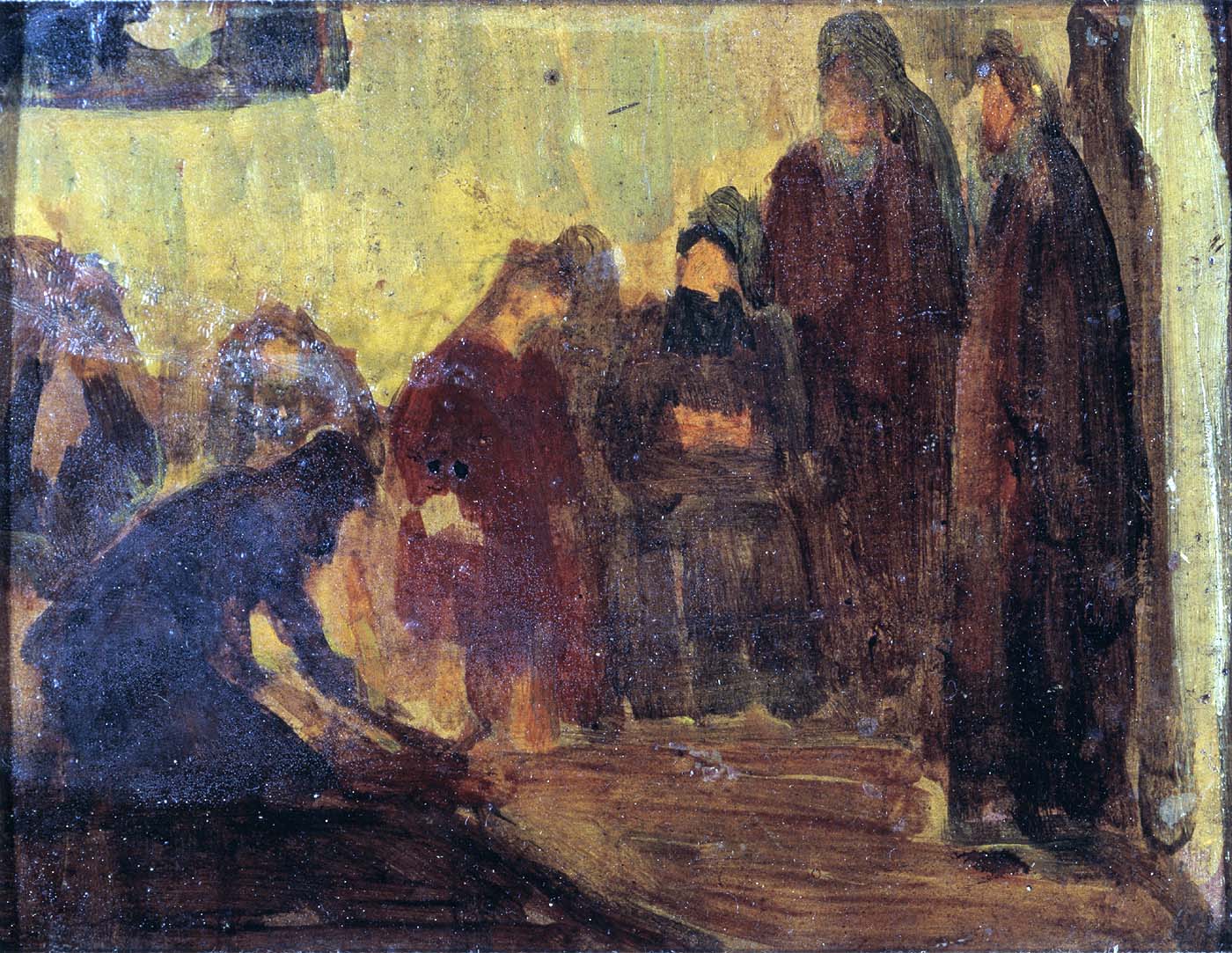
*Jesus-Washing-the-Disciples-Feet-Tanner

“‘Sanctification’ … is often misunderstood as a progress, kicked off, as it were, by baptism. This has obviously to be false. Baptism initiates into the life which God’s three persons, Father, Son and Spirit, live among themselves; what would we progress to from that? Rather, sanctification is the continual return to baptism…. Baptism is always there as a fact in my past; I can always, as Luther said, ‘creep’ back to it and begin anew.”
 
~ Robert Jenson, A Larger Catechism
 
Would that this understanding of sanctification ‘creep’ its way into those regions of the Church that have devised a two-tiered ecclesiology, the poor in spirit begging at the bottom, the ‘perfect’ in spirit standing tall and entitled at the top.
 
There is one way of sanctification, and it is the same way of salvation: the way of a down-low descent that comes eye-to-eye with the highest holiness only when it finds the God-at-rock-bottom. There he commands us, in effect, “Take up your guilt and come down here with me. If I, God, take the form of a slave and wash your feet to cleanse your soul with my humility, then you, sinners, follow suit, lest you continue to soil your souls with pride” (cf. Mt. 23:12; Mk. 10:43-35; Lk. 14:11; Jn. 13; Eph. 4:2; Phil. 2:6-8; 1 Pet. 5:6; Ja. 4:10; Ps. 51; Prov. 29:23; the rest of the Bible). If the One who knew no sin revealed his righteousness by identifying with sinners without becoming one, then I suppose that I, who knows most sin quite well, can best reflect his righteousness by identifying with sinners and not acting like I’m not one (2 Cor. 5:21).
 
This is the most basic precondition for perfect love, the omega point of sanctification, since the greatest obstacle of all love is pride. Love’s purest form is communal, indeed Trinitarian, that is: mutual self-donation and trusting open reception (perichoresis); but this perfect form of love in a fallen world is never exactly mutual because the degree of self-donation and trusting open reception is hindered by self-preserving pride and other-fearing mistrust.
We are afraid that if we open ourselves up to give we will be poured out; we are afraid that if we open ourselves up to receive we will receive nails. We are afraid that if we become Christians we will have to become followers of Christ. But we need not fear, for his infinite love fills up what is lacking in us and overflows into an offering out from us. Jesus is God’s gift (Christmas) to us and our gift to God (the Cross), and as such, but only as such, can we become a gift from God to the world, sanctified, set apart for self-giving love, a people sent to exist for the sake of our nonmembers. If we achieve the love of God in this world, it is only because God has achieved his love in us, for us. It is only because we are “buried with [Christ] by baptism into death” and something Alien was born. “We love because he first loved us” (1 Jn. 4:19).
 
But that Alien invasion is always engaged in some kind of revolutionary war, where the love of God’s will meets its most formidable enemy in the pride of mine. And hence love in a fallen world will never reach perfection until the world no longer can be given that description, until creation is made wholly new, until all persons are free from all fear and pride which are ever born anew in the womb of our awareness of death (Heb. 2:15). And so perfect love from here till Christ’s return must assume the form of descent (kenosis!), following the One whose eternal holiness as the God above us is demonstrated by way of his mortal identification with those below (Phil. 2:6-11), whose perfect love is revealed to be a love that crosses enemy lines (Mt. 5:43-48; Rom. 5:8-11; Col. 1:21) in order to adopt the mortal enemies of his bitter end as the immortal children of his new beginning (Rom. 8:12-17).
 
And so our Lord has taught us to pray a remarkably simple prayer that is staked there naked and uncomplicated, establishing the essential grammar of Christian confession, the delineation of love in a lost world, which we offer each morning as the daily bread for our souls and our sins: (A) the need to receive forgiveness (“forgive us our debts”), (B) the need to extend forgiveness (“as we forgive our debtors”), and (C) the need to be transformed (“lead us not into temptation but deliver us from evil”) so as to not continue the destructive cycle of wronging and keeping records of wrongs (1 Cor. 13:5).
 
Sanctification presumes daily reception of forgiveness–even if its not needed, the humble posture of asking can never be neglected–daily extension of forgiveness, and daily deliverance of our own capacity for evil. It is, indeed, the daily return to our baptism, graduation by way of demotion, the humble descent from the perfect righteousness of hypocrisy to the perfect love of the Father, displayed by the humble Lord of the cosmos (Mt. 5:20-6:4), the crossward way of the Kingdom of the forgiven, who are “called saints” (or “hagios” or “holy ones”, 1 Cor. 1:2). Yes, saints, because the one who calls us so makes us so in the way he makes all things: out of nothing. The Word that called forth light out of the void, life out of the tomb, is the same who calls forth sanctification out of the waters of our baptism–new Life still pouring forth from that Ancient Death–Jesus Christ, “who became for us wisdom from God, righteousness and sanctification and redemption, so that, as it is written, ‘Let the one who boasts, boast in the Lord’” (1 Cor. 1:30).
 
#downisthenewdown #learnyourabcs

Unplanned Parenthood

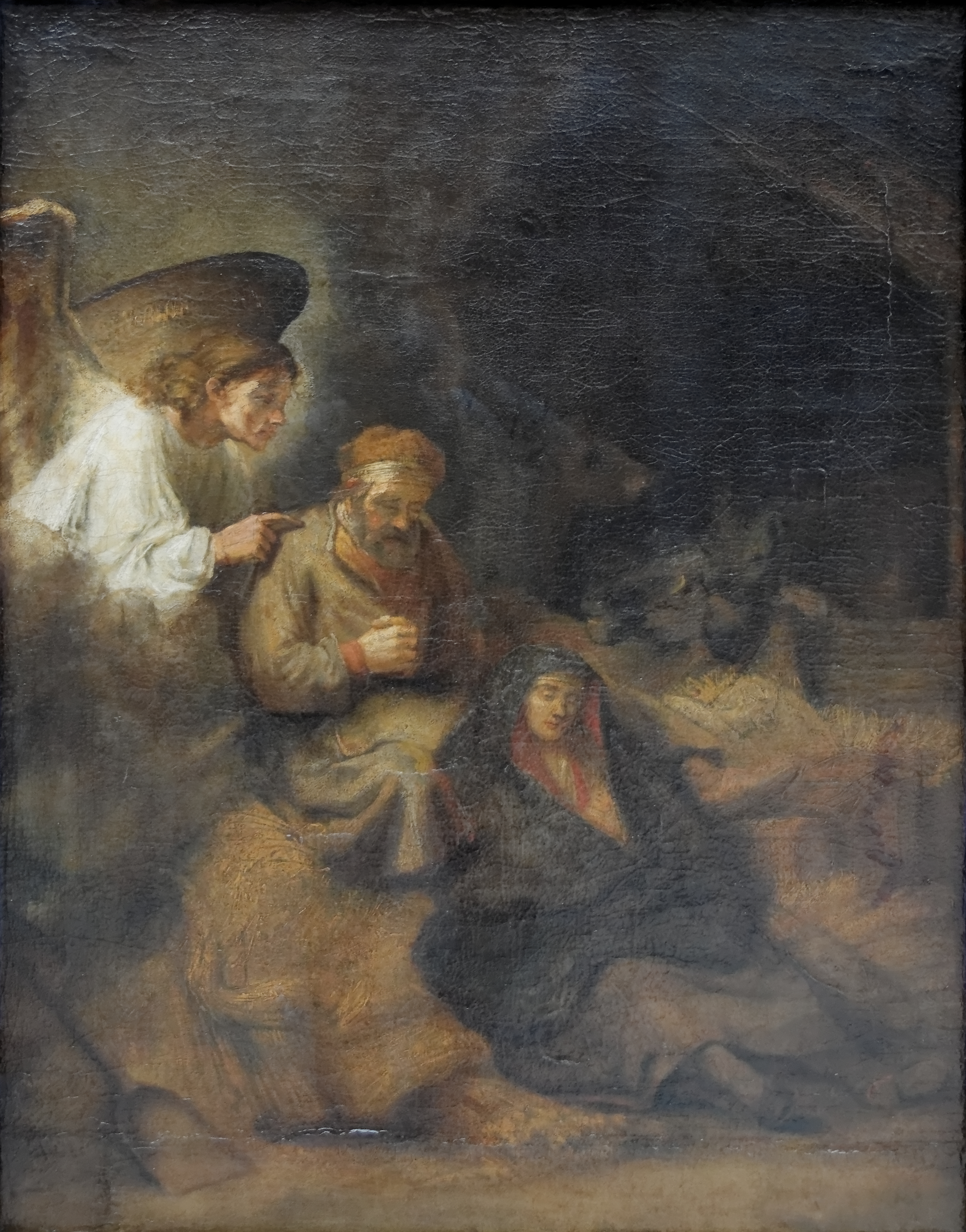
Joseph's_dream_Rembrandt

Joseph’s Dream, Rembrandt

Unplanned Parenthood

In light of yesterday’s congressional hearing–

I’m thankful not only that the virgin Mary embraced her Unplanned Parenthood but also that “Joseph was a righteous man and did not want to disgrace her” (Mt. 1:17). I’m thankful that Mary consented to mother the Son of an unconsented conception and that Joseph consented to father a Son of another Father.

I’m thankful too that when Mary received word of her pregnancy from God that with it came the assurance that she need not fear, that she had found favor with God (Lk. 1:30). She had found special favor with God because in the life of her unborn Son, who had already been named, was the Life of every son and daughter (Jn. 1:4), whose Life made flesh proved that every life made flesh has found special favor with God (Jn.1:14; 3:16)–for the kingdom of God belongs to such as these (Mt. 19:16; Mk. 10:14; Lk. 18:14).

I’m also thankful that when her Unplanned Son was hanging on a cross, the moment before he was able to declare all his work “finished” (Jn. 19:30), that his final provision for the human race was to ensure that his mother would not be left alone, that she would be cared for by the beloved disciple: “When Jesus saw his mother and the disciple whom he loved standing nearby, he said to his mother, ‘Woman, behold, your son!’ Then he said to the disciple, ‘Behold, your mother!’ And from that hour the disciple took her to his own home” (Jn. 19:26-27). If Christ shares the burden of human death, surely he can expect us to share the burden of human life, whether that means adopting babies or adopting mothers–for we all are adoptees (Rom. 8:15; Eph. 1:5).

Jesus became the Son of Man so that we could become children of God (Jn. 1:12-14; cf. 2 Cor. 5:21; Rom. 8:1-4, 28-29), but if we embrace God as Father and claim our right to be his children in Christ, we must embrace one another as family (Eph. 2:19; cf. 1 John–the whole book), “welcom[ing] one another as Christ has welcomed [us], for the glory of God” (Rom. 15:7; cf. Eph. 4:32). That means the embrace of every potential life of a baby, planned or unplanned, for indeed these are the least of “the least of these” (Mt. 25:40); but it means no less the embrace of every potential mother. When Mary found herself with an Unplanned Pregnancy, she did not find herself alone. She found herself within the embrace of God and the community he placed around her, and so was empowered to embrace her seemingly uncertain future.

The Church of Jesus Christ must be pro-life, but it must be pro-life in the way Joseph was pro-life at Jesus’ conception and the way the beloved disciple was pro-life at Jesus’ death. We must embrace the life of the unborn precisely by embracing the life of the mother. We can be no less than Joseph for every fatherless child and no less than the the beloved disciple for every lonely mother. But that’s costly. It means making room in our homes–literally. It means welcoming young guys and gals before they find themselves in such a situation. It means welcoming young guys and gals during and after they find themselves in such a situation, as well. It means: we make room for their lives so they can make room for life when it comes–planned or unplanned.

Indeed, Jesus’ Plan all along was to send that defining message to the disciples, that “I am ascending to my Father and their Father, to my God and their God” (Jn. 20:17), so that “those who believe in his Name would be given the right to be called children of God” (Jn. 1:12). So our calling, indeed our right, is to “conform to the image of the Son…the firstborn among a large family (Rom. 8:29).

I’m thankful that the Gospel announces God’s Planned Parenthood for all humanity: Jesus Christ, Son of God and Son of Man.

Give Them Christ!

    The Word of God, Jesus Christ, is the vantage point from which the Church views itself, the world, and God. Christ is the revelation of God that is transparent to the truth of God’s being in eternity and to the truth of human beings in history (John 1:1-14; Col. 1:15-20). If we have seen the Son, we have seen the Father (Jn. 14:9), and if we have believe that the Son is indeed God’s Son, then we are “given the right to be called children of God” (Jn. 1:12; Rom. 8:29; Col. 1:18; Heb. 1:6; 2:11). Thus, the Gospel claims that human beings participate in the divine life in Christ.[1] This becomes transparent to us only by means of the Holy Spirit, who makes divine perception a human possibility, for he is the divine Subject, the Spirit of Truth, who reveals Christ interior to human subjects (1 Cor. 2:6-16). It was indeed better for us that Jesus should go and send the Helper (Jn. 16:7), for creation is not in its essential form apart from our sharing, however limited, in the intersubjective life of God: “…I will ask the Father, and he will give you another Helper, to be with you forever, even the Spirit of truth…You know him, for he dwells with you and will be in you” (Jn. 14:15-6).

     Thus, the God who is Father, Son, and Holy Spirit, who is “I AM who I AM” from all eternity (Exod. 3:14), stands at the center of every “I think, therefore I am” in history as the “Word made flesh” (Jn. 1:14). Indeed, I AM, therefore I think is the more appropriate formula for Christian thought and speech. Absolute Being relativizes all contingent beings, and to the degree we can speak of the revealed form of Being as such, which is precisely what Christian proclamation presupposes, we must speak of Jesus Christ as the particular historical truth who is the absolute and eternal truth for humankind.

     Christ is the Light that is come to me without ceasing to remain above, the union of the eternal Subject and created subjects without either losing their proper names; he is God’s gift to me and my gift to God (2 Cor. 5:21; Rom. 8:1-4). Christ is in us, but Christ is not us; we are in Christ, but we are not Christ. Human life in Christ by the Spirit is nothing less than the subjective participation in the divine life as coheirs of salvation with Christ, the firstborn of creation (Col. 1:15) and thus the firstborn of the dead (Col. 1:18). And thus from a well that is deeper to us than we are to ourselves and extending up into infinite heights, “We cry Abba! Father!” (Rom. 8:15). And he hears us—his children.

    The Church thus abides in history according to its message heralded as the “eternal Gospel” (Rev. 14:6): (a) from the vantage point the divine Subject: “the mystery of [God’s] will, according to his purpose, which he set forth in Christ as a plan for the fullness of time, to unite all things in him, things in heaven and things on earth” (Eph. 1:9-10); (b) from the vantage point of the human subject: to “make known among the nations…the riches of the glory of this mystery, which is Christ in you, the holy of glory” (Col. 1:27); (c) and thus the principle relation that can be described as the actuality of human participation in the divine life: “Beloved, let us love one another, for love is from God, and whoever loves has been born of God and knows God. Anyone who does not love does not know God, because God is love. In this the love of God was made manifest among us, that God sent his only Son into the world, so that we might live through him. In this is love, not that we have loved God but that he loved us and sent his Son to be the propitiation of our sins. Beloved, if God so loved us, we also ought to love one another. No one has ever seen God; if we love one another, God abides in us and his love is perfected in us” (1 Jn. 4:7-12). The Gospel thus opens us up both to receive God’s life of love and to extend our lives in love. This is indeed the Alpha- and Omega point of creation, of salvation, of new creation–and thus necessarily too of our proclamation. 

Give them Christ!

Footnote

  1. In Christ we participate in the divine life through his “interior” (immanent) relations within the Godhead and his “exterior” (economic) relations within creation (cf. Jn. 17). And this is so precisely because the immanent Trinity is the economic Trinity and vise versa (Rahner, The Trinity, 22), which means we do not participate in a degraded form of his life, altered as it had to be in order to save us. Rather, since the essential life of God is love, the economic Trinity revealed in salvation history is simply divine love toward his creation–even when it had to sink its way down into death and back to effect love for us. [See my article on the Incarnation and the Trinity on Asbury’s Seedbed here.]

The Don’t-Beatitudes

“Blessed are the blessed in spirit, for theirs is the kingdom of heaven.

“Blessed are those who smirk, for they shall be comforted.

“Blessed are the proud, for they shall inherit the earth.

“Blessed are those who hunger and thirst, for they shall be satisfied.

“Blessed are the just, for they shall receive mercy.

“Blessed are the pure in affiliations, for they shall see God.

“Blessed are the compromisers, for they shall be called sons of God.

“Blessed are those who are persecuted for morality’s sake, for theirs is the kingdom of heaven.”

Said Jesus never.