The God-Damned god Within

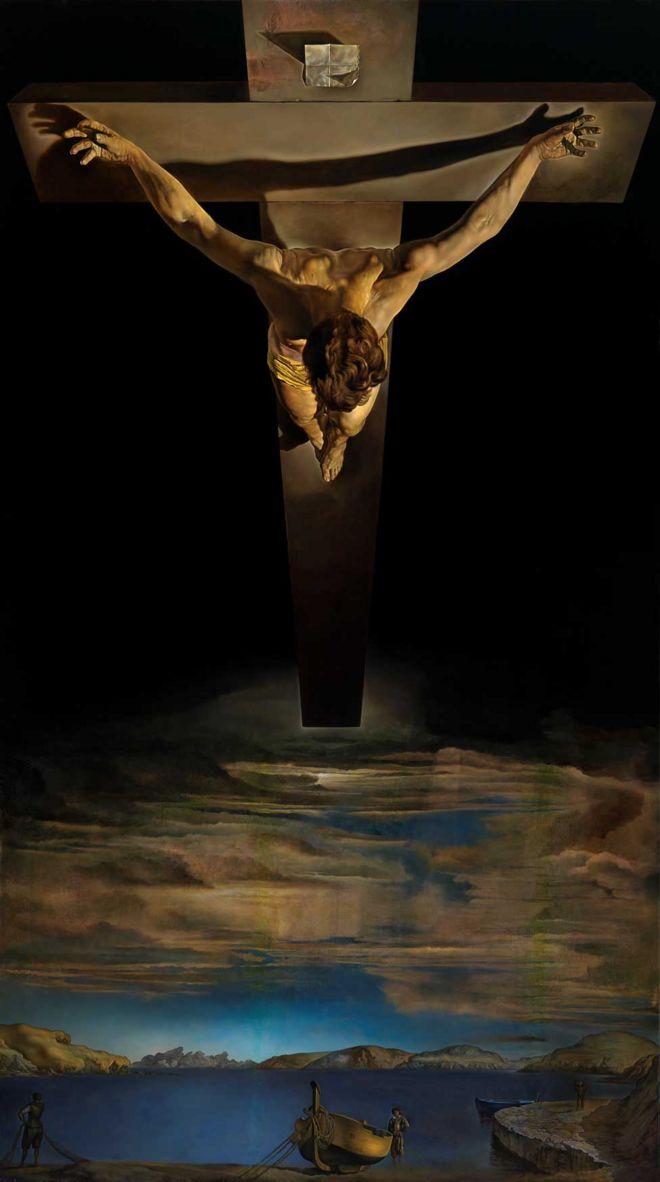
Dali painting

Salvador Dali, Christ of Saint John of the Cross


Fix your eyes on Jesus, the author and perfecter of faith, who for the joy set before Him endured the cross, despising the shame, and has sat down at the right hand of the throne of God. 

~ Hebrews 12:2

After about three months of focused reading of a number of ancient spiritual mystics and modern psychologists who would be called spiritual mystics if they were ancient, a clear message has emerged: if you haven’t discovered God, then you haven’t looked and listened deeply enough within your own soul. Discover your true self and there you will discover the God who accepts you just as you are. You need only now to accept yourself just as you are. You may even need to forgive yourself, but mainly just for not accepting yourself.

As much as I have gleaned from what I have read–there’s some laudable stuff on the woes of technology and the unexamined life–I cannot help but confess that in my own experience of the infinite inward dive I have never found anything other than an infinite inward abyss. Now it may just be that I am especially void of any inborn divinity or particularly undiscerning of the God who is always within. It could be that my spirituality isn’t mystical enough or my psyche isn’t spiritual enough. I could just be an anomaly of godlessness in a world of demigods.

Whatever the case may be, if there are others out there like me who have looked soberly within to discover God and discovered nothing but the self standing in empty space, perhaps you will benefit from the path I took toward discovering God. But the following only applies to such as these. Conveniently, it is only a three step path.


Once you get to the bottom and discover there is in fact no ground beneath; once you see that there is no one else there accepting just as you are; after you’ve carefully listened for that eternal voice saying of you “This is my beloved in whom I am well pleased” and hear only hissing echoes of your own disguised persuasions; once your exhaustive inward search has led you only more deeply into despair and you are finally ready to give up—now you are ready. This is where the path begins, where it began for me, at least.

Step one: turn around. Stop stop looking inside yourself for the God who accepts you just as you are, because perhaps God does not accept you just as you are. He didn’t accept me just as I was, or am.

Step two: consider that. Consider that the reason you can’t hear the divine voice calling you his beloved and assuring you he is well-pleased with your life or sense the peace of his presence is because, perhaps, your life is not well-pleasing to God, and perhaps he calls you by other names. And if you can entertain the notion that God does not accept you just as you are, that he is not well-pleased with your life, that you have not lived as his beloved but as a rebel, across enemy lines, you really only have one last step, and it is your last resort.

Step three: look outside of yourself and fix your eyes on Jesus Christ, the crucified One.

Once you begin looking, keep looking, like the way you’ve been looking in yourself. Fix your eyes on him, hanged, and there begin to listen–not to what the voice says about you but to what the voice says about him, the One called beloved by his Father in heaven, the One called by other names down here. Make sure it’s him you see, that he’s the victim, not you. Don’t confuse the well-pleasing waters of his acceptance for the displeasing flow of your forgiveness. Let the cross be the measure of your life and your love. And when you hold your gaze long enough, as though there were nowhere else to look for God, as though all the world has been called to find God and be found by him in this one place, and it alone, you will inevitably be confronted by just how displeasing you are just as you are, because your life and your love are nothing like the well-pleasing love of God revealed in the displeasing death of his beloved Son. He’s not like you, not like me. His life, his death—that’s just not what our lives look like.    

If you discover your true God there, at the cross, it is there you will discover your true self: a bona fide God-damned demigod, seated on a throne, floating on an abyss, guilty as Adam for the high treason of heaven–-“you will be as gods” (Gen. 3:5)–-an apple fallen not far from the tree. Jesus, after all, was nailed to a cross only after “Pilate…sat down on the judgment seat” (Jn. 19:13). He was a man-damned God. But when you see your God hanging there, high in our curse, carved into our tree (Gal. 3:13), the sun will rise, the truth will burn hot and clear in your empty soul, and you will see that it is not divine acceptance you need. It is divine forgiveness. And you need it terribly.


The human race is guilty of the highest offense, and that includes you, whoever you are. We’re not dealing with double-parking at the pearly gates or our devotion to the Seahawks over the Sabbath (though that is indeed a capital offense, cf. Exod. 31:14). We are guilty of condemning God. We have crucified God’s Son. There he is, the One who is always God, who one day was crucified by us. Even if it was not an undoable death, it is an undoable offense. Indeed, it’s a repeatable offense, and we repeat it every time we place God’s judgments under our judgment, which is all the time. All the time we disagree that the wages of sloth is death, the wages of gossip is death, the wages of greed and lust and covetousness and anything-less-than-love is death. Who does not daily disagree they deserve to die daily? Yet daily we are spared, up until our last day, at least. But Jesus did not deserve to die, ever, and one day he did, because we killed him. There he is. We accepted ourselves and rejected our God, condemned, crucified, cast out of human life. Fix your eyes on that truth.

You don’t need divine acceptance. You need divine forgiveness. But for that, you need not look anywhere else. Indeed, you must not look anywhere else. And if you can see that, I’m certain you don’t want to look anywhere else. For behold, the amazing love of God for a godless wretch, without strength, like me, like you.  

For when we were still without strength, in due time Christ died for the ungodly. For scarcely for a righteous man will one die; yet perhaps for a good man someone would even dare to die. But God demonstrates His own love toward us, in that while we were still sinners, Christ died for us...While we were enemies of God, we were reconciled to God through the death of His Son…There is therefore now no condemnation for those who are in Christ Jesus.”

~ Romans 5:6-11; 8:1

Guilty, yes. Condemned, no. So bow, beloved sinner, and let God be seated within. 
 

A Proper Name Never Dies

If an ant could talk, would you still kill it?

If it could plead for mercy,
make a case for insect rights,
express its hopes for a future in mind,
or read you a poem about friends in low places—
would you still just silence it under your shoe?

Or what if it could simply share with you its name?

But it can’t, so neither will I not kill an ant.

Chekhov’s ‘A Dead Body’—An Interpretation

After reading Chekhov’s A Dead Body (full text can be accessed here) I was curious to see how others interpreted it, so I looked at a handful of analyses from a few literary sites and was quite surprised by the frankly unimaginative readings I discovered (and one perhaps overimaginative reading). They were mostly preoccupied with surface observations about stranger danger and speculations about a hidden murder mystery plot, but all the interpretations I found basically amounted to Chekhov cautioning us against trusting people too much, especially peasants.

In my best judgment, the story is a parable about faith in a Christ, who at times seems as absent today as he was on Holy Saturday. Indeed, Christ is the dead body in the story, as the fire’s ‘purple glow’ is intended to reveal. Faith in the story is expressed by “keeping watch,” hence the two watchman, who had been ordered to “keep watch” like the ten virgins in Matthew 25. To keep the faith they, like the virgins, had only to keep the fire burning and keep watching. 
.
Read in that light, the story ends with (a) the pious (but fearful) pilgrim and the smart (but prideful and also fearful) young man walking into the ‘outer darkness’ of the night, as it were, away from Christ, and (b) the simple, humble, and faithful watchman dying with Christ (staying with the dead body until he “fell into a gentle sleep”), and so being raised up with Christ. Allusions to 1 Thessalonians 4:13-17 throughout the story, but especially here at the end and at the central (purple glow) fire scene.
.
The last two lines leave the reader with (a) Syoma’s eyes closed, eyes which had been resolutely fixed on the fire from beginning to end, save for when left to gather wood to feed it (as the young man “shielded his eyes” from it), and (b) with the dead body “lost among great shadows.” Between his eyes closing and the shadows emerging, Syoma fell asleep and the fire went out. The fire is the substance of Syoma’s life, which is indeed his faith–it consumed all his attention and efforts from beginning to end, and so it should since his job as a watchman is to “keep watch”!
.
When his eyes are closed and fire extinguished, Syoma is left in darkness with the dead body. But “soon” after that, “the dead body was lost among great shadows.” The singular dead body is now gone from the darkened scene, replaced though with “great shadows.” How can “great shadows” appear in the darkness of a fireless night, a scene that leaves us no light to cast a shadow nor any to distinguish the shadows from the night? The only thing left to imagine in the scene is two men, one dead, one asleep, united in the darkness of the scene (now established in both 3rd and 1st person perspectives, (hence he fell asleep but only after he closed his eyes) until the former is lost in great shadows. We are thus forced to imagine a light “from above” that now only reveals that the body is gone, a light that itself is only revealed by what stands in front of it, as Syoma before the fire, casting its shadow. Indeed, the opportunity for the watchman has passed, the door of the banquet has shut, and the Light of the world now remains only in the great shadows of those who died with Christ, and so who have risen with him. 
.
Ironically, both the smart young man and the pious pilgrim “knew” the soul stayed with the body until “the third day,” so their “superstition” condemns them in the end—the watchman for abandoning the body for profit (like Judas), the religious man for his fear of death and bribery of the watchman (like the Pharisees). Thus, “the sound of their steps and the talk died away into the night.” This is the dawnless night of death that will henceforth forever remain in the glorious shadows of life. To quote the pious pilgrim’s first words in the story: “Oh, ye that love not Zion shall be ashamed in the face of the Lord!”  
.
But we do not want you to be uninformed, brothers, about those who are asleep, that you may not grieve as others do who have no hope. For since we believe that Jesus died and rose again, even so, through Jesus, God will bring with him those who have fallen asleep. For this we declare to you by a word from the Lord, that we who are alive, who are left until the coming of the Lord, will not precede those who have fallen asleep. For the Lord himself will descend from heaven with a cry of command, with the voice of an archangel, and with the sound of the trumpet of God. And the dead in Christ will rise first. Then we who are alive, who are left, will be caught up together with them in the clouds to meet the Lord in the air, and so we will always be with the Lord. Therefore encourage one another with these words.
     —1 Thessalonians 4:13-18
A Dead Body was indeed written for our encouragement: keep the fire burning, and keep watching! 

Reimagine

Now that we’ve spent the last 50 years imagining John Lennon’s world–and ending up in a radicalized version of the same world in which he imagined it–I suppose it’s time to try something new.

Imagine there’s a heaven
It’s not easy when you try 
There’s hell all around us
Above us only night
Imagine all the people 
Living for a change

Imagine there’s a kingdom  
It may be hard to do
Something real to die for  
And love our enemies, too
Imagine all the people
Living life in peace
You

You may say I’m a dreamer 
But our King is the only one 
I hope someday He’ll join us
And the world will be as one 

Imagine our possessions
I wonder if you can
Shared for need and hunger
A brotherhood of man
Imagine all the people
Sharing God’s good world
You

You may say I’m a dreamer 
But Christ is the only one 
I hope someday He’ll join us
And the world will be as one 

Touching Death for the First Time

I remember first becoming aware of death by imagining death, but it was not my own death. One might expect the double insulation of merely imagining someone else’s death to provide double solace from the alternative means of becoming so aware. But I would have rather died.

The moment arrived, unsolicited. I was minding my own business, lying on the floorboard behind the driver’s seat of our family’s ’70-something beige-on-beige Buick. We were on our way home to Indiana from our extended family trip to Ocean Isle, NC, where we annually gathered with my better looking side of the family in their better everything part of the country. My father reached his hand back signaling for mine. I held his hand with both of mine. Suddenly, lightening struck in my memory and I was brought back to another hand I had touched only weeks prior. It was a dead hand.

I must have been about five years old. It was my first funeral. Actually it was the wake. A friend’s great grandmother had died and I guess I had reached the age that a person should start looking at other kids’ great grandparents, dead, a kind of necessary rite to help prepare me for a world in which the oldest people are systematically in the habit of falling off the radar. But I was as dispassionate about this lady’s death as any child is about any other child’s great grandmother’s life. There’s good distance between a five year-old and a ninety-five year-old. And it’s better to introduce death on the far end of the gap before it begins its inevitable process of closing that gap, sometimes in leaps and bounds.

So I was told Matthew’s great grandmother was going to go live in heaven and we were going to go see her off. Heaven was about as concrete as death at the time, and now the two were welcomed into a kind of unholy matrimony in the undiscriminating image pool of my childhood mind. All the same. Death and heaven were both chalked up to things that have nothing to do with being a child. At that time, neither really had anything to do with Jesus either. Jesus was still more like an invisible heart stent that was given to all children en masse by volunteer surgeons at Vacation Bible School. If Jesus ever got into heaven, it would only be through the vehicle of some kid’s heart. But heaven was reserved for dead people, and death was reserved for old people, so as long as I was still a kid, Jesus was safe and I was too. And I had all this sorted out at a young age, because my dad was a pastor. 


Walking in the funeral parlor, two things seemed immediately out of place. First, the funeral director’s smile—it was a commanding smile, either entirely artificial or entirely too eager for the occasion. Second, everything else. Almost everything was coated in a rather unconvincing white. The flooring, stairs included, was carpeted with a blanket of what looked like the swollen tips of overly handled yarn. The walls were nicotine. Worst of all were the lights, the kind you can hear and cannot dim. They were naked and not ashamed and made everything else feel naked and ashamed. The house was haunted with a clinical glow that only exaggerated the hard dark lines of everyone’s bereavement uniforms. Nor did it help that the rooms were small and ceilings were low. It had obviously once just been somebody’s house. I couldn’t tell if everything was trying not to be a house or rather trying too hard to make everyone feel at home, like when nobody feels at home at a church that tries to make everybody feel at home by not feeling like a church. In all such attempts, everything is blasphemed among the gentiles: homes, funeral homes, churches, and heaven. And this was no exception. It was a mix-matched monstrosity, like a heaven filled with old dead people. At that point, I just wanted to go home, and I sure as hell didn’t want to go to heaven.

Also, the strained faces presented a whole new dimension of social interaction I had as yet not observed. One lady’s face was strained like it had been turned inside out, like the lights, the soul in the fully ‘on’ position. I think it was Matthew’s aunt, the woman’s daughter. She did ugly things with their lips that you wouldn’t do if you could help it, at least not in that lighting. And yet, she seemed to be generating an attractive force with her display, as a steady stream of the guests gravitated toward her throughout the ordeal, touching her and nodding their head in a gesture of agreement. But most of the faces were strained in just the opposite way, trying so hard to match the ones not trying, though mostly trying in the eyes, not willing to match the lower region quiver for quiver. 


I think I remember the experience so vividly because it is the first time I realized that the world of adults is a pretend world because adults themselves, by and large, are actors, at least most of the time. The whole thing was as unconvincing as a movie with a split-second audio delay. I could actually see with my eyes the various distances between individuals and their place in time. There were a few who were consumed in the present moment, those who either could not or cared not to save face. But most kept some measured distance from that moment of death. I was learning that day something about the relationship between being and time or, less philosophically, empathy and being human.

Being human has something to do with being cut off from the whole and yet somehow still part of it. Humans are at once islands of consciousness and a sea of connectedness. Empathy describes the gravity in the tide on every shore, pulling fragments of sand into the sea and blurring the lines of selfhood. And it becomes far more empirically measurable whenever death is in the air, because grief is the sharp edge of empathy, and it is the edge that crashes against the surface at death and pulls something human out like a riptide, something irreversibly lost at sea.

Empathy with the dead is a kind of death, because it reveals the capacity for life to be shared like a hypostatic union. It reveals that the archipelago of human life is not void of isthmuses. We call those sandy land bridges love. Grief, then, or empathy with the dead, is experienced as a sharing in the loss of a life that was shared together in love. It hurts like you would imagine death hurting if death were something you could feel. Turns out you can. And so, humans can feel death and the people looking at the ones feeling it can almost see death in the manifestation of their grief, like the way you can see a demon when it manifests through its human host, or like the way you can see a baby when it kicks a woman’s belly from the inside. Grief throws and thrusts the soul around with such irrepressible immediacy that the embodied bereaver is contorted into the shape of a wordless groan, or of Edvard Munch’s Scream

Grief is love’s wild groping for its beloved in love’s refusal to die. It is love’s desperate dive into the infinite abyss in a futile search for the wholeness that gave birth to it. No love is an island. Love is an isthmus. Love is a singular word that exists only as it cradles together plural referents, like the word pregnancy or God. People die and love does not, and so every life shared in love will inevitably share the cradle with death. And so God gives us grief to teach us something about Being and time.


But on this occasion there was not much of a sense of a love flailing about in protest, like I would eventually see the first time I went to a little kid’s funeral. There was a general sense that, well, it was time. This woman had already extended most of herself into that hospitable abyss in the loss of her nearests. She was more grief than love. And the great majority seemed entirely removed from a sincere capacity to enter into the the moment. There was stuffy proximity and infinite distances. As humans, we’re not good at acting out death. 

I was shuffled from the crowd of strained faces into a single-file line of shifting eyes waiting to see the main attraction. Surely, for most this was the ideal scenario—getting to see a real live dead person without having to care. Since most people at the funeral of a great grandmother are almost entirely dispassionate it allows them to be wildly curious. But nobody wants to look at anybody else because they don’t want to be found out and don’t really know what to say, and perhaps because they all feel a little ashamed that they really just want to look at the corpse.

But as a five year-old I was free of all that pretense. With brows at attention and heels as well, I finally got my first glimpse—but what I saw was not a real live dead person. It was not even a person. It was a kind of rubberized memory of a person. It was very out of place, the most out of place. And this was my first time seeing the inside of a casket, which seemed less like a home for a person who couldn’t feel and more like a vehicle designed to tumble people safely down a mountainside. This made the ex-person look all the more out of place or all the more like a crash dummy with bad makeup. When it was finally my turn to receive my ten second introduction to death, I stepped into position, looked intently at the stranger, and next thing I know we’re holding hands.

It was an accident, or kind of an accident—an impulse. Death was in my reach, and I seized it. I remember being surprised, first that I was touching this hand, and second, what really stuck out to me, surprised by how cold it was. It wasn’t cold like ice is cold; it was just cold like a hand is not. There was something downright inhuman about this hand, about this face, about this whole situation. And not in a way that made me understand the reality or finality of death, but which almost seemed to render death unreal, even impossible. It was hard to take death seriously since it belonged to something so obviously not alive. Humans are alive, even old ones.


It wasn’t until I remembered the hand of that corpse while holding my father’s thick, warm hand that I became aware of death in any meaningful sense. Death meant the negation of all things. It wasn’t that I suddenly realized everyone would die. It was the overwhelming fore-shadow that came with the realization that if everyone would one day die, this hand would die, if every hand would one day feel cold like this hand does not, one day this hand would feel cold like this hand does not. This twice-removed encounter with death changed my life. The world became a sea of hungry hungry hippos eating away at love, carving one land mass into millions of castaways until all was washed away into sinking sand. But it wasn’t the all that mattered. I still didn’t care about anyone’s great grandmother. It was the prospect of this hand dying, which could not be replaced with the resurrection of a thousand others.

It is not the inevitable death of every person that makes death so unbearable; it is the inevitable death of love that makes certain deaths so unbearable. In my utter wickedness, I can stand the thought of damn near all the peoples on earth returning to the dust, but I cannot, to this day, stand the thought of a handful of loved ones, my loved ones, returning to the dust. That thought was sent on a rotation in my mind that day and I could not hold it still. It began to consume everyone in its wheel, beginning in that Buick and working its way across the killing fields of my home town that until then had just been plain old corn fields. The more I thought about it, the more I couldn’t not think about it. It was an idea more powerful than all my other ideas, consuming them in the way death does everything. I could do nothing about it. It had to be, and I knew it. I was thrust into life, into love, and I would be thrust out of both. We all would, and there was no solace to be found in any one being thrust out before another. The prospect of my death was no more or less tragic than the prospect of the death of those I love. The death of life is only tragic at all because it is the death of love, or at least the half-death of it, which is always more painful than the whole. 

I started to discover in that moment just how deep the soul goes. I kept holding my father’s hand, and the more I thought about not being able to, the deeper it went. By the end of the trip, I had drilled aching figure-eight canyons throughout my soul with a searching sadness that has never since been able to locate its origin or its end. I’m still looking for home. Indeed, love is so bent up toward eternity, it seems, that it refuses to tire out in the way our bodies refuse not to. And so I live and I look and I long. I love, therefore I’m damned.

One Final Word

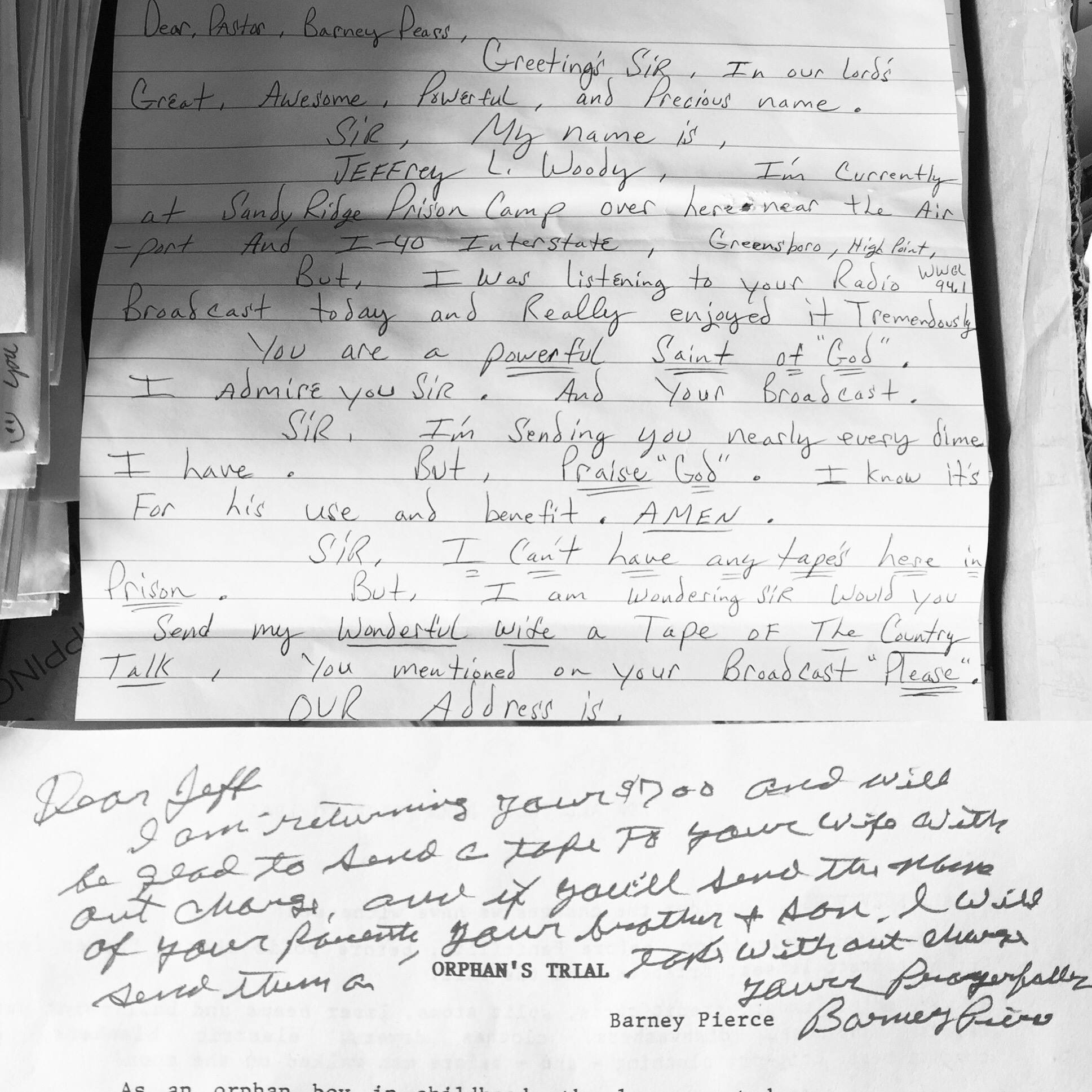
img_1332

This is one of the hundreds of letters to my grandfather (‘Granddaddy’) spilling out of an old, cracked leather satchel, most of which are from listeners of his radio Gospel broadcast. This one is from “Jeffrey L. Woody…at Sandy a Ridge Prison Camp,” requesting a tape of his “Country Talk” (the name, I suppose, of a compilation of recitations, songs, sermons and the like). He indicates in his letter that he sent enclosed with his request “nearly every dime [he had].”

I found the letter paper-clipped to a copy of the response my grandfather sent (copied likely for bookkeeping, likely by my grandmother) that read as follows: “I am returning your $7.00 and will be glad to send a tape to your wife without charge, and if you send the address of your parents, your brother and son, I will send them a tape without charge. Prayerfully, Barney Pierce.” Below this personal note was a copy of a poem he had written, who knows when, perhaps just then, perhaps just for Jeffrey, called “Orphan’s Trial.” It is about a criminal who found an advocate with the Father in Jesus, and, as an orphan, found much more than even that. The last line reads:

“The lawyer was Jesus, the crucified one;

the judge was his Father, now I am his son.”

The last letter in the clip was Jeffrey’s response, in turn, full of praises to God and the addresses for his family.

And so the Gospel was heard, the captives were set free, and the kingdom of God advanced.


My grandfather has had a greater Gospel influence in this world than anyone I have ever known. I have read about the spiritual giants in Church history, and I am not necessarily skeptical of the Gospel influence they had, but I do know that if they had any such influence it was not because they were giants but in spite of it. It is because they were the kind of people who could broadcast the Gospel across the globe by day and write to a prisoner named Jeffrey by night. It is because of all those little things history doesn’t tell us about that grandchildren find evidence of in untold testimonies while cleaning out the attic. The Gospel always comes to us swaddled in smallness, because how else can such a giant God convince such little people of his love?

Despite his Yoda-like stature (or perhaps because of it), Granddaddy was always a spiritual giant in my eyes. I realize now it is precisely because, despite his far-reaching influence and unscalable faith, he always met me at eye level. It is because his God-sized faith never tried to outgrow his childlike heart. He made it easy for all the little people to understand gigantic Love. I learned from my grandfather that the reach of a man’s impact for Christ can only be measured by the size of his willingness to shrink.

Granddaddy died yesterday at the ripe old age of 98. His testimony is now complete. Death delineates every life, carving it out of time as a single word left to the world with greater power than any of the many uttered before it. It both reveals and expresses the testimony of a life in the fullest sense, as legacy, or more precisely, as momentum.

Every life passes through this world like a semi on the highway, pulling life and matter and memory in its wake. Some lives, when buried, pull on the lives around them like a black hole on light. But some lives, when finally broken, release an outpouring of spirit that fills the sails of generations for generations. Granddaddy has left a mighty rushing wind of momentum pushing against the backs of his family and countless others with guidance and confidence and encouragement, indeed a kind of power, to stay the course, resolutely, to follow him Christ-ward headlong into death. We will finally, next weekend, sow his life into the ground, side-by-side with his beloved, where he and Grandmother will together continue to yield an orchard of blessing for all the lives living in the wake of their memory.

Thank you, Granddaddy, for showing me how to live and, more importantly, for showing me how to die.

“He who is faithful in very little is also faithful in much” (Lk. 16:10).

“Truly, truly, I say to you, unless a grain of wheat falls into the ground and dies, it remains alone; but if it dies, it bears much fruit” (Jn. 12:24).

granddaddy

Christmastide (Final) Reflection: Second-born


“And Simeon blessed them and said to Mary his mother, ‘Behold, this child will be laid down for the fall and the resurrection of many, and for a sign that is opposed, (and a sword will pierce your own soul also), so that the thoughts from many hearts may be revealed” (Lk. 2:34-35). 


Originally Titled: Levi Ryser: Born in the Shadow of the Savior


The baby was born. They called him James.

There’s not much to say about James. He doesn’t say much about himself in the letter he left for us. The only other thing the Bible says about James is that he was the brother of Jesus (Gal. 1:19). All we get from Church history about James is in fragments, no cohesive narrative. A guy named Hegesippus called him James the Just. It stuck.


But it’s no surprise there’s not much to say about James, because all that is said of him is said under the shadow of his big Brother. James the Just, brother of Jesus the Judge, born in the shadow of the Savior. A hard act to follow.


I wonder if Mary felt guilty. She was found to be with child, again, but not by the Holy Spirit again. This time by plain ol’ unholy Joe. This child surely would not be so godly as her First. I wonder if she felt guilty before James was born, knowing that she could not love him as much as her Firstborn (of all Creation)?


But even more than that, I wonder if she felt guilty after he was born. I wonder if she felt guilty when she realized that she loved her second-born just as much.


I remember when we were expecting our firstborn. All Keldy thought about was the baby. She loved him in I suppose the way only a mother can love an unborn child. I on the other hand felt guilty. I could not relate. For those nine months my reaction to her pregnancy was a kind of surprised “Oh yeah…”, coupled with a nagging fear that I wasn’t going to love him like a father is supposed to love his son. I literally feared that I would love my dogs more than my son. Babies just hadn’t been all that impressive to me, because I am not a woman. The honest men out there know what I’m talking about. Women have no clue.


Except for maybe Mary. Mary knows. Mary had, after all, held at her bosom the one who came from the bosom of God the Father (Jn. 1:18). Mary had indeed “kissed the face of God.” But this second-born would be just another face in the shadow of the Almighty. Mary wasn’t yet used to having children who weren’t God. And middle children already have a syndrome named after them, but what of the one that comes second to the Savior of the world. Mary knows.


When Kezek was born, I started treating my dogs like dogs. I loved my firstborn so intensely that I was afraid I loved him more than God. I was afraid that if anything were to happen to him I would hate God. That fear lingers.


When Keldy told me we were expecting again, I was doubly guilty and doubly afraid. Not only did I love my firstborn more than or as much as God, now I feared that I would not love my second-born as much as my firstborn, perhaps only as much as the dogs.


The baby was born. We called him Levi Ryser. There was no sound. He was blue. The voices of the people in white raised an octave. They stopped looking us in the eye. They were looking at some protocol that was visible only to those who knew some unspoken “code.” Ryser needed decoded.


The doctor handed him to me to carry as I was paced at an uncomfortable pace en route to the NICU. It seemed far too much like a formality for my first embrace of my second-born son, like it was a consolation, a mere gesture, the beginning of some process necessary for some Contingency Plan Z. It felt like I was greeting my newborn son with a goodbye. 


There are no words here that will do.

I held him as close to my heart heart as humanly possible. I tried to hold him as close to my heart as humanly impossible, or as inhumanly possible. I tried to pour my life into his. I tried to empty myself to fill him up. I tried to breath for him. I wanted to cut out my heart and put it into his body. I wanted to die so I could raise him from the dead. Anything. Just please…


I think that was the first day I ever actually interceded for someone. I beat on heaven’s door like one of those old grandmothers who’s earned the right to act that way. I was pleading, then I was demanding, then I was crying. I had felt the joy of a father’s love with my firstborn but with my second-born I was brushing up against the prospect of a father’s grief. I was feeling the very sharp other edge of love for the first time. I learned that day something about the sword Simeon told Mary about (Lk. 2:35). 


Four days later, he was stable. Over those four days I started to understand what I suppose Mary had come to understand with her second-born: that the love of God and the love of a son are not two separate loves. The sword that pierced Mary’s heart and the spear that pierced her Son’s were felt first in the love that was laid at the foundation of the world (Rev. 13:8).


God is love in a very nounish sense, like the nounish sense of the word creation or the Word Incarnation. Mary couldn’t compare her love for Jesus with her love for James, because her love for James came from the life of Jesus. There is no love apart from that Life. Indeed, there is no life apart from that Love. If it is in God that we “live and move and have our being” (Acts 17:28), then Love is the ether of all our relationships. To love is merely an act of alignment.


His name has become more fitting than I had intended. Levi Ryser means, by my assignment, death and resurrection, or offering and acceptance, or more simply “Gift of God” (with the intentionally ambiguous genitive). It is the second-born of Mary, after all, by whom we discover ourselves, since we all are second-born of the dead. We discover that unto us a Child is born, to us a Son is given, in order to restore love to its proper form, that we might love our own as we love God, because he loves us as though we were his own. That is the meaning of yesterday’s Birthday and therefore every birthday in the light of its shadow.


Levi was born on the altar, where all gifts are born. He was born without breath, blue. But while he was yet unknown and unknowing, en route to the NICU, he was already being born in the bosom of his father. I think in that moment, if for only that moment, I understood Mary. I think I understood something about motherhood that day. I understood what it was like to carry a life that could not carry itself apart from my own. I understood what it was like to carry life with a sense that if one dies, we all die, if one lives, we all live. I think I learned something about being the Mother of God that day. I’m certain I learned something about being a father that day, maybe even something about being a Son.


We had decided to call him Ryser before he was born. But Levi was Ryser before he was born. He was raised in his mother’s heart for nine months. And he was raised in his father’s for four days. He is now growing up in both. And all this is from God, because he has been raised from eternity in the heart of Love. And my only plea for his life is that through our feeble hands he will continue to be held in that Love. God, help us.


Ryser is our number two, but he is loved just as much as the Firstborn, even if he was born in His shadow, even if we did use leftover nativity scene wrapping paper for his birthday presents this year.


Happy Birthday, Ryser. You are loved with an everlasting love, my son.


“How precious is your steadfast love, O God! The children of man take refuge in the shadow of your wings.” 

~ Psalm 36:7

Christmas Reflection ~

“The beginning of the Gospel of Jesus Christ, the Son of God…Now after John was arrested, Jesus came into Galilee, proclaiming the gospel of God, and saying, ‘The time is fulfilled, and the kingdom of God is at hand; repent and believe in the gospel'” (Mk. 1:1-15). 

Mark get straight to the point. There are no mangers or magi, no sheep or stars, no angels in the sky or shepherds in the field. A Man appears with a message, with News: Times up! The King is come! 

Good News, indeed. 

And the response? Repent. To repent means to change your mind. If the King is come, change your mind about your unwarranted fears, about your uncertain future. If the King is come, change your mind about your hopelessness, your joylessness, your unrest. If the King is come, change your mind about yourself, your neighbors, this world, and your God—because you and they and this world are loved.

So beloved of God, repent, for Christmas is at hand!

“The war is at an end – even though here and there troops are still shooting, because they have not heard anything yet about the surrender. The game is won, even though the player can still play a few further moves. Actually he is already mated. The clock has run down, even though the pendulum still swings a few times this way and that. It is in this interim space that we are living: the old is past, behold it has all become new. The Gospel of God’s Kingdom tells us that our enemies, sin, the curse and death, are beaten. Ultimately they can no longer start mischief. They still behave as though the game were not decided, the battle not fought; we must still reckon with them, but fundamentally we must cease to fear them any more. If you have heard the Gospel message, you can no longer run around with a tragic face and lead the humorless existence of a person who has no hope. One thing still holds, and only this one thing is really serious, that Jesus is the Victor.” 

~ Karl Barth

Merry Christmas!

Advent Reflection 23: Homeless

Another special guest post from my sister, ChristiAnna Coats. For more of her writings, you can buy her first book on Amazon (also a great stocking stuffer!): click here for link. 

“And he rose and took the child and his mother by night and departed to Egypt and remained there until the death of Herod. This was to fulfill what the Lord had spoken by the prophet, ‘Out of Egypt I called my son'” (Mt. 2:14-15). 

I had lied to my mother. I had lied to her about where I was going, who was with me, and what I would be doing. Those were the three questions she always asked and I had lied about each one in order to go on a double date…fully two years before I was permitted to do so.

And I regretted it immediately.

I thought it would be dinner and a movie. Like an episode of Saved by the Bell, where we ended the evening laughing at the diner drinking milkshakes. I was fourteen.

We had ended up at someone’s home. No. Someone’s house. But did anyone really live here? I couldn’t figure out what they were doing with the spoon over the fire. I remember feeling invisible. No one seemed to notice me and I tried not to look directly at any of them. Being invisible was the only solace I had. Should anyone have spoken to me, or attempted to engage me in whatever it was they were doing, I fully expected to become a puddle in the floor. It was the Saturday night before Easter.

I wanted to go home. I was 14, but I may as well have been 5. I longed for the scent of my mother, the creak in our wooden floor, and blankets that would envelope my shame. I imagined that she would be preparing our baskets and the morning would come and it would be the most glorious feeling in the whole world. I couldn’t wait. I looked around the room and knew that no one else there had a mother like mine. I was so close to home, but had never felt so far away. My gut had such a wrenching ache.

This was my first true experience of longing for home.

My second longing, however, is much different from the first. The second longing comes with an assurance that the first longing only dreamt of. There is no longer a hollow ache in my gut. My second longing is accompanied with hope. The second longing is accompanied with peace. The second longing is able to experience the kingdom already but not yet the kingdom to its fullest. The kingdom to its fullest is still yet to come. Until then, we sojourn on. Until then we are all foreigners here, strangers in a strange land. Even when the babies are tucked in tight, and there are soft carols playing, and the glow of the twinkling lights provide the only evening light we need, and I am in my home…I’m not home. Permanence here is illusive. Because for every child nestled all snug in his bed, there is a restless one with no earthly ear to hear his cry.

And in despair I bowed my head
“There is no peace on earth,” I said,
“For hate is strong and mocks the song
Of peace on earth, good will to men.”

I’m not home until there are no more homeless refugees, trying to makes sense of their plight. I’m not home until there is nary a need for a gun, nor a fence, nor a password, nor a calendar, nor antidepressants. I’m not home until the fatherless get evening bear hugs with real touchable beards. I’m not home until babies sleep from a full belly, rather than hungered exhaustion. I’m not home until there are no more orphans smoking in crack houses on the Saturday night before Easter. I’m not home until there is no more night. In his book, Longing for Home, Frederick Buechner writes, “to be really at home is to be really at peace, and our lives are so intricately interwoven that there can be no real peace for any of us until there is real peace for all of us.”


Then pealed the bells more loud and deep:
“God is not dead, nor doth He sleep;
The wrong shall fail, the right prevail
With peace on earth, good will to men.”

But there will come a Day!

Until that Day, we wait. We wait as Israel waited. And we wait with the promise that “The Lord watches over sojourners; he upholds the widow and the fatherless…”. Until that Day, we wait not as we wait in line at WalMart, passively biding the moments until we can get on with our day. We wait as we wait for Christmas. We wait in constant preparation and proclamation. We wait, all the while proclaiming to the orphan that she has a Father! We wait, all the while proclaiming to the addict that the void can be filled – filled to overflowing! We wait, all the while proclaiming to the hungry, and the weary, and the worn – hope! And we proclaim to the refugees – all of us longing for a home – there is a home with table prepared, and where everyone has a Father.

And the Father is always, always home (John 14:2-3).

Advent Reflection 22: Violence

“Now when they had departed, behold, an angel of the Lord appeared to Joseph in a dream and said, “Rise, take the child and his mother, and flee to Egypt, and remain there until I tell you, for Herod is about to search for the child, to destroy him.”

All was not calm, all was not bright for Joseph, Mary, and the Baby. Christ came into a world that was turned in on itself. The people of God were divided, their hopes were divided, their allegiances were divided. Alliances were formed as much around what people were against as what they were for. It was a world of violence, a world all too familiar to our own. One thing virtually everyone could agree on, however, is that they were not interested in crowning a “Prince of Peace” (Isa. 9:6). The Son of God came into the world to bring peace and from day one the world sought to destroy Him. Everybody hates a peacemaker. May the Church of Jesus Christ be willing to be hated by all.

“Blessed are the peacemakers, for they shall be called sons of God (Mt. 5:9). 


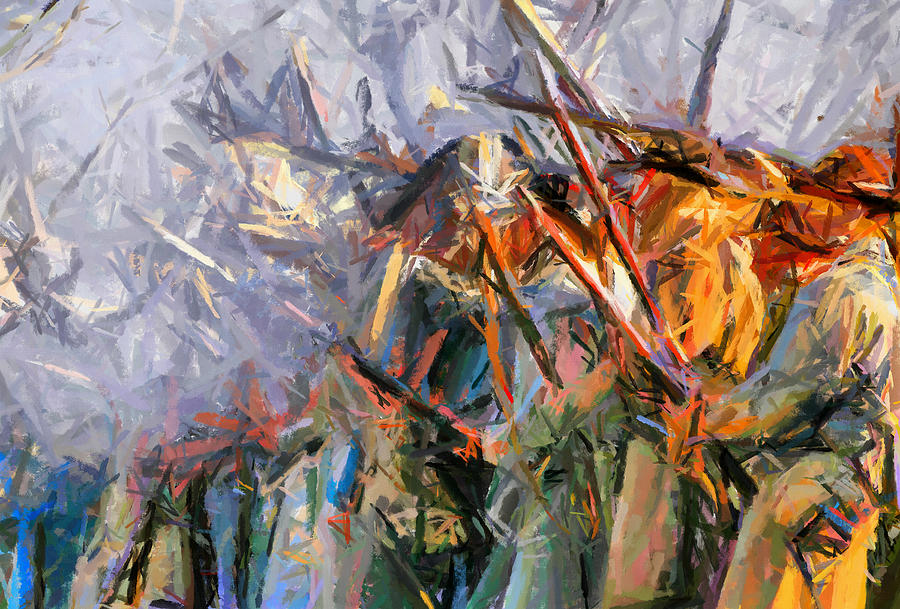
american-civil-war-abstract-expressionism-zeana-romanovna

~ American Civil War by Georgiana Romanovna

This article was recently published at Asbury Theological Seminary’s Seedbed website during the height of conflicts that precipitated from the Ferguson ‘incident’. Below is a revised and slightly expanded version that better qualifies the most salient points. 


Originally Titled: A Confession of Violence

As a person who regularly tries to encourage fellow brothers and sisters in Christ to try to spend more time concerning themselves with the Good News of Jesus (that produces hope) than the nothing-new-under-the-sun headline news (that produces fear), I think it is necessary at this time to acknowledge a certain need for followers of Christ to speak out publicly—with a distinctly Christian voice—in light of the recent tragedies and the increasing angst in our nation’s cultural climate. There is only one such voice: 

For that reason, I have a confession I need to make. It is a confession of violence.


I was reminded this week of what Karl Barth once wrote in his journal at a significant turning point in his life and thought during the First World War:

“It is not the war that disturbs our peace. The war is not even the cause of our unrest. It has merely brought to light the fact that our lives are all based on unrest. And where there is unrest there can be no peace” (Karl Barth: His Life from Letters and Autobiographical Texts, Eberhard Busch). 

As fingers continue to point, defenses continue to rise, and the wilderness is increasingly populated with a rapid influx of expatriated goats (Lev. 16), I hesitate to say what I feel I must say, because I am quite possibly wrong. But with that disclaimer: I want to suggest that there is a very real possibility that the recent tragedies in this nation were not simply caused by a few bad apples in an otherwise innocent bunch. I have to consider at least the possibility that somehow the increased supply of violence in our culture is suited precisely to meet the increase of a cultural demand, of which we are all complicit.

Consider for example the current political circus. There have been no shortage of aggravated complaints and expressions of puzzlement over how, of all the people our nation could have produced, we ended up with Cruella Deville and Leopold II as the two representatives of our nation’s principle values and common visions. And yet, I can’t help but think we are just willfully ignoring the obvious and only explanation; namely, the reason we ended up with the current representatives of this nation is that they are most representative of this nation.

This is not simply a principle of democracy. It is a principle of the more decisive governing factor in our consumerist culture, the principle of supply and demand. We have been feeding on this extended campaign season with an irrepressible appetite. Media networks, profiting outrageously from our patronage, have risen to meet our demand, and we in turn rise to feed on the surplus (a few tweeting feuds, some scandals, and a delicious array of ad hominem attacks). All the while the people blame the networks for the results, while the networks blame the other networks, while the other networks blame the people. Everybody is taking from everybody and then turning on everybody. It’s like a group of smeared-mouth toddlers blaming each other for cookies missing from the pan, but actually it’s a lot more like a twisted praying mantis love triangle.

But all this misses the point, because it is not the candidates we support that have produced this conflict; it is the conflict we support that has produced these candidates. And indeed they were perfect candidates for the task.

I think I can say unequivocally, if only because it can be neither proved nor denied, that what has most resonated with this nation in this campaign is its unprecedented rhetoric of violence. A civil war of clumsy words and gasoline passions is raging throughout our nation. We’re not looking for representatives of social values–we’re looking for spokesmen of social angst. Thus, rather than candidates engaging in principled arguments with regular appeals to the constitution, candidates must engage in a hyper-reactive surface battle of uncritical sentiments and prove most capable of weaponizing trivia and amplifying slander. Who will prove to be the biggest bullhorn for the mob? Who will prove to have the loudest arguments? Who will lead half of this country in a campaign of disgust against the other half of this country?

The nominees may not represent much of what we stand for, but they represent quite exactly what we stand against, which is why we ended up with the two candidates who are supremely competent at attacking the incompetence of the other. It has become far easier in our nation to rally people around whom they hate than what they love. The appeal that resonates with this country’s soul is a an appeal to our restlessness, for which we are miserably fearful or passionately infuriated (a rather pedantic distinction), the only cure of which is blame or blood or some other sacrificial motif. But since we have long rejected “religious” categories to explain “secular” realities, we have nothing to sacrifice but one another. But far be it from me to suggest a source of our violence so outrageous as an existential need for atonement. Suffice it just to say it seems quite evident that we are a nation increasingly naked and commensurately ashamed. 

Indeed, “the [violence] is not even the cause of our unrest. It has merely brought to light the fact that our lives are all based on unrest.”


But perhaps I should be more transparent. The truth is I was confronted by my own complicity with this restless violence this week in a way I wish I could have kept hidden from myself.

If I am uncomfortably honest, I must confess that I have grown completely numb to the pain of the wider world. I don’t think I qualify as a sociopath or anything, but neither will I suggest that I am an accurate representative of the human heart. I know my capacity for pride and self-indulgence, and I should only hope that by and large human nature is at least better than my nature. All that to say, when I read or hear about a person being shot or multiple people being shot or riots breaking out because of all the people being shot, I am sorry to say that that it in no way affects me, at least not in a way that elicits compassion. If I feel anything it is invariably a kind of distracted, yawning anger, which isn’t really concerned with human beings and in fact is quite amused with blood. But most of the time I just don’t care.

I don’t know if I have always been particularly numb to distant tragedies or if I am just particularly sensitive to local misfortunes that hardly rank anywhere near the level of “tragedy,” but the truth is I am more likely to weep with my son weeping while getting shots at the doctor than I am to weep over strangers getting shot at a distance. And I know this to be the case, because I did weep–just a few tears–a few weeks ago when my son got five immunization shots in a single visit, and I did not weep upon hearing about the five police officers killed in a single shooting–not a single tear.

Until this past week. This past week I was confronted with an unlikely encounter with compassion. While watching a newly widowed woman give a public statement regarding the injustice of her husband’s death, suddenly the camera panned over to a young boy (15) covering his face with his shirt. It appeared he was trying to restrain himself at first, but his efforts soon proved futile. He began to weep, loudly. Recognizing the moment’s need, supporters began gently escorting him off stage, at which point his tears found their deepest and purest interpretation in a simple and repeated lament: “I want my daddy! I want my daddy! I want my daddy!”

I think this was the first time I have ever felt real compassion for someone so removed from my everyday life. I am certain it is the first time I have ever wept with such a person so removed from my everyday life. But in that moment it wasn’t about what the cops had done or what the man had not done, or vice versa on either side. It was about the longing of a lost boy’s heart for the presence of a father who is forever gone. That felt too close to home in too many ways for me. And perhaps for a moment I became a little more human and discovered the possibility of a far-reaching compassion.

But my empathy was short-lived, rather short-fused. In a matter of seconds I was moved from a blooming compassion to disturbed desire. I found myself looking up information about the police officers. I am ashamed to say that I wasn’t looking for anything about a “fair trial” or “due process” or “the other side of the story…” I was looking for blood. It was irrational. It was I imagine the way I would act if something were to happen to one of my own children or tribe. At first, I just wanted that little boy to have his father back, but I got over it. Rather than wallowing in that boy’s hopeless pain, perhaps in truth just to alleviate my pain, or perhaps more likely to satisfy my wrath, I grew up. I gave up on the childish hope of redemption, and frankly I wasn’t satisfied with even the rational desire for justice. I wanted revenge.

At some point after scrolling through headline after headline in a trance I snapped out of it. And in a moment I was confronted by my own hypocrisy, my immense capacity not only for violence but for a kind of self-righteous violence, if not a kind of self-congratulatory violence. And as such, I was confronted with the fact that even (or especially) my life is based on unrest, that I have no raw materials within me for peace, because what is in me is death and death must come out in blood (Heb. 9).

But rather than arbitrarily seeking it from a few cops I don’t know from Adam–or perhaps I know them precisely from Adam–I looked up to the print of Grunewald’s Isenheim Altarpiece hanged above my desk, and I acknowledged where I must go for blood if I am ever going to find peace. For there is a Victim whose blood cries out from the ground with a word of Life louder than the word of Abel (Heb. 12:24; Gen. 4:10). But to go to him for blood, I must not attempt to take his side: I must go as the soldier with hammer in hand, for I am the reason for all this bloodshed, I have preferred Pilate’s basin to Jesus’, I am the executor of my own standard of justice, I am the restless criminal, I am the self-righteous murderer, I am the greedy thief, I am the hair-triggered abuse of power, I am the taunting spectator standing safely at a distance with no compassion for the pain of this Man and no tears for the sorrow his mother, for I have refused to be my brother’s keeper (Gen. 4:9) and instead have become his accuser (Rev. 12:10). I am the over-exacting vengeance I too often refuse to hand over to the Lord who demands that I do (Rom. 12).

So I surrendered: I handed over every last drop of my vengeance to him by way of an iron stake.

And I wept again. I wept for myself, for that boy, for my boys and my family, for that boy’s family, for that widow, for all those police officers and all their families and those widows, for all the restless souls caught up the violent whirlwind of our fire-breathing nation.

But I did not weep for Jesus. I don’t know why. I don’t know if it’s because I didn’t feel worthy or maybe because he seemed too distant and strange. But maybe it was just the opposite. Maybe it was the first time I was able to weep with real compassion, the kind that refuses to give way to violence, because maybe it was the first time Jesus was able to weep through me.

Lord, have mercy.